
You’ve sent out 50 applications. You’ve refreshed your inbox every hour. You’ve updated your resume three times. Still silence. Meanwhile, your LinkedIn feed is full of job posts, recruiter activity, and people announcing new roles. It doesn’t add up. Here’s the truth: the market is hiring. You’re just not reaching it.
Let’s look at what’s really going on in tech hiring right now, why so many skilled people are still stuck without interviews, and — most importantly — what you can actually do about it starting today.
The Hiring Market in 2026: Active, But Selective
The tech job market has recovered. Tech job postings are up 21% year-over-year as of April 2026 — the strongest growth seen so far this year. In the US alone, about 9.8 million people are expected to be employed in tech roles by the end of 2026, up from 9.6 million in 2025. That’s real growth, not noise.
| Statistic | Insight |
|---|---|
| 21% | Year-over-year rise in US tech job postings (April 2026) |
| 75% | Resumes are rejected by ATS systems before a human reads them |
| 85% | Employers now use skills-based hiring, not just degree screening. |
| 71% | US tech job postings now require some AI skill (April 2026) |
So the jobs are there. Companies like those in Finance, Aerospace, Healthcare, IT, and Cybersecurity are hiring hard right now. Cities like Philadelphia (+69% YoY), Chicago (+50%), and Boston (+40%) are leading the surge. But here’s the twist—companies are not just hiring anyone. They’re hiring the right people, and they’re filtering out everyone else faster than ever before.
The Real Reason You’re Not Getting Called Back
Most people think they’re not getting calls because the market is bad. That’s not the problem. Here are the three things working against you — often all at once.
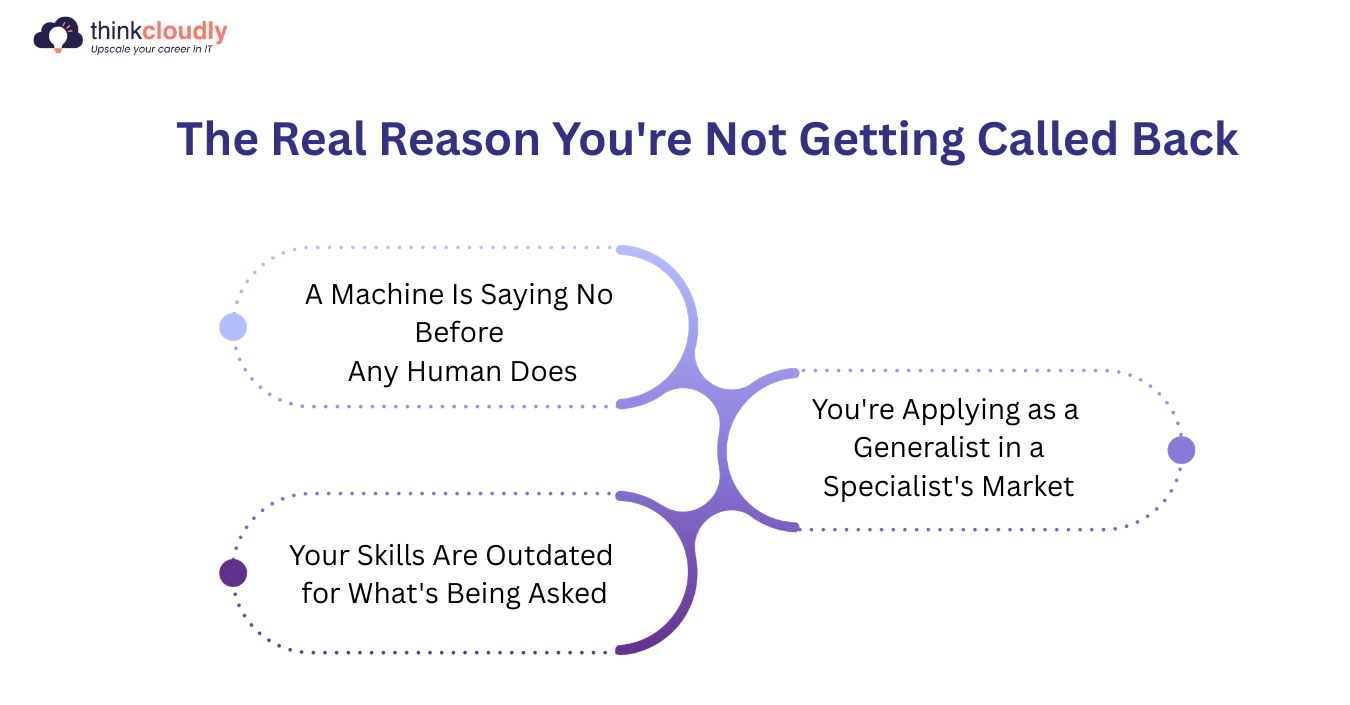
1. A Machine Is Saying No Before Any Human Does
Right now, approximately 87% of companies use AI-driven tools in their recruitment pipelines. These systems — called ATS (Applicant Tracking Systems) — read your resume before any recruiter does. And they are ruthless. They look for exact keyword matches, clean formatting, and specific section headings.
If your resume says “Managed projects end to end,” but the job description says “Project Management,” the system may not connect the two. About 75% of resumes are rejected within seconds — not because you’re unqualified, but because the machine didn’t find the right words in the right places.
2. You’re Applying as a Generalist in a Specialist’s Market
The 2026 tech market has split into two lanes. On one side: too many candidates for general roles like junior developer, IT support, or basic QA. On the other side: a massive shortage of people with specialized skills in AI, cloud infrastructure, cybersecurity, and data engineering.
If you’re applying to roles where hundreds of people look just like you on paper, the odds are stacked against you by default.
3. Your Skills Are Outdated for What’s Being Asked
AI skill requirements now appear in 71% of US tech job postings — up 181% in a single year. A year ago, listing AI skills was a way to stand out. Today, not listing them is a way to get filtered out. Companies don’t want people who “know about AI.” They want people who use it, build with it, or work alongside it daily.
At the same time, only 7% of tech leaders say their current teams have the skills needed to complete priority projects. That’s a massive gap — and it’s an opportunity for anyone willing to close it.
Real-World Scenario: Marcus, a Software Developer from Austin, Texas
Marcus had four years of solid experience in backend development with Java and Python. He applied to 60 companies over three months and heard back from exactly two. After a resume audit, the issue became clear: his resume used tables and text boxes that ATS systems couldn’t parse. His skills section listed “Machine Learning awareness” — too vague for any AI-screening tool to flag as relevant. After rebuilding his resume with plain formatting, specific tool names (TensorFlow, AWS SageMaker), and targeted keywords pulled from job descriptions, he got five interview requests within two weeks. Same experience. Same skills. Different presentation.
Privacy Note: This scenario is based on a composite of real situations encountered during career coaching sessions. The name and identifying details have been changed to protect individual privacy. No real person’s identity is disclosed.
What Skills Actually Get You Hired Right Now
Here’s a clean look at which tech skills are in high demand, how fast they’re growing, and how easy it is to build them through online learning — the kind of targeted upskilling that platforms like Discover are designed to deliver.
|
Skill Area |
2026 Demand Level |
YoY Growth |
Learnable Online? |
|
AI / Machine Learning |
Very High |
+181% |
Yes — Courses + Projects |
|
Cloud (AWS, Azure, GCP) |
Very High |
+17.9% |
Yes — Certifications |
|
Cybersecurity |
Very High |
+367% (projected) |
Yes — Hands-on Labs |
|
Data Engineering / Analytics |
High |
+414% (projected) |
Yes — Bootcamps |
|
Python / Go / Rust |
High |
+28% / +41% / +67% |
Yes — Self-paced |
|
General IT Support |
Medium |
Stable |
Yes — Entry-level certs |
|
Basic Web Dev (generalist) |
Saturated |
Declining |
Needs specialization |
The Degree vs. Skills Debate Is Already Over
This one surprises a lot of people. More than 53% of employers have now removed degree requirements from tech job listings — a 30% jump from 2024. And 85% of employers now use skills-based hiring practices, meaning they’re evaluating what you can do, not what university you went to.
The World Economic Forum projects that 39% of core job skills will change by 2030. That means even a fresh degree from two years ago may already have gaps. What employers are rewarding now is evidence — a portfolio, a certification, a real project, something that says “I can do this today.”
In AI roles specifically, a skills-based approach increases the available talent pipeline by 8.2x globally, according to LinkedIn Economic Graph data. This is genuinely good news. It means your background matters far less than your demonstrated capability.
6 Things You Can Do This Week to Start Getting Calls
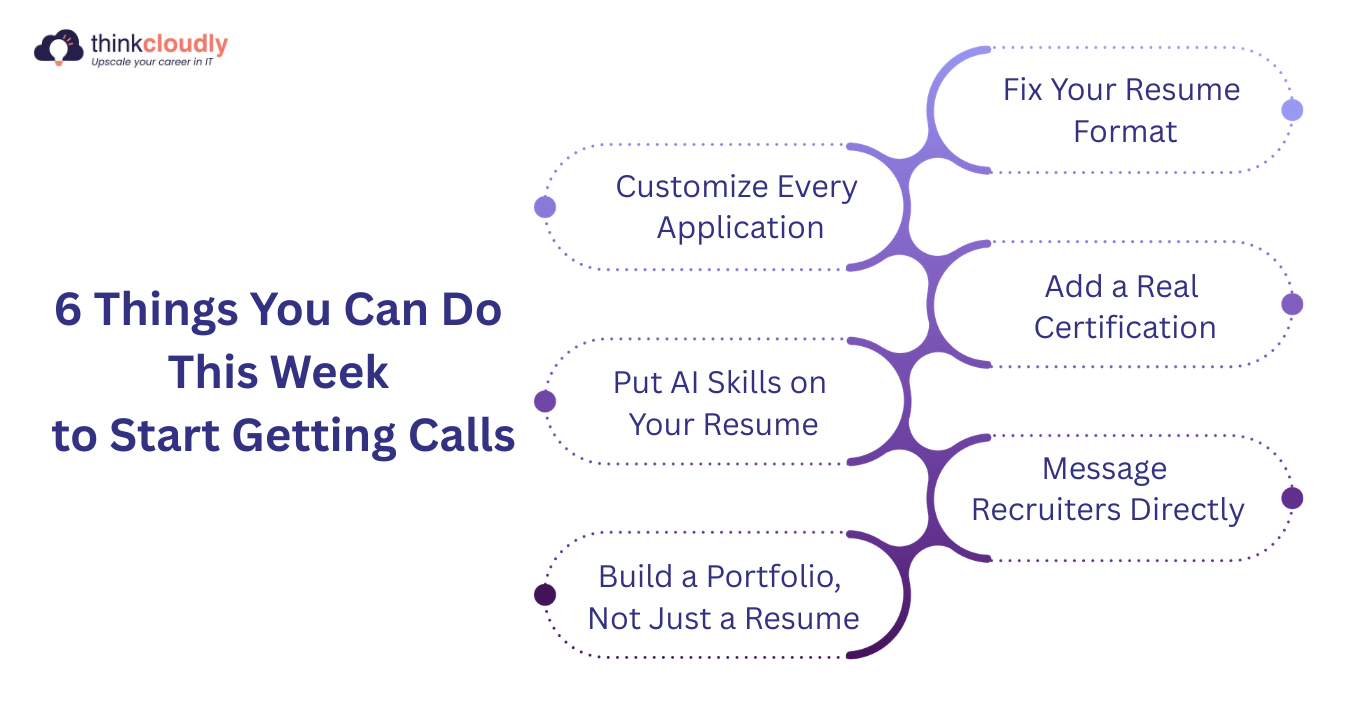
Fix Your Resume Format
Strip out tables, columns, and text boxes. Plain text, clear headings — “Work Experience,” “Skills,” “Education.” ATS systems need simplicity to read you correctly.
Customize Every Application
Copy exact keywords from the job description into your resume. Don’t paraphrase — if they say “CI/CD pipelines,” you say “CI/CD pipelines,” not “build automation.”
Add a Real Certification
AWS Cloud Practitioner, Google Data Analytics, CompTIA Security+ — these are fast, recognized, and directly signal what employers are asking for right now.
Put AI Skills on Your Resume
Even basic AI fluency — knowing how to use tools like ChatGPT, Copilot, or Claude in a workflow — should be listed. It’s now a baseline expectation, not a bonus.
Message Recruiters Directly
A well-written LinkedIn message to a hiring manager can bypass the ATS entirely. It shows initiative — and it gets read by a human, not a machine.
Build a Portfolio, Not Just a Resume
Two or three focused projects — even personal ones — demonstrate what you can actually do. Employers in 2026 respond to portfolios as much as credentials.
The Skills Gap Is an Opportunity — If You Move Now
Here’s the part most people miss: 84% of tech companies report significant skills gaps internally. They cannot find enough people with the right capabilities. By 2026, the skills shortage in IT is projected to cost organizations $5.5 trillion globally in missed projects and lost productivity.
That gap works in your favour — if you’re willing to move on it. Companies aren’t just hoping the right resume shows up. They’re actively looking for people who’ve put in the time to stay current, because most candidates haven’t. The candidate who spent three months learning cloud architecture or completing a data analytics course is far more attractive than the candidate who spent three months sending the same resume to 200 job boards.
Robert Half’s 2026 Salary Guide confirms that companies are willing to pay significantly more for in-demand skills like cybersecurity, data analytics, and AI. The median tech wage in the US sits at $112,805 — roughly 126% above the national median. That gap doesn’t close if you wait. But it stays wide open for anyone who shows up with the skills companies are actually short on.
The Market Is Open. Your Move.
Tech hiring in 2026 is not broken — it’s just different. Companies are hiring fast, paying well, and desperately looking for people with the right skills. The gap between getting ignored and getting called isn’t talent. It’s preparation, presentation, and the right learning path.
The candidates who update their skills now, format their resumes for the tools that actually screen them, and build even a small portfolio of real work—those are the people filling roles right now.
Sources and References
- Dice Hiring Insights—”US Tech Job Market Report, May 2026: postings up 21% YoY, AI skills in 71% of job posts.”
- CompTIA—”State of the Tech Workforce 2026: US tech employment projected at 9.8M, 128K new jobs added in 2026. “
- Robert Half—”2026 Tech & IT Salary Guide: only 7% of tech leaders report having capabilities to meet project needs.”
- SalaryFor —“Why AI Is Rejecting Your Job Applications in 2026: ATS rejects 75% of resumes within 5 seconds.”
- IEEE-USA InSight—”2026 Tech Hiring Outlook: surplus of generalist applicants, shortage in specialized AI roles.”
- TechTarget / TestGorilla — “The 2026 Talent Reckoning: 53% of employers removed degree requirements, up 30% from 2024. Scholaro—”Why Employers Care More About Tech Skills Than Your Degree in 2026: 85% now use skills-based hiring.”
- TechRadar Pro—”Your resume is getting rejected by machines: AI tools process thousands of resumes/hour with no human nuance.”
- AnitaB.org—”Tech Job Market 2026: employers hiring with precision for roles that drive revenue or support AI adoption.”
- Second Talent—”Tech Industry Hiring Statistics 2026: 84% of companies report skills gaps; AI/ML roles take 89 days to fill.”