
That’s the headline everyone keeps seeing. And honestly, it’s not completely wrong—AI is changing some roles. But here’s what’s flying under the radar: agentic AI is also creating entirely new IT jobs at a pace most people simply aren’t tracking.
We’re not talking about a slow shift. We’re talking about job postings for agentic AI skills that jumped 986% between 2023 and 2024 — and the growth hasn’t stopped. Companies like Salesforce, Deloitte, Apple, NVIDIA, and Microsoft are actively hiring for roles that didn’t even have names two years ago.
If you’re in tech already—or actively trying to break in—this shift is worth understanding before the hiring market fully prices it in.
What Is Agentic AI?
Here’s the simplest way to think about it. The AI tools most people have used so far—ChatGPT, Gemini, Copilot—they wait for you. You type something, they reply. That’s it. They’re reactive.
Agentic AI is different. It doesn’t wait. You hand it a goal, and it goes off to figure out how to get there. It picks its own steps. It uses different tools. It makes small decisions along the way. Then it comes back with results.
Picture this: your sales manager asks an AI agent to “follow up with every lead who clicked our product page but didn’t book a demo.” A regular chatbot would maybe draft one email for you to copy-paste. An agentic AI would pull the lead list from your CRM, check which ones already have meetings scheduled, draft personalized follow-ups for the rest, and send them—without anyone babysitting it through each step.
The Numbers Are Hard to Ignore
Look, stats can feel abstract. But some of these are genuinely hard to brush off.
LinkedIn’s 2026 Labour Market Report tracked 1.3 million new AI-related jobs added in just two years—not projections, but actual new roles including AI Engineers, Forward-Deployed Engineers, and Data Annotators. On the same platform, AI Engineer now ranks as the single fastest-growing job title in the U.S. for 2026.
Between 2023 and 2025, LinkedIn recorded 639,000 AI-related job postings in the U.S. alone. Of those, 75,000 were specifically for AI engineer roles. CBS News ran a story on it. The headline called it “gorging on AI talent. ” That’s not a typo.
Meanwhile, Gartner is projecting that by the end of this year, 40% of enterprise software applications will have task-specific AI agents baked into them—compared to less than 5% in 2025. And by 2029, at least half of all knowledge workers will need to pick up new skills specifically around working with or managing these agents.
The supply of people who can do this work is nowhere close to the demand. That’s a problem for companies. But for you? That’s a door wide open.
The New IT Jobs Nobody Is Talking About
Here’s a breakdown of the roles being created right now—and who is hiring for them:
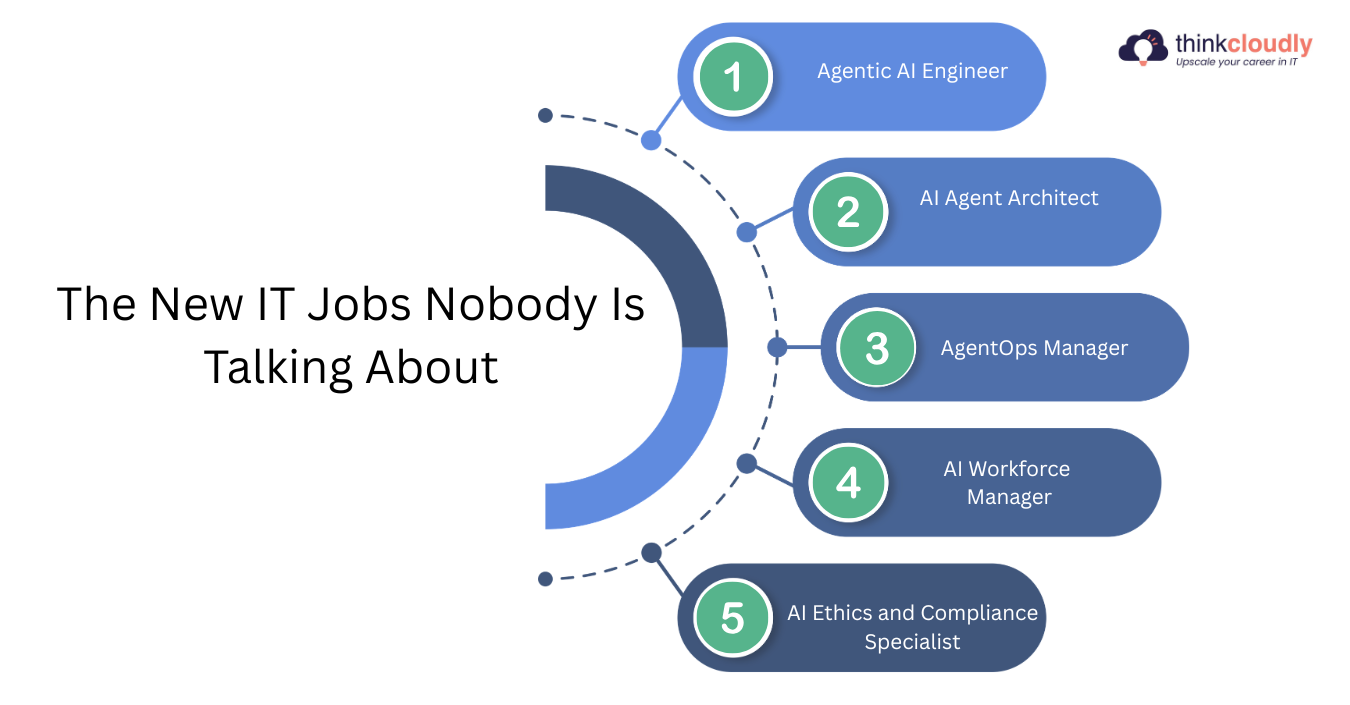
1. Agentic AI Engineer
This one’s the most in demand right now and probably the hardest to fill. The job is essentially building the agent systems that companies are desperately trying to get into production. That means writing the actual code, hooking agents up to real data sources and business tools, testing whether the whole thing holds up under real conditions, and fixing it when it doesn’t.
Glassdoor’s current data puts average U.S. pay at roughly $192,000 a year. Top earners — the ones with production-level framework experience — are crossing $300,000.
2. AI Agent Architect
A step above the engineer in terms of abstraction. The architect isn’t writing every line of code — they’re deciding the whole system design. How many agents does this workflow need? How do they talk to each other? What happens when one agent fails? Who owns what data?
Pay is anywhere from $95,000 on the junior end to well over $300,000 for senior architects at major tech companies.
3. AgentOps Manager
Remember when “DevOps” didn’t exist? Cloud computing created it because suddenly, you needed someone responsible for keeping deployed software alive and healthy in the real world.
Salesforce’s own 2026 enterprise AI report specifically calls out hiring for titles like Agent Supervisor, Agent QA Lead, and AI Ops Manager. These aren’t hypothetical—they’re budgeted headcount. The job is making sure AI agents that go into production stay reliable, don’t go rogue, stay within budget, and get fixed fast when something breaks.
4. AI Workforce Manager
Here’s one a lot of people haven’t heard of yet. As companies build teams where some “members” are humans and some are AI agents, someone has to actually run that team. Who gets which task — the human or the agent? Is the agent staying within the rules? Are the outcomes actually good or just technically completed?
That’s this role. It’s less technical than engineering but requires a solid understanding of how agents behave and what can go wrong. Financial services companies and large consulting firms are among the first movers on this one.
5. AI Ethics and Compliance Specialist
When an AI agent is making decisions — approving loans, filtering job applications, triaging customer complaints — someone needs to be asking hard questions about whether those decisions are fair, legal, and actually aligned with what the company said it stood for.
It’s not a purely technical role. In fact, many people in this space come from law, policy, or risk management backgrounds. But you do need to understand how these systems work well enough to spot where things could go wrong.
Salary Snapshot: What These Roles Pay in 2026
|
Role |
Average U.S. Salary (2026) |
Experience Level |
|
Agentic AI Engineer |
$152K – $247K |
Mid to Senior |
|
AI Agent Architect |
$95K – $300K+ |
Senior |
|
AgentOps Manager |
$110K – $200K |
Mid to Senior |
|
AI Workforce Manager |
$90K – $160K |
Mid-level |
|
AI Ethics Specialist |
$80K – $140K |
Any level |
|
Data Annotator (AI) |
$45K – $85K |
Entry-level |
The average AI engineer salary in the U.S. has climbed to around $206,000 — up $50,000 from the previous year. Specialization pays a premium: expertise in frameworks like LangChain or LlamaIndex can add 20–40% to base pay, according to Second Talent’s 2026 compensation analysis.
A Real-World Scenario
Note: The following is based on a real career pattern seen across multiple professionals in 2025–2026. I’ve changed the name and a few details here, but this career arc is based on something that actually happened.
Alex was a mid-level Python developer at a fintech company. In late 2024, his team started experimenting with AI agents to automate parts of their customer onboarding process. He learned LangChain on the side, built a small agent workflow as a side project, and documented it on GitHub.
Within three months, he had two unsolicited recruiter messages. He joined a startup as an Agentic AI Engineer, negotiating a salary 45% higher than his previous role. He didn’t get a degree in AI. He didn’t wait for his company to retrain him. He just noticed the gap, learned the tools, and showed what he could do.
What Skills Do These Jobs Actually Need?
You don’t need to start from scratch. Most of these roles are built on foundations you may already have:
Technical skills in demand:
- Python (essential for most roles)
- Prompt engineering
- LangChain, LlamaIndex, or similar agent frameworks
- RAG (Retrieval-Augmented Generation) systems
- Cloud platforms: AWS, Azure, or GCP
- Vector databases
- API integration
Non-technical skills that matter:
- Systems thinking
- Risk and governance awareness
- Communication (especially for AI Ethics and AI PM roles)
One thing worth knowing: the LangChain State of Agent Engineering survey found that 57% of companies already have agents running live as of 2026, up from 51% the year before. Thirty percent more are mid-build. The window where “I’m still learning” is a valid answer to recruiters is getting shorter. Not gone — but shorter.
Why Most People Are Missing This
The media narrative is all about jobs being replaced. That’s a real concern in some areas. But the quieter story — the one that tends to get buried — is the creation of brand-new roles.
It happened with cloud computing. Nobody knew what a “DevOps engineer” was. That job didn’t exist. Then suddenly it was everywhere, and the people who figured it out early made very good money for a very long time.
Agentic AI is doing the same thing. The window where early movers have a real advantage is open right now. It won’t stay open forever.
Conclusion
Agentic AI isn’t just automating tasks — it’s creating a whole new layer of technical jobs that the industry desperately needs people to fill. Companies literally can’t find enough people to fill these roles—that’s not a figure of speech; it shows up in the hiring data.
If you’re already in IT, this is one of the fastest paths to a meaningful salary jump. If you’re trying to break in, agentic AI skills can get you there without waiting for the traditional pipeline. And if you’re a hiring manager, the professionals building these skills today are the ones who’ll define your AI strategy tomorrow.
The door is open. The people who walk through it now will look back in three years and call it obvious. Everyone else will wonder how they missed it.
If you’re starting today, open LangChain’s docs and build one small agent this week. That’s it. That’s the move.
Sources and References
- LinkedIn Jobs on the Rise 2026
- World Economic Forum – AI Has Already Added 1.3 Million Jobs (LinkedIn Data)
- Salesforce – 8 Ways AI Agents Are Evolving in 2026
- Glassdoor – Agentic AI Engineer Salary (May 2026)
- ZipRecruiter – Agentic AI Salary (May 2026)
- Second Talent – Top 10 Most In-Demand AI Engineering Skills and Salary Ranges 2026
- The Interview Guys – Top 10 Agentic AI Jobs in 2026
- CIO Magazine – How Agentic AI Will Reshape Engineering Workflows in 2026
- CBS News – AI Engineer Is the Fastest-Growing Job for Young Workers
- Dice – AI-Related Jobs Top LinkedIn’s Fastest-Growing Roles List for 2026