
Hospitals are using AI to flag patient risks. Banks are using it to approve loans in seconds. Law firms are using it to scan thousands of documents overnight. AI is no longer a future technology—it is running right now, inside organizations you interact with every day.
But here’s the problem nobody is talking about loudly enough: the people needed to keep all of this safe, legal, and working properly simply do not exist yet.
The World Economic Forum’s Future of Jobs Report 2025 projects that AI and data technologies will create 11 million new roles by 2030. And according to PwC’s 2025 Global AI Jobs Barometer—which analyzed close to a billion job listings across six continents—jobs requiring AI skills are growing 3.5 times faster than all other job postings combined.
The roles growing fastest aren’t the ones you’d expect. They’re not just coders or data scientists. They’re a new category of professionals—people who sit at the crossing point of technology, law, ethics, and business judgment. The seven roles below are already in high demand, already paying well, and already severely understaffed.
Why These Numbers Are Real — Not Hype
Three things are happening at the same time, and that combination is what makes these numbers so extreme.
Regulation has arrived
The EU AI Act, in force since 2024, legally requires companies using high-risk AI to run risk assessments, keep audit trails, and name someone responsible when things go wrong. Similar laws are advancing across the US, UK, Canada, and Asia-Pacific. Every new rule creates a job that didn’t exist a few years ago.
The cybersecurity skills gap is enormous
ISC2’s 2025 Cybersecurity Workforce Study—which surveyed over 16,000 professionals—found that 88% of organizations experienced a real security consequence because of a skills shortage. AI has made this worse by creating entirely new categories of attack that older defences can’t handle.
AI needs people, not just computing power
An AI system doesn’t run itself. Someone has to manage it, monitor it, ensure it’s making fair decisions, and explain those decisions to regulators. That’s a layer of human expertise companies are desperate to hire—and currently struggling to find. Workers with AI skills now earn a 56% wage premium over colleagues in identical roles without those skills (PwC, 2025).
The 7 IT Roles Growing 300%+ by 2030
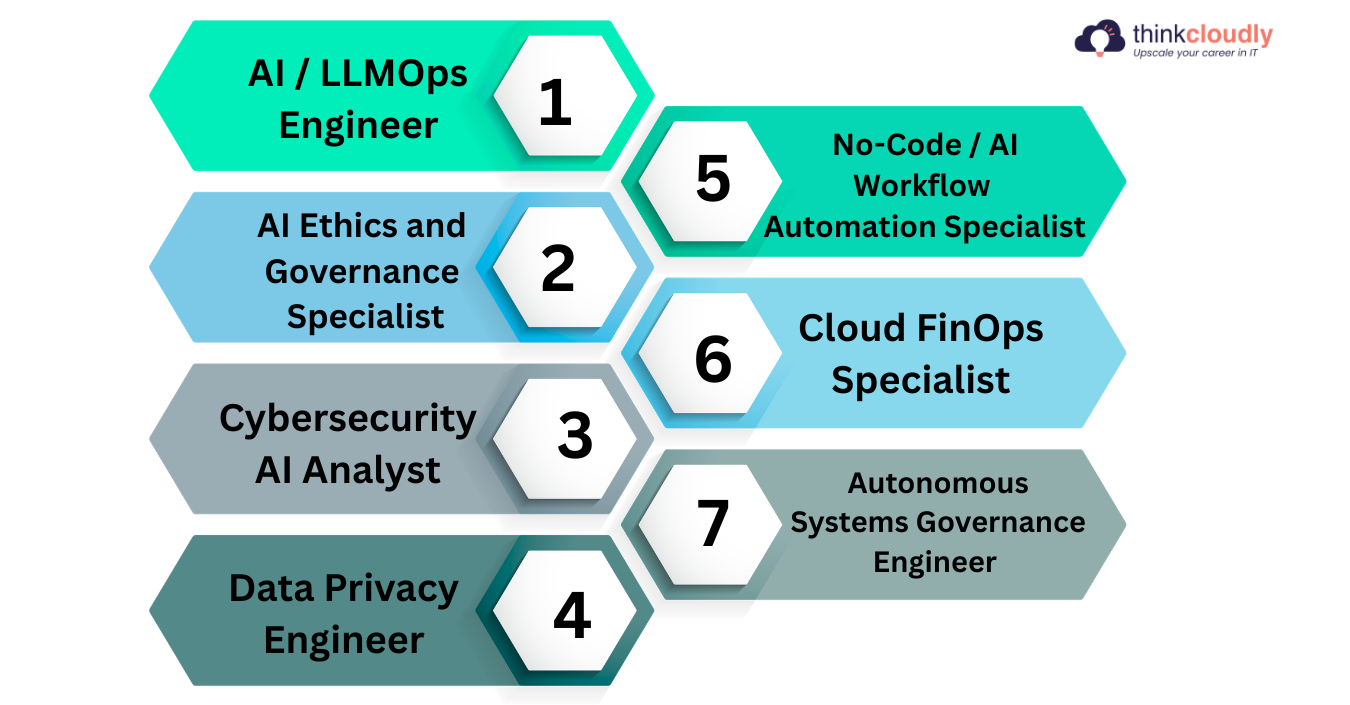
1. AI / LLMOps Engineer — 400%+ Growth
Getting an AI model to work in a lab is one thing. Keeping it running reliably at scale — inside a hospital, a bank, or a government department — is something else entirely.
An LLMOps Engineer handles that second, harder job. They monitor whether the AI is producing accurate outputs, build systems that catch errors before they cause harm, manage updates when the model changes, and keep everything running under real operational pressure.
This role barely existed in 2022. By 2026, LinkedIn data consistently shows demand outpacing supply across every major market, particularly in healthcare and financial services, where a wrong AI output can have serious consequences.
How to get started:
Python, cloud platforms (AWS or Azure), and hands-on experience with model testing tools. Most people come from software engineering or data engineering backgrounds.
Typical salary range (US): $95,000 – $130,000
2. AI Ethics and Governance Specialist — 350%+ Growth
Three years ago, this job title appeared on almost no org charts. Now it’s written into law.
The EU AI Act doesn’t just encourage good behaviour—it requires companies to have designated oversight functions, documented processes, and a named individual accountable for how their AI systems behave. Someone has to build and run that infrastructure day to day.
What makes this role worth paying attention to if you’re not from a technical background: the WEF’s Future of Jobs Report 2025 specifically notes that AI governance roles recruit heavily from legal, policy, philosophy, and social science backgrounds. Stanford HAI’s 2026 AI Index Report shows demand grew over 200% between 2023 and 2025.
How to get started:
You don’t need to know how to build AI — you need to understand how it makes decisions and where it fails. Familiarity with the EU AI Act and GDPR, combined with strong written communication, makes you genuinely competitive.
Typical salary range (US): $95,000 – $140,000
3. Cybersecurity AI Analyst — 300%+ Growth
The nature of cyberattacks has changed. Attackers used to need skill, time, and manual effort. AI has removed all three of those bottlenecks.
Phishing emails that once required careful research now generate themselves—personalized, convincing, and sent at a volume no human team could match. Malware mutates mid-deployment to avoid detection. Networks get probed continuously by automated systems that never stop.
ISC2’s 2025 Workforce Study found that 95% of organizations have at least one critical cybersecurity skills need, and AI-related skills have jumped into the top five most-needed capabilities. The US Bureau of Labor Statistics projects 32% growth in information security roles by 2032 — AI-specialised positions are growing faster.
How to get started:
CompTIA Security+ establishes your fundamentals. Then get hands-on with AI-powered security platforms—CrowdStrike Falcon AI and Darktrace are widely used entry points.
Typical salary range (US): $80,000 – $110,000
4. Data Privacy Engineer — 310%+ Growth
For most of the past decade, data privacy was a legal department problem. Engineers built the systems; lawyers made sure the paperwork was correct. The two worlds rarely needed to understand each other deeply.
That stopped working around 2023. Regulatory enforcement got serious — fines got larger and more frequent. AI systems started requiring personal data at a scale that made privacy a genuine design constraint, not just a box to tick. And high-profile data breaches started costing companies hundreds of millions of dollars.
The IAPP’s 2025 Privacy Workforce Study recorded 45% year-over-year growth in technical privacy roles since 2022. The global shortfall is estimated at approximately 1.5 million professionals.
How to get started:
Start with data engineering — understand how data moves and is stored before you protect it. Layer on knowledge of GDPR and CCPA. The unusual skill here is translating between engineers and lawyers — people who can do that fluently are genuinely rare and well-paid.
Typical salary range (US): $90,000 – $120,000
5. No-Code / AI Workflow Automation Specialist — 380%+ Growth
Most organizations are running on a patchwork of systems that don’t talk to each other properly, manual processes that eat hours nobody officially accounts for, and temporary workarounds that became permanent years ago.
Platforms like Make, Zapier, n8n, and Microsoft Power Automate have matured to the point where someone who genuinely understands how to use them can build sophisticated automations—connecting different business systems, eliminating manual steps, and pulling in AI capabilities—without needing a development team.
Gartner projects that citizen developers will outnumber professional developers four to one in enterprise environments by 2026. GitHub’s Octoverse Report 2026 found the fastest-growing software-adjacent roles are precisely those that blend workflow design, AI integration, and process thinking.
How to get started:
Go deep on two or three platforms rather than collecting surface knowledge of many. If your background is in operations, project management, or business analysis, you’re already better positioned than you might think.
Typical salary range (US): $65,000 – $95,000
6. Cloud FinOps Specialist — 340%+ Growth
Every organization that scaled cloud infrastructure aggressively eventually arrives at the same uncomfortable realization: the bill is larger than expected, the waste is harder to identify than it should be, and nobody has clear ownership of the problem.
AI workloads made this moment arrive much faster. Training AI models, running them at scale, and processing the data they need all add up quickly—and cloud costs that were once a background expense became a material financial concern almost overnight.
The FinOps Foundation’s State of FinOps 2026 Report found that organizations with dedicated FinOps functions reduce cloud waste by an average of 30%. These roles carry a consistent 25–30% salary premium above comparable technical positions.
How to get started:
Build familiarity with at least one major cloud provider at meaningful depth—AWS, Azure, or GCP. The FinOps Foundation’s Certified FinOps Practitioner credential is achievable in six to eight weeks and widely recognized by hiring managers.
Typical salary range (US): $90,000 – $125,000
7. Autonomous Systems Governance Engineer — 320%+ Growth
Self-driving vehicles. Algorithmic trading systems. AI diagnostic tools in hospitals. Automated logistics networks. These systems are making consequential decisions in public right now.
When something goes wrong — when a vehicle makes a harmful decision, when a trading system acts outside its permitted parameters, when a medical AI misses a diagnosis — regulators and courts want to know who is responsible and what rules the system was operating under.
Autonomous Systems Governance Engineers build the layer that makes accountability possible. They design rule architectures, develop constraint frameworks, and construct the audit trails organizations need to deploy responsibly and satisfy regulators. Oxford Internet Institute research identifies this as one of the fastest-emerging professional roles in both public and private sectors.
How to get started:
Systems architecture provides the technical foundation, but the distinguishing skill is the ability to work fluently across legal, engineering, and executive functions. Regulatory knowledge is sector-specific — the rules governing autonomous vehicles look very different from those governing medical AI.
Typical salary range (US): $100,000 – $135,000
Quick Reference: All 7 Roles at a Glance
|
Role |
Growth by 2030 | Entry Salary (US) | Key Certifications |
| AI / LLMOps Engineer | 400%+ | $95K – $130K |
AWS ML Specialty, Google Cloud ML |
|
AI Ethics & Governance Specialist |
350%+ | $95K – $140K | CIPP/E, AI Governance certs |
|
Cybersecurity AI Analyst |
300%+ | $80K – $110K |
CompTIA Security+, CISSP |
| Data Privacy Engineer | 310%+ | $90K – $120K |
CIPP/E, CIPM (IAPP) |
|
No-Code / AI Workflow Specialist |
380%+ | $65K – $95K | Make, Zapier, Power Automate |
|
Cloud FinOps Specialist |
340%+ | $90K – $125K |
FinOps Certified Practitioner |
| Autonomous Systems Gov. Engineer | 320%+ | $100K – $135K |
Sector-specific / regulatory |
What All 7 Roles Have in Common
1. They sit at the intersection of technology and human judgment.
None of them is purely technical work. Each requires communication across teams, sound decision-making in ambiguous situations, and awareness of consequences beyond the immediate technical task. That combination is what organizations find hardest to hire for and what commands the strongest compensation.
2. Regulation is a permanent tailwind for all of them.
Government intervention in AI governance, data privacy, cloud security, and autonomous systems is accelerating across every major economy. Each new law creates hiring demand for people who can implement it. This is a structural shift, not a temporary spike.
3. A computer science degree is not required.
Hiring data across all seven roles consistently shows that certifications, demonstrated portfolio work, and practical skills carry more weight than academic credentials. The perceived barrier to entry is higher than the real one.
Sources and References
- World Economic Forum — Future of Jobs Report 2025
- PwC — Global AI Jobs Barometer 2025
- LinkedIn Economic Graph — Jobs on the Rise 2026
- ISC2 — Cybersecurity Workforce Study 2025
- Stanford HAI — AI Index Report 2026
- IAPP — Privacy Workforce Study 2025
- FinOps Foundation — State of FinOps 2026
- Gartner — Low-Code and No-Code Market Guide 2025
- Oxford Internet Institute — Ethical Governance of Autonomous Agents
- GitHub Octoverse Report 2026 — The Rise of AI-Native Development
- European Commission — EU AI Act Implementation Guide 2024
- CompTIA — State of the Tech Workforce 2026
- US Bureau of Labor Statistics — Information Security Analysts