
Maybe you’ve heard the same two stories in the last few months.
Story 1: “AI is killing IT jobs. Don’t even bother starting now.” You see headlines about layoffs, about ChatGPT replacing developers, about companies cutting tech budgets.
Story 2: “IT is the best career on the planet. Six-figure salaries are waiting for you!” You see ads selling courses, success stories on LinkedIn, and people calling tech “the new oil.”
Both stories cannot be true. So which one is real?
To answer that honestly, I went through Gartner’s 2026 global IT spending forecast, the World Economic Forum’s Future of Jobs Report 2025, IDC research on the skills shortage, Robert Half’s 2026 hiring data, the US Bureau of Labour Statistics projections through 2034, and salary data from across the world.
The answer turned out to be more interesting than either story. IT careers in 2026 are still very much worth starting — but only if you understand what’s changed and adjust your approach. Let me show you what the data actually says, who should start now, and who shouldn’t bother.
The Big Picture: What’s Really Happening to IT in 2026
First, let’s get the numbers straight. Here’s what the latest global data shows about the IT industry as of mid-2026:
- Worldwide IT spending hit $6.08 trillion in 2026 for the first time in history — a 9.8% increase over 2025 (Gartner). That’s more money flowing into tech than ever before.
- The IT skills shortage is causing $5.5 trillion in global business losses, according to an IDC survey. Companies literally cannot find enough qualified people.
- 87% of technology leaders report struggling to find skilled workers, according to Robert Half’s 2026 hiring data.
- Computer and IT occupations are projected to grow 11% through 2034, nearly three times faster than the average for all jobs (BLS). That’s about 317,700 new openings every year.
- The global AI market is projected to reach $1.8 trillion by 2030, and 85% of organizations plan to increase AI spending in 2026.
- IT professionals earn approximately 127% more than the median wage across most developed economies (CompTIA State of the Tech Workforce).
So far, this sounds like Story 2 was right. But here’s the part most career-advice blogs don’t tell you.
What’s Actually Changed (The Honest Side)
The IT industry is still growing. But the way you succeed inside it has changed completely. Here’s what’s different in 2026:
1. Salary increases are slower than they used to be
Tech salaries climbed an average of 1.6% in 2026, according to Robert Half. That’s well below the 5-7% jumps people saw in the early 2020s. Payscale puts the number slightly higher at 3.5%, still below 2025’s 4%. Around 66% of employers say economic uncertainty is the main reason.
The takeaway: yes, IT still pays more than most other fields. But the days of automatic big yearly raises are over for now.
2. AI is changing what “basic” tech work looks like
The simplest IT tasks — writing routine code, basic data entry, first-line tech support — are being partially automated. This doesn’t mean IT jobs are disappearing. It means the easy entry points are getting smaller. People who learn AI skills alongside their main tech skill are seeing salaries rise faster than peers who don’t.
3. Entry-level competition is real
After the 2021-2022 hiring boom, many companies have become pickier about juniors. Job descriptions ask for more skills, more projects, and more proof of work. This doesn’t mean entry-level jobs don’t exist — they do. But landing one takes 6 to 12 months of focused effort, not 2 months of casual learning.
4. Certifications alone don’t guarantee anything
Five years ago, getting a CompTIA or AWS certificate could land you interviews. In 2026, certifications are still useful but no longer enough on their own. About 67% of IT hiring managers now prioritize demonstrable skills — meaning real projects on GitHub or proven work experience — over certificates or degrees.
5. The gap between top and average performers has widened
In 2026, people who specialize in high-demand niches — AI engineering, cloud security, data engineering, MLOps — are earning 30-50% more than the general IT average. Generalist roles still exist, but the salary premium goes to specialists who can solve specific, high-value problems.
Quick Look: The Honest Pros and Cons of IT Careers in 2026
Here’s a simple comparison you can save:
|
Why IT Is Still Worth It |
What’s Changed (The Honest Side) |
|
Global IT spending: $6.08 trillion in 2026 (Gartner) |
Salaries growing only 1.6-3.5% per year, not 5-7% like before |
| 11% projected job growth through 2034 (BLS) |
AI is replacing some basic tasks — pure manual work shrinking |
|
IT pay is ~127% higher than median wages globally |
Entry-level competition is tougher than 2020-2022 era |
|
87% of tech leaders can’t find skilled people |
Certifications alone no longer guarantee a job |
| Remote work options stay strong worldwide |
Real projects and portfolios now matter more than degrees |
So Is IT Still Worth It in 2026? The Real Answer
Short answer: Yes, but only if you treat it like a real career, not a quick path to easy money.
Here’s the longer answer based on what the data shows.
IT is still one of the highest-paying career paths globally
The median wage for IT professionals worldwide is about 127% higher than the median wage for all other occupations. That’s not just true in the US — it holds across the UK, Germany, Canada, Australia, the Netherlands, Singapore, and most developed and emerging markets. Even at the entry level, IT typically pays more than the average starting salary in any other field.
The growth is real, not hype
The US Bureau of Labour Statistics projects 11% growth in IT jobs through 2034 — three times the average growth rate for all occupations. That’s a decade of expansion ahead. Globally, the picture is similar. Gartner forecasts $6.08 trillion in worldwide IT spending in 2026, with cloud and AI driving most of the increase.
Remote work has stayed strong
Unlike many other industries that rolled back remote work, IT remains one of the most flexible fields. Many companies in 2026 still hire globally, meaning a developer in one country can work for a company in another and earn closer to that country’s pay rate. This is a unique advantage of IT careers that other fields cannot match.
Future-proof skills are now well-defined
In 2026, you no longer have to guess which skills will matter. The data is clear. AI and machine learning, cloud computing, cybersecurity, data analysis, and Python programming appear in the majority of job descriptions globally. If you learn any one of these well and build real projects, you have a clear path forward.
Who Should Start an IT Career in 2026?
IT in 2026 is a great fit for some people and a poor fit for others. Here’s an honest look at both.
Start an IT career if you…
- Enjoy learning continuously — technology changes fast. People who like learning new things will thrive. People who want a job they can “finish learning” will struggle.
- Can commit 6 to 12 months of focused effort — breaking in takes real work. Not weekends. Not casual study. Daily consistent learning.
- Are willing to build real projects — not just consume tutorials. The people who land jobs are the ones who actually create things.
- Want a globally portable career — IT skills work in almost every country. Few other fields offer this kind of geographic flexibility.
- Are okay with starting at the bottom — first IT roles can be junior support, junior developer, or junior analyst positions. The pay grows fast, but only if you put in the work.
Who Should NOT Start an IT Career in 2026?
This part rarely gets said honestly. IT is not the right path for everyone. Skip it if you…
- Want to get rich in 6 months — it doesn’t work that way. The high salaries come after 2 to 5 years of solid experience, not in your first role.
- Hate problem-solving — most IT work is figuring out why something isn’t working. If you don’t enjoy puzzles and troubleshooting, the day-to-day will feel miserable.
- Are only doing it for the money — there are much easier ways to earn good money than spending years learning tech skills. People who don’t enjoy any part of IT usually burn out.
- Can’t commit to long learning windows — IT isn’t something you learn once and apply forever. You’ll be learning new tools, new frameworks, and new approaches every year. If that exhausts you, this career will too.
- Want clear, predictable workdays — IT jobs come with unexpected problems, urgent bugs, and shifting priorities. People who need predictable structure may find this stressful.
The Smart Path to Starting IT in 2026
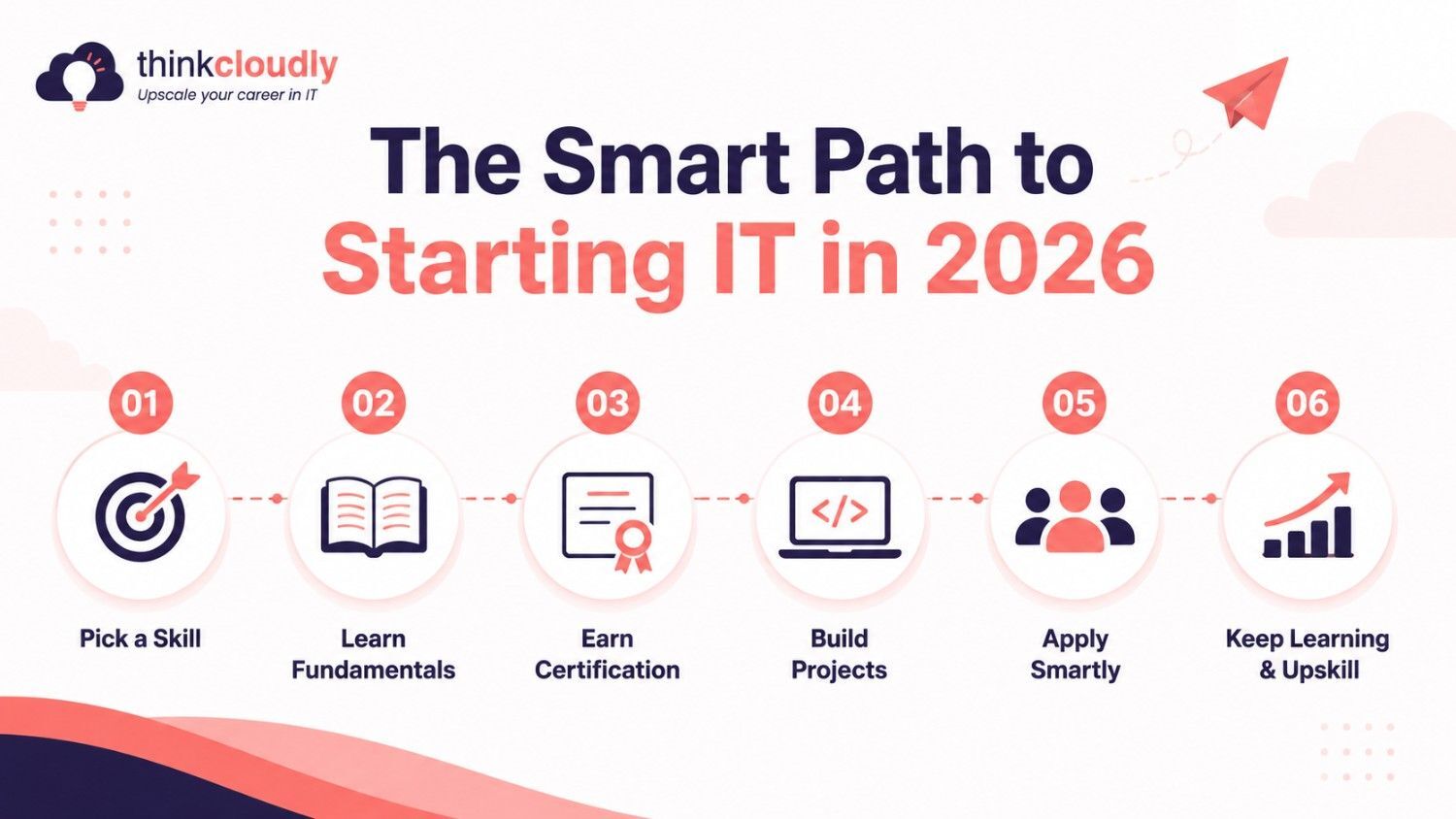
If you decide IT is right for you, here’s a realistic, simplified path that works in 2026 based on what employers actually want:
Month 1: Pick one direction. Don’t try to learn everything. Choose one of the five high-demand areas: AI/Machine Learning, Cloud Computing, Cybersecurity, Data Analysis, or Software Development. Each opens doors. Pick the one that genuinely interests you.
Months 2-4: Build foundation skills. Learn the basics through one quality course. Free options exist (freeCodeCamp, Coursera audit mode, YouTube tutorials by recognized educators). Paid options work faster if you can afford them. Focus on one course at a time.
Months 3-6: Get one respected certification. Examples: AWS Cloud Practitioner or AWS Solutions Architect Associate for cloud. CompTIA Security+ for cybersecurity. Google Data Analytics Professional Certificate for data. Microsoft AI-900 or Azure AI Engineer Associate for AI. Pick the cert most respected for your chosen path.
Months 4-7: Build 3 real projects. This is the step most beginners skip. Build actual things: a working cloud-deployed website, a real cybersecurity lab, a working data dashboard, a small AI tool. Document everything publicly on GitHub or LinkedIn with clear explanations.
Months 6-9: Start applying smartly. Apply to 10-15 tailored jobs per week, not 100 generic ones. Build connections on LinkedIn. Reach out for referrals. Most first IT jobs are landed through referrals—referred candidates are about 4 times more likely to get hired than cold applicants.
Months 9-12: Keep learning while applying. Don’t pause learning while job hunting. Add a second skill (for example, cloud engineers who add AI skills, or cybersecurity people who add cloud security). This shortens your job search and increases your starting salary.
Salary Reality: What to Actually Expect in 2026
Salary expectations matter. Here’s an honest look at what IT pays globally in 2026:
Entry-level IT roles globally: Help desk and IT support roles typically start around $40,000-$55,000 in the US, and proportional amounts in other markets. Junior developers and junior cybersecurity analysts often start at $65,000-$85,000.
Mid-level IT roles (3-5 years experience): Most specialized mid-level roles pay $90,000-$130,000 globally in developed markets. This is where the salary growth really shows up.
Senior and specialist roles: Cloud architects, senior cybersecurity engineers, AI engineers, and senior data scientists earn $140,000-$220,000+ in major markets. The highest specialists can earn over $250,000.
Leadership and executive IT roles: IT directors, VPs of Engineering, and CTOs at large companies can earn $300,000 to over $1 million annually in total compensation.
Important note on global variation: Pay levels vary significantly by country, but the relative premium of IT over local average wages is consistent worldwide. Even where absolute salaries are lower, IT typically pays well above the local median.
The Bottom Line
Is an IT career still worth it starting in 2026?
Yes — but only if you approach it the right way.
The data is clear. Global IT spending crossed $6 trillion for the first time. There are 317,700 new openings expected every year in the US alone. 87% of tech leaders cannot find enough skilled workers. The salaries are still well above most other fields. And the field is one of the few that allows you to work globally, often remotely.
But you also need to understand what’s changed. Salary increases have slowed. AI is shifting what “basic” IT work looks like. Companies want proof of skills, not just certificates. Entry-level competition is real.
Here’s the truth nobody else will tell you so plainly: IT is no longer a default “easy path to success.” It’s still one of the best careers in the world, but you have to earn it. The people who get serious, learn the right skills, build real projects, and apply smartly are still landing strong jobs and building great careers.
If that’s you — if you’re willing to put in 6 to 12 months of consistent work — then yes, an IT career in 2026 is absolutely worth starting. The opportunity is real. The challenge is real. The reward is real.
Just don’t expect shortcuts. There aren’t any. But the path forward has never been clearer.
Sources & Further Reading
The data and statistics in this article are drawn from the following sources:
- Gartner 2026 Worldwide IT Spending Forecast — $6.08 trillion global IT spending in 2026; 9.8% year-over-year increase; cloud and AI driving growth
- IDC Global IT Skills Shortage Research — $5.5 trillion in projected global business losses from the IT skills gap
- Robert Half 2026 Demand for Skilled Talent — 87% of tech leaders struggling to find skilled workers; 1.6% average tech salary increase in 2026
- US Bureau of Labor Statistics Employment Projections — 11% projected growth for IT jobs through 2034; 317,700 annual job openings; median annual wage of $105,990
- CompTIA State of the Tech Workforce 2026 — Median tech wage 127% higher than median national wage; 275,000+ AI job postings in January 2026
- World Economic Forum Future of Jobs Report 2025 — 39% of skill sets will be transformed or outdated by 2030; AI and big data top fastest-growing skill categories
- Payscale 2025-2026 Salary Report — 3.5% projected tech salary increase in 2026; 66% of employers cite economic uncertainty as the main reason for slower raises
- Dice US Tech Job Market Report (May 2026) — 71% of US tech postings require AI skills; 181% year-over-year growth in AI skill requirements
- Indeed Hiring Lab Trends — Python largest single-year growth; AI skills doubled in job postings from 2024 to 2025
- LinkedIn Economic Graph — Referred candidates 4x more likely to get hired; multi-skill engineers earn 18-25% more
- IEEE-USA 2026 Tech Salary Trends Outlook — DevOps Engineer mid-range $145,750; Data Analyst $117,250; specialized tech roles still command premiums
- Cisco AI Workforce Consortium 2025 Report — 78% of ICT roles now include AI technical skills; growing global demand for AI-skilled professionals
All data verified as of May 2026. IT job growth projections, salary data, and global tech spending statistics reflect Q1-Q2 2026 reports from leading job market research firms and government agencies.