You did everything right. You learned Docker, mastered CI/CD pipelines, and stayed late to fix broken deployments. You called yourself a DevOps engineer. And then, one day, a colleague with fewer years on the job — but a slightly different job title — started making $40,000 more than you. Same tools. Same cloud. Very different pay. Here’s why that happened and what you can actually do about it.
The tech industry has been quietly shifting how it values engineering talent. While DevOps is still very much alive, a newer discipline called Platform Engineering has emerged—and it’s paying engineers significantly more. If you’re curious about why or if you’re thinking about pivoting your career, this article breaks it all down in plain language.
| Statistic | Insight |
|---|---|
| $172K | Avg. Platform Engineer salary Source: Kube Careers Q1 2025 |
| $143K | Avg. DevOps Engineer salary Source: Kube Careers Q1 2025 |
| 20–27% | Salary premium: Platform Engineers earn over DevOps Source: Kube Careers / State of Platform Engineering Report 2024 |
| 80% | Of large engineering orgs expected to have platform teams by the end of 2026 Source: Gartner 2024 |
First, What Exactly Is the Difference?
Most people use DevOps and Platform Engineering interchangeably. They don’t, and that confusion is part of why engineers miss out on better opportunities.
DevOps started as a cultural movement — a push to remove the traditional wall between developers (who write code) and operations teams (who keep systems running). It encouraged teams to share responsibility, automate repetitive work, and ship software without the usual back-and-forth delays. Gradually, it turned into a job role. DevOps engineers found themselves owning CI/CD pipelines, handling deployments, jumping on incidents at 2 am — the whole deal.
Platform engineers work at a different level. Rather than solving one team’s deployment headaches, they build the shared foundation that every team in the company relies on. Think of it this way: a DevOps engineer fixes a broken road. A platform engineer builds the highway network so fewer roads break in the first place — and everyone travels faster.
This shared system is called an Internal Developer Platform, or IDP.
The Pay Gap: By the Numbers
Let’s look at what the data actually says:
|
Role |
North America Avg. |
Europe Avg. |
Trend |
|
Platform Engineer |
$172,038 |
$118,028 |
Growing demand |
|
DevOps Engineer |
$143,001 |
$96,132 |
Stable, maturing |
|
Site Reliability Eng. |
$142,623 |
— |
Stable |
|
ML Engineer |
$129,286 |
— |
Rising |
|
Software Engineer |
$126,641 |
— |
Stable |
Note on figures: Kube Careers’ Q1 2025 data puts the North American average at $172,038, while the State of Platform Engineering Report 2024 reports a higher figure of $193,412 — reflecting differences in company size and seniority distribution across their respective survey pools.
What stands out? Platform Engineering tops every category — including machine learning engineers and SREs. That’s not a small detail. It means if you’re working in cloud-native infrastructure today, moving toward platform thinking is probably the highest-value shift you can make.
Why Do Platform Engineers Actually Get Paid More?
The pay difference isn’t random. It comes down to three real reasons.
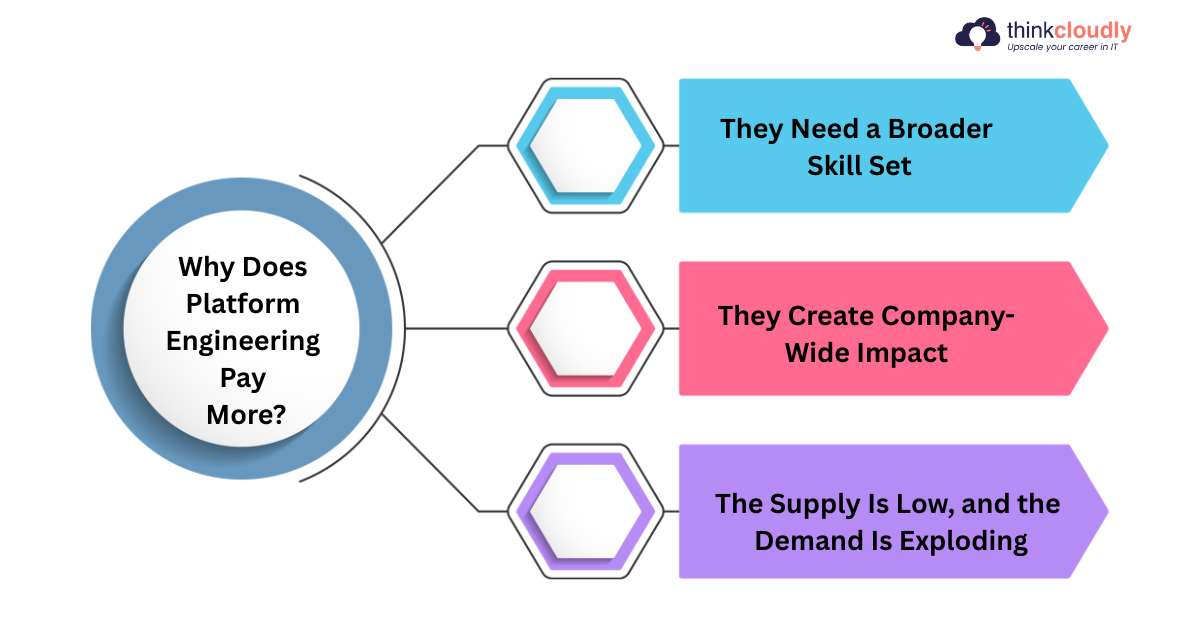
1. They Need a Broader Skill Set
Platform engineering isn’t just infrastructure. It’s infrastructure plus product thinking. A platform engineer has to understand developer experience (what do developers actually need?), build self-service tooling, write documentation, manage internal roadmaps, and balance technical decisions with business priorities. That combination is rare.
According to Kube Careers Q1 2025 data, around 85% of platform engineer job listings require senior-level experience — compared to about 75% for DevOps roles. That gap alone pushes the starting salary higher before any negotiation even happens.
2. They Create Company-Wide Impact
A DevOps engineer might improve one team’s pipeline. A platform engineer’s work touches every team at once. When they build a good self-service portal, every developer in the company ships faster, with fewer errors, and without needing to open a ticket. That kind of leverage is directly visible to leadership—and companies pay for leverage.
3. The Supply Is Low, and the Demand Is Exploding
Gartner predicted that by the end of 2026, 80% of large engineering organizations would have dedicated platform teams — up from just 45% in 2022. That’s a massive jump in a short time, and there simply aren’t enough qualified platform engineers to fill those seats. Basic economics: when demand outpaces supply, salaries go up.
A Real-World Career Scenario
Marcus is an engineer who has been working as a DevOps engineer at a mid-sized SaaS company in Austin, Texas, for four years. He manages CI/CD pipelines, handles cloud infrastructure, and is always on call. He’s good at his job. His salary sits at around $128,000.
A colleague on a different team, Jordan, joined the company two years ago as a Platform Engineer. Jordan’s job was to build an Internal Developer Platform that allowed 80+ developers to spin up environments without needing to open an ops ticket. Jordan earns $168,000 — nearly $40,000 more than Marcus.
When Marcus asked about the difference, the answer was straightforward: Jordan’s work saved the engineering org an estimated 4,000 developer hours per year. That saved time translated into shipped features, faster releases, and real revenue. The company could clearly see what Jordan’s work was worth.
Marcus spent six months upskilling—learning Backstage for internal portals, deepening his GitOps knowledge, and studying developer experience principles. He transitioned to a Platform Engineer role within his same company. His new salary: $161,000.
Privacy Disclaimer: This scenario is a composite illustration based on industry trends and aggregated salary data from publicly available reports (Kube Careers, State of Platform Engineering 2024). It does not represent any specific real individual. Names have been changed, and any resemblance to actual persons is coincidental. No private or personally identifiable information has been used.
Skills That Get You the Platform Engineering Premium
If you’re already in DevOps, you’re closer than you think. Here are the skill areas that most directly lead to the salary jump:
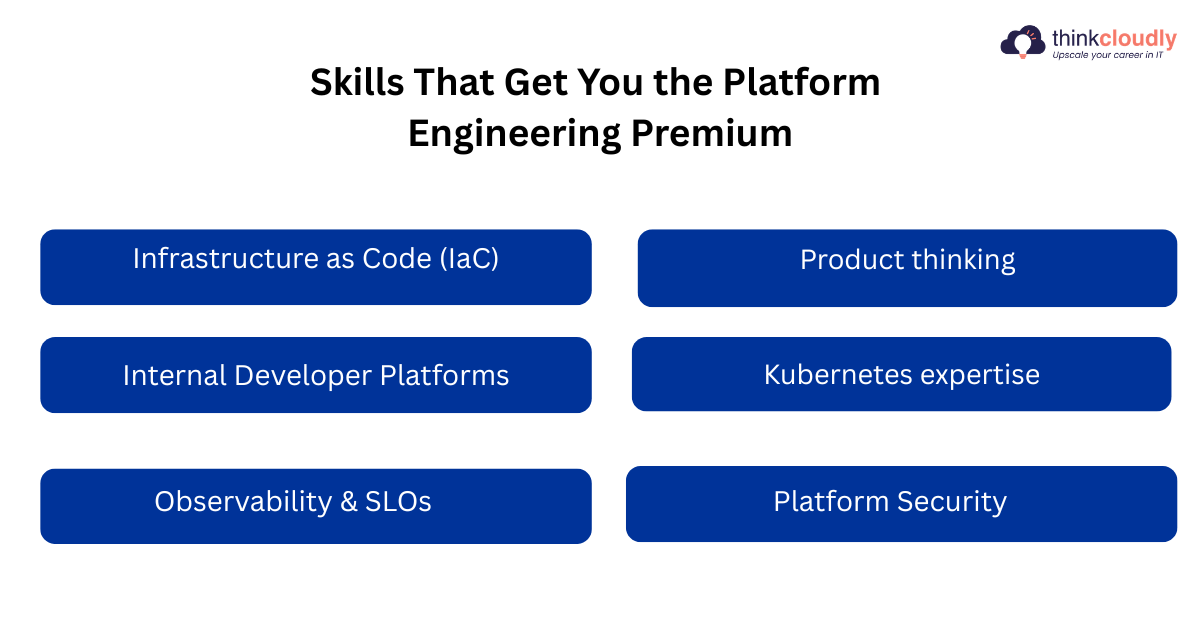
Infrastructure as Code (IaC)
Setting up servers by clicking through dashboards is slow, error-prone, and impossible to repeat consistently. IaC means you write that setup as code instead — so anyone on the team can run it and get the same environment every single time. Tools like Terraform and Pulumi handle the heavy lifting.
Internal Developer Platforms
This is the core of the job. You’re building a self-service hub — something like an internal app store — where developers can grab what they need, deploy their work, or spin up a test environment without filing a request and waiting three days for someone to action it.
Observability & SLOs
You set up dashboards and alerting so your team isn’t flying blind. SLOs are the commitments you make about reliability — something like “this service should be available 99.9% of the time.” When that number starts slipping, your monitoring tells you before your users do.
Platform Security
Security gets baked into the platform itself rather than bolted on at the end. Secrets are stored properly, access permissions are handled automatically, and problematic code gets flagged during the build — not after it’s already in production.
Product thinking
This is the skill that surprises people. Platform engineers treat their internal platform like a real product, with developers as the users. That means gathering feedback, prioritizing improvements, and caring whether people actually adopt the tools — not just whether the tools technically work.
Kubernetes expertise
Kubernetes is how most large-scale cloud applications get orchestrated. Knowing it well means you can manage hundreds of services running at the same time, handle failures gracefully, and keep things updated without taking anything down. It’s a core expectation in most platform engineering roles today.
So Should You Switch?
Platform engineering grew directly out of DevOps. The tools overlap heavily. What changes is the scope and framing of your work — and how you communicate that value to employers.
Here’s a realistic picture of who Platform Engineering is a good fit for:
- You enjoy designing systems, not just operating them
- You get frustrated when different teams solve the same problem in different ways
- You care about developer experience — making life easier for other engineers
- You’re comfortable thinking in terms of products, users, and roadmaps
- Your organization has 30+ developers and is starting to feel “too much manual processing.”
If that resonates, then the path is clear: start building your IDP knowledge, get hands-on with tools like Backstage, and look for opportunities within your current role to demonstrate platform thinking. Titles and salaries follow demonstrated value.
Conclusion
Look, nobody handed platform engineers a salary premium because the job title sounds fancier. Companies started paying more because the work genuinely changed what engineering teams could ship — and how fast. That’s a real business outcome, not a trend someone made up at a conference.
Platform engineers consistently earn 20–27% more, lead in Kubernetes-focused job listings, and are in demand, which is still outpacing supply by a significant margin.
If you’re in DevOps today, what you already know is the foundation. The next step is expanding how you think — from “how do I get this deployed” to “how do I build something that makes deployment easier for everyone.” That’s where the premium sits.
Companies aren’t short on engineers who know Terraform or Kubernetes. What they genuinely can’t find is someone who builds a platform other developers actually want to use — and keeps improving it based on real feedback. That’s the gap. Fill it, and the salary follows without you having to argue for it.
Sources & References
- Kube Careers — State of Kubernetes Jobs Report, Q1 2025. Platform engineers earn an average. $172,038; 85.1% roles require senior-level experience.
- Platform Engineering — Why Platform Engineering May Be a More Lucrative Career Than You Think (2025).
- PlatformEngineering — Top 5 Takeaways from the State of Platform Engineering Report 2024. Avg. salaries: $193,412 (PE) vs. $152,710 (DevOps); 26.6% gap in North America.
- Gartner — Platform Engineering Topic Page. “By 2026, 80% of large software engineering organizations will establish platform engineering teams up from just 45% in 2022. “
- DistantJob — Platform Engineering vs. DevOps: What’s the Difference? (Updated April 2026). North America and Europe salary comparison.
- Code & Pepper — Platform Engineering vs. DevOps: Key Differences in 2026. Platform engineers command 20–27% salary premium; 76% of DevOps teams integrated AI into CI/CD by late 2025.
- Octopus Deploy — Platform Engineer vs. Software Engineer: Salary Comparison (2025). Platform engineers earn ~20% more than DevOps engineers and 16% more than ML engineers.
- Artech—DevOps vs. Platform Engineering Salary and Career Guide (2026). McKinsey research on tech talent bottlenecks and Deloitte 2026 structural shifts.
- Full Stack Techies—Platform Engineering vs DevOps (2025–2026): 10 Differences. State of Platform Engineering Report 2024 salary data.