You apply for an IT job. You have the right certifications. You know the tools. But you hear nothing back. Meanwhile, someone with fewer certifications gets the interview. What do they know that you don’t?
Here is the truth: most IT resumes look the same. Everyone lists Python, AWS, and cybersecurity. Employers are tired of seeing the same words. What they really want — the skills that actually make someone hierable — are hiding in the gaps that almost nobody fills.
This blog tells you exactly what those skills are, backed by real numbers, and shows you how to list them in a way that makes employers stop scrolling.
Here is what the data says about hiring right now:
| Statistic | Insight |
|---|---|
| 85% | Employers now use skills-based hiring (up from 73% in 2024) |
| 41% | Recruiters look at your skills section first, before anything else |
| ATS Research | A significant majority of employers acknowledge that ATS systems can filter out strong candidates due to poor resume formatting or missing keywords |
| 40% | Higher interview chance when your resume includes real, measurable results |
These numbers come from real hiring surveys, ATS industry reports, and studies of recruiter behavior published between 2025 and 2026. They tell one clear story: employers are changing how they hire. Your resume needs to change, too.
Why your current IT resume is not working
Most people write an IT resume by listing tools they know. SQL. Docker. Azure. Firewalls. These are fine, but here is the problem: thousands of other candidates list the same things.
Recruiters see hundreds of resumes for a single job. If yours looks the same as everyone else’s, it gets skipped by both the human recruiter and the automated software (ATS) that screens resumes before a human even sees them. According to research, 97.8% of Fortune 500 companies use ATS software to automatically filter resumes.
So, what breaks through? Skills that are real, specific, and proven — especially the ones most people forget to mention.
Real-Life Scenario
Meet James, a system administrator in Manchester. He had six years of experience and strong technical skills. But every resume he sent looked the same: a list of tools, a list of companies, a list of duties. He heard nothing back for weeks.
He added three things to his resume: documentation skills (with an example), a note about cross-team communication during a server migration, and a result: “reduced ticket resolution time by 20% by building a team knowledge base.” Within two weeks, he had three interviews.
He did not get a new certification. He just told the whole story of what he actually did.
Note: The scenario above is illustrative and based on patterns commonly reported by IT professionals and hiring managers in published career research. It does not represent a single real individual.
At a glance: The Skills Gap on Most IT Resumes
|
Skill |
Who lists it |
Who wants it |
Demand Level |
|
Technical documentation |
Very few |
Almost all employers |
Very High |
|
Incident management (ITIL) |
Some |
Most IT operations roles |
High |
|
Cross-team communication |
Rarely |
Nearly all employers |
Very High |
|
AI-assisted productivity tools |
Growing |
Fast-growing demand |
Rising Fast |
|
Root cause analysis |
Few |
IT ops and support roles |
Medium – High |
|
SLA awareness |
Rarely |
Service-focused roles |
Medium |
|
Knowledge base management |
Almost no one |
IT support and ops teams |
Underrated |
The 6 skills employers want, but nobody lists
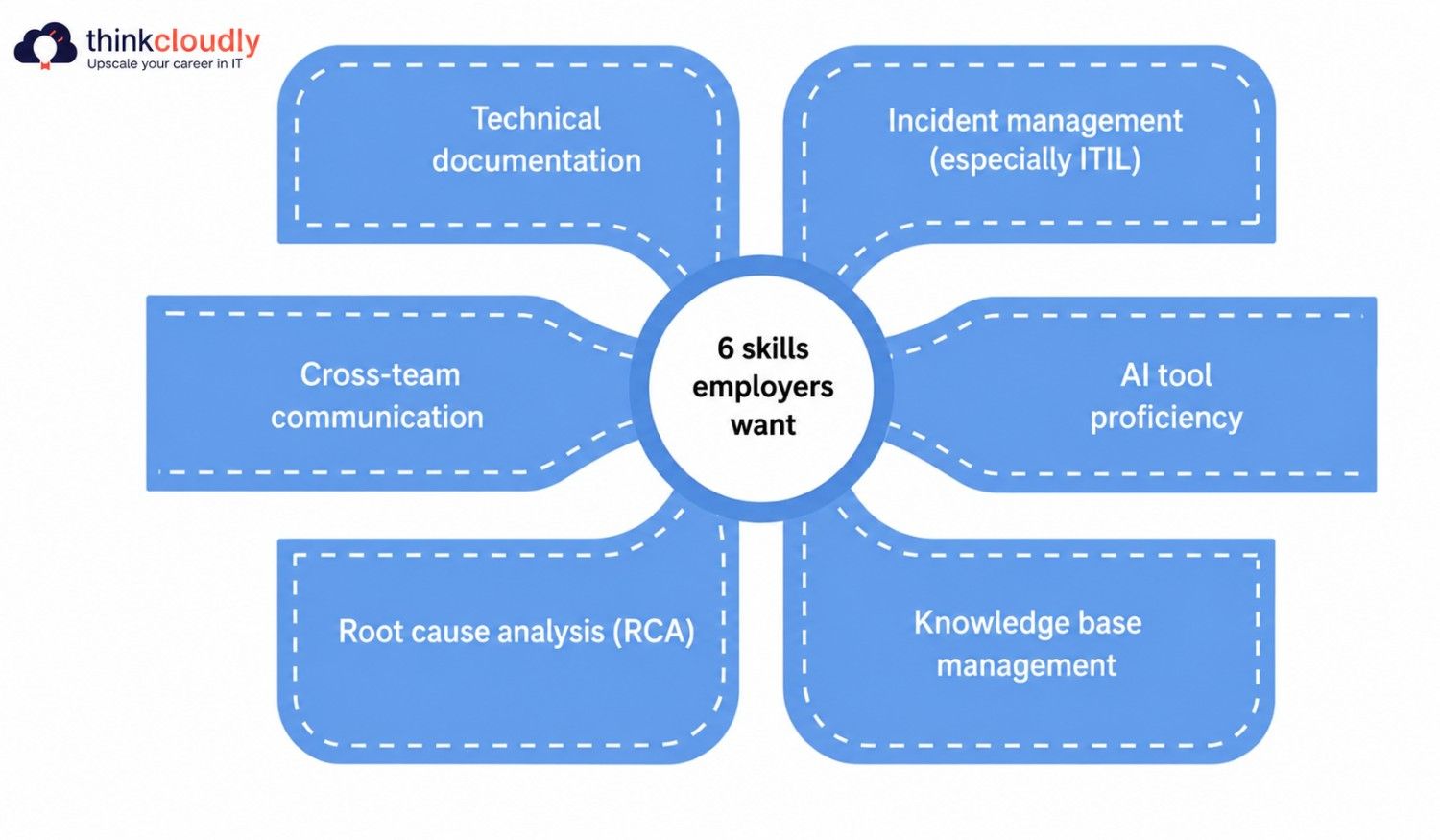
Technical documentation
This one surprises people. Writing skills — on an IT resume? Yes. Being able to write clear runbooks, how-to guides, and incident reports is one of the most valued and least listed skills in IT today.
When a system goes down at 2 am, your team needs clear documentation to fix it fast. When someone new joins your team, they rely on what was written down before them. Companies lose thousands of hours every year because nobody documents anything.
According to research on ITIL-aligned teams, organizations that implement structured documentation processes reduce repeat incidents by up to 50%.
How to list it: “Built and maintained internal IT runbooks covering 30+ common incident types, reducing average resolution time by 15 minutes per ticket.”
Incident management (especially ITIL)
When IT systems break down, employers do not just want someone who can fix things — they want someone who handles the chaos well. That means knowing how to detect what went wrong, communicate clearly while it is still happening, and close the loop properly once it is resolved.
ITIL gives you a shared language and process for doing exactly that. Companies that run their IT operations on ITIL principles tend to see measurable improvements across the board. SLA compliance among ITIL-aligned teams typically climbs from around 89% to 97%, and the amount of time customers are actually affected by outages drops by more than 22% within a quarter.
That is not a small difference. That is the kind of outcome that keeps clients and managers happy — and keeps you employed.
How to list it: “Handled IT incident response end-to-end using ITIL principles in ServiceNow — ticket resolution times dropped by roughly 30% across six months.”
Cross-team communication
Nearly 88% of employers say problem-solving is a top priority. But problem-solving in IT is rarely solo work. You need to talk to developers, business teams, management, and end users — often all at once during a crisis.
The ability to translate technical problems into plain language for non-technical people is rare. If you can do this, employers want you. Most candidates never think to mention it.
How to list it: “Coordinated incident communications between IT, operations, and senior leadership during major outages — keeping all stakeholders updated every 15 minutes.”
AI-assisted productivity tools
Here is something worth paying attention to: between 2025 and 2026, the number of job postings that specifically called out AI-assisted productivity tool skills grew by 30%. By 2026, nearly half of all hiring managers — 47% — ranked it among the hard skills they actively look for when reviewing candidates.
What does that mean for you in practice? Not much has to change. Employers are not expecting IT professionals to suddenly become machine learning engineers. What they do want is someone who knows how to get more done in less time using the tools that are already out there.
That looks like writing scripts faster with a code assistant, speeding up log review, or using suggestion tools during routine configuration work. If you have been doing any of this — even casually — it belongs on your resume.
How to list it: “Used AI-assisted productivity tools, including GitHub Copilot, in daily scripting work, cutting the time spent on manual configuration tasks by around 20%.”
Root cause analysis (RCA)
Any IT professional can fix a problem. The best ones find out why the problem happened — so it never happens again. This is called root cause analysis, and it is a skill most people have but almost nobody writes on their resume.
Employers running ITSM operations specifically look for RCA experience. Teams that conduct structured post-incident reviews using RCA methods reduce repeat incidents by up to 28% over six months.
How to list it: “Ran structured post-incident reviews after major outages, using five-whys questioning to trace problems back to their source — the corrective actions that followed brought repeat incidents down by 28% over six months.”
Knowledge base management
A knowledge base is a library of solutions, guides, and how-tos that your whole IT team uses. Building and managing one is a skill most employers desperately need — and almost no one lists on their resume.
This skill connects to documentation, but it goes further: organizing information so others can find it, keeping it up to date, and training colleagues to use it. Teams with strong knowledge bases resolve tickets faster and onboard new staff in a fraction of the time.
How to list it: “Created and maintained a 200-article IT knowledge base in Confluence, used by a 40-person team and reducing tier-1 escalations by 18%.”
Conclusion
Your technical skills get you in the door. But the skills above—documentation, incident management, communication, AI – assisted productivity tools, RCA, and knowledge management—are what make you the person they actually want to hire.
These are not soft, vague skills. They are specific, measurable, and backed by data. And because most IT professionals never list them, you stand out the moment you do.
Pick two or three from this list that match your real experience. Write them a result. Put them on your resume this week. Then watch what changes.
Sources and references
- TestGorilla — The State of Skills-Based Hiring 2026: “85% of employers now use skills-based hiring, up from 73% in 2024.”
- Axonify / SHRM Workforce Research — AI Skills in Job Descriptions 2026: “A 30% year-over-year increase in AI skills listed in job postings between 2025 and 2026.”
- ATS Industry Research — Research suggests a significant majority of employers believe ATS systems can filter out highly qualified candidates due to formatting or missing keywords. For verified figures, refer to primary sources such as iCIMS Hiring Insights or Greenhouse Recruiting Benchmarks.
- Indeed Hiring Lab — Recruiter Behaviour Survey: “41% of recruiters look for skills on a resume first before reviewing experience or education.”
- Jobvite — Recruiter Nation Report 2025: “Resumes with quantified, metric-backed achievements have up to a 40% higher chance of securing an interview. ” Axelos / ITIL Foundation — ITSM Workforce Data: ITIL-aligned incident management improves SLA compliance from 89% to 97% and reduces customer-impact minutes by 22% quarter over quarter.
- U.S. Bureau of Labor Statistics — Occupational Outlook Handbook: IT Occupations: ITIL and structured incident management practices are consistently cited among top employer requirements for IT roles.
- NACE / Handshake — Job Market Report 2026: “47% of hiring managers rank AI-assisted productivity tools among the top hard skills they look for on a resume in 2026. ” (National Association of Colleges and Employers).