
If you scrolled LinkedIn this morning, you probably saw another “I’ve been laid off” post. You’re not imagining it. The tech industry cut nearly 80,000 jobs in just the first quarter of 2026, and roughly half of those layoffs were blamed on AI. That’s not a recession. That’s a rewrite of what IT work even means.
But here’s the part nobody is putting on a banner: not all of tech is burning. While help desk teams, QA testers, and junior developers are watching AI eat their daily tasks, cloud engineers are getting raises. Some roles are so short on people that companies are flying candidates across continents and paying signing bonuses that would have sounded fake two years ago.
I’ve spent the last few months going through hiring data from Robert Half, Gartner, LinkedIn, and layoffs.fyi, talking to cloud hiring managers, and watching which job posts actually get filled vs. which ones sit open for 90+ days. A clear pattern showed up. Seven specific cloud roles keep showing up on the “we cannot find enough humans” list – and AI, at least in its current shape, is making them more valuable, not less.
If you work in IT right now and you’re worried, this is the article I wish someone had shown me a year ago.
First, The Uncomfortable Truth: Yes, AI Really Is Replacing IT Jobs
Let’s not sugar-coat it. This isn’t just hype.
- Around 30% of companies told an AI Resume Builder survey they plan to replace workers with AI in 2026. IT and technical support were named in the top three most-at-risk roles, right behind customer service and admin work.
- Amazon alone linked about 14,000 corporate job cuts to AI progress at the end of 2025, and reportedly has bigger restructuring in motion for 2026.
- Atlassian dropped roughly 1,600 people – about 10% of its global workforce – and their CEO openly said team members with “transferable skills” were the ones who survived the cut.
- An MIT simulation estimated AI could displace about 12% of the U.S. workforce, which in salary terms is around $1.2 trillion in wages.
- Goldman Sachs has already warned that another AI-driven layoff wave is coming through the rest of 2026.
So if your job is mostly “take a ticket, look something up, type a response, close the ticket” – or “write boilerplate code from a spec someone else wrote” – the risk is real. There’s no point pretending otherwise.
But here’s the flip side that rarely gets the same headline.
Why Cloud Work Is Holding Up
Here’s a small detail that changes everything: AI runs on cloud.
Every chatbot, every Copilot, every image generator your friends are playing with, every enterprise AI agent – they all sit on AWS, Azure, Google Cloud, or some hybrid setup. The more AI the world uses, the more cloud infrastructure the world needs. More GPU clusters. More storage. More networking. More security. More cost optimization. More compliance.
Gartner is projecting global public cloud spending to cross $700 billion as AI adoption accelerates. Employer postings that mention AI skills jumped 117% between 2024 and 2025. And in the U.S. alone, 41% of tech job ads now require some AI fluency, according to labor market data tracked by Nucamp.
This is the part people miss. AI isn’t an opponent of cloud – it’s the biggest customer cloud has ever had.
And that creates a weird split in the IT job market:
|
What AI is replacing |
What AI is creating demand for |
|
Basic monitoring & alerts |
People who design resilient cloud systems |
|
Simple ticket triage |
People who respond when production breaks at 3 AM |
|
Boilerplate code |
People who secure and govern AI workloads |
|
Manual reports & dashboards |
People who cut cloud bills from millions to thousands |
|
Template documentation |
People who architect multi-cloud + on-prem setups |
The roles on the right don’t just survive AI. They scale with it. Let me walk you through the seven I’d bet my career on.
The 7 Cloud Roles AI Is Struggling to Touch in 2026
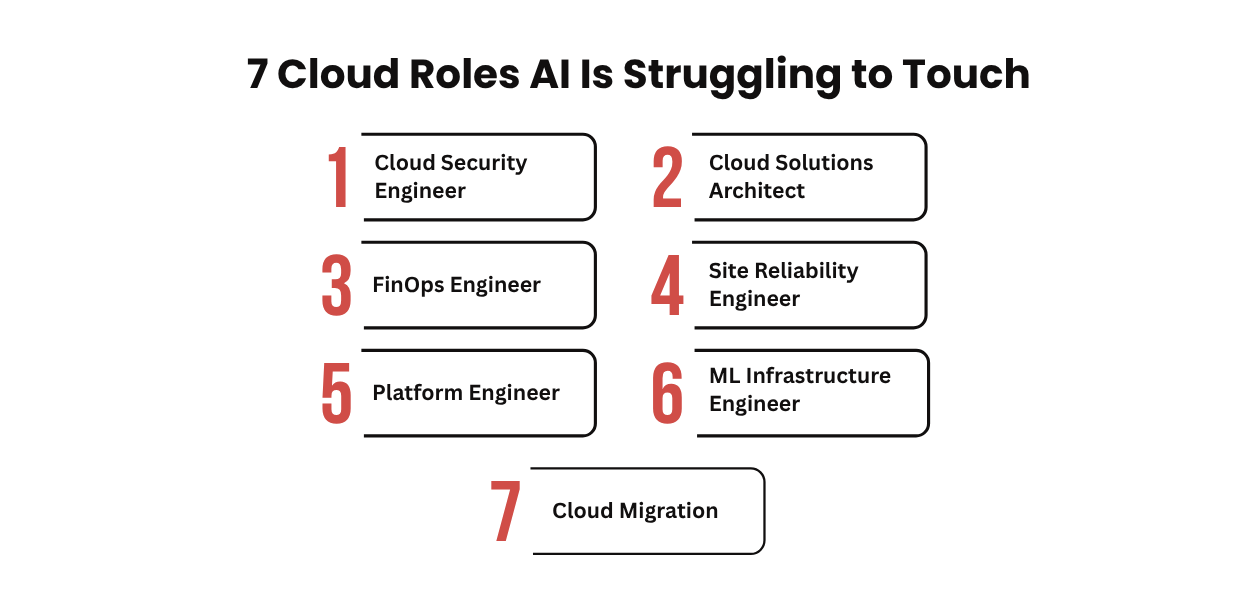
1. Cloud Security Engineer / Cloud Security Architect
What they do: Protect cloud environments from breaches. Design how identity, data, and workloads are secured across AWS, Azure, GCP, and increasingly, LLM-based applications.
Why AI can’t replace them: Security is a judgment job, not a pattern-matching job. When a ransomware crew is actively inside your environment at 2:47 AM, no AI agent is going to take full accountability for telling the CEO, “Shut down production in Frankfurt, now.” A human has to own that call – and the legal, regulatory, and reputational weight that comes with it.
Also: every new AI system your company ships creates a new attack surface. Prompt injection, data leakage, model theft, AI supply-chain risk – this stuff didn’t exist as a category five years ago. Someone has to defend it.
What it pays in 2026 (global reference, USD):
- Cloud Security Engineer: average around $155,000 (Glassdoor 2026)
- Security Architect: $138,000–$176,000 (Robert Half 2026 range)
- Top AI security specialists: $200,000+
Real-world signal: Gartner is tracking cloud security spending growing at roughly 18% a year. Meanwhile, the ISC2 workforce study continues to show a global cybersecurity talent shortage measured in the millions. There is simply no world where demand dips here in the next 5–7 years.
Who should look at this: Anyone in network admin, SOC analyst, or general sysadmin roles. Your fundamentals transfer well.
2. Cloud Solutions Architect
What they do: Sit between the business and the engineers. Translate “we want to launch in 12 countries in 9 months” into “here’s the AWS region strategy, here’s the data residency plan, here’s the cost model, here’s the timeline.”
Why AI can’t replace them: Architecture is mostly about tradeoffs nobody wrote down yet. Faster or cheaper? Flexible or simple? Multi-region or single-region with a DR plan? An AI can spit out a reference architecture diagram in 4 seconds. It cannot sit in a room with a nervous CFO, a frustrated CTO, and a compliance officer and get all three of them to agree on one plan by Friday.
I’ve watched architects save companies from 7-figure mistakes just by asking one question nobody else thought to ask. That’s not a prompt.
What it pays in 2026:
- Cloud Architect average: around $147,000 (ZipRecruiter / CCI Training 2026)
- Senior / Principal: $180,000–$220,000+ in major markets, with total comp often crossing $250,000 at FAANG-tier employers
Real-world signal: As more companies move past “lift and shift” into real multi-cloud and hybrid setups, architect roles only get harder to fill. The 2025 Foundry CIO study found 70% of IT leaders said their company accelerated cloud migration in the last 12 months – and every single one of those migrations needed an architect at the front.
3. FinOps Engineer / Cloud Cost Optimization Specialist
What they do: Make sure your company doesn’t accidentally spend $4 million on a GPU cluster that’s idle 80% of the time. Partner with finance, engineering, and product to bring cloud bills under control.
Why AI can’t replace them: This is the role people sleep on, and I think that’s a mistake. Here’s the thing – AI workloads are absurdly expensive. Training runs, inference at scale, vector databases, always-on agents – it adds up fast. A single badly-configured Kubernetes job can burn six figures in a weekend.
FinOps is part engineering, part finance, part politics. You have to tell a VP of Engineering that their pet project is the reason the quarterly cloud bill went up 34%. You have to negotiate reserved instance commitments with AWS. You have to understand both a P&L and a Terraform file. AI tools can surface the anomalies – they can’t have the hard conversation with the human who caused them.
What it pays in 2026:
- Cloud FinOps average U.S. salary: around $128,000, with senior roles commonly in the $154,000–$176,500 range (ZipRecruiter, Feb 2026)
- Global equivalents scale with tech-hub cost of living
Real-world signal: The FinOps Foundation’s member list has exploded. Every serious cloud shop – from Atlassian to Adobe to Capital One – now has a named FinOps team. Five years ago, that role didn’t have a title.
Who should look at this: People with a finance or operations background who picked up some cloud. You are massively underpriced right now.
4. Site Reliability Engineer (SRE)
What they do: Keep the lights on. Write the runbooks, design the failovers, run the post-mortems after everything breaks. SREs are the reason you can buy a plane ticket at 11:59 PM on Dec 31st and the booking system doesn’t fall over.
Why AI can’t replace them: Production outages are chaos. They are political, messy, and ambiguous. The Slack channel is on fire, the status page is red, a customer tweet is going viral, and something is wrong – but nobody knows what.
An AI agent might help you grep through logs faster. It cannot take ownership when three teams are pointing fingers at each other and the CEO is asking for an ETA. That’s human judgment, backed by years of scar tissue.
What it pays in 2026:
- SRE average: solid six figures globally, often $150,000–$200,000+ for senior roles in the U.S., with comparable scaling in Europe, Singapore, and Australia
- Specialized SREs (large-scale Kubernetes, high-frequency trading infra, etc.) frequently cross $250,000 total comp
Real-world signal: Google literally invented this role and still can’t hire enough of them. Every company that has “99.99% uptime” in its SLA has an SRE team quietly burning midnight oil to protect that number.
5. Platform Engineer (the evolved DevOps role)
What they do: Build the “internal developer platform” – basically, a self-service cloud toolkit so that a 100-person engineering team can ship safely without asking DevOps for permission every 15 minutes.
Why AI can’t replace them: Platform engineering is a product job disguised as an infra job. You’re not writing YAML in a cave. You’re interviewing developers, finding their biggest friction points, designing APIs and golden paths, measuring adoption, and iterating. It’s closer to being a product manager for engineers than to traditional IT.
AI can generate a Helm chart. It can’t understand that your backend team hates the current CI/CD pipeline because it takes 22 minutes and nobody trusts the test results.
What it pays in 2026:
- Senior DevOps / Platform Engineers in the U.S. regularly earn $150,000–$200,000+, with exceptional talent pulling more (Robert Half, Kore1 2026 data)
- The 2026 shift is clear: “DevOps Engineer” titles are quietly being renamed to “Platform Engineer,” and comp has gone up with the name change
Real-world signal: Gartner has been tracking platform engineering as one of the top strategic tech trends for three years running. Companies like Spotify, Netflix, and Shopify have publicly shared their internal developer platform playbooks – and every big enterprise is trying to copy them.
6. Cloud AI / ML Infrastructure Engineer
What they do: Get AI models into production and keep them running at scale. GPU provisioning, distributed training, inference optimization, vector DB scaling, model versioning – all the plumbing beneath ChatGPT-style products.
Why AI can’t replace them: This is the funniest one. The people building the AI that’s replacing other jobs are, themselves, nearly un-replaceable right now. Running a 70-billion-parameter model in production isn’t a prompt – it’s a distributed systems problem with networking, cost, latency, and reliability all fighting each other.
There’s also a massive gap between “I fine-tuned a model in a Colab notebook” and “I can serve this model to 10 million users with 99.9% uptime at reasonable unit economics.” The second skill is what companies are desperate for.
What it pays in 2026:
- ML / AI infrastructure engineers at top AI labs and large tech companies frequently earn $200,000–$350,000+ in total comp (LinkedIn and Levels.fyi 2026 data)
- Even at mid-sized enterprises, base salaries of $160,000–$220,000 are normal
Real-world signal: The fact that NVIDIA’s market cap crossed $3 trillion in 2024 tells you everything. Somebody has to actually wire up all those GPUs. That somebody is this role.
Who should look at this: Cloud engineers with a strong Linux/networking foundation who are willing to learn ML fundamentals. You do not need a PhD in machine learning to do this job – you need to know how to run heavy workloads reliably.
7. Cloud Migration / Multi-Cloud Specialist
What they do: Move legacy on-premise systems to cloud, or move workloads between clouds. Untangle 15 years of spaghetti infrastructure from a bank, a hospital, or a government agency.
Why AI can’t replace them: Migrations are 20% technical and 80% organizational. The technical part is hard enough – there’s always one obscure mainframe integration that nobody has touched since 2009 and the guy who wrote it retired. But the real blocker is human: you need to get 14 different stakeholders across finance, legal, security, and operations to agree on a change freeze window.
AI tools can generate migration assessments. They can’t sit in a steering committee and absorb a compliance officer’s anxiety about data sovereignty.
What it pays in 2026:
- Migration consultants and multi-cloud specialists at Big 4 consulting firms and cloud partners regularly bill at $1,800–$3,500 per day globally
- Full-time multi-cloud engineers earn $145,000–$175,000+ on average (multi-cloud expertise commands a premium over single-platform skills)
Real-world signal: Apponix and CIO Magazine both report that by 2026, over 90% of organizations are expected to face IT skills shortages, with multi-cloud being one of the most painful gaps. This demand isn’t temporary – hybrid cloud will be a 10-year story, minimum.
Let’s Be Honest: What Do These 7 Roles Have In Common?
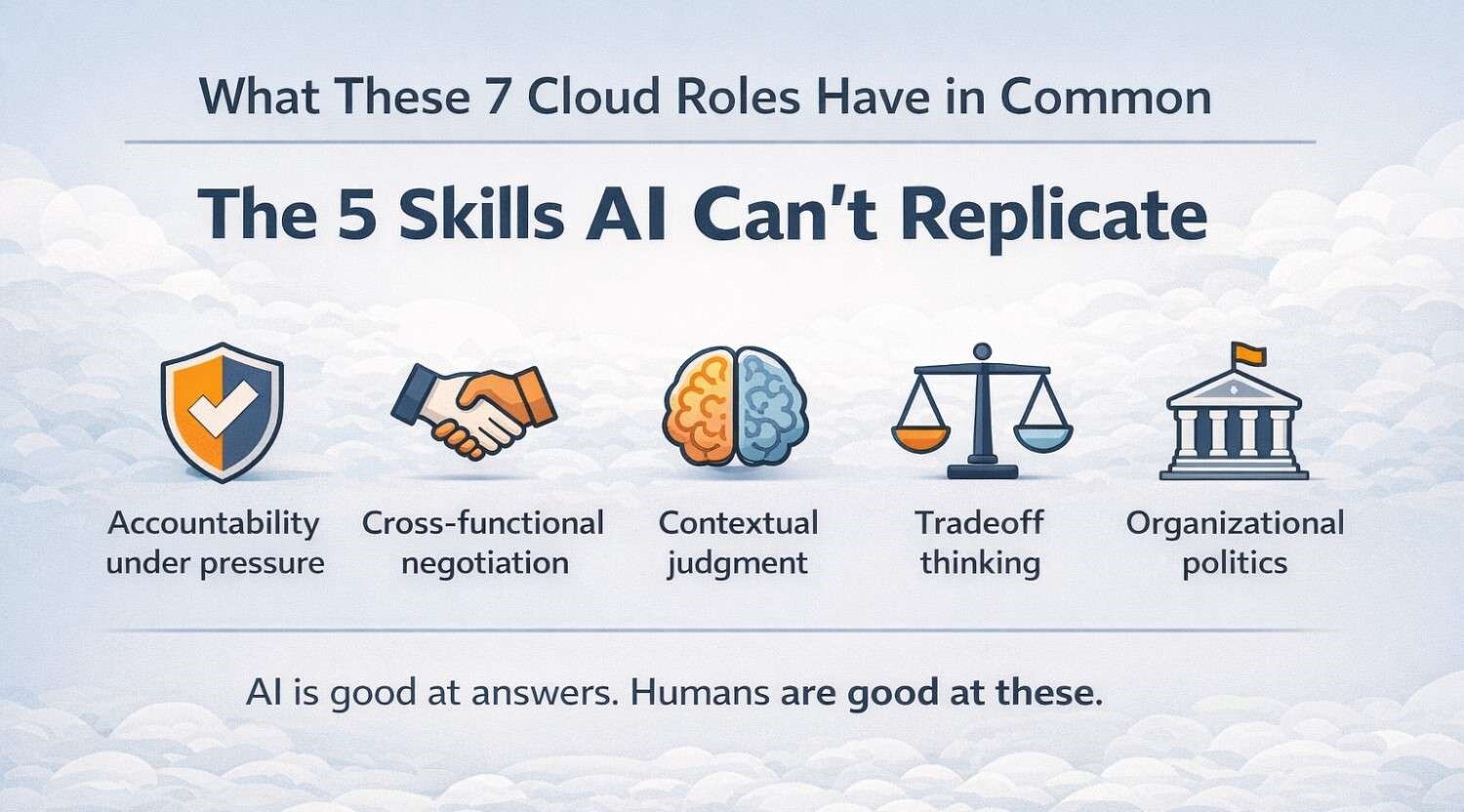
Look at the list again. You’ll notice a pattern.
Every single one of these roles requires at least two of the following things that current AI struggles with:
- Accountability under pressure – someone has to sign their name on the decision
- Cross-functional negotiation – getting humans with different goals to agree
- Contextual judgment – knowing when a best practice does not apply
- Tradeoff thinking – choosing between two imperfect options
- Organizational politics – navigating who owns what, and who has a grudge against whom
AI is getting scary good at generating code, summarizing docs, and answering known questions. It is not good (yet) at being the person the CEO yells at when the store goes down on Black Friday. Until that changes, these seven cloud roles are your safest bet in tech.
How To Make The Pivot – Without Starting From Zero
If you’re a network admin, helpdesk lead, QA engineer, or junior dev who’s feeling the ground move, here’s the shortest path I’d recommend – in the order that actually works in 2026:
Step 1: Pick one cloud platform and get one real certification. AWS Solutions Architect Associate, Microsoft Azure Administrator (AZ-104), or Google Associate Cloud Engineer are the three that move the needle. Don’t collect certifications like Pokémon – pick one, pass it, and put it on LinkedIn.
Step 2: Build one public project. Not a tutorial clone. A real thing – even if it’s small. A static site hosted on S3 with Terraform. A simple Kubernetes cluster on GKE with monitoring. Put the code on GitHub. This is your “Experience” signal. It matters more than the cert.
Step 3: Pick your specialization based on your existing skills.
- Coming from security? → Cloud Security Engineer
- Coming from infra/ops? → SRE or Platform Engineer
- Coming from finance or business analyst? → FinOps (you’re the rarest candidate there is)
- Coming from dev? → Cloud AI/ML Engineer or Platform Engineer
Step 4: Apply while underqualified. The cloud shortage is so severe in 2026 that companies are hiring for “potential + one cert + one project” over “5 years of experience.” I’ve seen it in Indian, European, U.S., and Southeast Asian markets. Don’t wait until you feel ready. You won’t.
Step 5: Learn one AI tool deeply. Not ten. One. Claude Code, GitHub Copilot, Cursor – whichever. Cloud + AI fluency is the combo that gets you paid in 2026.
Conclusion
AI isn’t ending IT careers. It’s ending a specific shape of IT career – the one built on repetitive, codified, ticket-closing work.
The new shape of IT – cloud, security, architecture, reliability, cost engineering, AI infrastructure – is not only surviving, it’s one of the few places in the global economy where demand is massively outrunning supply. Over 90% of organizations are expected to face IT skills shortages in 2026. That isn’t a bad sign for you. That’s a wide-open door.
If you take one thing from this article: don’t panic. Pivot.
The people I’ve seen do best in the last 18 months weren’t the smartest or the most senior. They were the ones who picked a cloud specialization, committed to it for 6–9 months, and kept going when it felt slow. That’s it. That’s the formula.
AI will keep getting better. The people who run the cloud that AI lives on will keep getting paid.
Sources & Further Reading
The data, statistics, and salary benchmarks cited throughout this article are drawn from the following sources.
We encourage you to explore them for deeper context:
- Tom’s Hardware — Q1 2026 tech layoff analysis (80,000 jobs cut, ~50% linked to AI)
- Robert Half 2026 Salary Guide — Cybersecurity and cloud role salary benchmarks
- Gartner — Global public cloud spending forecast ($700B+ projection)
- layoffs.fyi — Real-time tech industry layoff tracker
- ZipRecruiter — 2026 Cloud FinOps salary data
- Glassdoor — 2026 cloud security role salary benchmarks
- Nucamp Labor Market Report — 2025-26 AI job posting trends (117% growth, 41% of tech ads)
- InformationWeek — 2026 tech company layoff tracker
- Foundry — 2025 CIO Cloud Computing Study (70% accelerated migration data)
- CIO Magazine — In-demand cloud roles 2026 analysis