
Every few weeks, someone posts on LinkedIn: “Just earned my 12th certification! On to the next one!”
The likes pour in. The congratulations flow. But nobody asks the important question — are all those certifications actually doing anything?
In 2026, IT certifications have become a multi-billion-dollar industry. There are courses, bootcamps, practice exams, and prep guides for practically everything. And while getting certified can genuinely open doors and boost your salary, there is a side of this world that nobody really talks about.
The cheating. The overpricing. The fast-expiring badges. The certifications that looked great on paper but meant almost nothing to employers. And most recently, the rise of AI-powered tools designed to help people cheat their way through exams in real time.
This isn’t a reason to avoid certifications — it’s a reason to choose them wisely.
First, the Good News (Because It Is Real)
Before going into the dark side, it is only fair to share what the data actually says.
According to Foote Partners’ IT Skills and Certifications Pay Index, cash pay premiums for 663 IT certifications posted their strongest quarterly jump in roughly a decade in Q1 2026. Meanwhile, pay for non-certified IT skills dropped 2.2% in the same period — the steepest single-quarter decline since 2002.
That is a significant shift. Employers are clearly placing more value on verified, certified skills than ever before.
The numbers back this up:
- Certified IT professionals earn an average of $138,800 per year — roughly 25% more than uncertified peers (Global Knowledge IT Skills and Salary Report, 2024)
- AWS Solutions Architect – Professional holders earn an average of $221,069 per year (CertStud Salary Analysis, Q1 2026)
- Google Certified Professional Cloud Architect roles command between $175,000 and $200,000 annually (Frontline Source Group, 2026)
- 76% of IT leaders say certified employees add $30,000 or more in annual value to their organizations (CompTIA IT Industry Outlook 2026)
- Nearly 70% of IT leaders now say skills — not degrees — are their primary hiring criteria (CompTIA IT Industry Outlook 2026)
So yes, the right certifications still pay off. But here is where it gets complicated.
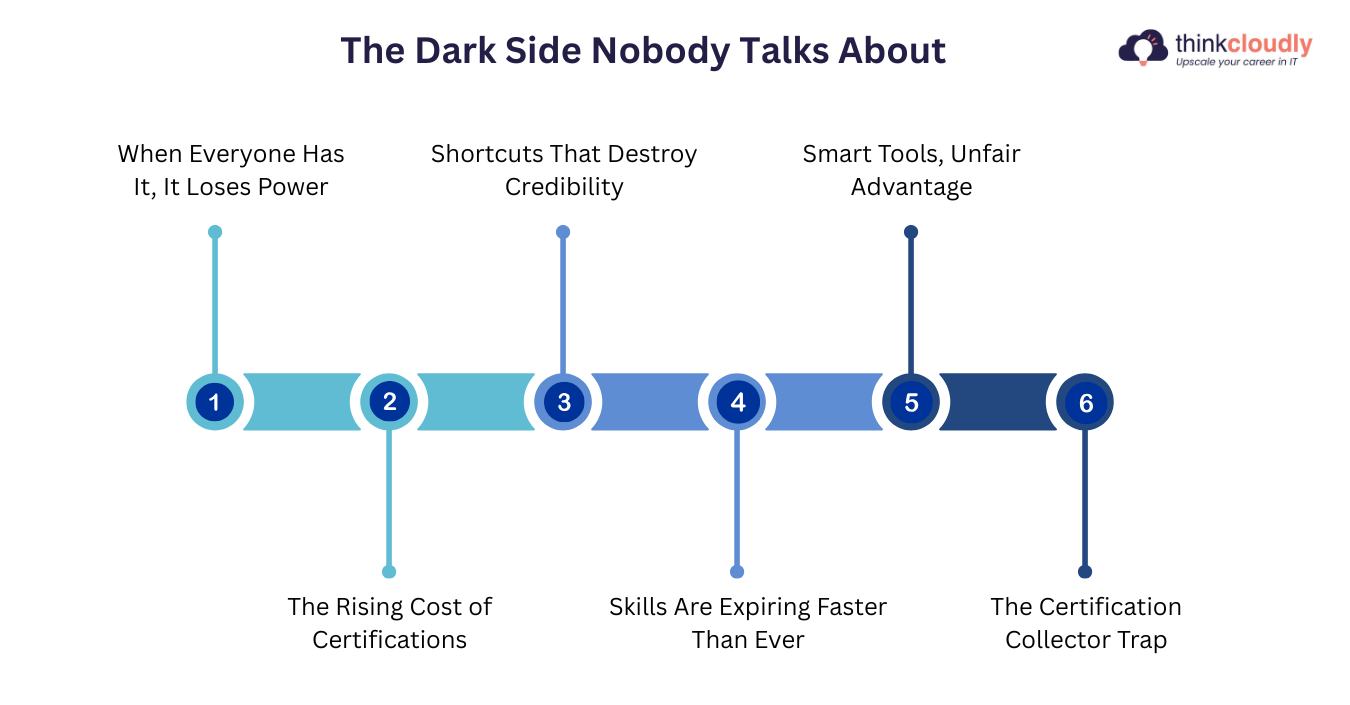
The Dark Side Nobody Talks About
Here’s what’s hiding beneath the surface:
1. Some Popular Certifications Are Quietly Losing Their Value
Here is a fact that might surprise you. Not all certifications are going up in value — some are dropping fast.
Foote Partners data reveals that widely adopted certifications, including CompTIA Security+, CompTIA CySA+, VMware security credentials, and several Microsoft Azure certifications, have dropped 30% to 55% in market value over the past two years.
Why? Because too many people have them now. When a certification becomes easy to obtain — or when millions of professionals hold it — employers stop seeing it as a differentiator. It just becomes a checkbox.
David Foote, Chief Analyst at Foote Partners, puts it plainly: the market is reacting to an oversupply of certain certified skills. Employers are now paying more for rare, specialized certifications — and less for common ones.
The lesson here is simple but important: chasing what is popular is not the same as chasing what is valuable.
2. Brain Dumps and Exam Cheating Are More Widespread Than You Think
This is the part of the certification industry that makes actual professionals quietly furious.
Brain dumps are websites and files that contain real exam questions — usually obtained by people who took an exam and immediately wrote down what they remembered, or worse, by organized groups that pay people to sit exams specifically to harvest the questions.
These are sold online, sometimes for as little as $10–$30, and they are everywhere. A simple search reveals dozens of these sites operating openly in 2026, some boasting “95% success rates” and claiming to be perfectly legal study tools.
They are not legal. Using brain dump content is a direct violation of the terms and conditions of every major certification body — including CompTIA, Microsoft, Cisco, AWS, and ISC2.
According to CompTIA, using brain dumps is considered cheating and can result in losing your certification permanently and being banned from future exams. Microsoft has a lifetime ban policy for confirmed cheaters. CBT Nuggets notes that vendors now use data forensics — comparing individual exam answers against historical patterns — to catch dump users, often without the cheater ever knowing they have been flagged.
But in 2026, the threat has escalated well beyond brain dumps.
3. AI Cheating Tools Are Now Actively Defeating Exam Security
This is genuinely new — and genuinely alarming.
According to Internet Testing Systems (ITS), a new wave of AI-powered cheating applications is now being marketed specifically to exam takers. These tools use artificial intelligence to read the test content on your screen and provide answers in real time — during the actual exam.
These tools are built to evade secure browsers. They are designed to look invisible to proctoring software. And some of them now advertise specific “modes” for different certification subjects, making them easy to target at specific exams.
The implications are serious. As ITS notes, even large item pools, randomized question delivery, and secure browsers — the traditional defenses against cheating — may no longer be enough when an AI is answering on behalf of the candidate.
And here is the downstream consequence that affects every honest certification holder: if enough people in a certification pool cheated their way through, the credential itself loses credibility with employers. You worked hard, studied for months, and passed honestly — but now the badge on your resume carries the shadow of doubt.
4. The Cost Problem: Certifications Are Getting Expensive Fast
Let us talk about money, because this affects real people.
A CISSP exam now costs $749 — plus study materials, practice tests, and potentially a prep course. An AWS Solutions Architect Professional exam is $300. A PMP exam is $555 for non-PMI members.
Many professionals need multiple certifications to stay competitive, and those costs stack up quickly. Add to that the renewal fees — most certifications expire in 2–3 years and require continuing education or re-examination — and the total cost of staying certified becomes a significant financial burden.
For professionals in lower-income countries or those just starting their careers, this creates a serious barrier. The certification industry, despite its reach, remains structurally unequal.
On average, broad AI certifications earn premiums of around 8.5% of base salary — but specialized credentials like CAIS command nearly double that, at 18%.
5. Certifications Expire — But Skills Expire Even Faster
Here is something nobody in the certification industry advertises: the shelf life of technical knowledge is shrinking rapidly.
Linux Foundation Education notes in its 2026 trends report that the shelf life of technical skills is collapsing, and that static courses simply cannot keep up. What was cutting-edge knowledge in 2023 may be outdated or replaced by 2026.
This creates a treadmill effect. You earn a certification, you use it for a year or two, and then you have to renew or replace it — often at great cost in both money and time. For professionals who are not careful about choosing certifications that evolve with the technology (known as “evergreen” credentials), this cycle never ends.
The real question is not just “can I pass this exam” but “will this certification still mean something in three years?”
6. The “Certification Collector” Trap
There is a growing trend — particularly visible on professional networking platforms — of people collecting certifications the way others collect trophies.
The problem is that more badges do not always equal more value. The Linux Foundation 2026 report is direct about this: employers in 2026 are not looking for long lists of disconnected badges. They want professionals who can demonstrate mastery within a specific technical domain.
A professional with three deeply relevant, specialized certifications in cloud security, AI pipelines, and infrastructure architecture will outperform someone with twelve general certifications in almost every hiring scenario.
According to Pearson VUE’s 2026 Value of IT Certification Employer Report, employers are specifically looking for certifications that connect to measurable performance improvements, productivity gains, and real-world skill application — not simply credential volume.
What Employers Actually Care About in 2026
Despite all of the above, certifications still matter. They just matter differently than most people think.
Employers use certifications primarily as filters — a way to screen large volumes of applicants quickly. As CertStud notes, based on 50,000+ job posting analysis, without the right certifications, your resume may be automatically filtered out before a human even looks at it.
But once you get into the interview room, the certification gets you through the door. Your actual skills, experience, and problem-solving ability get you the job.
The certifications that are commanding the highest premiums in 2026 sit at the intersection of:
- Cloud + Security: (AWS Security Specialty, CCSP, CISSP)
- AI + Infrastructure: (Certified AI Scientist, MIT CSAIL AI Certificate)
- Specialized Architecture: (Network Architecture, Google Cloud Architect)
According to the Foote Partners Q1 2026 data, the Certified Artificial Intelligence Scientist (CAIS) now commands premiums of 18% of base salary, and the MIT CSAIL Professional Certificate in AI and Machine Learning rose 45.5% in market value over just six months.
The Certification Landscape at a Glance: 2026
Below is a clear overview of how different types of certifications are performing in 2026 — to help you decide where to focus.
|
Certification Type |
2026 Market Trend |
Avg. Salary Range (USD) |
Risk Level |
|
AI & Machine Learning (CAIS, MIT CSAIL) |
Rising Fast (+45% in 6 months) |
$150,000 – $190,000
|
Low |
|
Cloud Architecture (AWS SA Pro, GCP Architect) |
Strong & Stable |
$155,000 – $221,000 |
Low |
|
Cloud Security (CCSP, AWS Security Specialty) |
Rising |
$135,000 – $203,000 |
Low |
|
Cybersecurity Leadership (CISSP, CISM) |
Appreciating |
$125,000 – $165,000 |
Low |
|
CompTIA Security+ / CySA+ |
Declining (-30 to -55% market value) |
$65,000 – $95,000 |
High – Oversaturated |
|
General Microsoft Azure (Basic tiers) |
Declining |
$80,000 – $120,000 |
Medium – Oversupply |
|
Web & E-commerce Dev Skills |
Falling (-9.7% YoY) |
Varies |
High |
|
Database & Data Management |
Falling (-10.9% YoY) |
Varies |
High |
|
Project Management (PMP) |
Stable |
$110,000 – $140,000 |
Low – Evergreen |
|
Networking (CCNA, CCNP) |
Stable with AI integration demand |
$85,000 – $130,000 |
Medium |
How to Navigate the Certification World Smartly
Given all of the above, here is practical advice for anyone thinking about certifications in 2026:
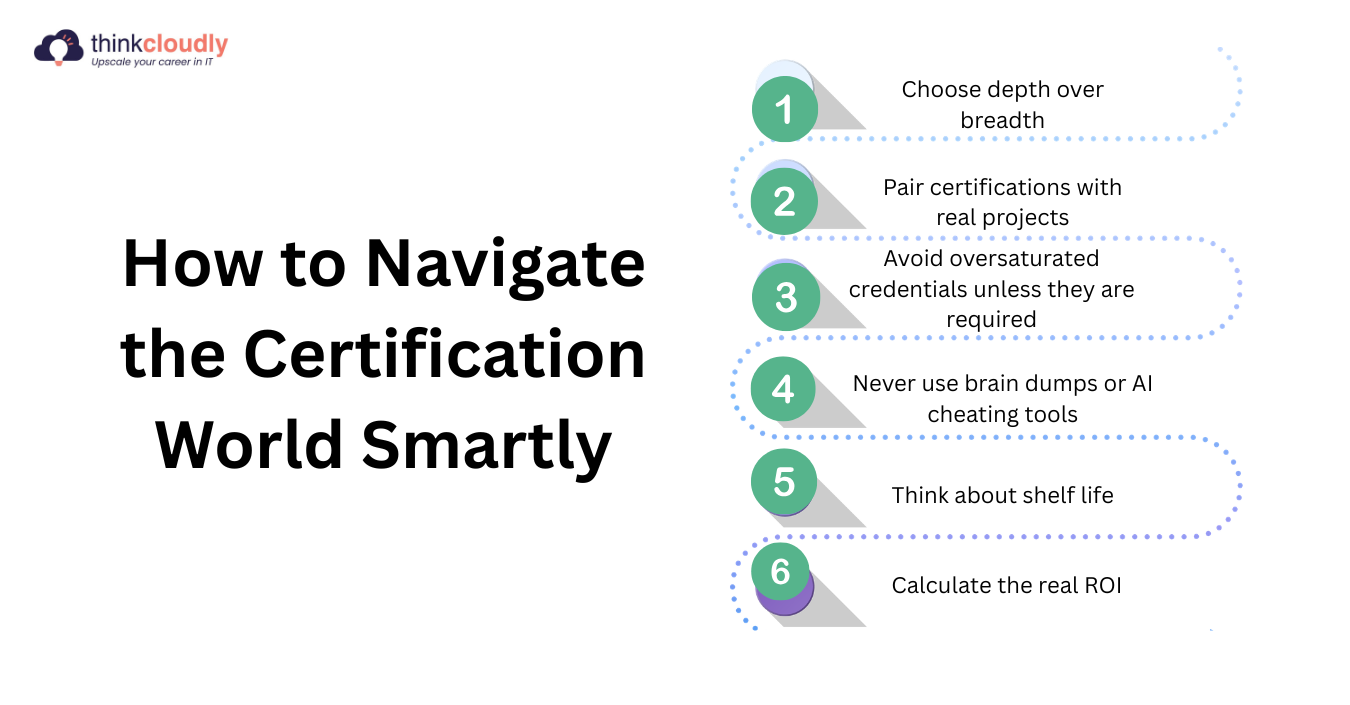
Choose depth over breadth: A small number of specialized, high-demand certifications will always outperform a large collection of general ones. Focus on where technology is heading, not where it has been.
Pair certifications with real projects: Every employer survey in 2026 points to the same thing: hands-on experience is what wins interviews. Your certification gets you shortlisted; your portfolio proves you belong there.
Avoid oversaturated credentials unless they are required: If a certification is held by millions of people, its pay premium is likely shrinking. Check Foote Partners or similar pay index data before committing.
Never use brain dumps or AI cheating tools: Beyond the ethical and legal consequences, you are simply setting yourself up to fail on the job — and potentially damaging the value of the credential for everyone else who earned it honestly.
Think about shelf life: Before investing in any certification, ask: Does this certification body update its curriculum regularly? Will this skill still be relevant in three years? Evergreen certifications tied to fundamentals (security thinking, architecture, AI governance) age better than tool-specific credentials.
Calculate the real ROI: Total the exam fee, study materials, prep courses, and renewal costs. Then look at realistic salary data for your region and career stage. If the numbers make sense, move forward.
Conclusion
IT certifications in 2026 are not good or bad by themselves — they are tools. And like any tool, their value depends entirely on how you use them.
The data is clear on both sides of the story. The right certifications, chosen thoughtfully and backed by real hands-on skills, are still one of the fastest paths to a higher salary and a stronger career. Certifications in AI, cloud security, and specialized architecture are commanding pay premiums that have not been seen in years.
But the certification industry also has a real dark side — one built on brain dumps, AI cheating tools, overpriced renewals, oversaturated credentials, and the illusion that more badges equal more success. These are not small problems. They affect employers’ trust, erode the value of honest professionals’ hard-earned credentials, and cost people serious money without delivering real returns.
The smartest professionals in 2026 are not the ones with the longest list of certifications. They are the ones who study and certify with purpose — picking credentials that align with where technology and the job market are actually heading, not just what looks impressive on a LinkedIn profile.
Certify smart. Learn deep. Build real. That is the formula that actually works.
Sources & References
1. Foote Partners IT Skills and Certifications Pay Index, Q1 2026 The primary compensation benchmarking resource covering 1,382 IT skills and certifications across 5,112 U.S. and Canadian employers.
2. Network World — “IT Certification Pay Surges as Noncertified Skills Slump” (May 2026) Covers the Q1 2026 Foote Partners findings on certification pay premiums hitting a decade high and noncertified skill pay dropping 2.2%.
3. Linux Foundation Education — “2026 Top 10 IT Education & Certification Trends” (January 2026) Annual analysis of market signals, employer behaviours, and training uptake shaping IT education in 2026.
4. Pearson VUE — “2026 Value of IT Certification Employer Report” Global employer insights on how certification strengthens talent pipelines, productivity, and long-term workforce strategy amid AI and emerging technologies.
5. CompTIA — “Why Brain Dumps Don’t Work” Official CompTIA guidance on the dangers of exam dumps, cheating policies, and consequences of using unauthorized exam material.
6. Internet Testing Systems (ITS) — “The Rise of AI Cheating Tools and What It Means for Exam Security” (August 2025) Industry analysis of new AI-powered cheating applications designed to defeat secure browsers and answer exam questions in real time.
7. Workday — “The 10 Best IT Certifications in 2026” (April 2026) Enterprise-level analysis of the most valuable certifications based on employer demand and workforce strategy, including data from Workday’s Global State of Skills Report.
8. CertStud — “15 IT Certifications Employers Actually Want in 2026” (February 2026) Analysis of 50,000+ job postings and salary data from Dice, Robert Half, Glassdoor, and Gartner’s 2026 IT Skills Forecast.
9. CertStud — “25 Highest-Paying IT Certifications in 2026” (December 2025) Salary rankings sourced from Skillsoft IT Skills and Salary Survey (5,000+ respondents), CompTIA IT Industry Outlook 2026, and Gartner IT Spending Forecast.
10. Frontline Source Group — “Highest Paying Certifications in 2026” Salary ranges and market analysis for top IT, cloud, and cybersecurity certifications based on BLS and industry survey data.
11. Microsoft Learn — “Exam and Assessment Security Policies” Official Microsoft policies on exam fraud, brain dumps, proxy testing, AI-assisted cheating, and consequences including lifetime bans. 12. Chauster — “How AI Is Reshaping the Value of IT Certifications” (March 2026) Explores how generative AI tools are disrupting the traditional certification model and what it means for career development.
13. Artech — “The 10 Most In-Demand Tech Certifications for 2026” (March 2026) Hiring trend analysis from a leading IT staffing firm, covering enterprise certification demand across cloud, AI, security, and DevOps.
14. CBT Nuggets — “The Dangers of Exam Dumps” Detailed breakdown of how brain dumps work, why they fail learners, and how certification vendors use forensic algorithms to detect cheating.
15. Global Knowledge — IT Skills and Salary Report 2024 Widely referenced benchmark report tracking IT professional salaries, certification premiums, and skills demand across global markets.
16. CompTIA — IT Industry Outlook 2026: Annual forward-looking report on technology hiring trends, skills-first hiring shifts, and certification demand across the global IT industry.