
A Personal Note Before We Begin
I have spent the last several years consulting with software teams across the UK, US, and Canada—watching them wrestle with the same painful question over and over: Why does security always feel like it shows up too late? I have sat in sprint retrospectives where engineers discovered critical vulnerabilities that had been sitting in production for weeks. I have seen the panic, the all-hands calls at midnight, the frantic hotfixes. And then I started watching a different kind of team—one where security engineers sat beside developers in daily standups, where every pull request triggered an automatic scan, and where releasing on a Friday felt fine because the pipeline already had their back.
That shift — from security as a checkpoint to security as a culture — is exactly what this blog is about. This is not a theoretical exercise. The data from 2026 makes the case clearly, and I want to walk you through it in a way that makes sense whether you manage a product team, run a startup, or are just trying to understand why your engineering organization keeps talking about “shifting left.”
What Does It Mean When We Say Security Arrives Too Late?
Picture a factory assembly line. You build a car, put every piece together across a hundred steps, and then — right at the very end, just before it rolls out the door — a quality inspector checks whether the brakes work. If they do not, you pull the whole car back and start tearing it apart. That is exactly how software security used to work, and in many organizations, it still does. The average data breach now costs $4.88 million, but organizations with high DevSecOps integration saved nearly $1.7 million per breach compared to those with low or no adoption, according to IBM’s Cost of a Data Breach report. That is not a marginal saving. That is the difference between a painful incident and an existential one for a mid-sized company.
In 2026, the software delivery landscape has shifted so dramatically that treating security as an afterthought is not just risky—it is financially indefensible. This is where Agile DevSecOps steps in as the central framework connecting speed and safety in a way that neither Agile alone nor traditional security alone could achieve.
What Is DevSecOps Integration, and Why Does It Matter in 2026?
DevSecOps integration is the practice of weaving security checks, controls, and accountability directly into the software development and delivery process—from the first line of code to the moment something is deployed and monitored in production. The term combines Development (Dev), Security (Sec), and Operations (Ops), and the integration piece is crucial: it is not about adding a security layer on top of DevOps; it is about making security inseparable from every workflow.
This matters enormously in 2026 because the Secure SDLC — the software development lifecycle with security baked in throughout — has moved from aspiration to industry expectation. The DevSecOps market in 2026 is valued between USD 8.58 billion and USD 10.88 billion, reflecting robust growth from 2025 figures, driven by cloud-native shifts, regulatory pressures, and AI integration. Teams that have not adopted this model are not just falling behind technically — they are falling behind competitively.
Agile security practices sit at the heart of this shift. When a team runs two-week sprints and ships code continuously, there is no logical moment to “pause for a security review.” Security has to move at the same pace as the sprint. That is not a nice-to-have. It is structural.
How Do Agile and DevSecOps Integration Actually Work Together?
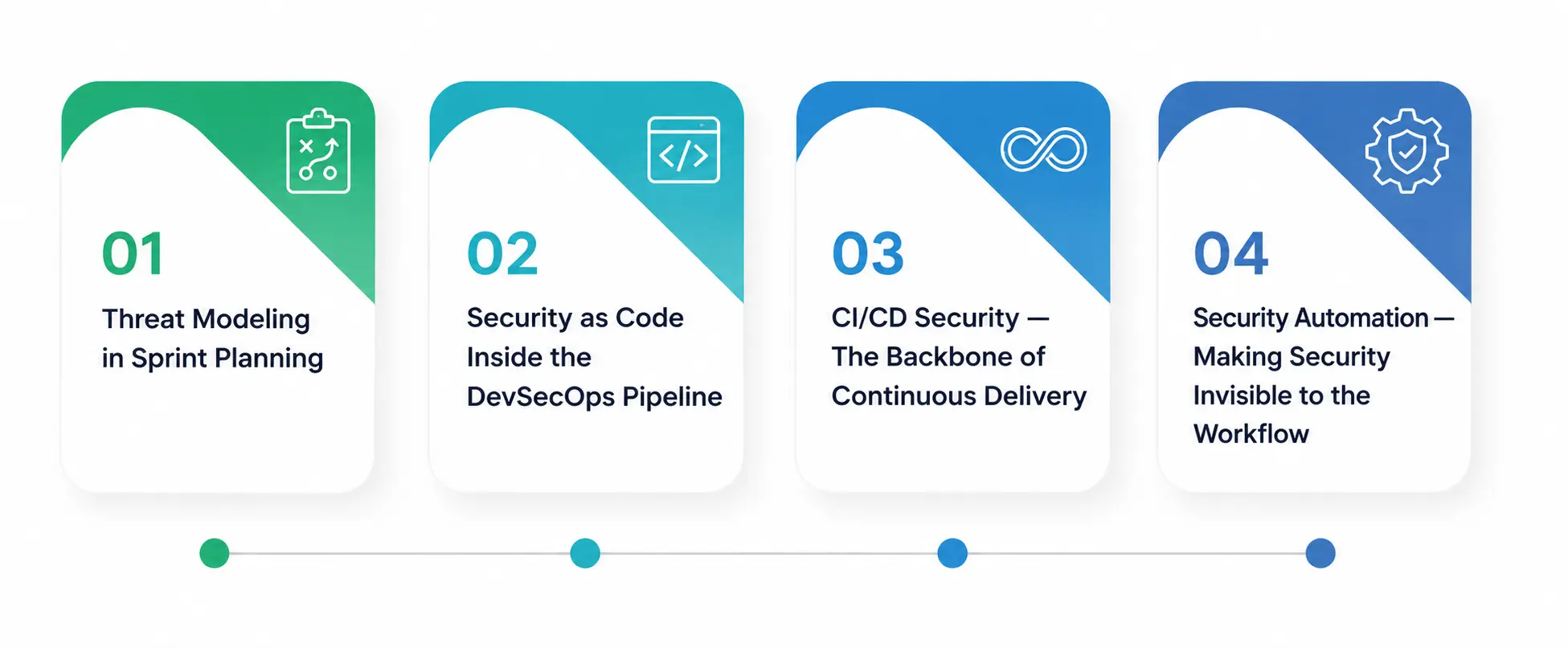
The reason Agile DevSecOps works as a combination is that both frameworks share a foundational philosophy: short feedback loops, continuous improvement, and cross-functional collaboration. Agile already broke down the walls between product, design, and engineering. DevSecOps Integration extends that same logic to security.
Here is what that looks like in practice across the key stages of an Agile sprint:
1. Threat Modeling in Sprint Planning
Most teams associate threat modeling with a once-a-year security audit. In a mature Agile DevSecOps environment, it happens at the start of every sprint where a new feature or integration is being built. Before a developer writes a single line of code for a new payment flow or authentication change, the team asks, “What could go wrong here?” Who might attack this, and how?
Integrating Threat Modeling into Agile sprints — particularly before building new microservices, APIs, or third-party integrations — ensures teams catch design-level vulnerabilities before they are embedded in code that is difficult to refactor. Tools like OWASP Threat Dragon and Microsoft’s Threat Modeling Tool make this accessible even for teams without dedicated security engineers. Threat modeling done well at sprint planning can prevent entire classes of vulnerability from ever entering the codebase. That is the real power of the shift-left approach.
2. Security as Code Inside the DevSecOps Pipeline
One of the most important concepts in modern DevSecOps integration is security as code—the idea that security policies, rules, and checks should be written as code and stored in version control alongside the application code itself. Instead of a security engineer manually reviewing each release, the DevSecOps pipeline executes those security rules automatically on every commit, every pull request, and every build. 96% of organizations said they would benefit from automating security and compliance processes—which is the foundational promise of security as code and a core principle of the DevSecOps pipeline.
Security as code also means that when your security standards change—say, a new regulatory requirement arrives—you update the code once and every pipeline inherits that standard automatically. No spreadsheet, no memo, no hoping that every team saw the update. This approach makes agile security practices genuinely scalable across large engineering organizations.
3. CI/CD Security — The Backbone of Continuous Delivery
CI/CD security refers to embedding security scanning and validation directly into the continuous integration and continuous deployment pipeline—the automated system that takes code from a developer’s laptop to production. Without CI/CD security, the pipeline is a fast road with no guardrails. Mature DevSecOps programs that embed CI/CD security properly reduce production vulnerabilities by 60% and remediation cost by 90%, while actually accelerating release velocity rather than slowing it.
The tools that power CI/CD security include the following:
- SAST (Static Application Security Testing): Scans source code for known vulnerability patterns before the code is ever run.
- DAST (Dynamic Application Security Testing): Tests the running application the way an attacker would — from the outside.
- SCA (Software Composition Analysis): Checks every open-source library and dependency for known vulnerabilities.
- IaC Security Scanning: Checks infrastructure configuration files (Terraform, Kubernetes YAML) for misconfigurations before they are deployed.
In 2026, roughly 80% of a modern application’s code comes from third-party libraries and open-source packages, creating a massive supply chain risk that CI/CD security tools like Snyk or OWASP Dependency-Check are specifically designed to address.
4. Security Automation — Making Security Invisible to the Workflow
The only way security can genuinely keep pace with agile delivery is through security automation. Manual security reviews create bottlenecks. They introduce inconsistency. And in a team shipping dozens of pull requests a day, they simply cannot scale. 75% of organizations currently use or plan to use AI, ML, or bots for code review and security automation—up from 41% in prior years—as teams recognize that automated security feedback is the only realistic option for high-velocity delivery.
Security automation does not replace human judgment. A security engineer still needs to triage findings, investigate false positives, and make strategic decisions about risk. But security automation handles the repeatable, pattern-based checks that would otherwise consume hours of manual review time, freeing security professionals to focus on the genuinely complex problems that require human expertise.
The Secure SDLC: A Stage-by-Stage View
The secure SDLC is not a single tool or a single moment—it is a commitment to applying security thinking at every phase of how software is built. Here is what that looks like across the standard development lifecycle:
|
SDLC Phase |
Agile Security Practices Applied |
Key Tool / Technique |
|
Planning / Sprint Grooming |
Threat Modeling, security user stories, risk assessment |
OWASP Threat Dragon, Miro |
|
Coding |
Secure coding standards, IDE security plugins, pre-commit hooks |
Semgrep, SonarLint |
|
Build / CI |
SAST scanning, Security as Code policy checks, secrets detection |
Checkmarx, Snyk Code, GitLeaks |
|
Test |
DAST scanning, SCA, API security testing, fuzz testing |
OWASP ZAP, Burp Suite, Trivy |
|
Deploy |
IaC security, container scanning, infrastructure compliance |
Checkov, Aqua Security, Wiz |
|
Monitor / Operate |
Runtime protection, anomaly detection, compliance dashboards |
Datadog, Wazuh, AWS Security Hub |
Each row in this table represents an opportunity where the DevSecOps pipeline catches a vulnerability that would otherwise travel downstream—where it is exponentially more expensive to fix.
Source: Total Shift Left — Shift Left Security 2026 | DevSecOps School — Shift Left Tutorial
What the 2026 Numbers Actually Tell Us?
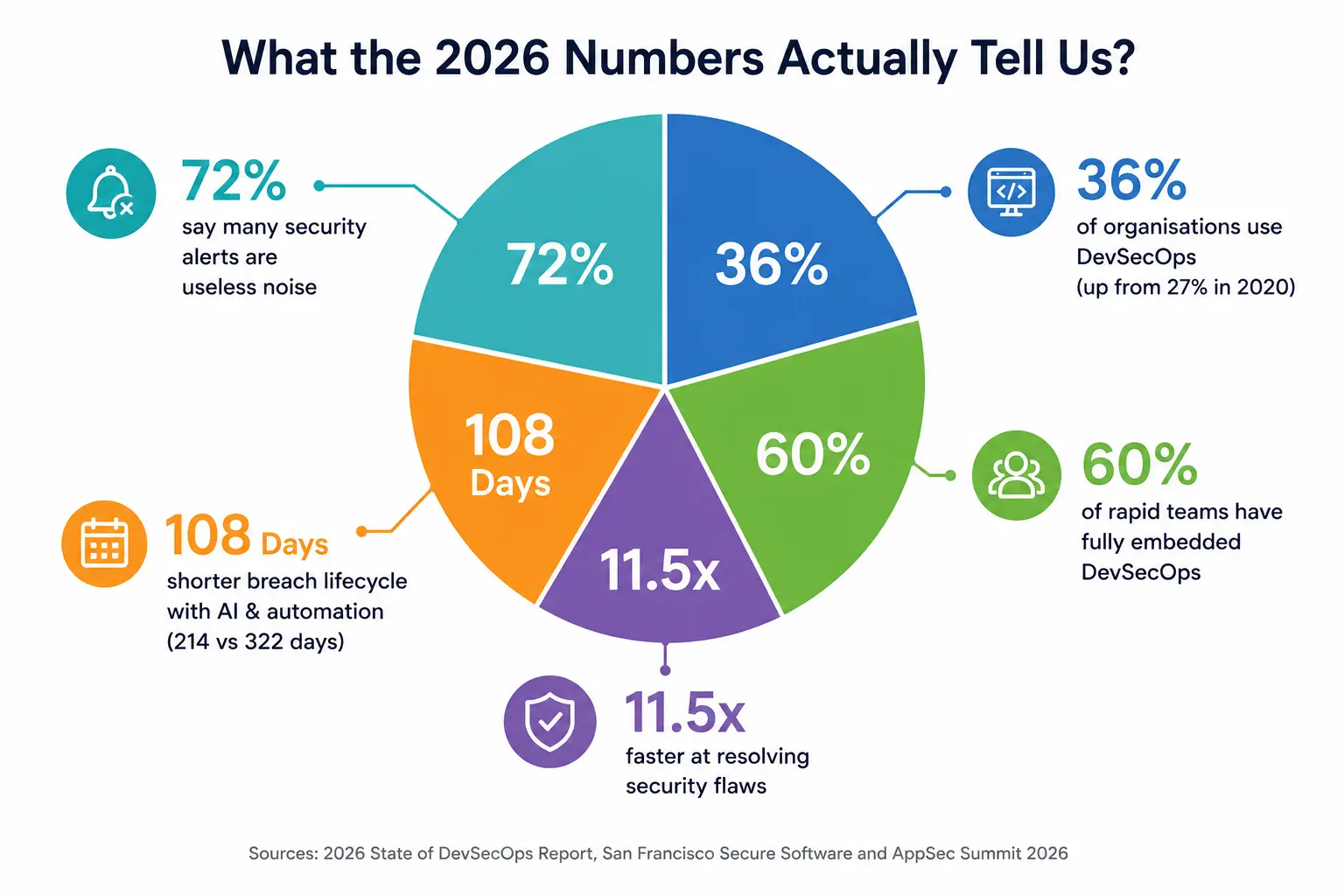
The data from 2026 removes any remaining doubt about whether DevSecOps integration is optional:
- 36% of organizations now develop software using DevSecOps—up from 27% in 2020—and 60% of rapid development teams have fully embedded the practices.
- Organizations adopting DevSecOps reduced their mean time to remediation (MTTR) by up to 60% compared to traditional models, according to a 2026 study from the San Francisco Secure Software and AppSec Summit.
- Mature DevSecOps organizations resolve security flaws 11.5 times faster than their counterparts.
- Organizations using AI and security automation had a breach lifecycle 108 days shorter than those without—214 days compared to 322 days.
- 72% of security and software professionals say a significant portion of security alerts are useless noise—making intelligent security automation and proper agile security practices critical to cutting through the clutter.
Sources: Practical DevSecOps 2026 | AppSec Santa Research 2026 | Veritis DevSecOps Statistics | Appfire DevOps Statistics 2026
The Cultural Shift: Why Agile DevSecOps Is Not Just a Tool Problem
I want to return to something personal here, because the data only tells part of the story.
Every team I have worked with that struggled with DevSecOps integration had the same root problem: security was treated as someone else’s job. Developers thought it was the security team’s responsibility. The security team thought developers should write safe code. Operations thought both of them should sort it out before deployment. Nobody owned it completely, so it fell through the cracks between all three.
Agile DevSecOps fixes this by creating shared accountability. When security is embedded into sprint ceremonies — when a security finding blocks a pull request just like a failing unit test does — it becomes part of the engineering culture, not a separate department’s concern. In 2026, leading organizations are moving toward what practitioners call “governed agility,” where continuous delivery includes continuous assurance—developer velocity is measured not just by speed but by security posture integrity.
That is the cultural transformation that underpins everything else.
DevSecOps Integration vs. Traditional DevOps: A Direct Comparison
|
Dimension |
Traditional DevOps |
DevSecOps Integration |
|
Security timing |
Post-development gate |
Embedded throughout Secure SDLC |
|
Responsibility |
Security team only |
Shared across Dev, Sec, Ops |
|
Vulnerability detection |
Late-stage or post-breach |
Caught at code commit |
|
Compliance |
Manual audit cycles |
Security as Code — always current |
|
Release confidence |
Low (security unknown until late) |
High (pipeline validates continuously) |
|
Remediation speed |
Weeks to months |
Hours to days |
|
Breach cost impact |
Full exposure |
Up to $1.7M lower per incident |
Source: dasroot.net — DevSecOps vs Traditional DevOps 2026
Common Pitfalls When Implementing Agile Security Practices
Not every DevSecOps integration journey goes smoothly. Here are the mistakes I see most often and how to avoid them:
- Tool sprawl without strategy: Teams buy five scanning tools, integrate none of them properly, and end up with thousands of alerts that nobody reads. Start with one tool per category and integrate it properly before adding more.
- Skipping threat modeling because it feels slow: Teams under sprint pressure skip threat modeling to save an hour. They then spend three sprints fixing a design-level vulnerability that threat modeling would have caught in thirty minutes.
- Treating security automation as a one-time setup: Security rules need to evolve as your application grows. A pipeline configured in January will be outdated by June if nobody maintains the ruleset.
- Ignoring the cultural side: The best CI/CD security tools in the world will not help if developers disable the checks because they feel blocked. Security must be positioned as a teammate, not a gatekeeper.
Conclusion: DevSecOps Integration Is Now the Standard, Not the Exception
The evidence from 2026 is unambiguous. DevSecOps integration is no longer an advanced capability that only large enterprises pursue—it is the baseline expectation for any team that ships software at meaningful speed and scale. The DevSecOps Pipeline, powered by Security Automation and Security as Code, makes it possible to deliver fast without compromising on security. Threat modeling at the sprint level, CI/CD security across every commit, and a genuine secure SDLC culture are the components that turn aspiration into outcome.
From my own experience, the teams that have embraced Agile DevSecOps are not slower. They are calmer. They release on Fridays without dread. They spend less time firefighting and more time building. That is what DevSecOps integration actually delivers—not just fewer breaches, but a better way of working.
If your team is still treating security as an afterthought, 2026 is the year to change that. The tools exist, the frameworks are proven, and the data makes the cost of inaction very clear.