

Here’s what most blogs won’t tell you: AWS retired its Data Analytics Specialty exam on April 9, 2024, and replaced it with something deliberately harder. The AWS Certified Data Engineer exam doesn’t test whether you can name what a service does. It tests whether you can make the right call when three services could technically work, but only one makes sense given your cost, latency, and scale constraints. That gap is the real reason most first attempts fall short.
Every company chasing AI initiatives, real-time analytics, or basic reporting dashboards needs someone who can move data reliably and prove they know how. That’s exactly what the AWS Certified Data Engineer credential validates. According to AWS’s own exam guide, that means implementing, monitoring, and optimizing complete production pipelines, not just describing individual services.
I’ve seen candidates waste months studying for the wrong exam entirely. If you’ve started researching the AWS data engineer certification, you’ve probably hit the same confusion: outdated forum threads, retired exam codes, and course providers using “data analytics” and “data engineering” interchangeably. This guide cuts through all of that: what the DEA-C01 exam covers in 2027, what it costs, how hard it is, and how to prepare based on your background.
What Is the AWS Certified Data Engineer – Associate Certification?
The AWS Certified Data Engineer – Associate (exam code DEA-C01) validates your ability to build, operate, and secure data pipelines on AWS. It launched in March 2024 and replaced the older AWS Data Analytics Specialty, and the change in name wasn’t cosmetic. The retired exam leaned toward analytics tooling and business intelligence outputs. The DEA-C01 exam leans toward the engineering work that happens before any dashboard gets built: ingestion, transformation, orchestration, storage design, security, and pipeline reliability.
According to AWS’s own exam guide, the certification validates a candidate’s ability to implement data pipelines and to monitor, troubleshoot, and optimize cost and performance issues in line with best practices. In practical terms, the exam expects you to think like someone who owns a production pipeline, not someone who can only describe what a service does.
This matters if you’re choosing between certification paths. If your daily work (or target job) is SQL, BI tools, and dashboards, the old data analytics skill set still applies conceptually, but the current credential to pursue is the AWS Certified Data Engineer Associate. If your work involves building the pipelines that feed those dashboards, this is unambiguously the right exam.
Who Should Take the AWS Data Engineer Certification?
AWS designed the DEA-C01 exam for a fairly specific candidate, and being honest about that profile will save you wasted study time. The ideal candidate has roughly 2–3 years of data engineering or data architecture experience, plus 1–2 years of hands-on AWS experience. There are no formal prerequisites, but this is not a beginner-friendly exam the way Cloud Practitioner is. It assumes you already understand ETL concepts, schema design, and basic distributed-systems thinking.
Honestly, when I look at who actually passes, it’s rarely the person with the “perfect” background. It’s the person who has spent time building real data pipelines. “Ideal candidate” doesn’t mean “only candidate”: three groups consistently succeed with focused preparation.
- Career changers from software development or database administration, who understand programming and relational data but need to map that onto AWS-specific services.
- IT professionals adjacent to data teams (DevOps engineers, sysadmins, and BI analysts) who want a credential employers recognize immediately.
- Students and early-career professionals willing to build hands-on labs rather than rely on theory alone. Slower, but far from impossible with deliberate practice.
If you’re newer to AWS, pairing structured instruction with lab time tends to compress the learning curve significantly compared to self-study alone. That’s one reason cohort-based programs exist: they front-load the hands-on practice that self-taught candidates often skip until it’s too late. You can sanity-check any course’s curriculum against the official AWS exam guide to confirm it maps to what’s tested.
DEA-C01 Exam Format, Passing Score, and Domains
|
Exam detail |
DEA-C01 |
|---|---|
|
Questions |
65 (multiple choice and multiple response) |
|
Time |
130 minutes |
|
Passing score |
720 on a scaled range of 100–1,000 |
|
Cost |
$150 (approx. ₹15,600 in India incl. 18% GST) |
|
Validity |
3 years |
|
Prerequisites |
None (2–3 years of data engineering experience recommended) |
AWS uses a compensatory scoring model, so you don’t need to pass every domain individually. Strong performance in one area can offset a weaker one, as long as your overall score clears 720.
Here’s how the content breaks down, based on AWS’s published exam guide:
| Domain | Weight | What It Really Tests |
|---|---|---|
|
Data Ingestion and Transformation |
34% |
Building ETL/ELT jobs, streaming ingestion, applying programming logic to pipelines |
|
Data Store Management |
26% |
Choosing the right storage service, schema design, data lifecycle policies |
|
Data Operations and Support |
22% |
Monitoring, troubleshooting, orchestration, and data quality checks |
|
Data Security and Governance |
18% |
Encryption, access control, logging, and data privacy |
The heaviest domain, over a third of your score, is ingestion and transformation. This is where AWS Glue and Amazon Kinesis live, and it’s where most candidates underestimate the depth required. AWS isn’t asking, “What does AWS Glue do?” It’s asking you to pick the right transformation approach for a given latency, cost, and data-volume scenario and whether Amazon Redshift or a data lake pattern is the better destination.
AWS also refreshes exam guides as services evolve; recent updates reportedly add AI-related data skills such as preparing data for LLM and vector-search workloads. Always check the current DEA-C01 exam guide before you finalize your study plan.
AWS Services You Need to Master for the DEA-C01 Exam
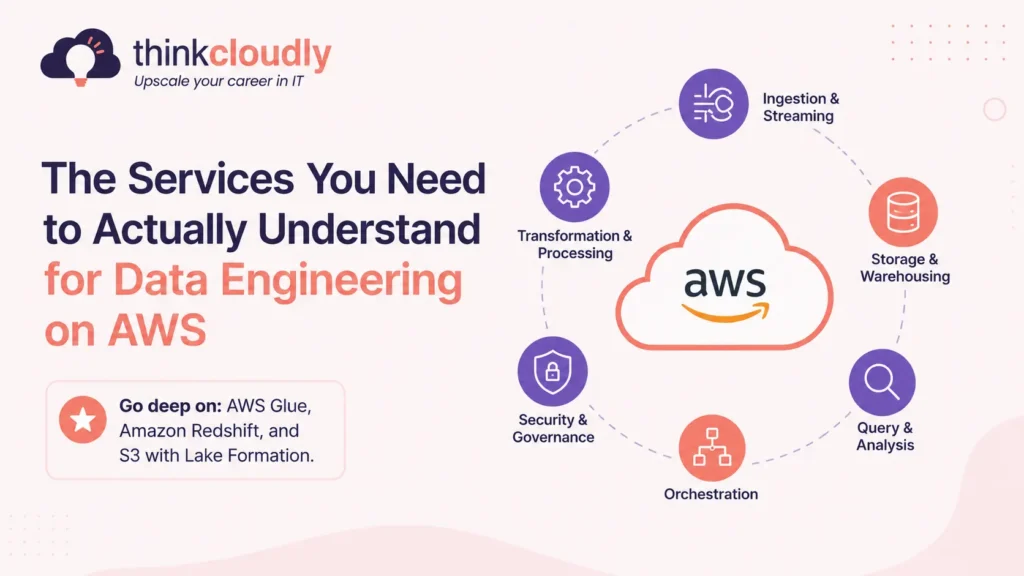
A lot of exam prep content lists every AWS service under the sun and calls it “comprehensive.” That wastes your time. Based on the exam guide’s in-scope services, here’s where your study hours belong.
Ingestion and streaming: Amazon Kinesis Data Streams, Amazon Data Firehose (formerly Kinesis Data Firehose), Amazon MSK, and AWS Database Migration Service for moving data from existing systems into AWS.
Transformation and processing: AWS Glue is the centerpiece: Glue jobs, Glue Studio, the Glue Data Catalog, and Glue crawlers all show up repeatedly. Amazon EMR appears for big data processing where you need more control than Glue offers. Knowing when to recommend Glue versus EMR versus Lambda for a transformation job is a recurring exam pattern, not a one-off question.
Storage and warehousing: Amazon Redshift anchors most analytical storage questions. You’ll need its architecture (leader and compute nodes), distribution styles, sort keys, and when Redshift Spectrum makes more sense than loading data directly. Amazon S3 underpins almost every data lake scenario, often paired with Lake Formation for fine-grained access control.
Query and analysis: Amazon Athena for serverless SQL directly against S3, plus QuickSight when visualization enters the picture.
Orchestration: Step Functions and Amazon Managed Workflows for Apache Airflow (MWAA) both appear for pipeline coordination. Know the trade-offs between a lightweight Step Functions workflow and a full Airflow DAG.
Security and governance: KMS for encryption, IAM for access policies, and CloudTrail and CloudWatch for auditing and monitoring pipeline health.
If you only have time to go deep on three services before your exam date, make them AWS Glue, Amazon Redshift, and S3 with Lake Formation. They show up across nearly every domain. Thinkcloudly’s AWS Data Engineering course is structured around this exact priority order, so you’re not guessing which services deserve the most lab time.
AWS Data Analytics Certification vs. AWS Data Engineer Certification
This is the question I get asked most, so it deserves its own section. Search for “AWS Data Analytics certification” and you’ll land on years of old content describing an exam AWS no longer offers. The Data Analytics Specialty (DAS-C01) was retired on April 9, 2024.
The legacy exam tested whether you could choose the right analytics service for a business question: which tool for a dashboard, how to query a data lake, and how to visualize results. It assumed someone else had already built the pipeline. The DEA-C01 exam assumes the opposite: you’re the one building, securing and running that pipeline.
If your resume says “data analyst” and you’re chasing the old analytics certification because that’s the term you grew up studying, know that AWS has moved on. The skills overlap (SQL, Amazon Redshift, and schema design), but the depth expected differs. Prepping with the old analytics mindset will leave you underprepared for today’s engineering judgment calls.
A quick gut-check table:
|
If you mostly… |
You probably want |
|---|---|
|
Query data, build dashboards, interpret results |
A BI/analytics-focused skill path |
|
Build pipelines, manage Amazon Redshift clusters, write AWS Glue ETL jobs |
The AWS Data Engineer certification (DEA-C01) |
|
Do both, or want to grow from one into the other? |
Start with the engineering path; it’s broader and more current. |
That last row matters most. If you’re unsure which side you fall on, the engineering path is the safer long-term bet. It’s the credential AWS actively maintains today, while the old analytics exam is now just legacy context.
How Hard Is the AWS Data Engineer Exam?
Most associate-level AWS exams test whether you know what a service does. The DEA-C01 exam frequently tests whether you know what to do when three services could technically solve the same problem, but only one is right given specific constraints on cost, latency or data volume.
A typical scenario might describe a company ingesting clickstream data at high velocity, needing near-real-time dashboards, on a tight budget. The correct answer isn’t necessarily the most powerful service. It’s the one that balances throughput, overhead and spend the way a senior data engineer would. That’s why real experience matters and why purely theoretical study tends to produce mediocre results. I’ll be blunt: if you’ve only watched videos and never configured an AWS Glue job yourself, you will struggle on exam day. Not because you’re not smart, but because this exam is designed to catch exactly that gap.
There’s also a structural quirk worth knowing: the exam uses short names for some services, with a glossary available through the in-exam Help button. Spend five minutes reviewing that list beforehand so you’re not decoding abbreviations under time pressure.
AWS Data Engineer Study Plan: A Realistic Timeline
Generic advice like “study for six weeks” ignores how different everyone’s starting point is. Here’s a more honest framework:
| Background | Recommended Prep Time | Primary Focus |
|---|---|---|
| Active data engineer, AWS-adjacent role | 4–6 weeks | Service-specific exam patterns, practice questions, weak-domain review |
|
Strong IT background, new to AWS data services |
8–10 weeks |
Hands-on labs with Glue, Redshift and S3, then exam-pattern practice |
|
Career changer or student, building from fundamentals |
12–16 weeks |
ETL fundamentals, SQL fluency, then AWS-specific implementation |
Whichever bucket you fall into, the sequencing matters more than the total hours. Learn the concept, build it in an AWS Free Tier account, then test yourself with scenario-based DEA-C01 practice questions. Skipping the middle step (actually building an AWS Glue job or loading an Amazon Redshift cluster yourself) is the most common reason capable candidates fail on their first attempt.
This is where structured programs earn their keep. Thinkcloudly’s AWS Data Engineering training follows that exact sequence: instructor-led sessions paired with hands-on labs across Redshift, Glue, EMR, Athena and pipeline orchestration. If you’ve struggled to stay consistent with self-study, a cohort and a deadline can be the difference between “someday” and an actual exam date.
AWS Data Engineer Certification Cost in 2027
Pricing is one area where outdated blog posts cause real confusion. As of 2027, the fee structure is straightforward and confirmed through AWS’s certification FAQ: foundational exams cost $100; associate-level exams, including the AWS Certified Data Engineer, cost $150; and professional or specialty exams cost $300. In India, the fee is billed in rupees with 18% GST added, so the DEA-C01 exam costs roughly ₹15,600.
Two cost-saving details are easy to miss. First, once you pass any AWS certification, you get a 50% discount voucher for your next exam, valid for one year. Second, if you fail, you must wait 14 calendar days before retaking and pay the full fee again; there’s no free resit. Budgeting for one possible retake ($300 total) is more realistic than assuming a first-try pass.
The certification is valid for three years, after which you’ll need to pass the current exam version again, or a qualifying higher-level exam, to recertify.
Is the AWS Data Engineer Certification Worth It in 2027?
Here’s an honest take most certification blogs avoid: the AWS Certified Data Engineer badge alone doesn’t get you hired. What it does is solve a specific problem for hiring managers. It lets them filter candidates without spending hours probing for baseline competency in an interview. For a data engineering role, where production pipeline mistakes are expensive and hard to reverse, that signal carries real weight.
Demand for this skill set has grown steadily through 2025 and into 2027, driven by the same forces pushing AI adoption. Organizations need clean, well-governed data pipelines on AWS before any machine learning or generative AI initiative can succeed. A data engineer who can build and secure those pipelines (Amazon Redshift for the analytical layer, AWS Glue for transformation, proper governance throughout) sits at the center of that demand. This is exactly the profile employers mean when a job posting lists the AWS data engineer certification as a requirement.
If you’re early in your career, pairing the certification with one portfolio project (a real, end-to-end pipeline you built and can explain) does more for your job search than the certification alone. Employers increasingly ask candidates to walk through design decisions, not recite what a service does. Building that first pipeline is far easier inside a guided course: explore the AWS data engineering course curriculum if you want a head start on a portfolio-ready project.
Common DEA-C01 Exam Mistakes
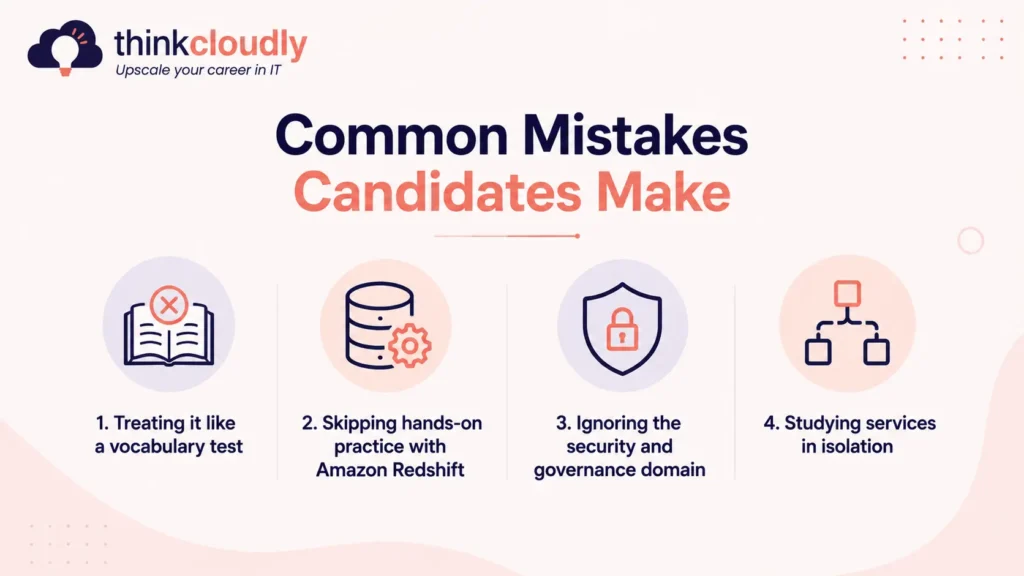
A few patterns show up repeatedly among people who don’t pass on their first attempt:
- Treating it like a vocabulary test. Knowing that AWS Glue “does ETL” isn’t the same as knowing when Glue is the wrong choice. The exam tests judgment, not recall.
- Skipping hands-on practice with Amazon Redshift. Redshift questions often hinge on architectural details (distribution keys, sort keys, workload management) that you can’t memorize from a slide deck. You need to have configured a cluster yourself.
- Ignoring the security and governance domain. At 18%, it’s the smallest domain, but candidates consistently under-prepare for it and lose points they didn’t need to lose.
- Studying services in isolation. Real exam scenarios combine ingestion, storage and orchestration in one question. Practice connecting services into end-to-end pipelines.
Your Next Step
The AWS Certified Data Engineer credential rewards people who’ve actually built things, not just read about them. From a strong data or IT background, a focused 6–10 week sprint with consistent lab time is realistic. If you’re newer to the field, give yourself the runway to build fundamentals first; rushing this exam tends to backfire.
Whichever path fits you, the fastest way to close the gap between “I understand the concepts” and “I can pass the DEA-C01 exam” is structured, hands-on practice with the services that matter: AWS Glue, Amazon Redshift, S3, and the orchestration tools that tie them together. Review the task statements yourself in the official DEA-C01 exam guide before you commit to a study plan. If you’d rather not piece that structure together alone, Thinkcloudly’s AWS Data Engineering training course was built around this exam’s domains, with hands-on labs instead of passive lectures.