Two years ago, listing “AI” on your resume made you stand out. Hiring managers leaned forward. Recruiters took notice. It was a signal that you were ahead of the curve.
Today, not having it on your resume is starting to raise questions.
Between 2023 and 2025, the number of job postings requiring AI-related skills jumped from roughly 1 million globally to over 7 million, according to LinkedIn Economic Graph data backed by World Economic Forum analysis. That is not a trend. That is a restructuring. And restructurings do not wait for people to catch up before they happen.
Here is what most coverage of this story gets wrong: the assumption that all those new jobs went to software engineers and data scientists. A significant chunk of them did not. They went to lawyers who understood accountability. To operations managers who could spot a broken process. To finance professionals who knew how to connect technology decisions to business outcomes. To policy specialists who could read a regulation and translate it into something an engineering team could act on.
People who never once called themselves tech professionals are walking into some of the fastest-growing, best-compensated roles in the current job market. This blog explains exactly how that happened, what roles are driving it, and what it means for anyone deciding whether now is the right time to make a move.
What Drove the Numbers?
The seven-fold jump in AI jobs was not a hiring spree driven by enthusiasm. It was a logical consequence of what happened when AI stopped being a pilot project and started being something hospitals, banks, retailers, and government agencies actually depended on to function.
Think about what it takes to keep an AI system running inside a major hospital. Someone needs to monitor its outputs and catch the cases where it flags the wrong thing. Someone needs to make sure the infrastructure it runs on is secure. Someone needs to be able to explain to a regulator, in plain language, how the system made a specific clinical recommendation and what checks were in place to catch errors. None of those jobs are filled by the team that built the AI. They required a different set of people with a different set of skills, and by 2025, every major AI deployment was discovering that it needed all of them.
Three forces drove the numbers beyond what anyone had projected.
Laws created jobs. The EU AI Act is the clearest example. It came into force in 2024 and legally required organizations using high-risk AI to do specific things: conduct conformity assessments, keep complete audit trails, and designate individuals who are personally accountable for AI oversight. Those are not vague aspirational requirements. They are concrete obligations that need real people to fulfill them. The United States, the United Kingdom, and governments across the Asia-Pacific are building comparable frameworks. Each one adds to the demand for people who did not have a job title three years ago.
The threat changed, not just the scale. For most of the history of cybersecurity, defending systems meant understanding what attackers had done before and building protection against it. That model got significantly harder when attackers started using AI. Personalized phishing at scale. Malware that mutates mid-deployment. Network probes running continuously without anyone having to manually operate them. Defending against these techniques requires security professionals who understand how AI-driven attacks work, not just how to block the ones that came before. According to ISC2’s Cybersecurity Workforce Study 2024, the global security workforce shortfall sits at roughly 4 million positions, and the AI-specialized roles within that gap are the ones growing fastest.
Data became load-bearing. Every AI system is built on data. The organizations that figured this out early started treating their data pipelines, governance processes, and privacy frameworks as strategic assets rather than administrative overhead. The ones that did not found their AI systems producing unreliable outputs and creating compliance exposure they had not anticipated. That realization elevated data roles from back-office functions into priorities that now attract executive attention and competitive salaries. Five years ago, a data governance specialist was a relatively quiet role. In 2025, it is one of the most actively recruited positions in enterprise technology.
Where is the Growth Concentrated?
The seven-fold increase is not evenly distributed across all technology roles. It is concentrated in specific areas where demand is outrunning supply by significant margins.
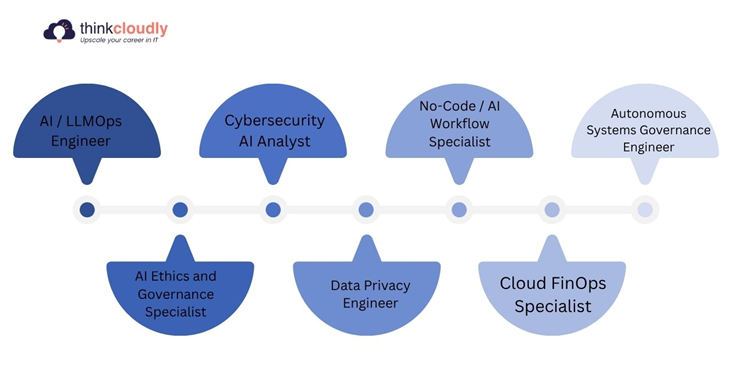
The growth isn’t spread evenly. Seven specific roles are pulling the numbers, each growing at rates that would have seemed implausible in 2022, each underfilled relative to demand, and each accessible without a traditional computer science degree.
|
Role |
Growth 2023-2025 |
Avg. Entry Salary (US) |
Degree Required? |
|
AI / LLMOps Engineer |
+380% |
$95,000 – $130,000 |
No, portfolio matters more |
|
AI Ethics and Governance Specialist |
+340% |
$95,000 – $140,000 |
No-law/policy backgrounds valued |
|
Cybersecurity AI Analyst |
+290% |
$80,000 – $110,000 |
No, certifications carry weight |
|
Data Privacy Engineer |
+310% |
$90,000 – $120,000 |
No, demonstrated skill valued |
|
No-Code / AI Workflow Specialist |
+360% |
$65,000 – $95,000 |
No, portfolio is everything |
|
Cloud FinOps Specialist |
+320% |
$90,000 – $125,000 |
No, FinOps certification valued |
|
Autonomous Systems Governance Engineer |
+300% |
$100,000 – $135,000 |
Sometimes – regulatory context |
The “Degree Required?” column tells the most important part of the story. In six out of seven roles, the answer is no.
Who Is Actually Getting Hired?
Here is the part of this story that most people covering AI job growth get wrong. They focus on the engineering roles. They talk about machine learning engineers and data scientists and LLMOps specialists. Those roles are real, and the demand is real. But they represent only part of the picture, and arguably not the most interesting part.
The more surprising story is happening in the adjacent roles, the ones filling up with people who came from law firms, finance departments, operations teams, and policy organizations. People who, two years ago, would not have described themselves as technology professionals in any meaningful sense.
AI Ethics and Governance Specialists are a good example. Ask most people who they expect to be filling those roles, and they will say engineers, or maybe academics with a background in computer science. The reality, as the World Economic Forum’s Future of Jobs Report 2025 makes clear, is that organizations are recruiting heavily from legal, philosophy, policy, and social science backgrounds. What they actually need is someone who can think carefully about accountability, hold multiple regulatory frameworks in their head simultaneously, and translate legal obligations into operational practice that engineering teams can follow.
That is not a software skill. It is a professional judgment skill, and it turns out that lawyers, policy analysts, and social scientists have been building it for years without realizing it was becoming valuable in a completely different context.
Data Privacy Engineers tell a similar story. The International Association of Privacy Professionals Privacy Workforce Study 2025 found that the most sought-after candidates are not the ones who are best at writing code or the ones who know data protection law most thoroughly. They are the ones who can do both well enough to make the two sides understand each other. An engineer who can explain why a particular pipeline design creates a GDPR exposure. A compliance specialist who can tell a development team what they need to change and why. That combination is rare, and rare combinations attract premium compensation.
No-Code and AI Workflow Specialists are coming largely from operations and project management backgrounds, which makes intuitive sense once you think about it. Building a good automated workflow is not primarily a technical exercise. It is a process exercise. You need to understand how work actually moves through an organization before you can figure out which parts of it should be automated and how. People who have spent years doing that professionally, in operations roles, in project management, and in business analysis, have a head start that a computer science graduate typically does not.
Cloud FinOps Specialists are perhaps the clearest example of all. The FinOps Foundation State of FinOps 2026 report found that financial literacy, the ability to connect cloud spending decisions to business outcomes and communicate the implications to both engineering and finance leadership, is the differentiating skill in this role. Finance professionals who took the time to understand cloud architecture basics are walking into roles that pay significantly more than anything they left behind.
The common thread connecting all of these is not what most people assume it to be. It is not a technical background. It is the ability to sit comfortably at the boundary between technology and another domain and to communicate clearly in both directions. That skill turns out to be exactly what the fastest-growing segment of the technology job market needs most and exactly what it has the fewest people to supply.
What Happened to Traditional Tech Jobs?
The obvious question about a seven-fold jump in AI jobs is whether it represents genuine net growth or whether new titles are replacing old ones.
The answer is both, and the line between the two is cleaner than most coverage suggests.
Roles built around repetitive, predictable execution have contracted. This includes junior developers doing routine code generation, data analysts running standard reports on fixed schedules, and IT support staff handling the tier-one troubleshooting queries that AI-powered help systems now resolve automatically. These reductions are not primarily a story about cost-cutting decisions. They reflect a genuine reduction in the volume of predictable, pattern-based work that organizations need humans to complete.
Roles requiring judgment, context, or cross-functional thinking have grown. Senior engineers who can architect systems that incorporate AI reliably. Security analysts who can interpret what an AI-generated threat correlation actually means and decide how to respond. Product managers who can connect AI capabilities to real business requirements and navigate the organizational complexity involved in getting that connection made. These roles grew because the work they involve is exactly the kind that automation does not handle well.
The distinction maps onto a simple underlying principle. AI handles predictable patterns efficiently. Humans handle ambiguity, judgment, and context better. The roles that contracted were disproportionately built around predictable patterns. The roles that grew are disproportionately built around judgment and context.
CompTIA’s State of the Tech Workforce 2026 confirms positive net job growth across technology overall. But net positive growth is compatible with significant disruption at the role level, and for people whose skills are concentrated in the categories that contracted, the current market is harder than the overall numbers imply. The opportunity in this moment belongs to people who move deliberately toward the judgment-and-context side of that line, before the talent supply catches up with where demand already is.
What This Means for your Next Move?
The practical implication of a seven-fold increase in AI job postings over two years is that the talent supply has not kept up with demand. Across most of the roles in the table above, qualified candidates are genuinely scarce relative to available positions. That scarcity has consequences for anyone willing to move deliberately toward one of these areas.
First, the barriers to entry are lower than they appear. Skills-based hiring has become standard across most AI-adjacent roles. Certifications, portfolio projects, and demonstrated experience consistently outweigh academic credentials in actual hiring decisions. A candidate who can show a working AI integration, a documented governance framework, or a functioning automation workflow is more competitive than one who can cite coursework.
Second, the learning timelines are more realistic than the complexity of the subject matter suggests. Cloud FinOps certification is achievable in six to eight weeks. No-Code Automation proficiency at a professional level takes three to six months of focused practice. AI Ethics competency sufficient for entry-level roles can be developed in six to twelve months through a combination of regulatory study and practical application.
Third, the compensation premium is real and immediate. Gartner’s research on AI talent market dynamics shows that roles requiring AI-related skills carry an average salary premium of 22 to 30 percent above comparable non-AI positions in the same function. That premium is not projected to diminish as supply catches up, because supply is not catching up at anything close to the rate demand is growing.
Sources and References
- LinkedIn Economic Graph: Jobs on the Rise 2026
- World Economic Forum: Future of Jobs Report 2025
- ISC2: Cybersecurity Workforce Study 2024
- International Association of Privacy Professionals: Privacy Workforce Study 2025
- FinOps Foundation: State of FinOps 2026
- US Bureau of Labour Statistics: Occupational Outlook Handbook – Information Security Analysts
- Stanford Institute for Human-Centered AI: AI Index Report 2026
- Gartner: Top Strategic Technology Trends 2026
- CompTIA: State of the Tech Workforce 2026
- European Commission: EU AI Act Implementation Guide 2024
- GitHub Octoverse Report 2026
- Oxford Internet Institute: Ethical Governance of Autonomous Agents