

Did you know the global cybersecurity workforce gap sat between 3.1 and 3.5 million unfilled roles in 2026, even while ransomware incidents kept climbing to record levels? That single number explains why SOC analyst training has quietly become one of the most practical doors into a stable, well-paid technology career this year.
Whether you’re switching over from IT support, finance, retail management, or the military, or you’re a recent graduate wondering where to even begin, this guide walks through the real courses, the real cost, and the real career outcomes you can expect right now—not recycled statistics from three years ago, treating cyber training as a practical investment rather than an abstract idea.
What Does a SOC Analyst Actually Do?
A Security Operations Center, or SOC, is the nerve center of an organization’s cyber defense. It’s the team that watches networks, endpoints, and cloud systems around the clock, hunting for signs that something has gone wrong. Good SOC analyst training teaches you how to work inside that nerve center: reading SIEM dashboards, triaging alerts, and escalating genuine incidents before an attacker causes real damage.
Salary guides note that SOC analysts play a crucial role in handling cybersecurity attacks, which is exactly why demand for this skill set keeps climbing as breaches grow more frequent and more costly. For many career changers, this is also the fastest realistic entry point into a full-time security career.
Unlike a four-year computer science degree, structured training for this role is built around one goal — getting you job-ready for entry-level cyber jobs within months, not years. A solid program blends theory (networking basics, operating systems, and log analysis) with hands-on labs that mimic real threat detection scenarios, so you graduate with practiced instincts rather than just memorized answers.
You’ll also get an early introduction to vulnerability management, since spotting weaknesses before attackers do is central to the role. That hands-on approach matters, because employers in 2026 are hiring for demonstrated skill and portfolio work over a diploma alone.
Best SOC Analyst Training Programs and Certifications in 2026
There isn’t one single path into this field, and that’s actually good news for anyone chasing today’s cyber jobs. Depending on your budget, timeline, and learning style, you can choose from several legitimate routes:
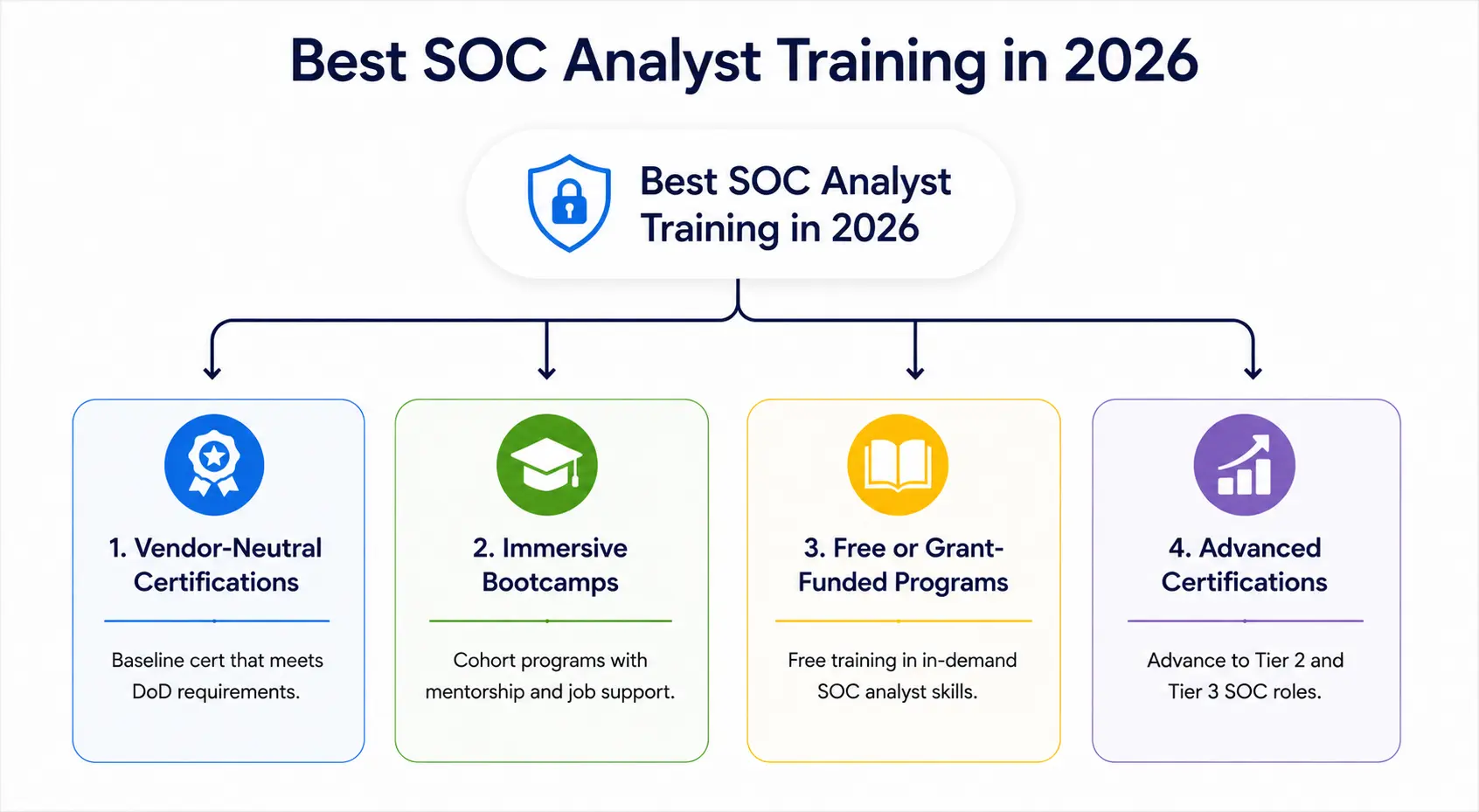
- Vendor-neutral certifications such as CompTIA Security+ remain the baseline most employers look for, and it’s also the credential that satisfies DoD 8570/8140 requirements for government and defense contracting roles.
- Immersive cybersecurity bootcamps like Springboard, Flatiron School, and Fullstack Academy compress six to twelve months of learning into focused, cohort-based programs with mentorship and job-search support.
- Free or grant-funded programs, including Per Scholas and CISA’s National Cyber Security Training Academy bootcamp, which teach threat detection, log analysis, and SIEM tools at little to no cost to qualifying learners.
- Advanced certifications such as CySA+ or GIAC’s GSOC, which build on Security+ and push you toward Tier 2 and Tier 3 cyber defense responsibilities.
Whichever path you pick, look for a program that includes a live SIEM lab (Splunk, QRadar, or Microsoft Sentinel), guided incident-response exercises, and interview coaching — theory alone won’t get you hired in a market this competitive.
Choosing between an employer-sponsored track, a paid bootcamp, and a free program often comes down to timing. MSSPs hire heavily from grant-funded cyber training pipelines needing round-the-clock Tier 1 coverage, while in-house cyber defense teams at banks and healthcare systems prefer candidates who’ve already completed a recognized security certification. Either route can lead to solid cyber jobs, but research placement data before committing tuition money.
SOC Analyst Training Cost: What You’ll Actually Pay in 2026
Cost is where most people get confused, because pricing swings wildly depending on the format you choose. Here’s an honest breakdown based on current 2026 market pricing.
|
Training Path |
Typical 2026 Cost | Duration |
Best For |
|
CompTIA Security+ exam only |
$425–$439 | 2–4 months self-study |
Budget-conscious beginners |
|
Security+ with structured course |
$700–$1,200 | 2–4 months |
First-timers wanting higher pass odds |
|
Grant-funded bootcamp (e.g., Per Scholas) |
Free (income-eligible) | 12–15 weeks |
Career changers with financial constraints |
|
Mid-tier bootcamp (Springboard, Nucamp) |
$2,100–$9,900 | 12–26 weeks |
Structured, mentor-backed learning |
|
Premium bootcamp (Flatiron, Fullstack) |
$14,995–$19,500 | 15–26 weeks |
Full-time, high-touch career support |
|
CySA+ / GIAC GSOC (advanced) |
$500–$2,000+ | 2–3 months |
Analysts moving to Tier 2/3 |
A single CompTIA Security+ voucher runs $425 to $439 in 2026, and most self-study candidates land a total certification cost between $600 and $1,000 once study materials are added. If you’d rather have a structured curriculum and job-placement support, bootcamps average roughly $10,600, a fraction of the $40,000-plus a four-year degree usually demands, and placement rates in the credible programs cluster between 70% and 85% within twelve months of graduation as per Hakia 2026 data. If tuition is a genuine barrier, don’t overlook grant-funded options — some cover the entire cost for income-eligible applicants and still include certification vouchers and hands-on SOC simulation that mirrors real cyber defense workflows. Programs that dedicate real lab hours to vulnerability management tend to show stronger Tier 2 placement outcomes than those that only cover theory.
Core Skills You’ll Build During Quality Cyber Training
A good program does more than prepare you for one exam. It builds a working toolkit you’ll rely on for years. Here’s what that typically covers, broken into the areas that matter most for hiring managers, since quality cyber training builds these skills in tandem rather than in isolation.
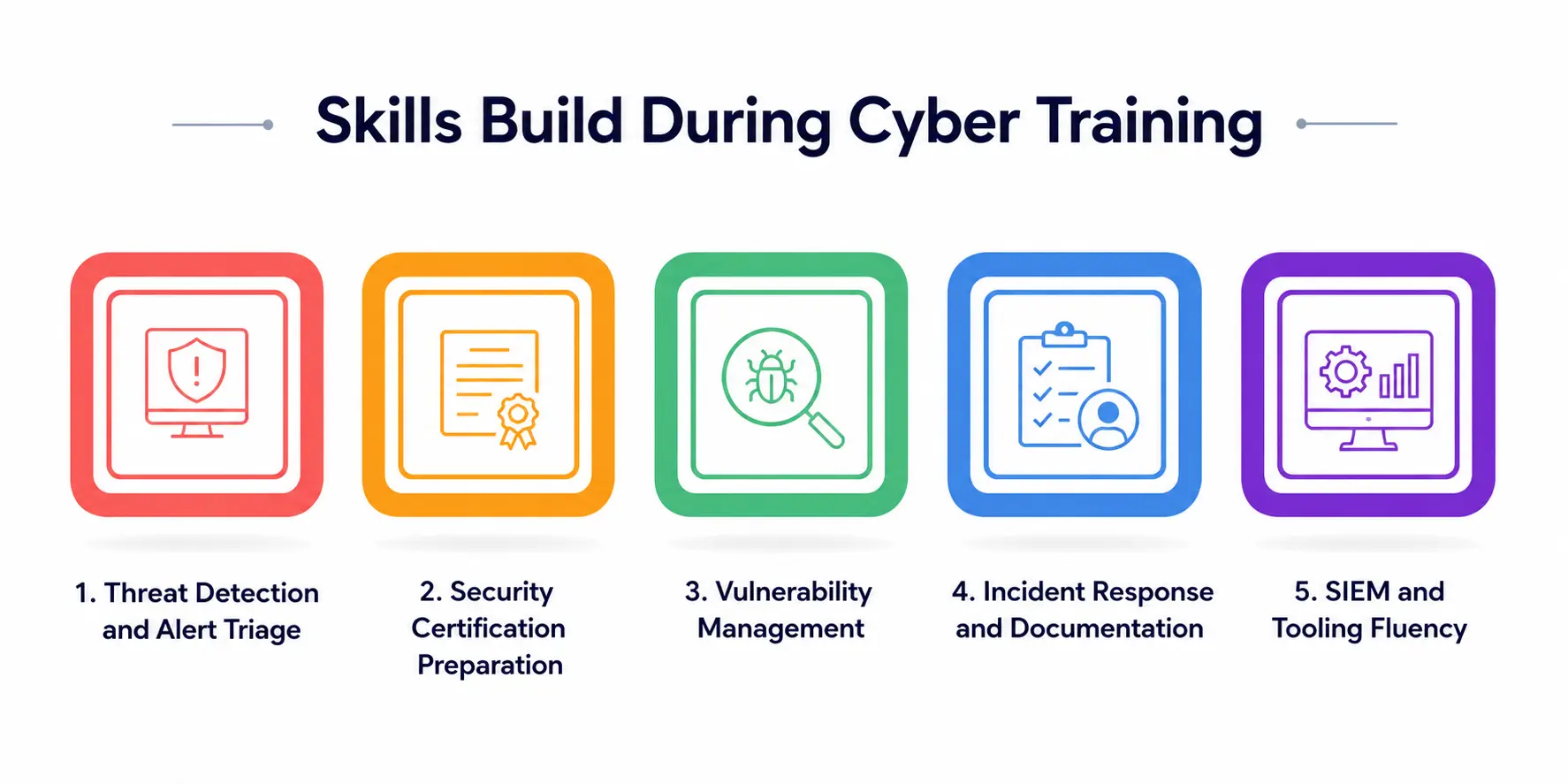
1. Threat Detection and Alert Triage
This is the daily bread of Tier 1 work—learning to separate genuine threat detection findings from the noise of false positives inside a SIEM platform, then deciding what deserves escalation. It’s a core threat detection judgment call you’ll make dozens of times a shift, and it only sharpens with repetition.
2. Security Certification Preparation
Most programs build toward at least one recognized security certification, since certified analysts report earning meaningfully more than uncertified peers doing the same job.
3. Vulnerability Management
You’ll learn to scan environments, prioritize findings by real-world exploitability, and communicate risk to non-technical stakeholders—a skill that separates analysts from those who just run tools. Employers filling cyber jobs increasingly test this directly, asking candidates to walk through a real vulnerability management backlog during the interview.
4. Incident Response and Documentation
Detecting an incident is only half the job; you also learn to contain it, document the timeline, and hand off clean reports that support both remediation and compliance audits.
5. SIEM and Tooling Fluency
Hands-on time with Splunk, Microsoft Sentinel, or QRadar turns theoretical knowledge into muscle memory you can demonstrate in an interview.
SOC Analyst Career Path and Salary in 2026
Once training is behind you, the career path is refreshingly linear compared to many tech fields. Most professionals move through four recognizable tiers, and pay tends to rise meaningfully at each step.
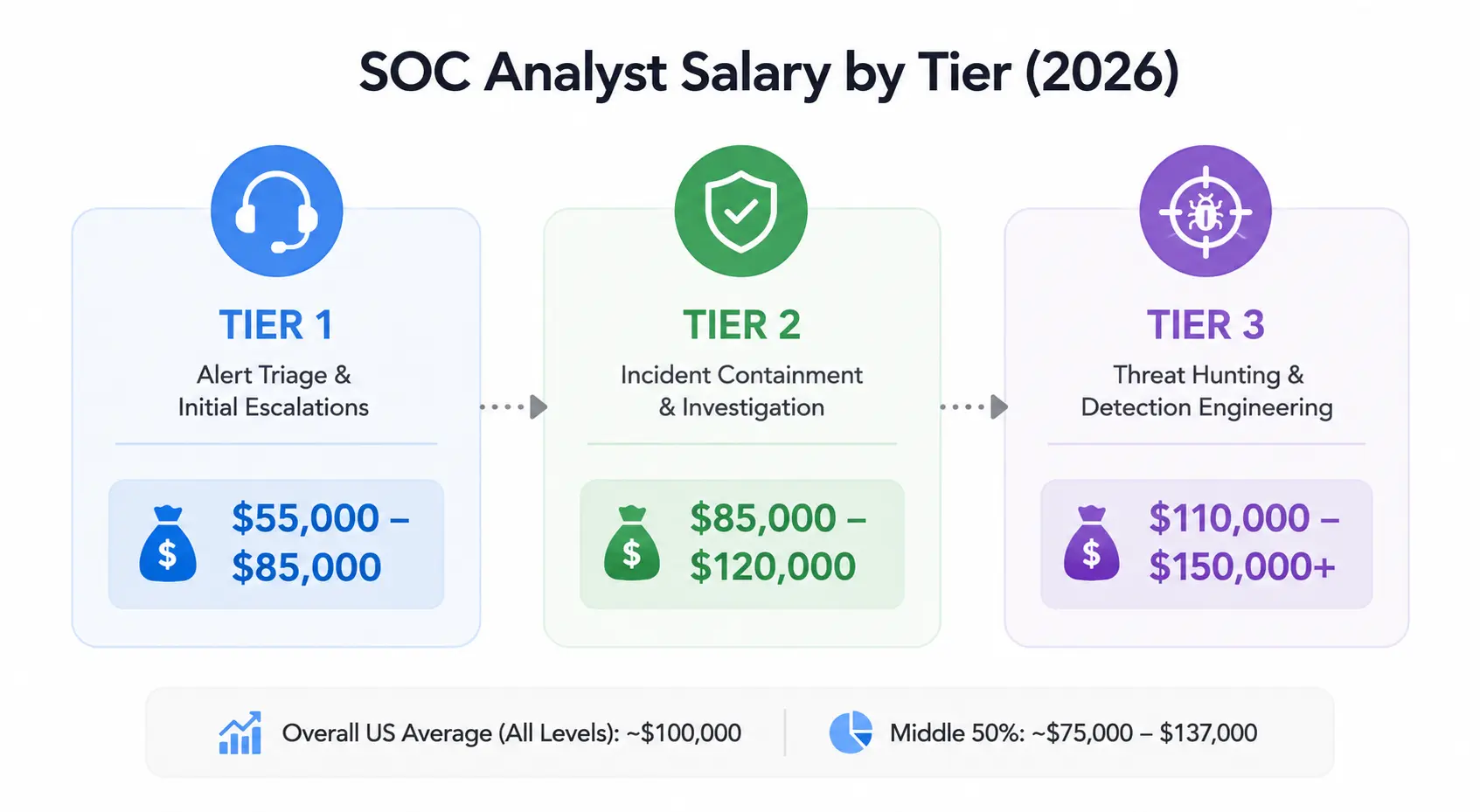
Entry-level Tier 1 analysts, who handle alert triage and initial escalations, typically earn between $55,000 and $85,000 depending on region and employer type. The overall US average across all levels sits close to $100,000, with the middle 50% of analysts earning between roughly $75,000 and $137,000 a year.
Tier 2 investigators, who own real incident containment, generally land between $85,000 and $120,000, while Tier 3 threat hunters and detection engineers can reach $110,000 to $150,000 or more. This tiered structure gives you a rare thing in tech: a security career with a clear, well-documented promotion ladder, where every step forward means deeper cyber defense responsibility rather than a sideways move.
The demand side of this equation is what makes the investment worthwhile. The Dropzone AI data projects roughly 29% growth in information security analyst roles between 2024 and 2034, which is dramatically faster than the average across all occupations.
That growth, paired with a global shortfall of unfilled cyber jobs, means employers are actively competing for candidates who can prove hands-on ability rather than just list credentials. If you’re weighing a security career against other tech paths, this combination of steady demand and a clear promotion ladder is hard to beat in 2026.
A Personal Note From the Author
I want to be upfront about something: I didn’t start in cybersecurity. I spent my first few years doing general IT support, and I remember staring at a wall of SIEM alerts during my first week on a SOC floor, completely unsure which ones actually mattered. What changed things wasn’t a certification on paper — it was the lab hours.
I built my own home lab, broke it on purpose, and learned to read logs the way a mechanic learns to hear an engine problem before the dashboard warns them. Years later, when I sat in on hiring panels for junior analysts, the candidates who stood out weren’t necessarily the ones with the most certifications; they were the ones who could walk through a real alert, explain their reasoning out loud, and admit what they didn’t yet know.
Looking back, the cyber training that stuck with me wasn’t the slide decks—it was breaking things at 11 p.m. and figuring out why, and no security certification alone can replicate that kind of stubborn curiosity. If you take one thing from my own path into this industry, let it be this: treat every practice lab like a real incident, because that habit is what interviewers can actually see.
Final Thoughts
Breaking into this field in 2026 doesn’t require a perfect resume or a computer science degree — it requires a clear plan and consistent hands-on practice. Good SOC analyst training, whichever format you choose, should leave you able to walk into an interview and talk through a real alert with confidence, not just recite definitions.
Pair a recognized security certification with genuine lab hours, stay curious about how modern cyber defense keeps evolving alongside AI-assisted tooling, and treat vulnerability management and threat detection as skills you sharpen weekly, not topics you memorize once.
The unfilled-jobs gap isn’t closing anytime soon, which means the door into a genuine security career is wide open for anyone willing to put in the work. Start with one solid SOC analyst training path, finish it fully, and let your lab work do the talking in interviews.