
You’ve probably seen the news. Amazon let go of thousands of people. Meta cut jobs while spending more on AI than ever. Atlassian shrank its workforce by 10%. The list keeps growing. And somewhere in every announcement, there’s a phrase that keeps coming up: “restructuring for the AI era.”
But here’s what the headlines often miss—most of these people weren’t replaced by a robot. They were let go so their companies could afford to build the robots. That’s a very different thing. And it matters a lot if you’re trying to figure out what happens next—for your career, for your team, or just to make sense of what’s going on.
This piece breaks it all down honestly. Why companies are doing this, who’s actually getting hired right now, what skills are worth learning, and what you can do about it today.
| 55,000+ | Jobs tied to AI adoption cuts in 2025 (Challenger, Gray & Christmas) |
| 143% | Rise in AI engineer job postings year-over-year in 2025 (LinkedIn) |
| $690B | Committed by top 5 cloud companies on AI infrastructure in 2026 (Futurum) |
It’s not what most people think
When a company says it’s cutting jobs “because of AI,” most people picture a machine doing someone’s job. But economists and researchers who study this closely say that the picture is mostly wrong — at least for now.
The companies doing the cutting are not the ones struggling. They’re doing fine. What they’re really doing is freeing up money to fund a very expensive arms race.
The five biggest cloud and AI companies — Microsoft, Alphabet, Amazon, Meta, and Oracle — have collectively committed somewhere between $660 billion and $690 billion on AI infrastructure in 2026 alone. Data centres, chips, energy, and top-tier talent. That takes cash. And payroll is one of the fastest ways to find it.
So when companies talk about “efficiency” and “restructuring,” what they usually mean is: we need the budget, and the job market is soft enough that we can make this move right now.” A ResumeBuilder survey of over 800 business leaders found that 88% of those making compensation cuts said the weak job market made it easier to do so without losing people they wanted to keep.
A real-life scenario: Mark’s story
Mark worked as a mid-level project coordinator at a software company in Austin. The company explained it was shifting budget toward AI tooling and infrastructure. Mark’s job wasn’t being done by an AI — it simply no longer fit the company’s spending priorities. Within four months, he had completed an online course in AI project management and prompt engineering. He landed a new role at a healthcare company as an “AI Implementation Coordinator,” helping clinical teams actually use the AI tools their company had purchased. His salary went up by 18%. The skill gap was real. So was the opportunity.
Mark’s story isn’t unique. Across industries, people who treat this moment as a reason to learn rather than just a reason to worry are finding that the demand for new kinds of work is genuinely strong.
Note: Mark’s story is a composite — the details are fictional, but the career pattern it reflects is playing out across industries right now.
What kinds of jobs are actually opening up?
The same companies laying people off are also hiring, just for different things. LinkedIn ranked AI Engineer as the number one fastest-growing job title in the United States in 2026, with postings up 143% from the previous year. But the story goes well beyond one job title.
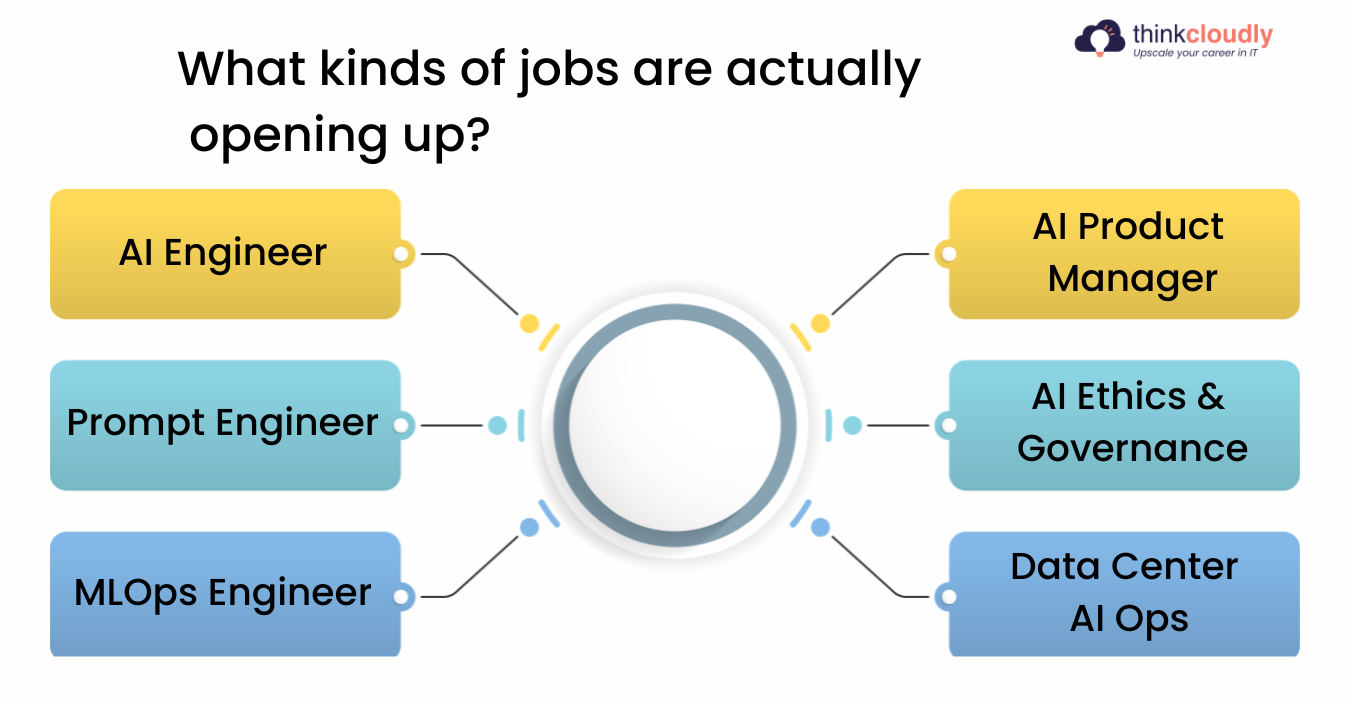
Here’s a clean look at the roles in real demand right now:
|
Job Role |
What They Do |
Avg. Salary Range (US) |
Level |
|
AI Engineer |
Build and deploy AI tools and systems for real business use |
$150,000 – $220,000
|
Mid-Senior |
|
Prompt Engineer |
Design and test the instructions that make AI tools work well |
$90,000 – $160,000 |
Entry–Mid |
|
MLOps Engineer |
Keep AI models running reliably in production environments |
$140,000 – $200,000 |
Mid-Senior |
|
AI Product Manager |
Connect AI technology to real customer needs and business goals |
$130,000 – $190,000 |
Mid-Senior |
|
AI Ethics & Governance |
Ensure AI systems are fair, legal, and used responsibly |
$120,000 – $180,000 |
Mid-Senior |
|
Data Center AI Ops |
Manage the physical and software infrastructure. AI runs on |
$95,000 – $145,000 |
Entry–Mid |
The pay gap between someone with AI skills and someone without has become hard to ignore. Hiring data from 2026 puts it at around 56%—meaning two people doing adjacent roles can be earning vastly different salaries based on one difference: whether they’ve built AI fluency or not. That’s not a small edge — it’s a career-defining difference.
You don’t have to become a coder to stay relevant
One of the biggest misconceptions right now is that surviving this shift requires becoming a software engineer. It doesn’t. The roles opening up are much broader than that.
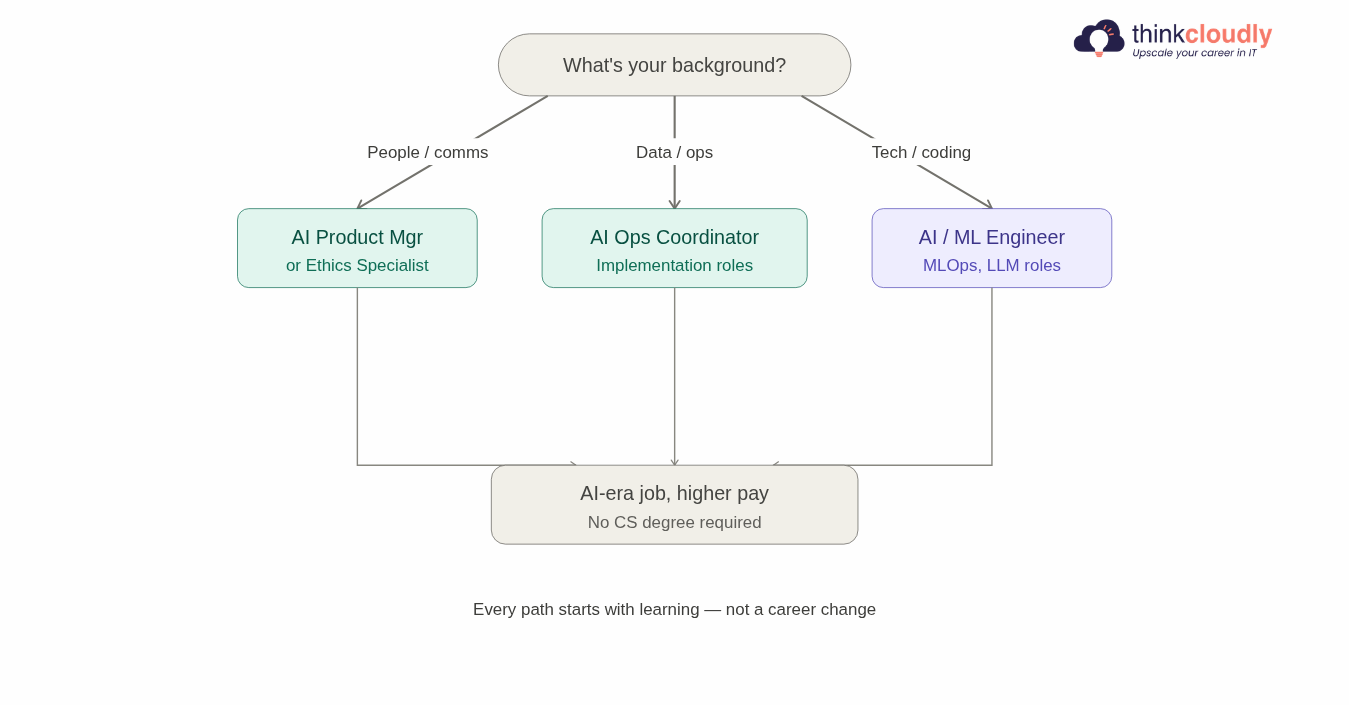
AI Product Managers don’t write code: they figure out what users need and make sure AI products actually deliver it. AI Ethics Specialists are often lawyers, policy experts, or communication professionals who can think clearly about fairness and risk. Forward-deployed engineers spend most of their time talking to clients, not writing algorithms.
What nearly all of these roles share is this: the ability to understand what AI can and can’t do and to work confidently alongside it. That’s a skill that can be learned. It doesn’t require a computer science degree. What it actually takes is simpler than most people expect — genuine interest in how these tools work, a few months of focused learning, and enough repetition to make it stick.
According to McKinsey’s 2025 State of AI report, 80% of tech-focused organizations say upskilling from within is the most effective way to close their skills gap. The irony is that only 28% of companies are actually investing in doing it. That gap is your opportunity.
Which industries are hiring the most?
The largest hiring is not happening inside the companies building AI — it’s happening in companies applying it to their own industries. Healthcare, finance, logistics, and education technology are all moving fast.
In healthcare, AI is being used to reduce billing errors, flag abnormal results faster, and manage patient records more cleanly. In finance, banks are using AI to catch fraud patterns that humans would miss. In logistics, AI-driven tools are handling scheduling and route planning that used to take teams of people.
Each of those applications needs someone to help implement it, train the team that uses it, monitor it, and make adjustments when things go wrong. Those are real jobs that don’t require you to have built the AI yourself.
What’s genuinely at risk—and what’s not
Let’s be honest about this, too. Some roles are genuinely at higher risk. Data entry clerks, basic customer service reps, routine copywriters, and telemarketers are all more exposed than they were a few years ago. Forrester projects that around 6% of all jobs could be lost to AI by 2030 — significant, but not the apocalyptic number some predictions suggest.
The roles that tend to stay safer require context, judgment, accountability, and human connection. A senior manager who has to make a call that affects 200 people isn’t easily replaced. A therapist, a nurse, a lawyer handling a complicated case—these are roles where the human element isn’t just nice to have; it’s part of what makes the work trustworthy.
The line isn’t really about white-collar versus blue-collar. It’s about whether the work is repetitive and predictable or whether it requires dealing with things that don’t fit neatly into a pattern. AI is very good at patterns. It’s still quite limited at everything else.
Your move—before the window closes
If you’re reading this and wondering what your next move should be, here’s what tends to work based on what the job market is rewarding right now.
Start by getting comfortable with the AI tools relevant to your current field. Don’t just use them passively — understand how they work well enough that you can explain them to a colleague. That puts you ahead of most people already.
Then consider picking one area to go deeper. Prompt engineering, data literacy, and AI project coordination — each of these can be learned through structured courses in a few months. They don’t require you to quit your job or go back to school full-time. Many working professionals are picking these up evenings and weekends and applying them immediately at their current company.
The companies that will need the most help in the next two to three years are not the ones building AI — they’re the ones figuring out how to use it responsibly and effectively. Those companies need people who understand both the business problem and the AI tool. That bridge is where the jobs are.
The bottom line
The layoffs are real. The pain for the people affected is real. But the story underneath the headlines is less about AI taking over and more about companies making a calculated bet—and right now, paying for it partly by reducing payroll.
For anyone thinking about their career, the message isn’t panic. It’s motion. Right now, employers are paying a premium for people who are moving—learning, practicing, and applying. The ones sitting still are the ones getting left behind. The window to get ahead of this shift is still open. It won’t be open forever.
The question isn’t whether AI changes the job market. It already has. The question is whether you’re going to be on the side of it that gets hired—or the side that doesn’t see it coming.
Sources & references
- Programs.com — List of Companies Announcing AI-Driven Layoffs (2025–2026) Used for: Accenture, Amazon, Atlassian, Chegg, and other specific company layoff figures.
- CEO Reporter—Tech Firms Cutting Jobs to Fund AI, Not Because AI Replaced Workers Used: the distinction between automation-driven and funding-driven layoffs; analyst projections through 2027.
- SHRM — The AI Layoffs Narrative: Real Transformation, or Scapegoat? Used for: Challenger, Grey & Christmas 55,000 figure; Wharton professor Peter Cappelli quote; Forrester 6% projection.
- Activist Post — AI Has Companies Cutting Jobs, But Not Replacing Workers Used for: Columbia professor Daniel Keum quote; $660–690B capex figure; Block/Jack Dorsey cuts; Bank of America “drift down” comment.
- Onward Search — The AI Talent Race: Top AI Jobs to Watch in 2026 Used for: 143% rise in AI engineer job postings; AI engineer as #1 fastest-growing role (LinkedIn); 56% pay premium for AI skills.
- HeroHunt.ai—Fastest Growing AI Roles in 2026: Data and Rankings Used for: global AI spending reaching $301B in 2026; data centre employment projections; SMB AI adoption tripling.
- Gloat—AI Skills Demand in the U.S. Job Market (2026) Used for: McKinsey 80% upskilling effectiveness finding; 28% of companies investing in upskilling; IKEA training is an example.
- Yoopya—AI Jobs in 2026: Where the Work Is, What’s Changing, and Who Will Thrive Used for: roles at risk (data entry, telemarketers); roles less exposed (surgeons, senior managers, lawyers); and AI literacy as a horizontal skill.