You spent months studying. You passed the exam. You added the badge to your LinkedIn. And then… silence from recruiters.
If this sounds familiar, you’re not alone.
Thousands of job seekers every year complete certifications, expecting doors to open — only to find that the certificate alone isn’t enough. The hiring world has changed, and what worked five years ago is no longer the full picture.
This blog breaks down exactly what’s happening in the job market right now, backed by real data, and tells you what you actually need to do to get hired in 2026 and beyond.
What the Data Actually Says
Here’s the hard truth: certifications still matter, but they’ve become the starting point—not the finish line.
A 2026 report by Western Governors University found that 86% of employers consider non-degree certificates valuable indicators of job readiness. That’s a good sign. But here’s the catch—the same report found that 78% of employers said work experience is equal to or more valuable than a degree or certificate. A certificate gets you noticed, but experience gets you hired.
Meanwhile, a study by LinkedIn Talent Insights (2025) found that over 72% of hiring managers see online certificates as a “useful supplement”—but only 18% consider them a “decisive factor” in their decision.
What does that tell us? Certifications open the door. But something else walks you through it.
Why Everyone Has the Same Certificate Now
Think about how many people have completed a Google Data Analytics certificate, an AWS Cloud Practitioner badge, or a Meta Social Media Marketing course.
According to research cited in a 2026 hiring trends analysis, thousands of candidates show up with identical course titles, the same wording on their resumes, and similar skill descriptions. For a recruiter scanning hundreds of applications, that’s not a signal — it’s background noise.
This doesn’t mean certifications are worthless. It means you can no longer rely on them alone. The credential gets you past the first filter. Everything after that depends on what you’ve actually done with the knowledge.
What Employers Are Actually Looking For
If not certificates, then what?
Here’s what employers are actually looking for while hiring:
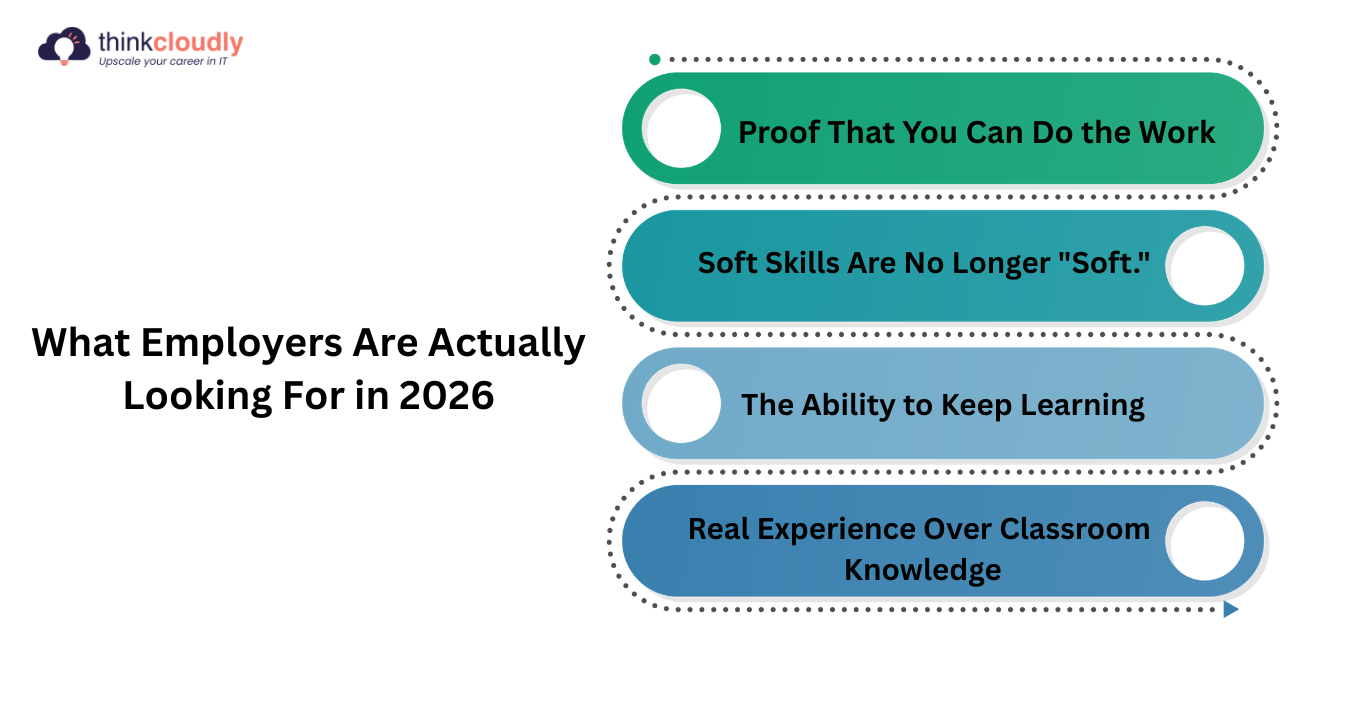
1. Proof That You Can Do the Work
Recruiters and hiring managers increasingly want to see portfolios, project work, and real-world problem-solving—not just credentials.
At companies like Google, Shopify, Figma, and dozens of growing startups, recruiters now explicitly ask candidates to “show how you worked, not just the results.” In 2026, Meta removed the education requirement for several design roles entirely, choosing to evaluate candidates on portfolio-based processes instead.
A GitHub repository with real projects, a case study of a problem you solved, or a live website you built will say more about your abilities than any certificate.
2. Soft Skills Are No Longer “Soft”
Here’s something that might surprise you: soft skills tests are now the most popular type of assessment used by employers in 2026.
Data from TestGorilla’s State of Skills-Based Hiring 2026 report shows that the Big Five personality test was completed over 127,000 times between January and March 2026 — a 69% increase compared to the same period in 2025. Critical thinking tests saw a 61% increase in the same window.
A Harvard Business Review analysis of over 70 million job transitions found that workers with a broad base of foundational skills—communication, teamwork, and problem-solving—earned more, advanced faster, and adapted better than those with only specialized technical skills.
Nearly 90% of recruiters look for problem-solving ability, and around 80% look for teamwork skills when reviewing entry-level candidates.
3. The Ability to Keep Learning
The tech world changes fast. A skill that was cutting-edge in 2022 might be automated today. Employers know this. What they want is someone who can learn, not just someone who learned something once.
As Scott Pulsipher, President of Western Governors University, put it: “The pace of change is shortening the shelf life of the skills we have.” Showing that you’re curious, that you take courses on your own, that you keep up with industry trends—that signals long-term value.
4. Real Experience Over Classroom Knowledge
56% of graduates who felt unprepared for jobs cited a lack of job-specific skills as their biggest gap. Meanwhile, personal referrals (25%), internships (22%), and interview skills (20%) mattered more than the degree itself (17%) when it came to actually getting hired.
Internships, freelance work, volunteer projects, open-source contributions — these are the building blocks that separate candidates who get callbacks from those who don’t.
A Real-Life Scenario: The Two Candidates
Let’s just take an illustrative example: two people apply for a junior data analyst role.
Candidate A has a Google Data Analytics Certificate, a Tableau badge, and a Power BI certification. Their resume lists these credentials front and centre. When asked in the interview to solve a real data problem, they struggled to give a concrete answer.
Candidate B has the same Google Data Analytics Certificate. But he/she also built a public dashboard by analyzing local housing price trends using freely available data. They can walk the interviewer through every decision they made, what went wrong, and how they fixed it.
In 2026, Candidate B gets the job — almost every time.
The difference isn’t the certificate. It’s the evidence of thinking, doing, and communicating.
Certifications That Still Carry Weight (And why)
To be fair, there are fields where certifications still carry significant influence — and it’s worth knowing which ones.
|
Certification |
Field |
Why it still matters |
|
AWS Certified Solutions Architect |
Cloud / Tech |
It is required for many regulated roles |
|
CISSP / CompTIA Security+ |
Cybersecurity |
It is often legally required; it signals risk management ability |
|
PMP (Project Management Professional) |
Project Management |
Globally recognized, employer trust is high |
|
CFA (Chartered Financial Analyst) |
Finance |
Extremely rigorous; sets industry benchmark |
|
Google / Meta Certifications |
Digital Marketing |
Widely recognized by hiring managers in marketing roles |
In fields like cybersecurity, cloud infrastructure, financial compliance, and healthcare, a certification is often an entry requirement, not optional. But even then, it’s an entry ticket, not a guaranteed seat. Technical interviews, case studies, and practical assessments still follow.
What You Should Be Building Right Now
Instead of collecting certifications, hoping one will unlock a job,
Here’s what actually moves the needle:
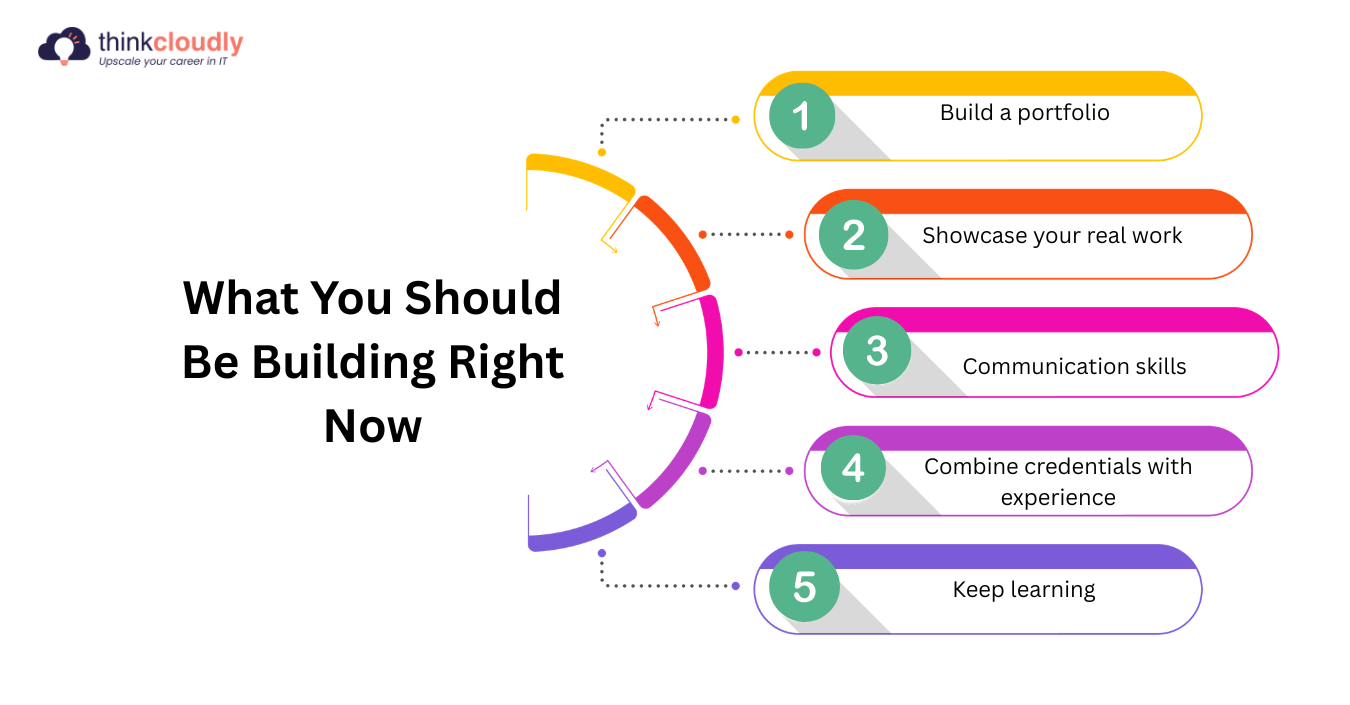
- Build a portfolio: Even two or three solid projects that solve real problems are more valuable than five certificates on a resume. Document your process. Show what you have built, why you built it, and what you learned.
- Showcase your real work: Internships, freelance projects, open-source contributions, or even helping a local business with a real problem—all of this counts. It demonstrates you can function outside a controlled learning environment.
- Develop communication skills: Practice explaining technical concepts in simple language. Write about what you’re learning. This serves as a portfolio piece and demonstrates that you can work with non-technical teams.
- Combine credentials with experience: The sweet spot employers love is a candidate with a relevant certification plus a portfolio of applied work. One validates your knowledge. The other proves you can use it.
- Keep learning publicly: Update posts on LinkedIn. Share your projects on GitHub. Write short articles about problems you’ve solved. This builds visibility and signals the kind of self-driven mindset that employers value in 2026.
Conclusion
Certifications are not dead. They’re just not enough on their own anymore.
The job market has shifted from “what do you know” to “what can you do with what you know.” Employers want real, tangible evidence that you can think, build, communicate, and adapt.
A certificate tells them you completed a course. A portfolio tells them you’re ready to work.
So don’t stop learning. Just make sure you’re showing your work along the way.
Sources & References
- TestGorilla — State of Skills-Based Hiring 2026
- Harvard Business School & Burning Glass Institute — Skills-Based Hiring: The Long Road from Pronouncements to Practice (February 2024)
- Western Governors University / Fortune — Job Readiness & Certifications Report 2026
- Criteria Corp — 2024–2025 Hiring Benchmark Report
- Cengage Group — 2026 Graduate Employability Report (Published September 9, 2026)
- LinkedIn Talent Insights (2025) — Data on certifications as a hiring factor, cited in Fieldtripzoom Hiring Trends Analysis 2026
- Harvard Business Review — Soft Skills Matter Now More Than Ever (August 2025)
- SHRM — 2024 Talent Trends Report
- World Economic Forum — Future of Jobs Report 2025 (Published January 7, 2026)
- CompTIA — Workforce and Learning Trends 2024