

Most people hear “cybersecurity careers” and picture someone hunched over a terminal writing scripts to patch firewalls at 2 a.m. That image is accurate for maybe a third of the industry—and it has scared off a huge number of genuinely strong candidates who assumed no non-technical path into the field exists. It does.
Entire departments run on policy writing, risk scoring, audits, and stakeholder communication, and none of that requires a single line of Python. The myth that every security hire needs to read code the way a developer does is simply outdated, and recruiters filling governance, audit, and awareness seats will tell you so directly.
This guide walks through seven real, hireable cybersecurity jobs without coding by doing what each one actually pays and demands in 2026 and the concrete steps to get hired into one even if your background is in business, compliance, law, HR, or IT support rather than software engineering—and why 2026 is turning out to be a particularly good year to make the move.
Why You Don’t Need to Code to Work in Cybersecurity?
Security teams are not just engineers chasing exploits. A huge share of day-to-day security work is about governance: deciding what rules an organization follows, proving it follows them, and managing who has access to what.
That world runs on policy writing, audit trails, and translating regulatory requirements like GDPR, HIPAA, or SOC 2 into something the business can actually operate under—and it rarely touches a code editor.
The U.S. Bureau of Labor Statistics projects employment for information security analysts to grow 21% from 2025 to 2035—far faster than the average occupation—and a growing share of that demand sits in non-technical, oversight-heavy roles rather than hands-on engineering. Organizations need people who can read a regulation, write a policy, and explain risk to a board member in plain English.
That demand is only getting louder as AI governance becomes a board-level priority, and it’s exactly the opening that non-coding security careers are built around. Hiring managers filling these seats increasingly care more about judgment and written clarity than about which programming language a candidate once studied.
7 Cybersecurity Jobs Without Coding You Can Land in 2026
Here’s the quick list before the breakdown—each of these is a real, actively hired-for role that leans on judgment, documentation, and communication rather than programming:
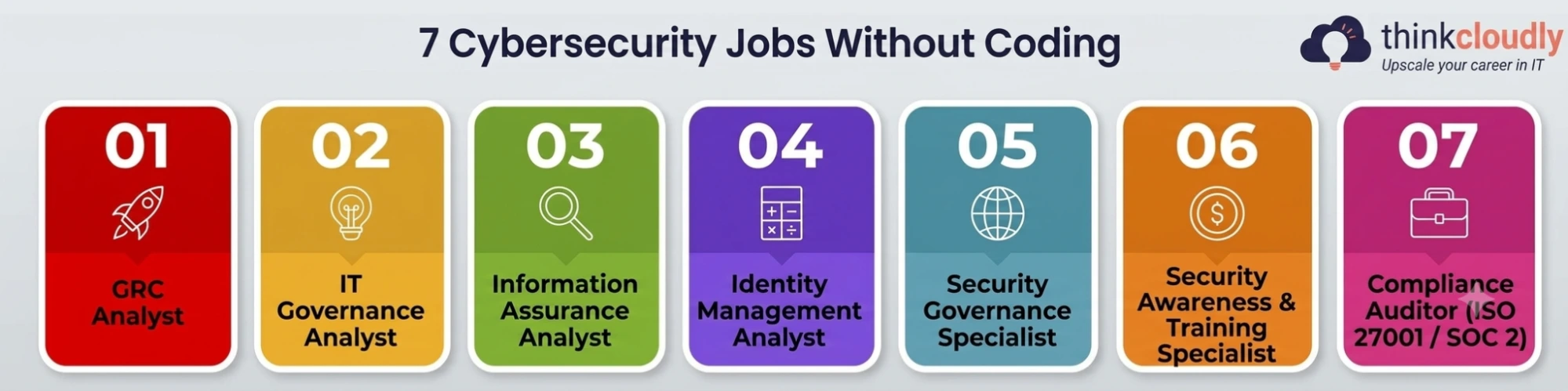
- GRC Analyst—governance, risk, and compliance work; the most common entry point into non-technical security
- IT Governance Analyst—builds and enforces the policy framework the whole organization follows
- Information Assurance Analyst—verifies data integrity, availability, and confidentiality controls actually hold up
- Identity Management Analyst—manages who gets access to what and for how long
- Security Governance Specialist—owns the policy and oversight layer that keeps leadership accountable
- Security Awareness & Training Specialist—teaches employees to spot and stop human-error breaches
- Compliance Auditor (ISO 27001 / SOC 2)—independently verifies an organization is actually doing what it claims
1. GRC Analyst
This is usually the fastest on-ramp into cybersecurity jobs without coding. The job centers on mapping business risk, maintaining compliance evidence for frameworks like ISO 27001 or NIST CSF, and keeping leadership informed about where the organization is exposed.
The entry-level roles in this track commonly start in the 45,000–60,000 range in the U.S., climbing well past $100,000 with a few years of experience. Most of the week is spent in spreadsheets, policy documents, and stakeholder meetings—not a code editor, and definitely not a terminal window.
2. IT Governance Analyst
This analyst builds the scaffolding that keeps technology decisions aligned with business risk tolerance and regulatory obligation. The role designs the policies that define who approves new software, how access requests get reviewed, and how technology spending ties back to risk reduction, drawing heavily on frameworks like COBIT and the NIST NICE Workforce Framework, which explicitly maps non-technical oversight work alongside hands-on technical roles. If structure, documentation, and process design appeal to you more than scripting ever will, IT governance is worth a close look.
3. Information Assurance Analyst
This discipline guarantees that data stays accurate, available, and protected, and an information assurance analyst spends their time validating that the controls meant to deliver that are actually working day to day.
Think audits of backup processes, reviews of data classification policies, and sign-off on whether a new vendor meets contractual security obligations. It overlaps heavily with governance, risk, and compliance work but leans more specifically on data lifecycle and integrity rather than broad enterprise risk—a subtle distinction hiring managers notice even when job titles blur the two together.
4. Identity Management Analyst
This is one of the fastest-growing niches in non-technical security, because every single breach investigation eventually asks the same question: who had access, and why? The analyst in this seat manages provisioning and deprovisioning, enforces least-privilege access reviews, and audits who holds administrative rights across the organization’s systems.
The role requires understanding access and identity concepts deeply—but configuring the underlying platform itself is usually handled by an engineer, while the analyst owns the policy, the review cadence, and the audit trail that proves it’s all being followed.
5. Security Governance Specialist
This specialist sits closest to leadership, translating technical risk into board-level language and making sure the organization’s security program actually reflects documented policy rather than informal habit.
The role owns the security governance calendar—policy review cycles, committee reporting, and tracking whether departments are actually following the rules that were written for them. It is one of the more senior seats in this field, and it tends to pay accordingly once a candidate has a few years of governance or audit experience behind them.
6. Security Awareness & Training Specialist
Human error still causes the overwhelming majority of breaches, so organizations invest heavily in people who can design phishing simulations, build onboarding security training, and measure whether employees actually change behavior after a campaign.
This role draws on instructional design and communication skills far more than technical ones, making it one of the more approachable entry points into security for someone coming from a teaching, HR, or marketing background rather than an engineering one.
A surprising number of people in this seat came from classroom teaching or corporate L&D, where the actual craft—holding attention, repeating a message until it sticks, measuring whether it actually landed—turns out to transfer almost directly.
7. Compliance Auditor (ISO 27001 / SOC 2)
A compliance auditor—internal or external—independently verifies that an organization’s stated controls match its actual practices. The work involves interviewing control owners, reviewing evidence, and writing findings reports that hold up under regulator or client scrutiny.
Auditors rarely touch a line of code; the job is built on structured interviewing, document review, and precise, defensible writing. Many auditors move into the role from accounting or internal-audit backgrounds, since the underlying skill—testing a claim against evidence rather than taking it at face value—is identical whether the subject is a financial statement or a server access log.
At a Glance: Cybersecurity Jobs Without Coding
|
Role |
Core Focus | Typical Entry Salary (US, 2026) |
Common Certification |
|
GRC Analyst |
Risk mapping, compliance evidence | 45,000–60,000 |
CRISC, CGRC |
IT Governance Analyst
Policy frameworks, oversight55,000–70,000
CGEIT, COBIT
Information Assurance Analyst
Data integrity & controls validation55,000–72,000
CAP, CISA
Identity Management Analyst
Access provisioning & reviews58,000–75,000
CIAM, Security+
Security Governance Specialist
Policy oversight, board reporting70,000–95,000
CISM, CGRC
Security Awareness Specialist
Training, phishing simulation50,000–65,000
CompTIA Security+
Compliance Auditor
ISO 27001 / SOC 2 audits60,000–80,000
CISA, ISO 27001 LA
Skills That Matter for Cybersecurity Jobs Without Coding
Hiring managers filling these non-technical security seats consistently screen for the same handful of strengths, regardless of which of the seven roles above you’re chasing:
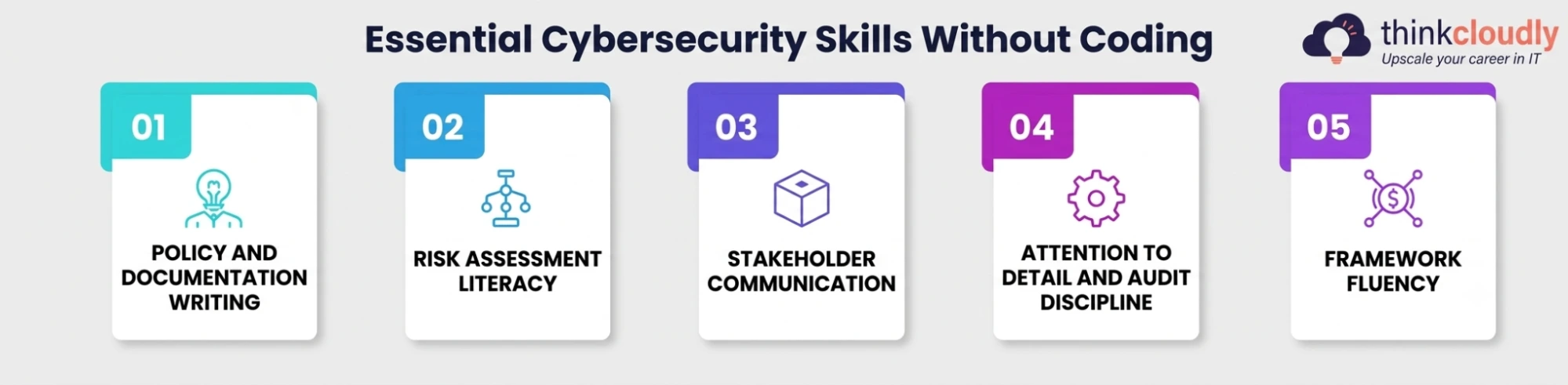
- Policy and documentation writing—turning a regulation or standard into something employees can actually follow
- Risk assessment literacy—understanding likelihood and impact well enough to prioritize, even without running the technical scan yourself
- Stakeholder communication—explaining risk to executives who don’t read vulnerability reports for a living
- Attention to detail and audit discipline—catching the gap between what a policy says and what actually happens
- Framework fluency—comfort with NIST CSF, ISO 27001, SOC 2, or COBIT, since almost every governance or compliance role expects at least one
None of these require writing code, but all of them require genuine security literacy—you still need to understand what a control is and why it matters, even if someone else configures it. A candidate who can walk an interviewer through one real risk assessment, one policy they’ve written, or one audit finding they’ve investigated will almost always beat a resume listing a dozen tools nobody ever asked them to explain in detail.
How to Get Hired Into Cybersecurity Jobs Without Coding?
Start with one foundational certification rather than collecting several at once. CompTIA Security+ remains the broadest entry credential, while CRISC or CGRC signal governance-specific intent to recruiters screening resumes for an entry-level opening in this space.
If access and identity work is the target, look at vendor-neutral access-governance training alongside a foundational cert; the IAPP’s certification programs are also worth exploring if the role touches data privacy, since privacy and access governance increasingly overlap in regulated industries.
Next, learn one framework in depth rather than skimming five. Pick ISO 27001 or the NIST Cybersecurity Framework and study how organizations actually implement it, not just what the standard requires on paper — that depth is what separates a candidate who can discuss governance frameworks intelligently from one who only memorized acronyms.
Recruiters notice the difference between someone who can name a framework and someone who can explain how it actually gets operationalized inside a real organization.
Finally, be specific about the role you want. Recruiters and hiring managers respond far better to “I’m looking for GRC analyst or compliance auditor roles” than to a vague “anything in cybersecurity.”
Request informational interviews with people already working in these governance-focused roles, study real job postings for recurring requirements, and resist the temptation to overstate technical skills you don’t have — framing your existing business, compliance, or communication background as the asset it is tends to land better than pretending to be something you’re not.
Career Outlook: Is It Worth Pursuing in 2026?
The short answer is yes, and the trend is accelerating rather than slowing down. ISC2’s 2026 workforce insights point to AI governance emerging as a top organizational priority, which is creating fresh demand for people who can oversee how AI systems are deployed responsibly — a role built almost entirely on governance and policy, not code.
Combined with the BLS’s 21% projected growth for security roles overall, cybersecurity jobs without coding are no longer a consolation prize for people who “couldn’t learn to code” — they are a deliberate, well-compensated career track with its own ceiling, from analyst up through director-level governance leadership.
Employers aren’t lowering the bar for these roles either; if anything, the bar for clear policy writing and sound judgment is rising as AI adds a new layer of risk to oversee.
A Personal Note
I’ve watched too many capable people talk themselves out of security careers because they assumed the only door required a computer science degree. It doesn’t. Some of the sharpest governance and compliance professionals I’ve come across started in auditing, project management, or even customer support — what they had in common was curiosity about how organizations actually protect themselves, and the discipline to write things down clearly, not a gift for writing code.
If that sounds more like you than a terminal window does, don’t wait for permission to call yourself a security professional. Pick one certification, learn one framework properly, and start applying before you feel completely ready — nobody ever does, and the people hiring for these roles know that too.