

Every forum thread about breaking into AI eventually lands on the same question: is AWS AI Practitioner worth it, or is it just a $100 badge that looks nice on LinkedIn and means nothing in an interview? I’ve watched enough people chase credentials for the wrong reasons to know that question deserves a real answer, not a marketing one.
So here it is, stripped of hype: the honest answer for 2027 depends almost entirely on where you’re starting from, what you already know, and what you’re actually trying to prove to an employer.
This isn’t a certification that teaches you to build models from scratch or fine-tune a transformer. It’s a foundational credential that proves you understand how AI, machine learning, and generative AI actually work inside AWS—and whether that’s valuable to you depends on your current role, your target job, and how much weight you’re expecting one exam to carry.
I’ll walk through what the exam covers, what it costs, what the 2026 data says about pay and hiring, and where this credential genuinely falls short, so you can decide for yourself instead of taking my word for it.
What the AWS Certified AI Practitioner Exam Actually Covers?
The AWS Certified AI Practitioner exam (exam code AIF-C01) is a 90-minute test with 65 questions—50 that count toward your score and 15 unscored questions you can’t identify during the exam, according to AWS’s own certification guide. It costs $100 USD, a fraction of what AWS charges for its associate and professional-level exams, and it’s scored on a scale of 100 to 1,000, with 700 as the minimum passing mark.
The content splits into five weighted domains: Fundamentals of AI and ML (20%), Fundamentals of Generative AI (24%), Applications of Foundation Models (28%), Guidelines for Responsible AI (14%), and Security, Compliance, and Governance for AI Solutions (14%).
Notice how nearly a third of the exam sits on applying foundation models—that’s where Bedrock lives, and it’s the single biggest reason this exam feels different from a typical foundational AWS certification.
There’s no formal prerequisite, though AWS suggests Cloud Practitioner Essentials for anyone brand new to the platform, and no coding or hands-on lab component anywhere in the test.
Is AWS AI Practitioner Worth It, or Is It Just Resume Padding?
This is the part people skip past too fast. Does this certification get you hired on its own, as a standalone credential sitting alone on a resume? No—and anyone telling you otherwise is selling a course.
Does it signal that you understand generative AI concepts well enough to hold a real, substantive conversation about them in an interview? That’s a much stronger yes, and it’s the actual use case this exam was built for in the first place.
The honest framing is this: Is AWS AI Practitioner worth it? It depends on whether you’re treating it as a floor or a ceiling. As a floor—proof you understand AI terminology, how foundation models get judged for quality, and responsible AI guardrails before you walk into a more technical role—it earns its $100.
As a ceiling—something you hope replaces actual hands-on experience with Bedrock or SageMaker—it will disappoint you the moment a hiring manager asks a single follow-up question.
What You Actually Walk Away With?
Here’s what passing this exam genuinely gives you, laid out plainly so it’s easy to scan:
- Working vocabulary for AI conversations. You’ll understand terms like prompt engineering, retrieval-augmented generation, and the basics of model evaluation well enough to follow a technical discussion without nodding blankly.
- A measurable boost to job readiness. Recruiters screening resumes for AI-adjacent roles treat this certification as evidence you’ve done more than watch a YouTube explainer on generative AI.
- Faster career advancement conversations internally. Employees who earn this certification report it’s easier to ask for AI-related project assignments once the badge is visible on an internal profile.
- A low-cost entry point into AI-adjacent work. At $100, it’s one of the cheapest ways to test whether a cloud-and-AI career path genuinely interests you before committing to a pricier, harder exam.
- A foundation for Bedrock and SageMaker study. The exam’s foundation-model domain gives you enough Bedrock context that the official documentation stops reading like a foreign language.
None of these are nothing. But none of them alone settle the bigger question for your specific situation—that still depends on what role you’re actually aiming at next and how far along that path you already are.
Where Amazon Bedrock and Model Evaluation Fit Into the 2026 Picture?
Amazon Bedrock isn’t a side mention on this exam—it’s close to the center of gravity. AWS has kept expanding what the platform can do, and the most relevant recent addition is Bedrock AgentCore Evaluations, a fully managed service that scores an AI agent’s tool selection, reasoning, and final responses rather than just a single model’s output. It first launched in public preview at AWS re:Invent 2025 and reached general availability by early 2026.
That matters for anyone asking is AWS AI Practitioner worth it in 2027, because the exam’s foundation-model domain is explicitly testing whether you understand concepts like model evaluation, not just model selection.
Knowing that the platform now ships built-in evaluators, LLM-as-a-judge scoring, and ground-truth comparison tools isn’t just exam trivia—it’s the actual skill employers want when they say they need someone who can judge whether a generative AI feature is production-ready before it ships. If your target job touches Bedrock in any capacity, understanding how that scoring works at this level is non-negotiable, certification or not.
AIF-C01 Exam Snapshot
|
Detail |
AWS Certified AI Practitioner (AIF-C01) |
|
Exam format |
65 questions (50 scored, 15 unscored); multiple choice, multiple response, ordering, matching |
|
Duration |
90 minutes |
|
Cost |
$100 USD |
|
Passing score |
700 out of a 100–1,000 scale |
|
Formal prerequisites |
None; AWS Cloud Practitioner Essentials is recommended for beginners |
|
Delivery |
Pearson VUE testing center or online proctoring |
|
Core domains |
AI/ML fundamentals, generative AI fundamentals, foundation model applications, responsible AI, security & governance |
|
Best suited for |
Non-technical and semi-technical roles moving toward AI-adjacent work |
Does It Actually Move the Needle on Cloud Computing Careers?
Cloud computing careers in 2026 are increasingly inseparable from AI literacy, and that’s the real backdrop behind every version of AWS AI Practitioner worth it you’ll find online. According to Charter Global’s 2026 tech careers analysis, employer postings mentioning AI skills rose 117% between 2024 and 2025, with AI, machine learning, and cloud engineering roles leading hiring trends across North America and Europe.
That’s not a reason to assume one exam guarantees career advancement, but it is a reason to take AI fluency seriously if you’re already building a career inside the cloud and AI more broadly.
Where this credential genuinely helps career advancement is in lateral moves—a cloud support engineer wanting to move toward an AI/ML team, a project manager who needs to speak intelligently about generative AI roadmaps, or a sales engineer selling AI-powered cloud products who needs real substance behind the pitch.
Where it does less to move the needle is in landing a senior ML engineering role outright; that path still runs through Bedrock or SageMaker project experience, not a foundational multiple-choice exam.
Who Should Actually Skip This Certification?
Not every path toward cloud computing careers needs this credential, and it’s worth being direct about who shouldn’t bother yet:
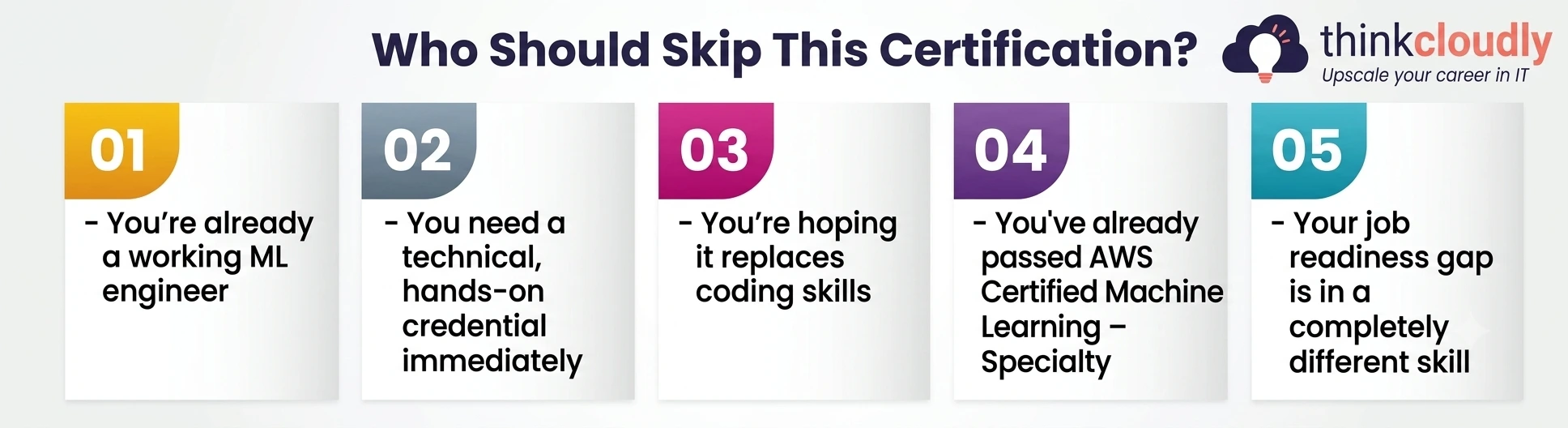
- You’re already a working ML engineer. If you build and deploy models daily, this exam tests concepts you’ve internalized years ago—spend the $100 on an associate or specialty exam instead.
- You need a technical, hands-on credential immediately. Employers hiring for Amazon Bedrock implementation roles usually want to see projects, not a foundational badge, so this won’t substitute for that proof.
- You’re hoping it replaces coding skills. This exam has zero hands-on labs; it won’t teach you to write a single line of inference code.
- You’ve already passed AWS Certified Machine Learning – Specialty. That credential subsumes everything this one tests and then some, so earning both is redundant.
- Your job readiness gap is in a completely different skill. If what’s actually holding you back is SQL, Python, or basic statistics, close that gap first—those fundamentals matter far more to a hiring manager than any badge on this list.
Salary and ROI: What the 2026 Data Actually Shows
Numbers help ground this entire debate in something other than opinion. There’s no standalone “AI Practitioner salary,” because—much like AWS Cloud Practitioner—it’s a supporting credential rather than a job title on its own. But the roles it feeds into have real, trackable numbers.
A 2026 machine learning engineer salary analysis puts the US median base salary around $160,000, with entry-level engineers typically starting in the 120,000–147,000 range and senior engineers with production experience reaching roughly $190,000 or more.
Zooming out to the broader labor market, the U.S. Bureau of Labor Statistics projects data scientist roles—the closest tracked occupation to AI/ML work—to grow 35% between 2025 and 2035, far faster than the average occupation, with about 24,800 openings projected annually and a median pay of $120,230.
None of that growth is guaranteed to any individual holding this specific certification, but it’s a strong tailwind for anyone treating job readiness in AI as a real, fundable career bet rather than a passing trend. That broader growth matters far more for your next raise than any single credential, this one included, so don’t mistake a certificate for the whole strategy.
Where the Certification Genuinely Falls Short?
It would be dishonest to stop at the upside, so here’s where this credential has real limits:
It tests recognition, not application — you’re selecting the right answer from options, not building anything from scratch, which means it can’t prove hands-on Bedrock or SageMaker fluency the way a portfolio project would.
It also ages fast; generative AI tooling moves quickly enough that AWS will almost certainly refresh this exam’s content before your three-year validity period is up, so treat it as a snapshot of 2026 knowledge, not a permanent credential.
And it says nothing about your ability to actually ship a responsible, compliant AI feature under real deadline pressure — that’s a skill built through practice and repetition, not multiple-choice recall, and no exam can hand it to you for free.
My Verdict for 2027
Is AWS AI Practitioner worth it? Yes, for the right person, at the right stage of their path — and I’d say that confidently rather than hedge it into mush. If you’re in a non-technical or semi-technical role and want a credible, affordable way to prove AI literacy before pursuing deeper cloud computing careers, this is one of the better $100 investments available right now.
If you’re already technical and aiming for a hands-on AI/ML role, skip straight to a credential or project portfolio that tests real model evaluation and deployment skills instead — this exam will feel like a step backward, not forward, for you.
A Personal Note
I get asked some version of AWS AI Practitioner worth it almost every week now, usually from someone hoping I’ll either talk them out of spending the money or hand them a shortcut to a job they’re not quite ready for yet. I won’t do either.
What I will say is that the people who get real value from this exam are the ones who treat it as a starting line, not a finish line — they pass it, then immediately go build something small in Amazon Bedrock just to see if the concepts actually stick under their own hands.
The ones who feel disappointed are usually the ones who expected the certificate alone to carry weight it was never designed to carry. Decide which group you’re trying to be before you register for the exam, and the $100 will feel like exactly what it is: a reasonable, honest first step.