
If you’ve ever used a shopping app during a big sale or watched a live stream that somehow didn’t crash with a million other people watching at the same time, you’ve already seen a load balancer at work. You just didn’t notice it.
I can still recall the first time I really got what a load balancer was doing. I was working with a friend on his college project. It was a simple ticket booking site that kept crashing when more than twenty people tried to book at a time.
The server wasn’t busted. It was alone, doing all the work, with no one to help. I learned it when somebody told me, “You need a load balancer.” That single sentence forever changed the way I saw web infrastructure.
In this blog I’ll demystify what a load balancer really is, how it works, why it’s important for high availability and smooth application delivery, and how it fits into real-world systems—in plain, simple language. No heavy jargon. No confusing diagrams. A simple explanation, the way I wished somebody would have explained it to me at the time.
What is a load balancer?
In simple terms, a load balancer is a system — either hardware or software — that sits between users and a group of servers and decides which server should handle each incoming request. It spreads out the traffic among many servers instead of having all the traffic go to one server. This helps to prevent one machine from being overloaded.
Imagine a restaurant with several counters at rush hour. If everyone goes to one counter, that person is overwhelmed, and the others are empty. A good manager leads people to whichever counter is free. That “manager” is essentially what a load balancer does for websites and applications—only instead of directing people, it’s directing digital requests.
IBM defines load balancing as the intelligent distribution of network traffic among multiple servers to maximize the availability of an application and to provide a seamless experience to end-users. This is important because high-traffic websites and cloud applications receive millions of requests per day, and a load balancer ensures that none of these requests get dropped or delayed.
Why do we need a load balancer?
Back to my friend’s ticket booking website. There was only one server, so everything was dependent on that one machine. If it was slow, the whole site was slow. If it crashed, the whole site crashed. There was no safety net, no distribution, no backup.
And that’s exactly what a load balancer does. It balances the traffic over several servers so that:
- No server bottlenecks
- If one server fails, others can automatically take up the traffic
- faster response times for users, as requests are not queued in one place
- The system stays up even with traffic spikes
This is where the idea of high availability comes in. A system that is made to be up and running, with minimal downtime, even under a heavy load or partial failure. The load balancer is really the heart of that concept because without traffic distribution, “high availability” is just a nice phrase that doesn’t mean anything.
How Does a Load Balancer Work?
Here’s a quick overview of what’s involved.
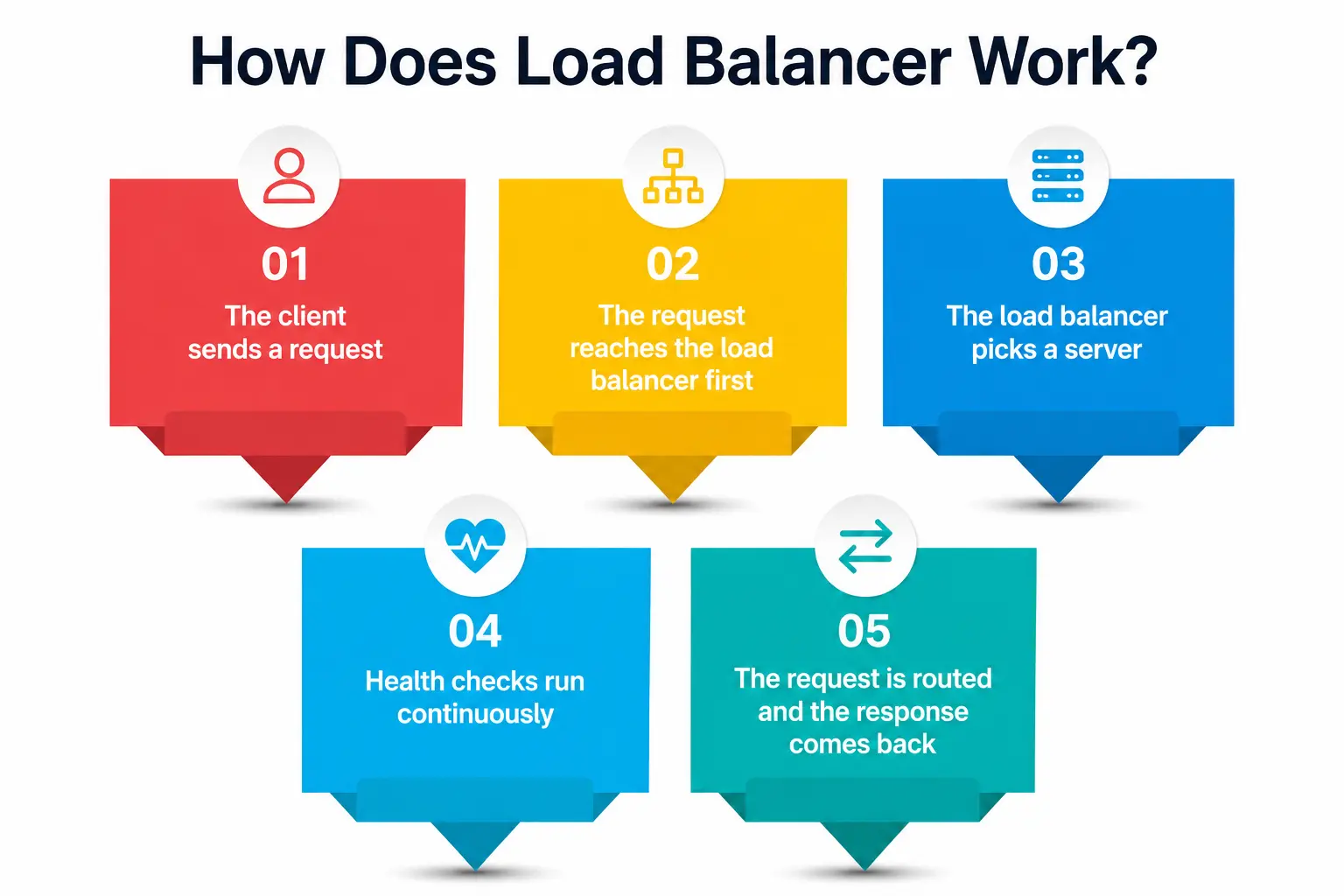
- The client calls—opens a website, fills in a form, or makes an API call.
- The request hits the load balancer and not the actual server. It exposes a single virtual IP address to the outside world so that users never communicate directly with individual backend servers.
- The load balancer uses an algorithm to determine which server in the pool is the best to handle this request at this moment.
- Health checks are always enabled. If any server is unresponsive, it is temporarily removed from the pool until it becomes responsive again.
- The request is routed and the response comes back. Usually so smoothly the user has no idea multiple servers were even involved.
- This whole mechanism is an integral part of application delivery—ensuring applications are delivered fast and reliably to users no matter how much traffic hits the system.
Reverse Proxy as Load Balancer
A load balancer is a reverse proxy (reverse proxy is a fancier way of saying it acts as a front for your servers). It handles requests for your servers but keeps the specifics of the server hidden from the outside world.
According to Contabo’s guide on load balancers, this type of setup forwards requests to backend servers and can add additional functionality, such as caching, compression, and SSL termination. Load balancers can do a lot, but their primary function is to route traffic to multiple backends and continuously monitor their health.
It also provides a further layer of security. Users are never directly connected to your actual servers, so it becomes much harder for the attackers to attack a specific machine. This indirectly improves your entire cluster management setup.
Types of Load Balancer
Load balancers don’t all work the same way. Normally they are one of a few types depending on what they do:
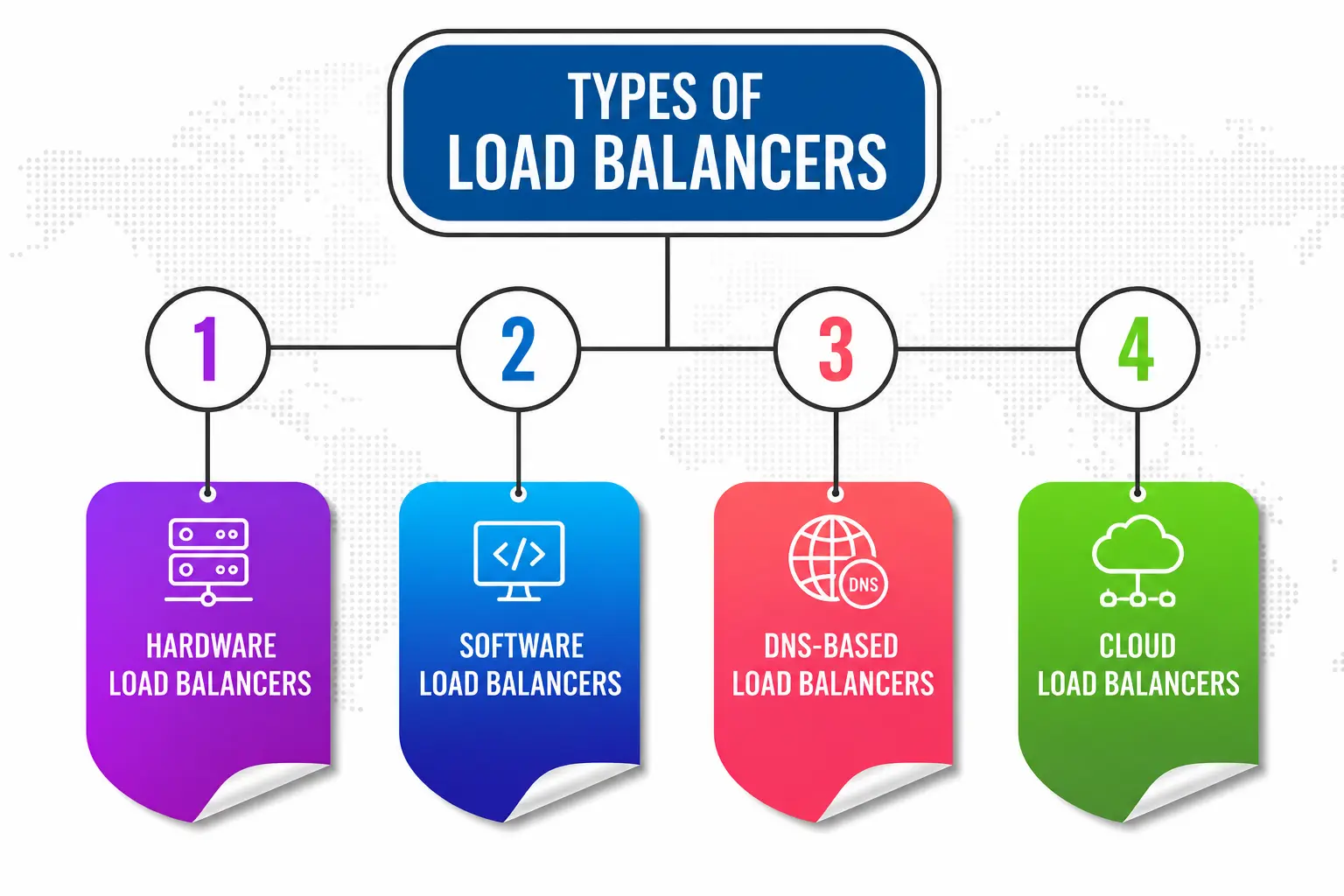
- Hardware load balancers are physical devices that you install on-premises. They are powerful, but expensive, and typically found in large enterprise data centers.
- Software load balancers run as applications on standard servers or virtual machines, usually as a reverse proxy. This is where tools like NGINX and HAProxy come into play, which are popular as they are flexible and cheap.
- DNS-based load balancers allocate traffic at the DNS level and are often used for global distribution of traffic over regions.
- Cloud load balancers are managed services by cloud providers that handle the scaling and cluster management for you, so you don’t have to manage physical infrastructure.
The one you choose depends largely on how much traffic you expect, how much you can afford to spend, and how your servers are architected.
Standard load distribution models
This is the part that confused me the most when I first learned about this subject, so here is the simple version.
Load balancers do more than balance loads; they also determine where to send requests. Some of the most common are the following:
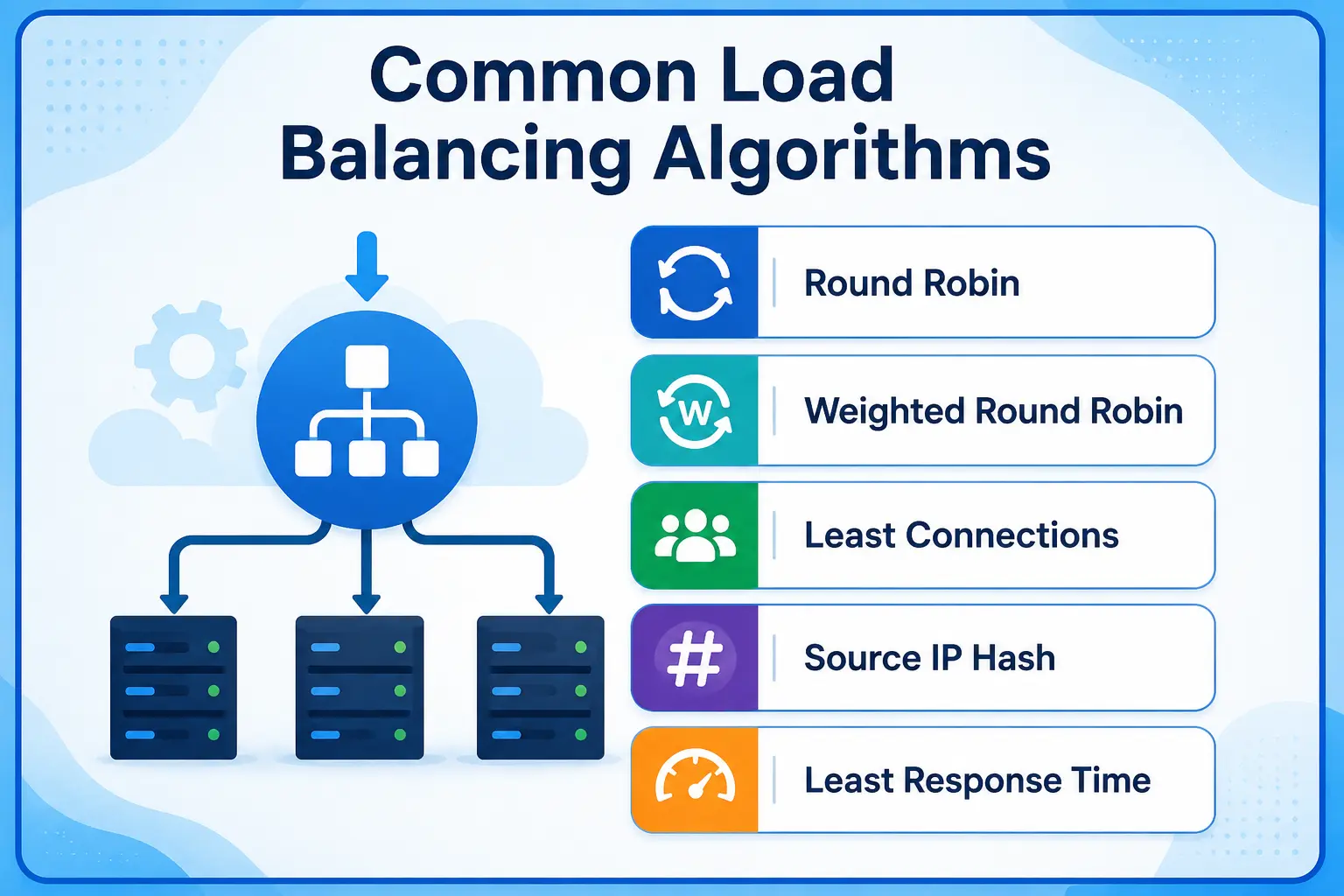
- Round Robin: Servers are sent requests in order and then repeat. Simple, but does not consider the busyness of a server.
- Weighted Round Robin: Similar to round robin, but more requests are assigned to more powerful servers based on the assigned weight values.
- Least Connections—Sends requests to servers with the fewest active connections at the time. Good for efficient resource usage when request loads vary widely.
- Source IP Hash: This will always send requests from the same client IP to the same server. This allows for session consistency for things like shopping carts.
- Least Response Time: Directs traffic to the server that is currently responding the quickest, helping to sustain high throughput even under pressure.
There is no one algorithm that fits all. It is dependent on your traffic patterns, if your servers are equal in power, and if you need persistence for sessions in your application.
Load Balancer How It Helps in Utilization of Resources and Throughput
One of the most overlooked benefits of a load balancer is the way it improves resource usage of your server pool. In the absence of this, some servers sit almost idle while others are swamped — a waste of computing resources and money, particularly in cloud environments where you’re paying for that unused capacity anyway.
A load balancer can also help you achieve high throughput. This means that your system can handle more requests per second without slowing down. It does this by intelligently distributing traffic so that each server is used efficiently.
This is, for example, very relevant in cluster management, especially in microservices architectures, where dozens of server instances work together. The load balancer is the traffic conductor to keep that orchestra in sync.
Load Balancer & Capacity Planning
People forget that a load balancer is not a device that you can just “set and forget.” This has direct implications for capacity planning: how much server capacity do you need for current and future traffic?
It’s a lot easier to predict when you need to scale up or down when you have a load balancer distributing traffic evenly and efficiently. Good capacity planning with proper load balancing helps to prevent the system from crashing under load at peak hours and prevents the waste of over-provisioning resources you don’t need.
This is exactly why the market is pumping so much money here. AceCloud’s guide on load balancers cited data showing that the load balancer market was about USD 7.09 billion in 2025 and is expected to reach about USD 13.79 billion by 2030, which quite clearly shows how important this type of technology has become.
Load Balancing Algorithms: A Glance
|
Algorithm |
How It Works |
Best Used For |
|
Round Robin |
Distributes requests to servers in round order |
Same size servers, simple stateless apps |
|
Weighted Round Robin |
Distributed more requests to server of higher-capacity using assigned weights |
Mixed hardware capabilities server pool |
|
Least Connections |
Sends requests to the server with the active connections |
Unevenly distributed connections or persistent application connections |
|
Source IP Hash |
Routes the same client to the same server every time |
Applications that need session persistence such as shopping carts |
|
Minimal Response Time |
Send traffic to the fastest-responding server |
Latency-sensitive high-throughput applications |
Load Balancers in Real-World Applications
Load balancers aren’t some theoretical concept from a system design class; they are running in the background for almost every major platform you use on a daily basis. E-commerce sites use them to ensure product pages and check-out systems work quickly during flash sales.
Streaming services need them to watch video smoothly for millions of simultaneous viewers. Financial apps and banks use them to keep the lights on, because even a few minutes of downtime can mean real financial and reputational damage.
According to Cherry Servers’ guide to load balancers, “Load balancers distribute network traffic evenly across a group of servers. This ensures that no single server becomes a point of failure. Modern applications such as Amazon or Facebook need to run smoothly for everyone, all the time.
The same even distribution keeps high-throughput applications humming along during their busiest hours and keeps resource usage healthy across large server fleets.
Load balancer problems
Reliable application delivery is not a given, and a load balancer has its own challenges. There’s a little setup involved—and a load balancer that isn’t configured correctly can become a bottleneck in itself.
You need to tune your health checks appropriately, or you could be sending traffic to a server that is failing or unnecessarily removing a healthy server from rotation. Cost is also a factor, especially in the case of hardware load balancers or premium cloud solutions.
Final Thoughts on Why Do Load Balancers Matter
After all, a load balancer is one of those technologies that quietly works in the background but holds the entire chain of application delivery together. Students often don’t understand the importance of this one part—but once you understand it, you start seeing it everywhere, from the apps on your phone to the largest enterprise systems in the world.
If you are a student trying to learn distributed systems or preparing for system design interviews, knowing the load balancers very well (not just the definition but also the algorithms and how they play a role in capacity planning and cluster management) will really make you stand out.
Personal Note
The first time I heard the term “load balancer,” I assumed it was a concern only for senior engineers at big tech companies. But when I wrote it down, I saw how basic the idea really is when someone explains it without the scary language.
The best way to learn the definition is to figure out how to create a simple load balancer yourself, with a free tool like NGINX on a couple of test servers. The way you see the traffic get distributed in real time is a different kind of understanding that you get, rather than just reading about it. So that’s how I really finally got it too.