
If you’ve ever sat in a compliance class or an internship orientation and heard someone rattle off “governance, risk, and compliance” like it’s one word, you’re not alone. Most students hear the term “GRC” before they actually understand what it protects an organization from—and honestly, most professionals learned it the hard way too, usually after something went wrong.
This blog breaks down GRC best practices in plain language, explains why they matter more in 2026 than they did five years ago, and gives you a framework you can actually apply, whether you’re studying for a certification or trying to make sense of your first compliance internship.
What Does GRC Actually Mean?
GRC stands for Governance, Risk, and Compliance. It’s the umbrella term for how an organization aligns its leadership decisions, its risk exposure, and its legal obligations into one coherent system instead of three disconnected departments fighting for the same budget.
- Governance is about who’s in charge and how decisions get made—the structures, policies, and accountability chains that keep leadership aligned with strategy.
- Risk is the practice of identifying what could go wrong (financial, operational, cyber, reputational) and deciding how to handle it before it becomes a crisis.
- Compliance is making sure the organization actually follows the laws, regulations, and internal policies that apply to it.
When these three functions operate in silos, you get duplicated work, blind spots, and — eventually — an audit finding nobody saw coming. This is exactly the gap that strong corporate governance is supposed to close.
That’s exactly why GRC best practices exist: not as a checklist to survive an audit, but as an operating model that keeps governance, risk, and compliance talking to each other continuously.
Why GRC Best Practices Matter More Than Ever in 2026
Here’s the uncomfortable part: doing GRC badly is still the industry norm. According to McKinsey’s 2026 Global GRC Benchmarking Survey, a striking share of organizations admit their GRC systems either need serious improvement or are missing entirely. That’s not a small-company problem—it’s happening at scale, across industries, while regulatory pressure keeps climbing.
Three shifts are driving why GRC best practices can’t stay theoretical anymore:
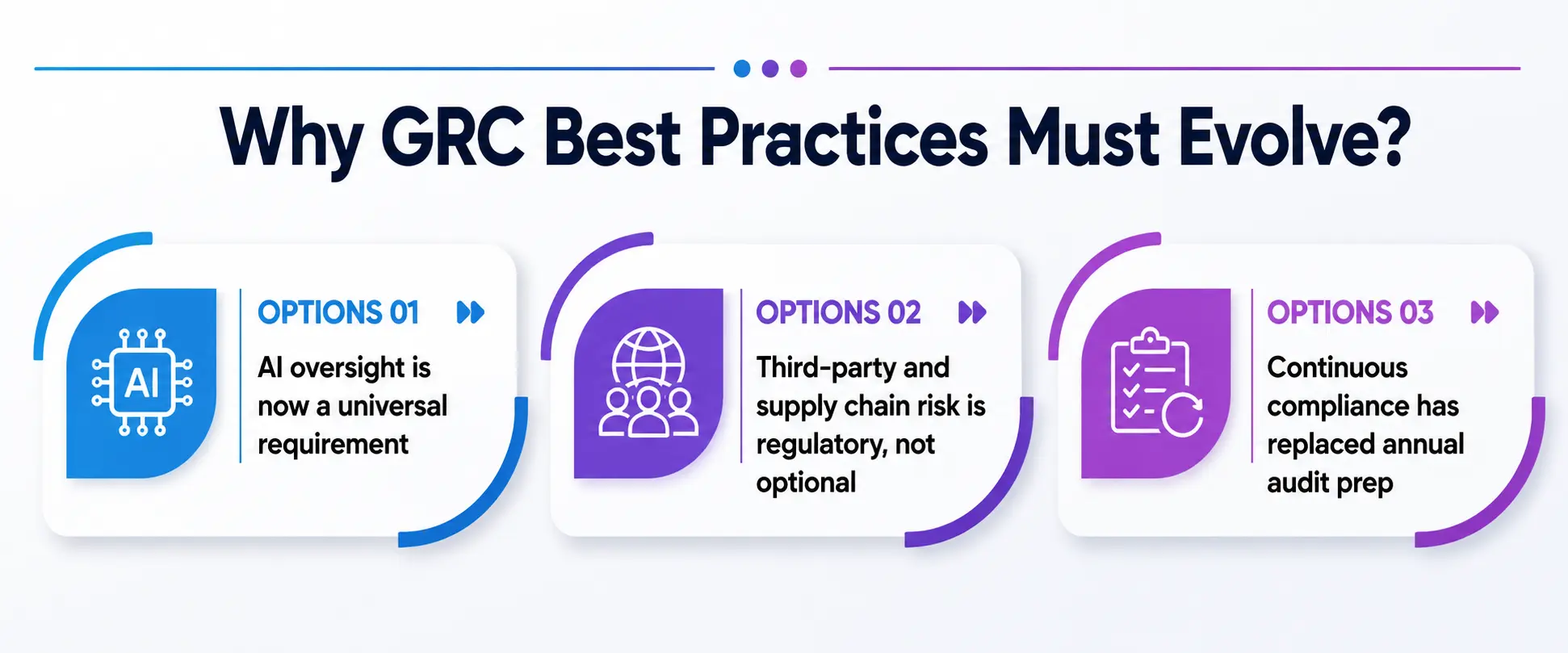
- AI oversight is now a universal requirement. Every sector deploying AI tools now needs risk assessment and bias monitoring baked into governance—it’s no longer just a tech company concern.
- Third-party and supply chain risk is regulatory, not optional. Frameworks like NIS2, DORA, and HIPAA have turned vendor risk oversight into a legal mandate rather than a nice-to-have.
- Continuous compliance has replaced annual audit prep. Point-in-time snapshots are giving way to real-time evidence generation, which changes how internal controls actually get built.
If you’re a student trying to break into risk, audit, or compliance roles, understanding this shift matters—employers aren’t just asking, “Do you know the frameworks?” They’re asking, “Do you understand why static compliance doesn’t work anymore?”
Core GRC Best Practices Every Organization Should Follow
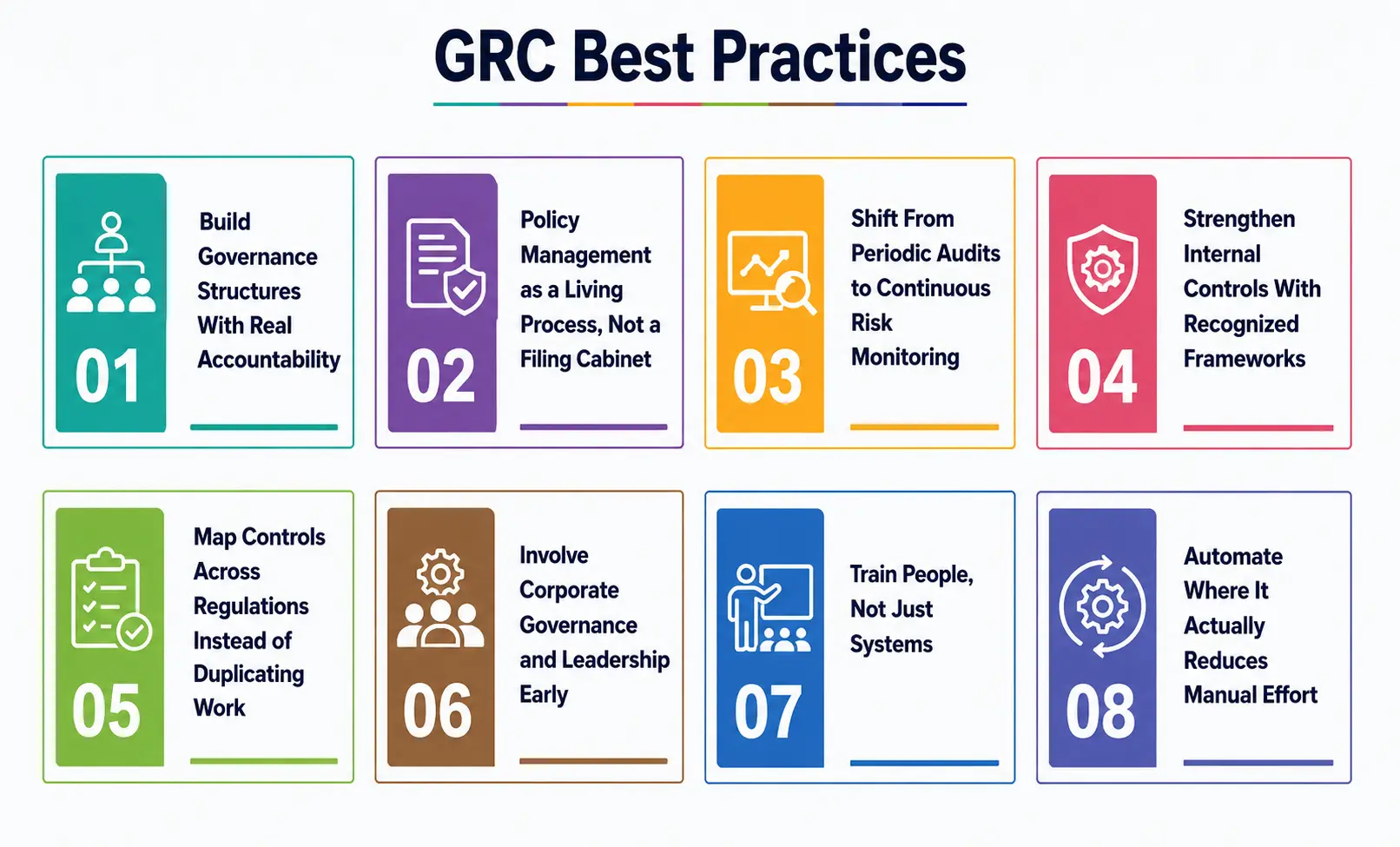
1. Build Governance Structures With Real Accountability
Strong risk governance starts with clarity: who owns which risk, who signs off on which decision, and where escalation happens when something goes sideways. Weak risk governance is rarely a knowledge problem — it’s an accountability problem. Vague ownership is the single most common reason GRC programs collapse in practice.
Good governance generally needs executive sponsorship, clear risk and control ownership, and defined escalation paths. Without that foundation, even beautifully written policies fall apart the moment they’re tested.
2. Policy Management as a Living Process, Not a Filing Cabinet
Policy management is not a document you write once and review only every three years when someone remembers. Policies need version control, clear ownership, planned review cycles, and a direct link to the regulations or internal standards that drive them.
If policy management is a one-time document exercise instead of a dynamic process, organizations end up enforcing old rules—which is arguably worse than no policy at all.
3. Shift From Periodic Audits to Continuous Risk Monitoring
This is probably the single biggest change in GRC best practices right now. Traditional compliance relied on periodic audits and reactive remediation—check the boxes once a year and hope nothing changes in between.
That model is breaking down. NIST’s guidance on continuous monitoring describes a near-real-time security lifecycle process that assesses controls and risk on an ongoing basis rather than through static, disconnected reviews. Risk monitoring done continuously — rather than quarterly — is what actually catches problems while they’re still small.
4. Strengthen Internal Controls With Recognized Frameworks
You don’t need to invent internal controls from scratch. Established frameworks exist precisely so organizations aren’t reinventing risk management logic every time they onboard a new business unit.
The COSO Internal Control–Integrated Framework is widely used to build a more holistic view of enterprise risk, while the NIST Cybersecurity Framework offers structured guidance for identifying, protecting against, detecting, and recovering from cybersecurity threats. Layering these over your existing governance model gives you internal controls that are actually defensible under audit, not just documented for appearances.
5. Map Controls Across Regulations Instead of Duplicating Work
Many organizations manage ISO standards, national cybersecurity mandates, and industry-specific regulatory compliance requirements as if they’re unrelated to broader regulatory compliance strategy. They’re not.
A single control — say, access management — often satisfies multiple regulatory obligations simultaneously. Mapping controls across frameworks instead of duplicating them for each regulation cuts audit fatigue dramatically and is one of the more underrated GRC best practices out there.
6. Involve Corporate Governance and Leadership Early
GRC only works when corporate governance treats it as a leadership responsibility, not something delegated entirely to a compliance officer in a back office. Boards are demanding clearer visibility into how risk is actually managed, which means risk reporting needs to reach leadership in a format they can act on — not buried in a 40-page spreadsheet nobody reads until something breaks.
Good corporate governance shows up in whether that reporting actually changes decisions, not just whether it exists.
7. Train People, Not Just Systems
Software can automate evidence collection, but it can’t build a risk-aware culture on its own. Training employees on their role in governance, risk, and compliance — even something as simple as knowing how to report a control failure — closes a gap that technology alone can’t fix.
8. Automate Where It Actually Reduces Manual Effort
Modern GRC platforms can automate access reviews, evidence collection, and control testing, freeing up your risk team to focus on judgment calls instead of repetitive documentation. Automation isn’t a replacement for governance — it’s a way to make continuous risk monitoring humanly sustainable.
GRC Best Practices at a Glance
|
GRC Best Practice |
What It Solves |
Common Mistake to Avoid |
|
Clear governance ownership |
Vague accountability during risk events | Leaving risk owners undefined until an incident forces the question |
|
Active policy management |
Outdated or ignored policies |
Treating policies as one-time documents instead of living processes |
|
Continuous risk monitoring |
Delayed detection of emerging risks |
Relying solely on annual or quarterly reviews |
|
Recognized control frameworks (COSO, NIST) |
Reinventing internal controls from scratch |
Building ad hoc controls with no framework backing |
|
Cross-regulatory control mapping |
Duplicated compliance work |
Managing each regulation in a separate silo |
|
Leadership involvement |
Poor visibility at the board level |
Treating compliance as a back-office function only |
|
Employee training |
Weak risk culture despite good tools |
Assuming software alone creates compliance awareness |
|
Selective automation |
Manual bottlenecks in evidence collection |
Automating without first fixing broken governance processes |
Common Mistakes That Undermine GRC Programs
Even well-intentioned organizations sabotage their own risk governance in predictable ways:
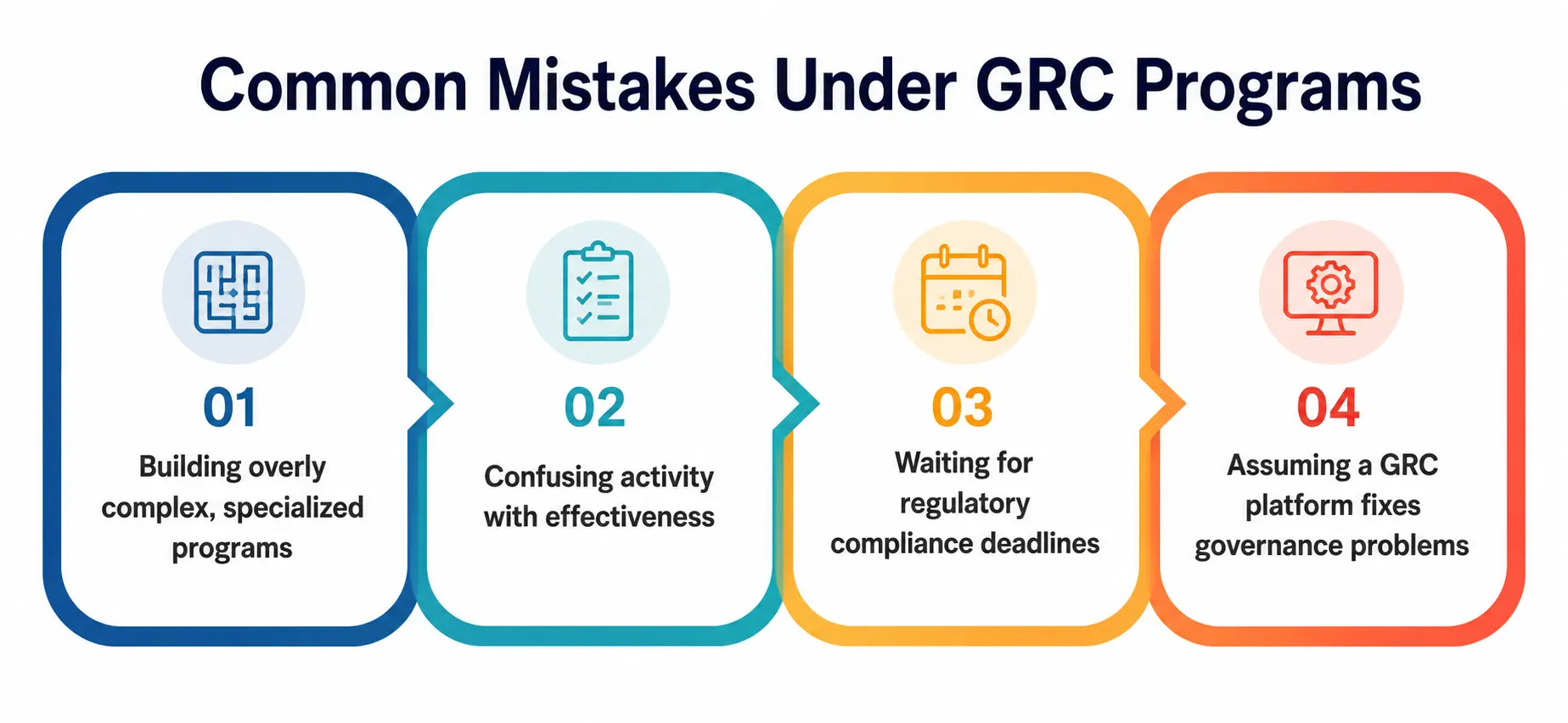
- Building overly complex, specialized programs instead of an integrated strategy—risk management, internal auditing, and compliance all operating as separate kingdoms.
- Confusing activity with effectiveness. Board reports that describe what the compliance team did, rather than what risk exposure actually looks like, create a false sense of security.
- Waiting for regulatory compliance deadlines to drive action instead of building monitoring that runs year-round.
- Assuming a GRC platform fixes governance problems. As one industry analyst put it, when decision rights are unclear and risk acceptance is informal, a GRC tool just automates the dysfunction faster — it doesn’t replace real governance.
How Can Students Apply This?
If you’re studying risk management, audit, or compliance, here’s the practical takeaway: Employers increasingly care less about whether you can recite framework names and more about whether you understand why fragmented GRC fails. Learn to read a risk register.
Understand the difference between a control that exists on paper and one that’s actually tested. Get comfortable with the idea that regulatory compliance isn’t a fixed target—it shifts as fast as the regulatory environment does, and NIS2, DORA, and AI governance rules are proof of that.
A Personal Note
I’ll be straight with you: GRC has a reputation for being dry, bureaucratic, and the kind of subject people study because it’s required, not because it’s interesting. I get it. But somewhere between the frameworks and the acronyms is a genuinely useful skill—the ability to look at an organization and see where it’s exposed before something breaks.
That’s not a boring skill. It’s the difference between a company that survives a regulatory shift and one that gets blindsided by it. If you’re a student working through this material, don’t just memorize the framework names. Ask yourself why each control exists and what failure it’s actually preventing, and you’ll find the subject a lot less abstract than it first appears.
At its core, this field is about risk governance and corporate governance done well enough that nobody downstream has to find out the hard way what was missing.