

Most people sign up for one of these credentials because they want a better job title. Few of them realize the certification itself is almost beside the point—it’s the skill-building process behind the exam that actually changes what you can do on a real network. Employers have noticed this gap too.
A recent Fortinet survey found that 92% of organizations would now pay for an employee to earn a certification, up sharply from 73% just a few years earlier. That shift tells you something important: companies aren’t paying for a certificate to frame on a wall. They’re paying for the specific, testable skills that come with it.
This guide walks through exactly what those skills are, why they matter in 2026’s threat landscape, and which certifications build them fastest—whether you’re taking a network security certification online while working a full-time job or starting from scratch through network security courses for beginners. By the end, you’ll know what a network security certification benefits you with beyond the resume line and which skills to prioritize first.
Why a Network Security Certification Matters in 2026?
The skills shortage behind this demand is not exaggerated. The most recent ISC2 Cybersecurity Workforce Study, based on responses from more than 16,000 professionals worldwide, found that 95% of respondents reported at least one critical skills gap on their team, up five points from the previous year, and 88% said their organization experienced a significant security event directly tied to a lack of skilled staff.
Meanwhile, global workforce growth slowed to just 0.1% in 2024—the weakest growth ISC2 has ever recorded—even as job postings in the US alone topped 514,000 over a 12-month stretch, per StationX’s skills gap statistics.
The shift toward AI is making this worse, not better. The same ISC2 study found that AI is now the single most in-demand critical skill at 41%, ahead of cloud security at 36%, because security teams are being asked to defend against AI-assisted attacks while most of their staff were trained on pre-AI threat models.
Put simply: there are more open roles than there are people who can prove they have the skills to fill them. A network security certification is the fastest, most standardized way to prove exactly that. It doesn’t just signal effort to a hiring manager—it forces you to build network security training skills in a structured order, rather than picking up fragments on the job and hoping they add up to something coherent.
Understanding the network security certification benefits up front makes it far easier to commit to the study hours ahead instead of losing momentum halfway through.
10 Skills You’ll Gain with Network Security Certification
Every reputable program builds toward the same practical core, even if the exam names and formats differ. Here’s what you actually walk away able to do once you’ve earned a network security certification.
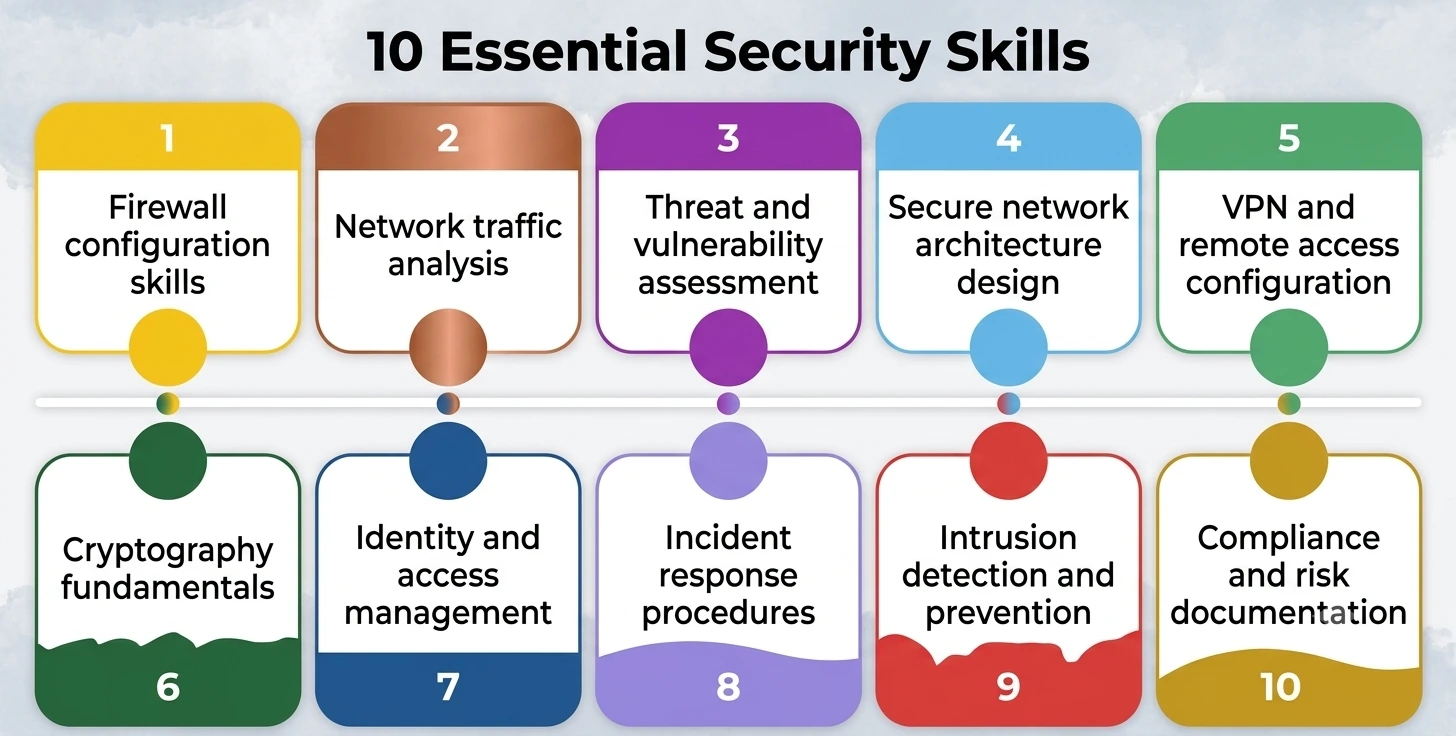
- Firewall configuration skills. You’ll learn to set up rule bases, segment traffic by zone, and configure next-generation firewalls like Palo Alto’s NGFW line to block malicious traffic without breaking legitimate business applications. This is one of the most hands-on, immediately hireable skills in the entire field.
- Network traffic analysis. You’ll be able to read packet captures, spot anomalies in flow data, and tell the difference between normal spikes in usage and the early signs of an intrusion.
- Threat and vulnerability assessment. You’ll learn how to scan a network for weak points, prioritize which vulnerabilities actually matter, and document findings in a way a non-technical manager can act on.
- Secure network architecture design. You’ll understand how to segment a network into zones, apply the principle of least privilege, and design topologies that limit how far an attacker can move after a single device is compromised.
- VPN and remote access configuration. With hybrid and remote work now permanent, you’ll learn to set up and troubleshoot secure tunnels that protect data without creating a backdoor into the rest of the network.
- Cryptography fundamentals. You’ll learn how encryption, hashing, and digital certificates actually protect data in transit and at rest, instead of treating “encrypted” as a vague buzzword.
- Identity and access management. You’ll gain the ability to design authentication systems, enforce multi-factor authentication, and apply role-based access so people only reach what their job actually requires.
- Incident response procedures. You’ll practice the exact sequence of steps—containment, eradication, recovery, documentation—that separates an organization that recovers in hours from one that takes weeks.
- Intrusion detection and prevention. You’ll learn to configure and tune IDS/IPS systems so they catch real threats without drowning your team in false alarms.
- Compliance and risk documentation. You’ll build the habit of mapping technical controls to frameworks like NIST or ISO 27001, which matters just as much to employers as the technical work itself.
Notice how that first skill and network traffic analysis show up early in that list—they’re consistently the two most tested, most job-relevant areas across every major network security certification on the market today, regardless of vendor.
Network Security Certification Online Options That Build These Skills
You don’t need to sit in a classroom to build any of the skills above. Most candidates now complete a network security certification online, through a mix of self-paced video modules, virtual labs, and proctored remote exams. A few programs consistently show up as the strongest starting points:
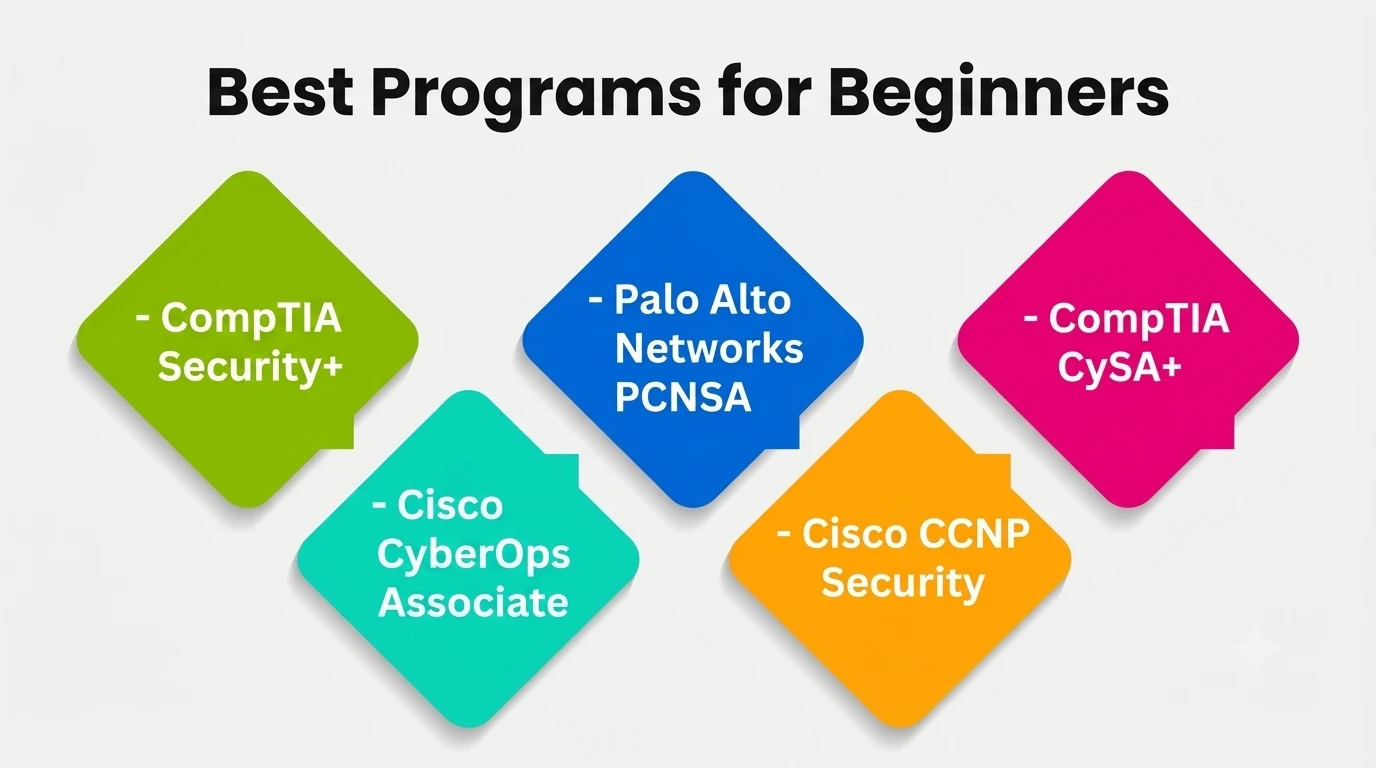
- CompTIA Security+—the most common entry point, covering threats, cryptography, and access control at a foundational level.
- Cisco CyberOps Associate—focused on monitoring, alerting, and incident response procedures for security operations work.
- Palo Alto Networks PCNSA—built specifically around configuring and operating next-generation firewall platforms from the ground up.
- Cisco CCNP Security—a mid-to-advanced credential covering secure network architecture, VPNs, and intrusion prevention.
- CompTIA CySA+—aimed at analysts who need behavioral analytics and vulnerability management skills.
Each of these can be completed as a network security certification online, which matters if you’re balancing study time around a job or coursework. The trade-off is self-discipline: without a classroom schedule forcing you forward, you have to build your own study rhythm.
Whichever path you choose, prioritize programs that let you practice network security training skills inside a live virtual lab, rather than ones that rely purely on multiple-choice review and flashcard-style memorization.
Network Security Courses for Beginners: Where to Start
If the list above feels overwhelming, start smaller. Good network security courses for beginners don’t try to cover everything at once—they build fundamentals first: basic networking (how IP addressing, routing, and DNS actually work), then move into security concepts like the CIA triad, common attack types, and basic firewall rules, before touching anything vendor-specific.
CompTIA’s Network+ or Security+ prep tracks are usually the right entry for network security courses for beginners, since both are vendor-neutral and assume no prior experience. Once those fundamentals are solid, moving into a vendor-specific track like Palo Alto’s or Cisco’s course material makes the hands-on firewall work click much faster, because you already understand what you’re configuring and why.
Skipping this step is the single biggest reason beginners feel lost halfway through a more advanced certification, and it’s also the most avoidable one—fundamentals are rarely the exciting part, but they’re what makes every later module make sense.
Network Security Certification Benefits at a Glance
Beyond the technical skills, there are concrete, measurable network security certification benefits worth knowing before you commit the study hours:
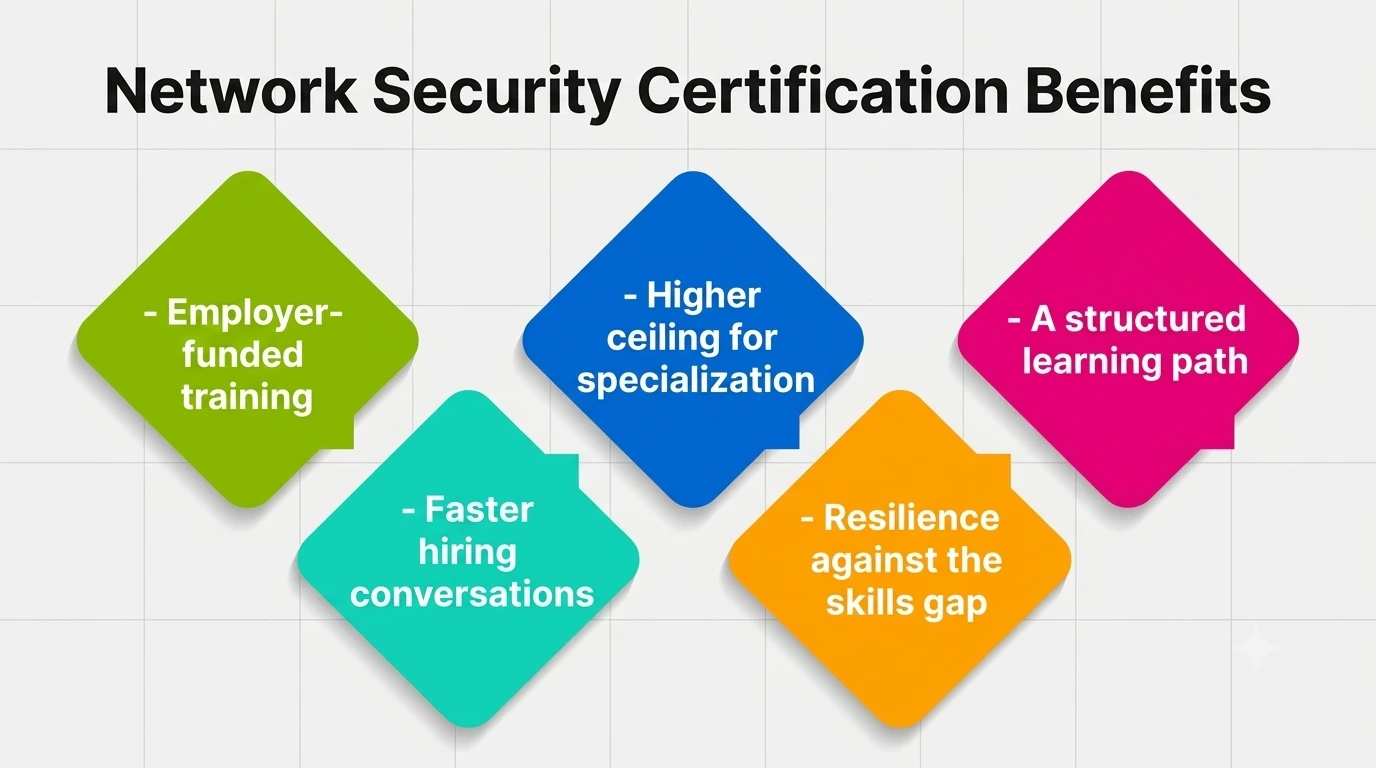
- Employer-funded training. 92% of organizations now say they’d pay for an employee’s certification, so this is a reasonable ask to bring to a manager rather than an out-of-pocket expense.
- Faster hiring conversations. A certification gives a recruiter a standardized way to verify baseline skill, which shortens the technical screening process considerably.
- Higher ceiling for specialization. Entry-level credentials open the door to advanced, higher-paying tracks like penetration testing or security architecture later on.
- Resilience against the skills gap. With 59% of organizations reporting critical or significant skills gaps, certified professionals are consistently the ones who get retained during budget cuts or layoffs.
- A structured learning path. Instead of guessing what to study next, the exam objectives tell you exactly which network security training skills to prioritize at each stage.
These network security certification benefits compound over a career—the first certification is rarely the last, and each one builds on skills the previous one already gave you.
Which Certification Builds Which Skill
|
Skill You Want |
Certification That Builds It Best | Format |
Typical Starting Point |
|
Firewall configuration skills |
Palo Alto PCNSA | Online, self-paced |
Intermediate |
|
Network traffic analysis |
GIAC GCIA | Online or instructor-led |
Intermediate/Advanced |
|
Threat and vulnerability assessment |
CompTIA CySA+ | Online, self-paced |
Intermediate |
|
Secure network architecture |
Cisco CCNP Security | Instructor-led or online |
Advanced |
|
Identity and access management |
CISSP | Instructor-led or online |
Advanced |
|
Incident response procedures |
Cisco CyberOps Associate | Online, self-paced |
Beginner/Intermediate |
|
Foundational security concepts |
CompTIA Security+ | Online, self-paced |
Beginner |
Read this table before registering for an exam, not after. Matching the certification to the specific skill you’re missing saves months of studying material you’ll rarely use on the job.
Firewall Configuration Skills and Other Hands-On Capabilities Employers Actually Test For
Of every capability on this list, firewall configuration skills get tested the most aggressively in real interviews, because they’re the hardest to fake. A hiring manager can ask you to walk through a rule base, explain why a particular rule order matters, or troubleshoot why legitimate traffic is being blocked — and there’s no bluffing your way through that without having actually done it in a lab.
This is also where network security training skills pay off the most directly. Virtual labs that simulate a live network let you break things safely, which is the only real way to learn why a misconfigured firewall rule causes more damage than having no rule at all. If your current study plan is all reading and no lab time, that’s the first thing to fix, regardless of which network security certification you’re working toward.
Common Mistakes When Choosing a Network Security Certification
- The most common mistake is going straight for an advanced credential like CISSP or OSCP without the networking fundamentals to support it. Exam content assumes you already understand TCP/IP, routing, and basic network topology — skipping that foundation means memorizing answers instead of understanding them, which falls apart the moment a real-world scenario doesn’t match the practice questions.
- The second mistake is choosing a certification based on name recognition alone rather than the actual skill gap on your resume. That credential is only as valuable as the skill it proves you have, so working backward from the job descriptions you actually want is a far better strategy than chasing whichever certification is trending this year.
- A third, quieter mistake is treating the exam as the finish line rather than the starting point — the skill only solidifies once you’ve actually used it on a real system, which is why continuing to lab after passing matters more than most study guides admit.
A Personal Note
I didn’t take my first certification exam because I felt ready — I took it because a job posting required it and I had three weeks to close the gap. What surprised me afterward wasn’t the credential itself; it was realizing I could finally read a firewall log and know what I was looking at, instead of nodding along in meetings. That’s the part nobody puts on the brochure. The letters after your name open the door, but the actual skill is what keeps you in the room once you’re there. If you’re on the fence about starting, stop waiting for the “right” certification and start with the one that fixes the biggest gap in what you can currently do.