


Everyone is writing more in 2026. Blog posts, newsletters, social media content, product descriptions, sales emails, documentation — the demand for written content has never been higher. The problem is that producing quality writing at that volume takes time that most people and teams simply don’t have.
AI text generation tools solve this. They draft content in seconds, maintain your voice across dozens of pieces, handle research-heavy writing, and help non-writers produce professional output. Writers using AI writing software complete first drafts up to 5x faster than manual writing alone.
But not all tools are equal. Some are genuinely excellent for specific use cases. Others are expensive wrappers around the same underlying models. This guide covers the 10 best AI text generation tools in 2026, what makes each one different, and where each falls short.
What Makes AI Text Generation Different in 2026
The AI text generation tools available in 2026 are fundamentally more capable than two years ago. The underlying models—GPT-5, Claude Opus 4.6, and Gemini 2.5—have crossed a threshold where output quality is genuinely useful for professional writing, not just rough drafts needing complete rewrites.
The key evolution is in long-form writing. Earlier AI tools were good at short content—social captions, email subject lines, and product descriptions. Holding a coherent argument across 2,000 or 3,000 words was inconsistent. In 2026, the best generative AI tools maintain structure, voice, and logical flow from introduction to conclusion reliably.
The other significant shift is workflow integration. The best content creation workflow tools now embed AI directly into where writers already work — inside documents, browsers, and publishing platforms. The friction of switching between tools is disappearing.
Quick Comparison Table
|
Tool |
Best For | Free Plan |
Starts At |
|
Claude |
Long-form quality writing | Yes |
$20/month |
|
ChatGPT |
Versatile all-purpose writing | Yes |
$20/month |
|
Gemini |
Research-heavy + Google Workspace | Yes |
$20/month |
|
Jasper |
Marketing teams + brand voice | No |
$49/month |
|
Copy.ai |
Copywriting + sales content | Yes |
$36/month |
|
Writesonic |
Blog writing + SEO | Yes |
$20/month |
|
Surfer SEO |
Content optimization | No |
$89/month |
|
Notion AI |
Docs-integrated writing | Yes |
$10/month |
|
Sudowrite |
Fiction + creative writing | No |
$22/month |
|
Grammarly |
Writing enhancement + editing | Yes |
$12/month |
Top 10 AI Text Generation Tools Reviewed
AI text generation tools have evolved beyond simple writing assistants, helping users create blogs, marketing copy, emails, scripts, and more. With so many options available, choosing the right one can be challenging.
1. Claude — The Best AI for Quality Long-Form Writing
In hands-on testing published by multiple independent reviewers in 2026, Claude produces longer, more coherent, and more nuanced output than any other AI text generation tool for long-form work. Claude remembers the arc of a piece and keeps it coherent from introduction to conclusion—maintaining tone, argument structure, and voice consistently across the full document.
Claude’s Projects feature allows writers to maintain persistent context across sessions—keeping brand voice guidelines, style preferences, and background active without re-entering them. For long-form writing like articles, essays, technical documentation, and thought leadership content, this coherence is what separates Claude from tools that produce grammatically correct but structurally fragmented content. For freelancers managing multiple client voices, it is one of the most practical AI writing software features available.
Pricing: Free tier available with rate limits. Claude Pro at $20/month for full access.
Good fit for: Long-form writers, journalists, content strategists, technical writers, and anyone who considers writing quality their primary metric.
Where it falls short: Narrower tool ecosystem than ChatGPT. No built-in image generation. No native SEO integration. Free tier rate limits are tighter than ChatGPT’s free plan.
2. ChatGPT — The Most Versatile AI Writing Software
ChatGPT is not the best AI text generation tool for any single thing. It is the best tool for people who do many different things. GPT-5’s writing capability, combined with built-in web browsing, DALL-E image generation, Python code execution, and custom GPTs for specific workflows, makes it the most complete writing workspace in 2026.
For automated blog writing, ChatGPT’s deep research mode pulls current statistics and sources automatically, producing drafts with up-to-date references. Custom GPTs let teams build writing assistants that understand their specific product, audience, and voice without technical expertise. ChatGPT is the choice for writers who move between brainstorms, emails, ad copy, and research throughout the day.
Pricing: Free version available. ChatGPT Plus at $20/month for GPT-5 and all features.
Good fit for: Writers who need multiple capabilities in one place, teams building custom AI writing workflows, and anyone whose work spans many content types in a single day.
Where it falls short: Without strong prompting, output can feel generic. For work demanding a specific voice or literary quality, ChatGPT requires more coaching than Claude.
3. Gemini — Best for Research-Driven Writing in Google Workspace
If your writing involves heavy research or large source documents, or if you live inside Google Docs and Gmail, Gemini has a structural advantage. The 2 million token context window processes entire research papers, full manuscripts, multi-hour transcripts, and large content libraries—then synthesizes them into coherent summaries or new articles.
Gemini’s deep integration with Google Workspace means it works directly inside Docs, Gmail, Slides, and Sheets — making it the most friction-free AI writing software for organizations already on Google’s platform. For automated blog writing workflows drawing from research and internal documents, Gemini handles the research layer better than any alternative.
Pricing: Free tier available. Gemini Advanced at $20/month as part of Google One AI Premium.
Good fit for: Researchers, journalists, organizations using Google Workspace, and content teams whose writing process is research-heavy.
Where it falls short: Sometimes declines tasks that Claude and ChatGPT handle without issue. Writing quality trails Claude for purely literary or narrative long-form writing.
4. Jasper — The Marketing Content Workflow Platform
Jasper is not the best AI text generation tool for raw writing quality — that’s Claude or ChatGPT. What Jasper does better is production at scale. Its Brand Voice feature reads your existing content, infers your tone and style, and maintains consistency across everything generated—so the 50th piece of content sounds like the first.
For marketing teams producing dozens of assets every week, Jasper’s campaign manager, template library, and team collaboration features address the real problem: not writing one good post but maintaining brand consistency at volume. Companies like Akbank, Adidas, and Cushman and Wakefield use Jasper for large-scale content creation workflow operations.
Pricing: Creator plan at $49/month. Pro at $69/month. No free tier.
Good fit for marketing teams producing high volumes of content and organizations where brand voice consistency is critical across multiple writers.
Where it falls short: Expensive relative to using the underlying models directly. Jasper’s revenue has declined since 2023 as teams realize raw models can match most outputs with good prompting.
5. Copy.ai — Copywriting Software for Sales and Marketing
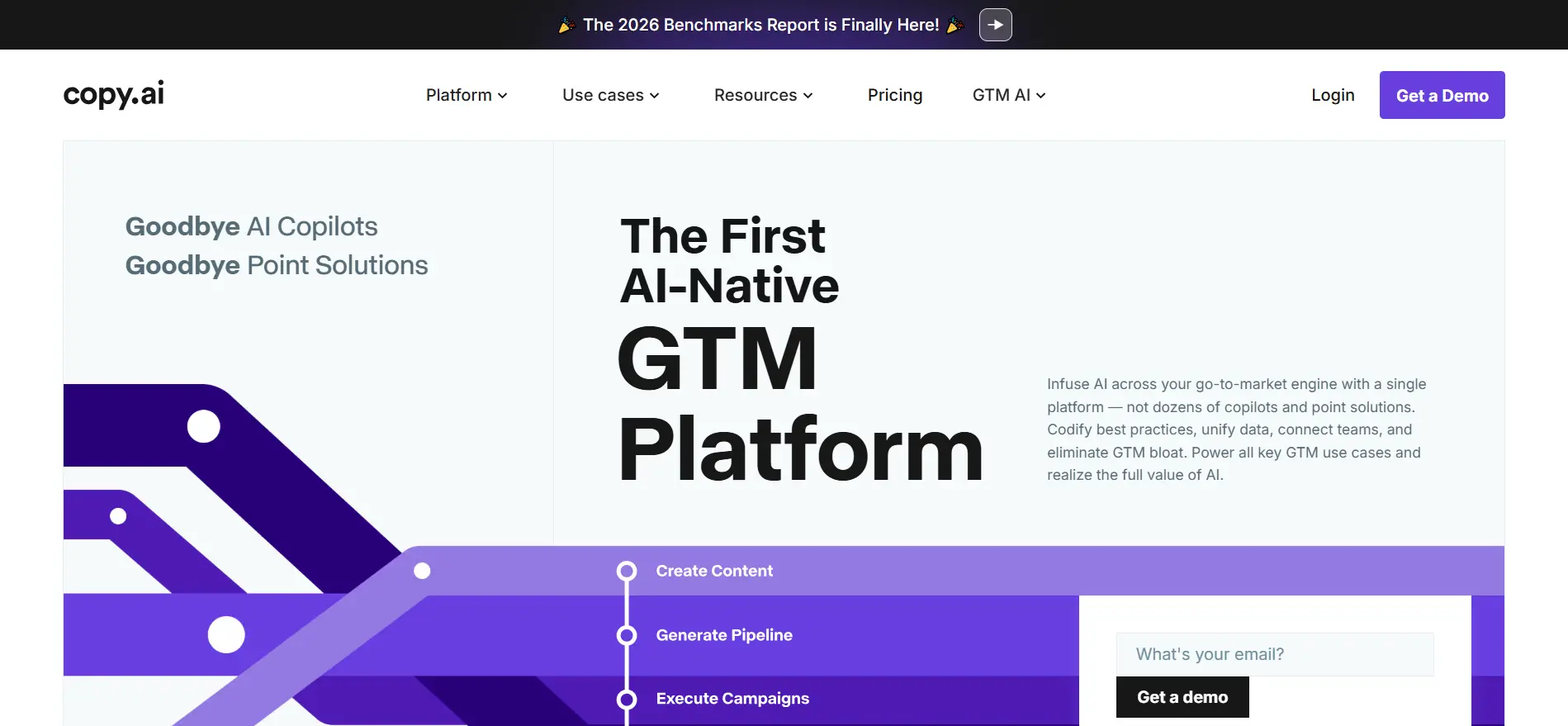
Copy.ai focuses specifically on copywriting software for sales and marketing use cases—landing pages, email sequences, ad variations, and product descriptions. The Go platform added multi-step workflow automation, allowing teams to build repeatable content processes that run from brief to finished copy without manual steps.
For teams producing large numbers of similar pieces—50 ad variations, 200 product descriptions, monthly email campaigns—Copy.ai’s workflow automation turns hours of work into minutes. This is where its improved writing productivity capability is strongest for high-volume, formulaic content.
Pricing: Free plan available. Starter at $36/month. Advanced at $186/month.
Good fit for: sales and marketing teams, e-commerce businesses producing large volumes of product copy, and teams needing copywriting software workflows rather than a general writing assistant.
Where it falls short: Not designed for long-form editorial content. Claude or ChatGPT produces better results for blog posts, essays, or thought leadership.
6. Writesonic — Automated Blog Writing With SEO Built In
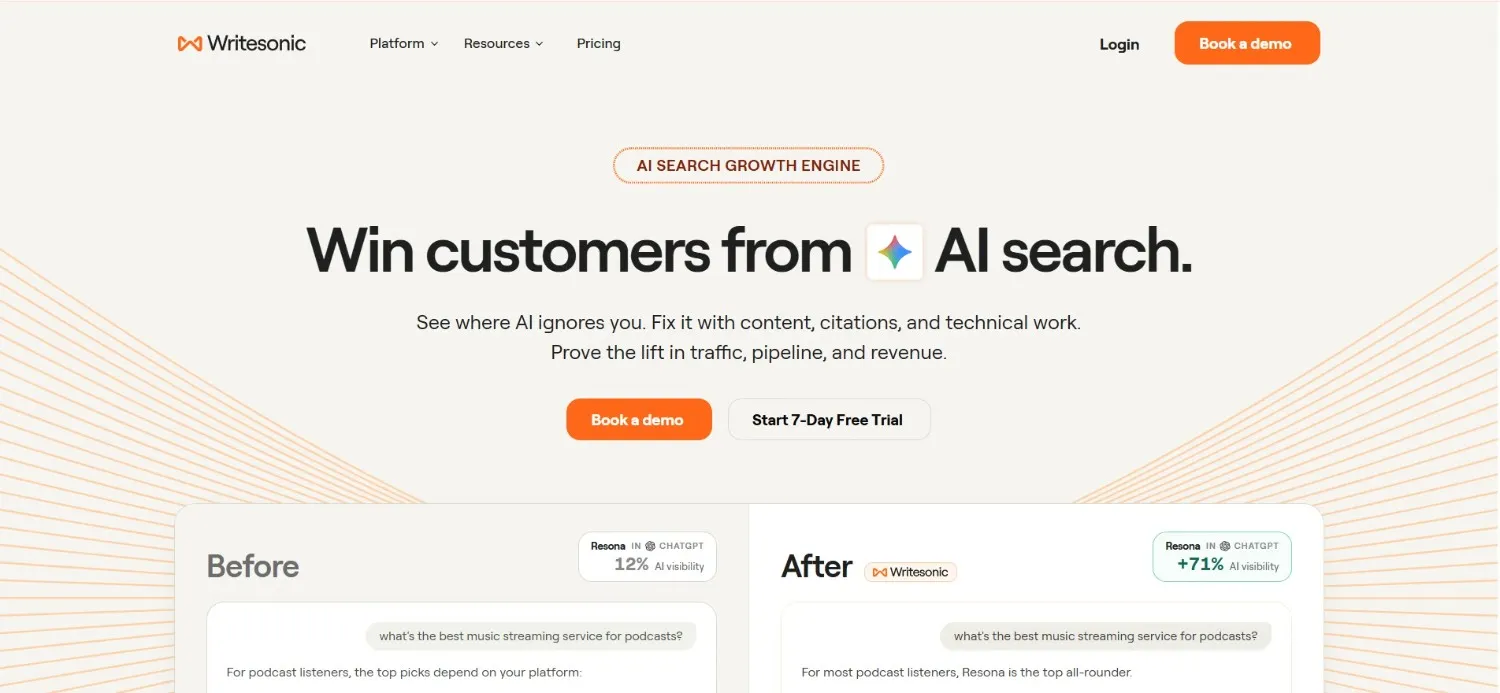
Writesonic combines AI text generation tools for blog writing with integrated Surfer SEO optimization — meaning you take a keyword from input to SEO-optimized draft in a single workflow. For teams managing a blog as their primary marketing channel, this integration compresses the content creation workflow significantly.
The Article Writer 6.0 generates long-form content with proper structure, headers, and keyword optimization built into the initial draft. For teams wanting automated blog writing with SEO optimization in the same platform, Writesonic eliminates the constant tool-switching between writing and optimization.
Pricing: Free plan available. Individual at $20/month. Standard at $49/month.
Good fit for: Content marketers focused on organic search traffic, bloggers needing regular output, and teams wanting automated blog writing with SEO optimization in one place.
Where it falls short: Output quality trails Claude for pure writing quality. SEO integration creates value, but output benefits from human editing before publishing.
7. Surfer SEO — Content Optimization for Ranking

Surfer SEO is technically an optimization tool rather than a pure AI text generation tool, but in 2026 it has become essential infrastructure for any team whose content depends on organic search. It analyzes the pages currently ranking for any keyword and tells you exactly how to structure your content to compete.
In 2026, Surfer’s biggest evolution is toward answer engine optimization—structuring content to appear in AI-generated search overviews, not just traditional Google results. For any content creation workflow built around SEO, Surfer is the optimization layer that makes generative AI tools useful for search. A real-time score updates as you write, showing when content is ready to publish.
Pricing: Essential plan at $89/month. No free plan.
Good fit for: Bloggers, content marketers, and SEO teams where organic traffic is the primary goal and anyone who wants AI writing software output to actually rank on Google.
Where it falls short: Optimization-focused — not a writing tool on its own. Best combined with a strong writing tool like Claude or ChatGPT for maximum value.
8. Notion AI — Writing Where Your Work Already Lives

Notion AI brings AI text generation tools directly into the workspace where many knowledge workers already manage their notes, projects, and documentation. Instead of switching to a separate tool, Notion AI generates, edits, and summarizes content inside existing Notion pages.
For teams managing a content creation workflow inside Notion, it’s the most seamless AI writing experience available. Notion AI generates first drafts, writes meeting note summaries, fills in templates from brief descriptions, and translates content — all without leaving the workspace.
Pricing: Notion AI add-on at $10/user/month. Free Notion plan available.
Good fit for: Teams using Notion as their primary workspace and individuals who want AI writing assistance without leaving their note-taking environment.
Where it falls short: Writing quality trails Claude and ChatGPT for complex content. Best as a convenience layer for existing Notion users rather than a primary AI writing tool.
9. Sudowrite — The Best AI for Creative Writing
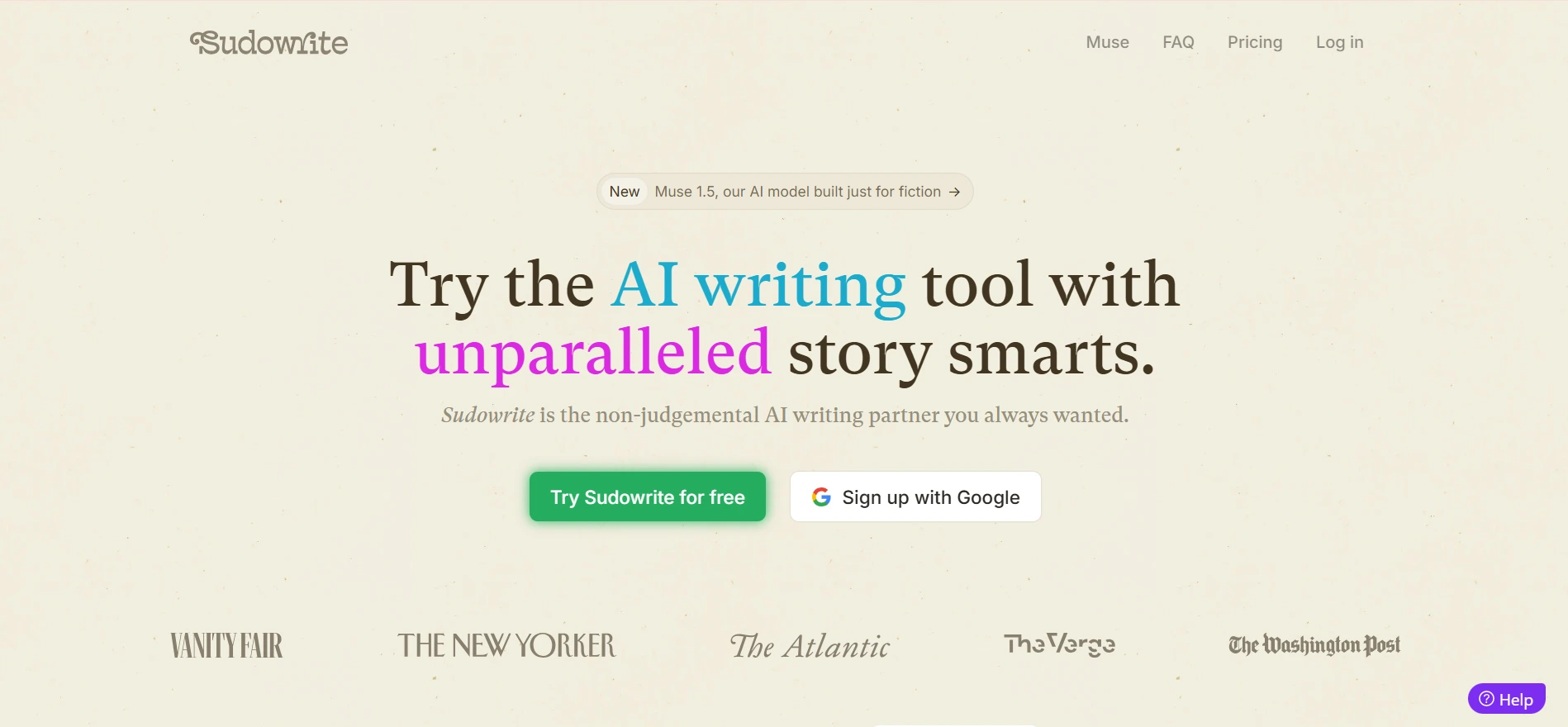
Sudowrite is the only AI text generation tool on this list built exclusively for fiction and creative writing. Every feature exists to help writers write better stories — not marketing copy, not business documents.
The Story Bible feature maintains character details, world-building rules, and plot threads across a full manuscript. The Rewrite feature offers multiple variations of any passage with different tones and pacing. For genre writers—fantasy, romance, thriller, science fiction—Sudowrite’s training and feature set outperform general-purpose generative AI tools that treat creative writing as just another content type.
Pricing: Hobby plan at $22/month. Professional at $44/month.
Good fit for: Fiction writers, novelists, screenwriters, and anyone whose primary writing is storytelling rather than professional or marketing content.
Where it falls short: Purpose-built for fiction — not useful for marketing, business, or SEO content. Expensive relative to what general AI tools provide for creative writing assistance.
10. Grammarly — The AI Writing Enhancement Layer
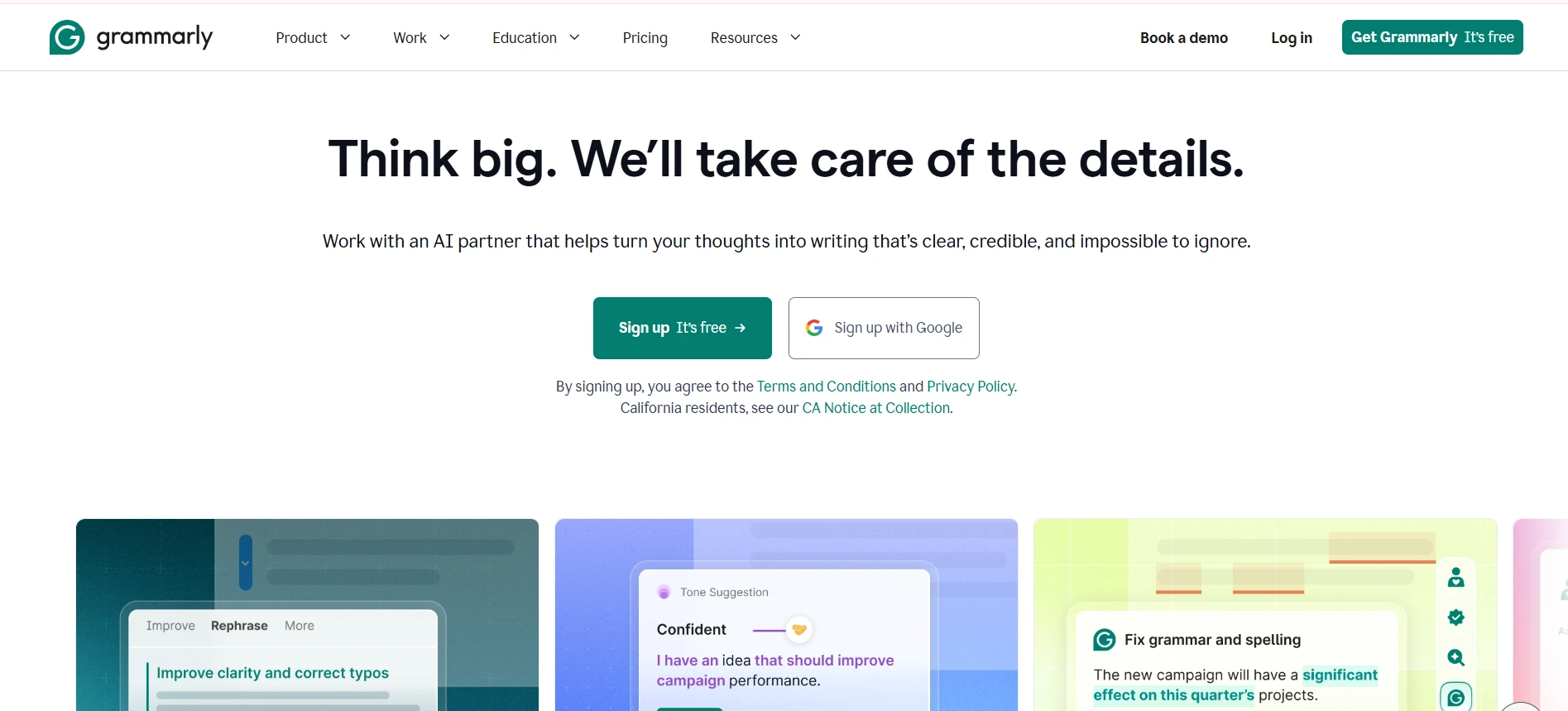
Grammarly occupies a different position than every other tool on this list. It doesn’t generate text from scratch—it makes text you’ve already written significantly better. In 2026, Grammarly has expanded from grammar correction into full-document editing, tone adjustment, clarity improvements, and rewrite suggestions at the paragraph level.
For teams using any of the AI text generation tools above, Grammarly functions as the final pass that catches what the AI missed — awkward phrasing, unclear sentences, and inconsistent tone. Adding Grammarly Premium to a Claude or ChatGPT subscription creates a complete writing stack that improves writing productivity at $32/month total.
Pricing: Free plan covers basic grammar. Grammarly Premium at $12/month. Business at $15/user/month.
Good fit for: Every writer, regardless of which AI writing software they use. Grammarly provides the editing layer without requiring manual proofreading of every draft.
Where it falls short: Editing only — Grammarly doesn’t generate content from prompts. Some writers find style suggestions overly conservative compared to their intentional voice choices.
Building Your AI Writing Stack
The smartest approach in 2026 is not picking one AI text generation tool — it’s building a small stack where each tool solves a specific problem.
For most individual writers, Claude Pro ($20/month) plus Grammarly Premium ($12/month) covers 90% of writing needs. Claude handles the drafting. Grammarly handles the polish.
For SEO content teams: Claude or ChatGPT for drafting plus Surfer SEO for optimization covers the full content creation workflow from prompt to publishable post.
For marketing teams: Jasper for brand-voice management and campaign templates. Claude or ChatGPT for higher-quality individual pieces where tone matters most.
For fiction writers: Sudowrite. No other tool handles the specific challenges of long-form writing for narrative the way it does.
For Google Workspace teams: Gemini is the path of least friction — inside the tools you already use.
Final Thoughts
AI text generation tools in 2026 are not a replacement for writers — they are a productivity multiplier. The writers producing the most output, the fastest, without sacrificing quality are the ones who use AI for mechanical writing tasks—first drafts, structural outlines, and research synthesis—and apply their own voice to the parts that matter.
The biggest mistake is treating all AI writing software as interchangeable. Claude and ChatGPT write differently. Jasper solves a different problem than Surfer. Sudowrite exists for a use case the other nine tools handle poorly. Picking the right tool for your specific situation determines whether AI actually helps your writing.
Start with a free trial of Claude and ChatGPT. Run the same writing task through both. You’ll know within one session which one fits your voice.