
Artificial intelligence is not something only IT teams need to worry about. Companies are using AI to screen job applicants, find fraud, look at how customers act, write reports, help workers, and choose what to do. As more companies use AI, another question comes up: when an AI system makes a decision that puts the company in danger, who’s in charge?
That is where AI governance steps in. AI governance is emerging as an important new area for GRC professionals, considering that artificial intelligence may impact nearly every aspect of an organization’s risk and compliance universe.
Even with strong cybersecurity, privacy, and controls over access, an organization can still be exposed to significant risk if it does not have a clear understanding of how its artificial intelligence (AI) systems are developed, purchased, used, and monitored.
Why exactly does AI governance matter?
AI governance can be defined as the framework by which an organization controls the risks and responsibilities of artificial intelligence. It addresses practical questions like
- What AI systems are being used?
- Who owns each system?
- What information does the system use?
- What decisions does it affect?
- What are the risks of using it?
- How do you monitor its performance?
- What if the system produces an incorrect or harmful outcome?
This is a radical departure from traditional IT governance. Traditional programs work based on business rules that are set in advance. This creates risks that’re not there with regular software.
For example, an AI system for hiring might pick people based on the company’s past hiring records. If those old records have bias, the AI system might even make that bias worse. The system might be working, technically, as it should. It could still cause a bad business result.
That is why AI governance means companies have to think in such a way about how technology works. The important question is whether it is right, easy to understand, safe, fair, and able to be held responsible for the job it is meant to do.
Why AI creates a different risk profile
One of the challenges with AI is that the risk does not necessarily sit in one department. The technology team may be responsible for integration and security. The legal team may be concerned about privacy and regulatory obligations.
The business team may focus on accuracy. Information security may examine data leakage. Internal audit may want evidence that appropriate controls exist. All of these concerns relate to the AI system. This makes AI governance inherently cross-functional.
Another challenge is that AI systems can introduce risks throughout their lifecycle. Risk can arise during development, procurement, implementation, and deployment, even after the system has been operating for months.
For example, a model may perform well when initially deployed but become less reliable as the underlying data or business environment changes. Therefore, AI risk management cannot be treated as a one-time approval exercise.
The major categories of AI risk
A GRC professional does not necessarily need to understand the logic behind machine-learning models. However, they need to think about the categories of risk.
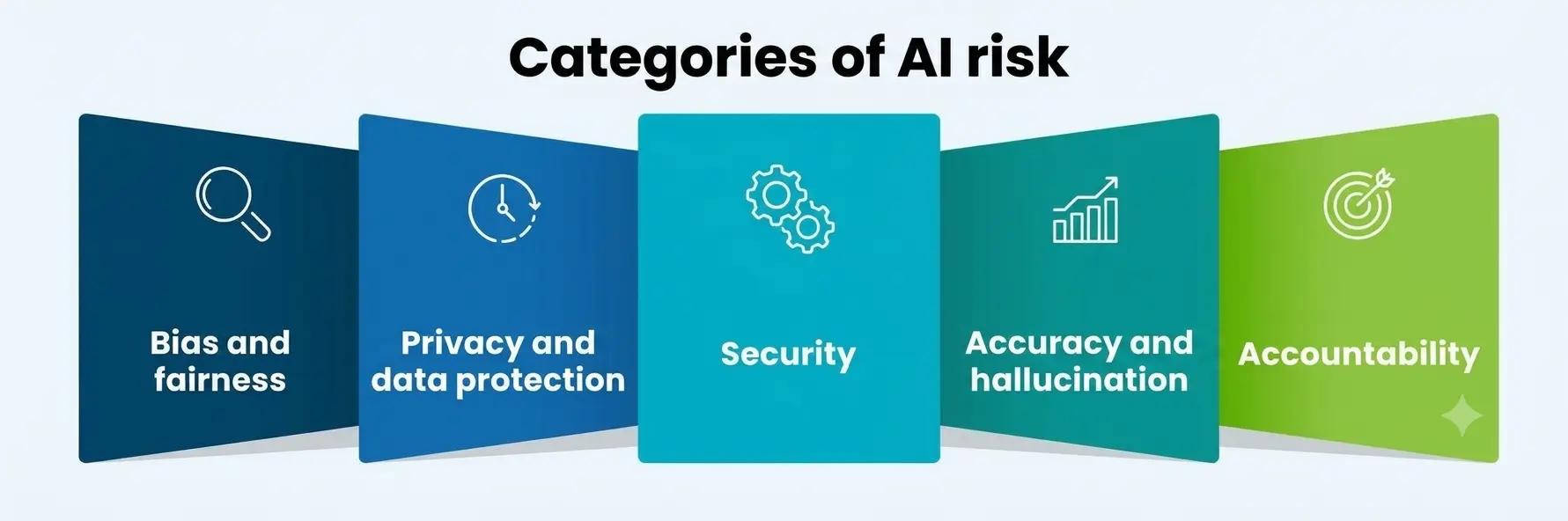
1. Bias and fairness
- AI systems learn from data, and data can contain existing biases.
- If an organization uses an AI model to evaluate loan applications, recruitment candidates, or insurance claims, biased training data could result in biased outcomes.
- A GRC professional should therefore ask whether the organization has identified bias and whether appropriate testing is performed.
2. Privacy and data protection
- AI systems can process large amounts of information, including personal and confidential data.
- An employee may enter customer information into a public generative AI tool without realizing that doing so could create a data protection issue.
- The risk becomes even greater when organizations start using 3rd-party AI platforms.
- GRC teams therefore need to understand what data is entering the AI system, how and where it is processed, who is authorized to access it, and what the retention period is.
3. Security
- AI systems themselves can become targets.
- Attackers may attempt to spoof the inputs to exploit the vulnerabilities in AI applications or obtain information through carefully constructed prompts.
- Organizations also encounter the risk of employees using AI tools, sometimes referred to as shadow AI.
- For example, an employee could upload a document to an external AI service to summarize it. From the employee’s perspective, this may seem harmless. From a security perspective, it could represent a transfer of organizational information.
4. Accuracy and hallucination
- Generative AI systems can produce answers that look convincing but are not correct based on the facts.
- This raises a risk when using AI for decision-making initiatives.
- AI output should not automatically be treated as authoritative simply because it sounds confident.
- The level of review should depend on the severity of the risk and also on which category the risk belongs to.
5. Accountability
- Perhaps the important governance question is, who is accountable for an AI-driven decision? An organization cannot simply blame the algorithm.
- If an AI system makes a recommendation that results in financial or regulatory consequences, responsibility still needs to sit with identifiable people and governance functions. This is why AI governance needs defined roles and responsibilities.
What should a GRC professionals actually test?
This is where AI governance becomes practical.
A GRC professional could ask whether the organization is able to identify its artificial intelligence systems and their use cases.
- Business and tech owners are assigned to standard artificial intelligence systems. AI risks are being formally assessed. Sensitive data is adequately protected. We do due diligence on AI vendors. Additional consent for high-risk areas of risk. There is proper human supervision. Report and investigate AI-related incidents. Control changes to model, data, or configuration.
- Employees receive AI-related awareness training.
- Evidence exists to demonstrate that controls are effectively operating.
The exact controls will depend on the organization and their use case. The important point is that AI governance should be evidenced, not merely documented.
A policy saying that AI systems must be reviewed is not enough. A GRC professional needs to determine whether those reviews actually happen and whether there is evidence supporting them.
The biggest mistake: treating AI governance as an IT problem
AI governance cannot succeed if it is delegated entirely to the technology department.
The board and senior management need to see the big AI risks. Business owners need to know what they have to do. Technology teams need the right technology controls. Legal and compliance teams need to know what they are required to do. An internal audit must have knowledge sufficient to provide independent assurance. The GRC professional can play an important role in connecting these functions.
The future role of the GRC professional
AI is changing the GRC profession itself. GRC professionals who previously focused mainly on traditional IT controls may increasingly encounter AI-related risks during audits, risk assessments, and compliance reviews.
The expectation is not that every GRC professional becomes a machine-learning engineer. Rather, they must possess sufficient AI literacy in order to ask the right questions. They should be able to determine the use of the AI system, potential problems, risk ownership, controls, and testing of controls.
This is the difference between AI governance as documentation and AI governance as a management discipline.
- Artificial intelligence is becoming an integral part of daily business processes and is therefore associated with risk. The problem for organizations is that they cannot do away with risks that arise as a result of AI. This would be unrealistic. What they have to do is identify these risks, put in place appropriate controls, and ensure accountability in the entire process. From the perspective of GRC professionals, this means possessing AI literacy in addition to traditional literacy in risk, controls, compliance, and assurance.
- Ultimately, AI governance is all about one core concept—organizations must remain accountable for AI usage, regardless of the machines’ role in decision-making. The GRC professionals who understand this shift will be better positioned to evaluate not only whether an organization is compliant but also whether its use of AI is genuinely controlled, responsible, and aligned with business objectives.