

If you’ve spent any time scrolling job boards lately, you’ve probably noticed the same pattern I have: almost every well-paid tech listing in Canada mentions “cloud” somewhere in the title. That’s not a coincidence, and it’s not hype either.
Canadian companies—banks, retailers, universities, and government agencies—have spent the last few years moving their infrastructure off old servers and onto AWS, Azure, and Google Cloud, and now they need people who can build, secure, and run that infrastructure. The result is a steady, well-documented rise in cloud and IT pay figures across almost every province.
This guide breaks down what that pay actually looks like in Canada right now, using 2026 figures rather than recycled numbers from a few years back. We’ll look at how architect-level pay differs from administrator-level pay, what engineering roles earn compared to general IT work, how compensation in these roles is actually built, and what your long-term growth path looks like for someone starting out today.
If you’re a student deciding whether this field is worth the time or a working professional wondering whether a certification would move your paycheck, this is written for you.
Why Is the Cloud Computing Salary in Canada Climbing?
Before getting into specific numbers, it helps to understand why pay in this field has moved upward so consistently rather than assuming it’s just another tech buzzword inflating headlines. A few forces are driving it at once:
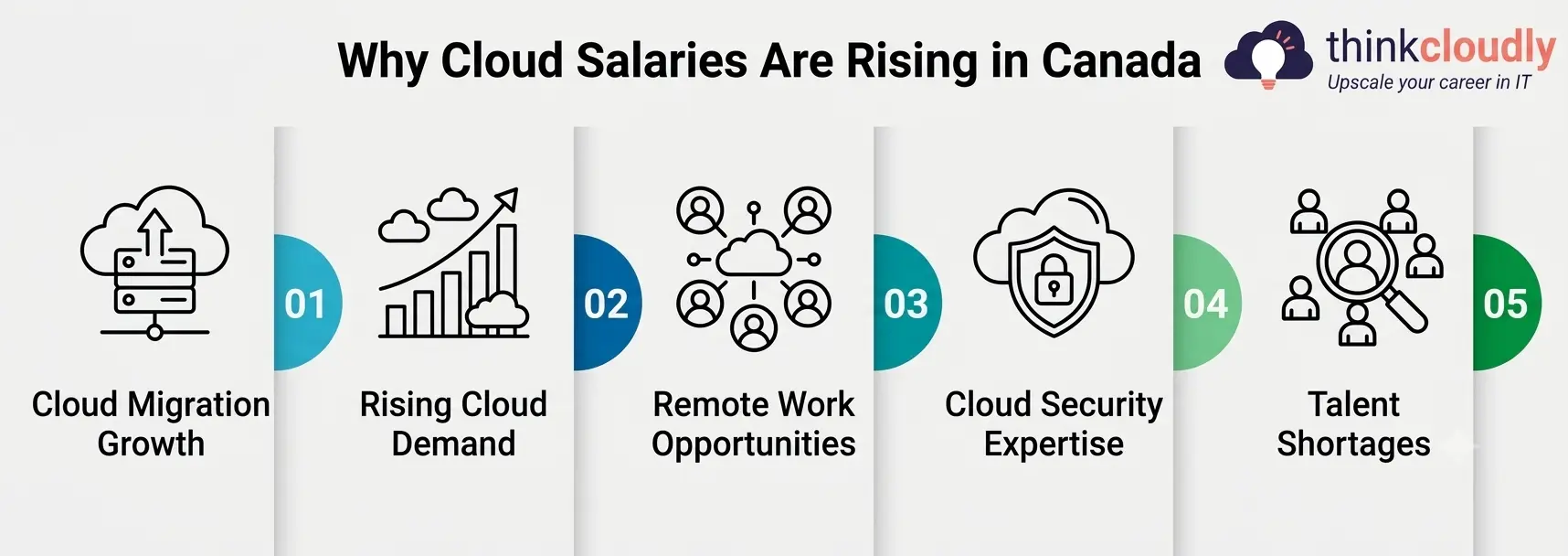
- Canadian enterprises are accelerating cloud migration projects, which creates sustained demand for people who can manage that transition safely
- AWS, Microsoft Azure, and Google Cloud all run active partner and training programs in Canada, which has widened the hiring pool but hasn’t slowed demand
- Remote and hybrid roles let Canadian employers compete for talent against US companies, which has pushed local compensation closer to American benchmarks
- Cybersecurity and compliance requirements have made cloud governance a specialized, higher-paying skill rather than a generalist task
- Skilled-worker shortages in mid-career cloud roles mean experienced professionals can negotiate well above entry-level pay bands
None of this means every cloud job pays the same, though. The specific title, your years of hands-on experience, and your province all move the number meaningfully, which is exactly why a single average doesn’t tell the whole story.
Cloud Computing Salary in Canada: The Big Picture
The average cloud computing salary across the country currently sits at roughly $103,649 per year, with base pay typically landing between $77,000 and $115,000 and total compensation (including bonuses) ranging from about $67,600 up to $166,500 depending on seniority and employer.
That’s a wide band, and it reflects how differently this figure gets defined depending on whether you’re talking about an entry-level cloud support technician or a senior architect with a decade of enterprise experience.
The table below lines up the most common cloud roles so you can see where your current title—or the one you’re aiming for—actually sits.
|
Role |
Average Annual Salary (CAD) | Typical Range (CAD) |
Source |
|
Cloud Computing (general) |
$103,649 | $67,633 – $166,573 |
Glassdoor Canada |
|
Cloud Architect |
$133,154 | $96,940 – $182,895 |
Indeed, Canada |
|
Cloud Engineer |
$113,213 | $82,116 – $156,085 |
Indeed, Canada |
|
Cloud Administrator |
$92,750 (midpoint) | $75,000 – $107,750 |
Robert Half Canada |
|
Systems Administrator (Cloud skills) |
$85,897 | Entry-to-midband |
Payscale Canada |
Two things jump out from that table.
- First, a cloud architect salary sits well above general cloud computing salary averages, because architects carry design responsibility across an entire environment rather than executing a narrower, defined task.
- Second, the cloud administrator salary band overlaps with general systems administration pay, which tells you that simply adding “cloud” to your resume isn’t enough—employers are paying for depth, not a buzzword.
Cloud Architect Salary: Why It Sits at the Top
Of every title in this guide, cloud architect salary numbers are consistently the highest, and the reason isn’t mysterious once you look at what the role actually does. This pay reflects years of accumulated judgment—the ability to design a multi-region environment, choose the right services for cost and reliability, and make decisions that an entire engineering org will live with for years.
Canada reports an average base of $133,154 annually, with experienced architects in major hubs like Toronto and Vancouver pushing well past $180,000 once bonuses and equity are included.
What tends to separate a strong cloud architect salary from an average one isn’t certifications alone, though they help. Its scope. An architect responsible for one application’s infrastructure earns differently than one responsible for an entire organization’s multi-cloud strategy. If you’re aiming for the top of that range, broadening your exposure—networking, security, cost governance, and disaster recovery—matters more than collecting another badge.
Cloud Administrator Salary: A Realistic Entry and Mid-Career Path
A cloud administrator salary tends to get overlooked in career conversations because it sounds less glamorous than “architect” or “engineer,” but it’s actually one of the more realistic paths into this field. Robert Half Canada lists a national range of $75,000 to $107,750 for these roles, with the midpoint around $92,750 depending on experience and the complexity of the environment being managed.
The appeal of this path is that it doesn’t require architect-level design experience to get started, but it still builds the operational muscle—monitoring, access management, patching, cost tracking—that eventually feeds into higher-paying roles.
Plenty of people treat cloud administration as a two-to-three-year stepping stone rather than a permanent ceiling, and the pay structure in most companies reflects that: raises tend to come faster here than in flatter, more specialized roles, precisely because administrators are expected to grow into broader responsibility over time.
Cloud Engineering as a Career Scope Decision
Cloud engineering sits in an interesting middle position in this market. It pays more than general cloud administrator salary bands but usually less than senior architect-level figures, and data from Canada puts the national average at $113,213 annually, with a typical range between $82,116 and $156,085. What makes this field worth separate attention isn’t just the number, though—it’s the room to grow when it opens up.
Unlike a narrowly defined administrator role, cloud engineering touches infrastructure-as-code, automation, deployment pipelines, and increasingly, security tooling. That breadth means the path branches in several directions from a single starting point: toward architecture, toward DevOps and platform engineering, or toward specialized areas like cloud security. Few other entry points into this market offer that much room to grow so early, which is part of why these roles tend to fill quickly whenever Canadian employers post them.
Cloud Computing Salary by Province: Where the Numbers Shift
National averages are useful for a baseline, but they flatten out real differences between Canadian markets. Ontario and British Columbia—anchored by Toronto and Vancouver’s concentration of banks, tech firms, and consulting companies—generally report the highest averages for architect and engineering roles in this field, while Alberta’s energy and logistics sectors have been hiring aggressively for administrator and engineering talent as they modernize legacy operational systems.
Quebec’s pay tends to run slightly below the Ontario and BC average, though Montreal’s growing tech sector is closing that gap year over year, and the Atlantic provinces and the Prairies generally offer lower averages but also a notably lower cost of living, which narrows the real-world gap more than the raw numbers suggest.
Remote-first roles have reduced the geographic gap somewhat too, since a growing share of companies now pay closer to a national band rather than a strict local one. None of this changes the fundamentals from the national table above, but it’s worth factoring in before assuming a posted number applies evenly everywhere.
Pay Structure: How Cloud Salaries Are Actually Built
A lot of confusion about compensation in this field comes from treating “salary” as one flat number, when in practice the pay structure behind these roles usually has several moving parts stacked on top of each other:
- Base salary—the guaranteed annual figure, and the number most comparison sites report by default
- Performance or annual bonus—often 5–15% of base for engineering and administrator roles, higher for architects at larger firms
- Signing or retention bonuses—increasingly common for in-demand cloud security and multi-cloud specialists
- Equity or stock units—more common at larger tech employers and less common at traditional enterprises
- On-call or shift differential pay—relevant for administrator roles supporting 24/7 production systems
- Certification or skills premiums—some employers formally raise base pay once a professional earns an advanced AWS, Azure, or Google Cloud certification
Understanding this layered pay structure matters because two job offers with the same advertised base can end up very different once bonus structure, on-call expectations, and certification premiums are factored in. When comparing offers, it’s worth asking directly how the full package is split rather than assuming the advertised number is the complete picture.
Certifications and Skills That Push Pay Higher
Certifications alone rarely explain the entire gap between an average cloud computing salary and a top-quartile one, but they consistently show up as a factor employers weigh. AWS Certified Solutions Architect, Microsoft Azure Administrator and Azure Solutions Architect Expert, and Google Cloud’s Professional Cloud Architect credentials all appear repeatedly in job postings for higher-band roles in Canada.
Beyond vendor badges, skills like infrastructure-as-code (Terraform, in particular), container orchestration with Kubernetes, and hands-on security governance tend to correlate with offers at the upper end of whichever salary range applies to a given title.
None of these skills substitute for real production experience, but stacking a relevant certification on top of a few years of hands-on work is one of the more reliable, well-documented ways to move from the middle of a pay band toward the top of it.
Employers in Canada increasingly treat a multi-cloud skill set — some working familiarity with more than one of AWS, Azure, and Google Cloud — as a meaningful differentiator too, since fewer candidates can genuinely claim it than job titles alone would suggest.
Career Scope: What Comes After Your First Cloud Role
The career scope for cloud professionals in Canada looks healthier than it does for many adjacent IT roles. Government of Canada Job Bank data shows roughly 229,400 people currently employed in closely related information-systems occupations nationally, with most provinces rating three-year job prospects as “good,” and national labour demand and supply currently described as broadly in line — meaning qualified candidates aren’t facing an oversaturated market the way some other tech subfields are.
That matters for long-term planning. A cloud administrator today has a realistic, well-documented path toward cloud engineering within a few years, and engineers who deepen their architecture and security knowledge have an equally realistic path toward architect-level titles and the salary that comes with them.
Very few Canadian IT specializations offer that kind of layered progression, where each step up genuinely unlocks the next rather than requiring a sideways restart.
If there’s one mistake I see people make around their own career scope, it’s picking a narrow specialty too early — say, only ever touching one cloud provider’s storage service — instead of building the broader skill set that lets them move laterally into security, networking, or architecture when the market shifts. Pay in this field rewards breadth almost as much as depth, especially in the first five years.
A Personal Note
I’ve watched a fair number of people second-guess themselves into inaction over this exact topic — waiting for a “perfect” certification roadmap before applying for anything, as if there’s one correct order to do things in. There isn’t.
The professionals I’ve seen build the strongest trajectories in this field weren’t always the most certified people in the room; they were the ones who took an unglamorous administrator or support role early, actually touched production systems, and let their scope widen from there instead of trying to map an entire decade out in advance.
If you’re staring at this guide wondering whether you’re “ready” for a cloud role, the honest answer is that readiness mostly gets built on the job, not before it. Start closer to the bottom of the range than you’d like, learn the pay structure from the inside, and let the next few years do the rest. That’s advice I’d give my younger self just as readily as I’d give it to a stranger reading this today.