

A former colleague of mine spent an entire interview convinced she’d priced herself out of a job. She’d quoted a number she pulled from a random “average salary” widget online, the recruiter went quiet for a second too long, and she left the call assuming she’d blown it. She hadn’t.
The widget had blended entry-level help-desk-adjacent compliance roles with senior enterprise risk leads and spat out a single misleading figure. Two weeks later she got the offer—at nearly 20% above what that widget told her to expect.
That story is the whole reason this piece exists. Most of what shows up when you search “GRC analyst salary” is a single flattened number with no context: no country, no experience band, and no sense of what actually moves the figure up or down. That’s not useful if you’re a student trying to decide whether this field is worth the certification fees or a working professional deciding whether to negotiate harder.
So this guide breaks the real 2026 compensation data down by experience level across the US, Canada, and the UK and ties it to the related roles people constantly confuse with this one—Risk Analyst Salary, Compliance Specialist Salary, and IT Auditor Salary—so you can see exactly where you sit inside these risk management careers and what it would take to move up a bracket.
Why Does GRC Analyst Salary Look So Different Depending on Where You Look?
Part of the confusion around this figure comes from how differently data providers define the role. Some figures tend to skew toward large metro employers and include bonus estimates that inflate the headline number. Salary.com leans closer to base-pay benchmarking drawn from job description matching.
is “”wrong”—they’re measuring slightly different slices of the same market, which is why one source can say the GRC analyst salary averages around $100,000 and another puts it closer to $140,000 in the same year.
The more useful way to read any salary figure for this role is by experience band, because governance, risk, and compliance work genuinely pays differently at each stage. An entry-level analyst maintaining a risk register and chasing policy attestations is doing meaningfully different work than a senior analyst who owns audit readiness for an entire business unit.
Lumping them into one number hides that gap completely, and it’s the same reason Risk Management Careers get dismissed as “not that lucrative” by people who only ever saw the entry-level end of the range.
United States: GRC Analyst Salary by Experience Level
The US market shows the widest spread of any country covered here, largely because of how much location and industry affect pay. Based on 2026 data from Salary.com and Glassdoor, GRC analyst pay in the US breaks down roughly like this:
- Entry-level (0–2 years): roughly 70,000–85,000, often starting lower outside major tech and finance hubs.
- Mid-level (3–6 years): roughly 95,000–115,000, with Salary.com’s May 2026 figure putting the broader average near $100,922.
- Senior / specialized (7+ years): $130,000 and climbing past $155,000 in regulated industries, with Glassdoor’s March 2026 data showing an average closer to $139,674 once bonus and location premiums are folded in.
For comparison, the adjacent roles people often weigh against this one show a tighter, lower spread. Risk analyst salary data from Payscale’s 2026 figures average $76,869, with a 10th-to-90th percentile range of $55,000 to $108,000. Compliance Specialist Salary numbers sit a little lower still, averaging $68,488 with a range of $49,000 to $96,000.
IT auditor salary figures land in between, averaging $85,992 with a wide spread from $65,000 up to $128,000 for the most experienced practitioners.
Regulatory pressure is a big part of why these numbers keep climbing. The US Bureau of Labor Statistics projects employment for compliance officers—the wider occupational family this role sits inside—to keep growing faster than the average for all occupations as regulatory obligations expand across finance, healthcare, and technology, according to the BLS Occupational Outlook Handbook. That growth is exactly why regulatory compliance jobs in the US aren’t slowing down even as hiring in other tech-adjacent fields has cooled.
Canada: GRC Analyst Salary by Experience Level
Canada’s market is smaller and more concentrated in banking, insurance, and federally regulated sectors, which keeps the numbers steadier and easier to read than the US spread. Robert Half’s 2026 Canadian salary data puts the national GRC analyst pay range at $78,750 to $125,250, with a mid-level benchmark around $109,000—a tighter band than the US, reflecting a less fragmented market.
Breaking that down by stage:
- Entry-level: closer to the $78,750 floor, typically in operations-heavy roles at insurers or regional banks.
- Mid-level: clustering around the $109,000 midpoint, Robert Half reports, usually after three to five years combining audit-support and risk-register work.
- Senior-level: approaching or exceeding $125,250, especially inside federally regulated institutions with OSFI reporting obligations.
United Kingdom: GRC Analyst Salary by Experience Level
The UK is where the data gets genuinely confusing if you don’t separate sources carefully. GRC analyst listing puts the UK median at roughly £42,000, with a range of £32,000 to £55,000—a figure that tracks closely with other individual-contributor analyst roles.
But itjobswatch’s October 2026 figures for the broader “GRC” job category, which blends in senior and lead titles, show a median of £75,000 across 379 quoted salaries. The gap isn’t a contradiction; it’s two different populations of job titles being measured.
Treating the Glassdoor figure as the realistic analyst-level baseline, the UK breaks down roughly like this:
- Entry-level: around £32,000, often inside financial-services graduate schemes.
- Mid-level: around £42,000–£50,000, once an analyst has a year or two of audit-support experience.
- Senior/lead-level: £60,000 and climbing toward the £75,000 median reports once titles shift to senior GRC or GRC lead.
For the adjacent roles, the risk analyst salary in the UK averages a notably lower £32,431 per Payscale, with a range of £24,000 to £55,000. Compliance Specialist Salary figures average £40,715, ranging from £26,000 to £74,000.
IT Auditor Salary data tells a different story—itjobswatch’s October 2026 figures put the UK median at £60,000, with the middle half of reported salaries sitting between £56,750 and £66,250, meaningfully higher than either the risk analyst or compliance specialist bands.
That IT-audit pay premium matters for anyone comparing regulatory compliance jobs across specializations. In the UK specifically, audit-track roles currently out-earn pure compliance or risk-analyst titles at the same seniority level, which is the opposite of what many candidates assume going in.
GRC Analyst Salary Comparison Table (2026 Data, by Country and Experience)
|
Country |
Entry-Level | Mid-Level | Senior-Level |
Source Year |
|
United States (USD) |
70,000–85,000 | 95,000–115,000 | 130,000–155,000+ |
2026 |
|
Canada (CAD) |
~$78,750 | ~$109,000 | $125,250+ |
2026 |
|
United Kingdom (GBP) |
~£32,000 | £42,000–£50,000 | £60,000–£75,000 |
2026 |
Read this table as directional, not exact. Every figure above is pulled from 2026 employer and salary-aggregator data, but actual offers shift with city, industry, and whether the employer is regulated at the federal, state, or national level. A GRC analyst salary quoted in New York or London will rarely match one quoted in a smaller regional market, even at identical experience levels.
What Actually Moves GRC Analysts Pay Up or Down?
Reading a national average is only half the picture, especially across the different flavors of regulatory compliance jobs this title can mean. These are the specific levers that explain why two analysts with the same job title can be paid 30–40% apart:
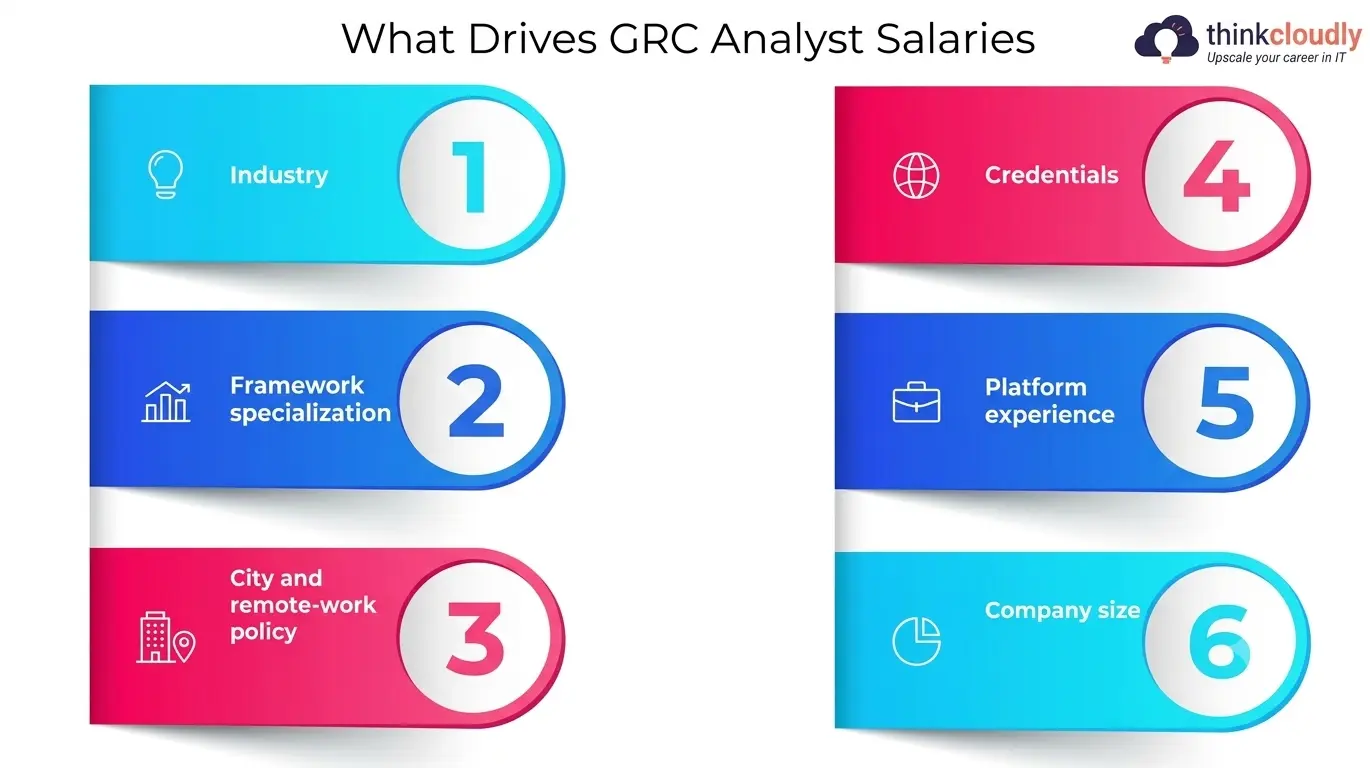
- Industry. Financial services, healthcare, and defense-adjacent employers consistently pay above the general average for this role’s pay because their regulatory exposure is higher and the cost of a compliance failure is larger.
- Framework specialization. Fluency in a specific framework—SOC 2, ISO 27001, NIST CSF, or PCI-DSS—commands a premium, especially when paired with hands-on audit-support experience rather than textbook knowledge.
- City and remote-work policy. Major financial hubs (New York, Toronto, London) pay noticeably more than regional markets, though fully remote postings are gradually narrowing that gap.
- Credentials held. A recognized certification—CRISC, CGRC, or CISA—doesn’t guarantee a raise on its own, but it consistently shows up in postings offering the upper end of any quoted range.
- Platform experience. Hands-on comfort with a GRC platform (Archer, ServiceNow GRC, Vanta, or similar) is increasingly treated as a baseline requirement rather than a bonus skill, and its absence can cap an offer at the lower end of the band.
- Company size. Larger enterprises with dedicated GRC functions tend to pay more than startups bundling governance work into a broader security or operations role.
How to Move From Entry-Level to Senior GRC Analyst Pay Faster?
For anyone currently sitting at the bottom of one of these ranges, here’s the sequence that consistently correlates with faster movement into the mid and senior bands:
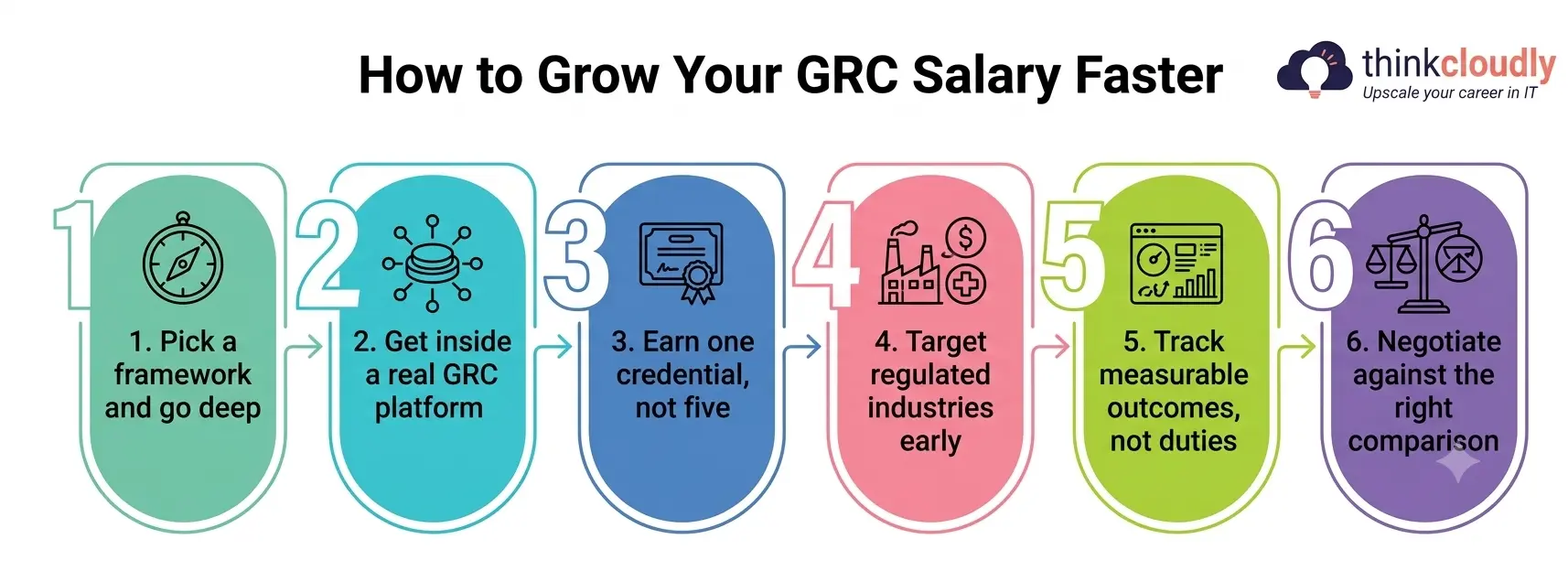
- Pick a framework and go deep. Generalist knowledge of five frameworks is worth less than genuine depth in one that your target industry actually uses.
- Get inside a real GRC platform. Most vendors offer free trials or demo sandboxes—spend real hours inside one rather than only reading about it.
- Earn one credential, not five. A single well-chosen certification, paired with practical project work, outperforms a resume full of unused badges.
- Target regulated industries early. Financial services, healthcare, and government-adjacent employers consistently pay closer to the top of the GRC analyst pay range than general tech or retail.
- Track measurable outcomes, not duties. “Closed 40 audit findings within SLA” moves a resume forward; “assisted with compliance tasks” does not.
- Negotiate against the right comparison. Walking into a salary conversation armed with Risk Analyst Salary, Compliance Specialist Salary, and IT Auditor Salary benchmarks for your specific country gives you a stronger anchor than a single blended number.
Where This Leaves Regulatory Compliance Jobs Heading Into 2027?
None of this data suggests the field is cooling off. Regulatory Compliance Jobs across all three countries are still being created faster than qualified candidates can fill them, and the pay data reflects that pressure rather than a mature, flattening market.
What’s changed is how precisely employers now expect candidates to understand their own worth — quoting a single outdated “average” number in a negotiation is a fast way to either undersell yourself or get politely passed over for seeming out of touch with the current market.
Anyone evaluating Risk Management Careers broadly, rather than this one title specifically, should treat GRC analyst pay as one data point among several closely related ones. The real question worth asking isn’t “what does a GRC analyst make,” it’s “which of these adjacent paths — risk analysis, compliance, or IT audit — pays best for the specific industry and country I’m targeting,” because as the UK data above shows, the answer isn’t always the one people assume.
A Personal Note
I’ve sat in enough salary conversations now to notice the same mistake repeating itself: people research the job title, not the market they’re actually walking into. The analyst who quoted the wrong number to my former colleague wasn’t bad at her job — she’d just trusted a single flattened figure instead of asking which country, which experience band, and which industry that number was actually describing.
If you take one thing from this breakdown, let it be that habit: before you quote a number in an interview or a negotiation, know exactly which slice of the market it came from. It’s a small discipline, and it’s the difference between walking in guessing and walking in informed.