
Everyone starting out in cloud computing eventually hits the same fork in the road: should the first certification be the easy one that proves you understand the basics, or should you skip straight to the credential that actually gets you hired for design work?
The AWS Cloud Practitioner or Solutions Architect Associate question sounds simple on the surface, but it’s really a question about how much runway you have, how fast you want to move, and whether you’re building a foundation or trying to leap straight to the deep end. Get the order wrong, and you either waste months on a credential that doesn’t move the needle for your goals, or you burn out attempting an exam you weren’t ready for yet.
This guide walks through that decision the way it plays out for real students and career-changers, not the sanitized version you’ll find on a certification vendor’s marketing page. If you’re weighing the AWS Cloud Practitioner or Solutions Architect Associate path right now, by the end of this you should know exactly which one fits where you actually are, not where you wish you were.
Quick Comparison Table
Here’s a side-by-side look at how the two credentials stack up on the factors that actually matter when you’re choosing between them.
|
Category |
AWS Cloud Practitioner |
Solutions Architect Associate |
|
Ideal starting point |
True beginners with little to no cloud background |
Candidates with roughly a year of hands-on AWS exposure |
|
Exam length |
90 minutes, 65 questions |
130 minutes, 65 questions |
|
Focus |
Broad cloud concepts, billing, and basic service awareness |
Infrastructure design, technical architecture, and security concepts in depth |
|
Architect skills required |
Minimal—conceptual understanding is enough. |
Substantial—you’re expected to design real solutions, not just recognize terms. |
|
Career growth potential |
Opens the door; rarely the credential that lands a design role alone |
Directly tied to career growth into architecture, engineering, and consulting roles |
|
Typical cost (2026) |
$100 USD |
$150 USD |
|
Average US salary tied to role (2026) |
~$88,000/year for cloud support roles |
~$176,595/year for Solutions Architects |
That table is useful for orientation, but it doesn’t settle the AWS Cloud Practitioner or Solutions Architect Associate debate by itself. The right starting point depends heavily on where you’re standing right now, which the next sections dig into.
Reference Blog: Is AWS Solutions Architect Certification Worth It for Your Career
What Each Credential Actually Tests
The AWS Certified Cloud Practitioner is, by design, an entry-level credential. According to AWS’s own certification page, it validates a foundational understanding of the AWS Cloud, including core services, basic architecture best practices, and billing and pricing concepts—no coding, no hands-on labs, and no deep technical architecture required.
It’s built for people in non-technical roles too: sales, marketing, project management, or anyone who needs enough fluency to talk intelligently about cloud computing without actually building anything in it.
The Solutions Architect Associate exam is a different animal entirely. AWS describes it as validating the ability to design resilient, high-performing, secure, and cost-optimized architectures on AWS. That single sentence is doing a lot of work—resilience, performance, security trade-offs, and cost all have to be balanced simultaneously, which is exactly the kind of judgment call a working architect makes daily.
Anyone weighing the AWS Cloud Practitioner or Solutions Architect Associate decision should understand that these aren’t two versions of the same test at different difficulty levels. They’re testing entirely different things: one tests whether you understand what the cloud is, the other tests whether you can build in it.
Infrastructure Design: A Skill One Exam Teaches, and the Other Doesn’t
Infrastructure design barely appears in the Cloud Practitioner exam beyond recognizing which service does what at a conceptual level. You’ll know that S3 stores objects and EC2 runs virtual machines, but you won’t be asked to weigh trade-offs between them for a specific workload. That’s a deliberate scope decision, not an oversight—the exam is meant to build vocabulary, not design instinct.
The Solutions Architect Associate exam puts infrastructure design at the absolute center of nearly every question. You’re given a scenario—a company needs a database that survives a regional outage, or an application needs to scale from a hundred users to a hundred thousand without a redesign—and asked to pick the design that actually solves it, not just one that technically works.
This is the clearest evidence that the AWS Cloud Practitioner or Solutions Architect Associate choice isn’t just about difficulty; it’s about whether you’re ready to practice infrastructure design under exam pressure, which usually means you’ve already been doing some of it hands-on beforehand.
Technical Architecture: Depth Is the Whole Point
Technical architecture knowledge is where the gap between these two credentials becomes impossible to ignore. Cloud Practitioner candidates need to recognize the names and general purposes of maybe thirty AWS services.
Solutions Architect Associate candidates need to understand how a dozen of those same services interact under real architectural constraints—how a VPC’s subnet layout affects a Lambda function’s ability to reach the internet, how DynamoDB’s partition key choice affects performance at scale, and how Auto Scaling Groups behave during a sudden traffic spike.
That depth is exactly why so many people fail the Solutions Architect Associate exam on their first attempt without hands-on practice first. Reading about technical architecture and applying it under a 130-minute clock are not the same skill, and the exam is specifically built to expose that gap.
If your current depth in this area tops out at “I’ve read the documentation,” the Cloud Practitioner exam is the more honest starting point, and there’s no shame in that—everyone architecting complex systems today started exactly there.
Security Concepts: Foundational vs. Applied
Security concepts show up on both exams, but at very different altitudes. Cloud Practitioner tests whether you understand the shared responsibility model—AWS secures the cloud infrastructure, and you secure what you put in it—along with basic IAM concepts like users, groups, and roles. It’s the kind of foundational grounding you’d want anyone touching an AWS account to have, technical or not.
The Solutions Architect Associate goes considerably further. You’re expected to apply security concepts to actual design decisions: when to use a security group versus a network ACL, how to structure IAM policies with least-privilege in mind, how KMS key management fits into an encryption-at-rest strategy, and how to design a VPC so that sensitive workloads stay properly isolated.
Getting that balance wrong on this exam usually means picking an answer that technically functions but leaves an unnecessary attack surface exposed—exactly the kind of mistake that matters far more in a real production environment than on paper.
Architect Skills: What You Actually Walk Away With
Architect skills are really the crux of the AWS Cloud Practitioner or Solutions Architect Associate decision. Passing Cloud Practitioner doesn’t hand you that kind of design ability in any meaningful sense—it hands you vocabulary and context, which matters, but isn’t the same thing as being able to design a system.
Passing Solutions Architect Associate is a much stronger signal, though even that credential alone doesn’t make someone a finished architect; it’s evidence of solid ability at an associate level, with plenty of runway still ahead toward professional-level work.
The honest way to think about architect skills is as something built through repetition—designing systems, watching them fail in small ways, and adjusting—rather than something a single exam certificate confers on its own.
Both credentials contribute to that process, just at very different stages of it. Cloud Practitioner gives you the map; The Solutions Architect Associate starts teaching you to actually navigate with it.
Career Growth: Where Each Credential Actually Leads
Career growth is usually the real reason someone is weighing AWS Cloud Practitioner or Solutions Architect Associate in the first place, so it’s worth being direct about it. Cloud Practitioner rarely opens doors to a technical role by itself.
Its upside shows up more in adjacent situations—a sales engineer who needs cloud fluency to close deals, a project manager who needs to understand what their engineering team is actually building, or a complete beginner using it as a low-stakes way to confirm they actually enjoy this field before investing further.
A Solutions Architect Associate has a direct line to career growth in a way a Cloud Practitioner typically doesn’t. It’s widely recognized by hiring managers as evidence you can design AWS solutions, and it frequently appears as a stated or implied requirement in job postings for cloud engineer, solutions architect, and DevOps roles.
If moving into a hands-on technical role is the actual goal, Solutions Architect Associate is where that trajectory realistically starts, even if Cloud Practitioner was a reasonable first step to get there without feeling completely lost on day one.
Salary and Market Data: What 2026 Actually Shows
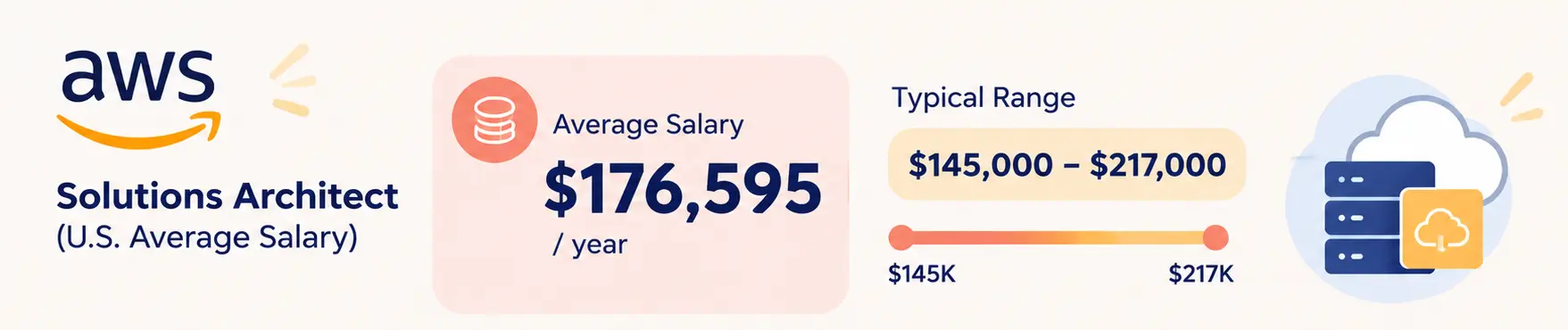
Numbers help cut through some of the uncertainty in the AWS Cloud Practitioner or Solutions Architect Associate decision. Solutions Architects in the United States average around $176,595 a year, with a typical range between $145,000 and $217,000 depending on experience and location.
There isn’t a direct “Cloud Practitioner salary” to compare it against, because the credential alone doesn’t map to a single job title—it’s a supporting qualification rather than the entire basis for a hire, which itself tells you something important about the two credentials’ relative weight in the market.
Zooming out, the U.S. Bureau of Labor Statistics projects demand for computer network architects to grow around 8% between 2025 and 2035, faster than the average across all occupations, driven largely by continued cloud migration.

That growth trend applies most directly to roles the Solutions Architect Associate credential supports, reinforcing that it’s the certification doing the heavier lifting for anyone chasing a design-focused career rather than a supporting one.
How Long Each One Actually Takes to Prepare For?
Cloud Practitioner is typically a four-to-six-week commitment for someone studying part-time with no prior cloud background, assuming a reasonable pace of a few hours a week. There’s no hands-on lab requirement baked into the exam itself, so most of that time goes into reading and watching structured video courses rather than building anything.
Solutions Architect Associate usually takes two to three months of consistent study, and that estimate assumes you’re also spending time in the AWS console building small projects alongside the reading, not just memorizing service names.
Skipping the hands-on portion to save time is one of the most common reasons candidates fail this exam on the first attempt — the scenario-based questions are difficult to answer correctly from theory alone.
Which One Should You Actually Start With?
If you have zero cloud background, work in a non-technical role, or just want a low-risk way to confirm this field is worth pursuing before committing serious time, start with Cloud Practitioner. It’s a reasonable, low-stress entry point, and there’s no real downside to spending a few weeks building vocabulary before attempting something harder.
If you already have some hands-on AWS experience — even from personal projects, a bootcamp, or a junior technical role — and your goal is a design-focused job within the next year, it’s often smarter to skip straight to Solutions Architect Associate rather than treating Cloud Practitioner as a mandatory stepping stone.
AWS itself doesn’t require candidates to hold Cloud Practitioner before attempting Solutions Architect Associate, and plenty of people with a technical background go straight for the associate-level exam successfully.
The AWS Cloud Practitioner or Solutions Architect Associate choice isn’t really about which one is “correct” in the abstract — it’s about being honest with yourself about how much hands-on experience you’re bringing to the exam room.
A Personal Note
I’ve watched a lot of people talk themselves into skipping Cloud Practitioner because it feels like it doesn’t “count,” and I’ve watched almost as many talk themselves into delaying Solutions Architect Associate for another few months of studying because they didn’t feel ready yet.
Both instincts are usually wrong for the same reason: they’re driven by how the certification looks on paper rather than by what you actually need to learn next. If you’re new to this and Cloud Practitioner would genuinely teach you something, take it without apologizing for starting small.
If you already have real hands-on time in an AWS account, stop treating the beginner exam as a required toll booth and go earn the credential that actually matches where your skills already are. The certificate on your profile matters far less than whether you can walk into a design conversation and hold your own — chase that, and the exam results tend to take care of themselves.