

If you’ve ever used Google Drive for an assignment or watched a company shift its office to Microsoft 365 overnight, you’ve already seen the cloud in action. It’s fast and convenient — but the same convenience that makes it attractive also makes it a magnet for attackers.
I’ve spent years watching businesses, from five-person startups to large enterprises, get blindsided by problems they didn’t see coming. Not because they were careless, but because nobody explained the risks in plain language.
That’s what this blog post is for: a clear walkthrough of what can go wrong in the cloud and how businesses and students can actually understand it.
Why Does This Topic Deserve Your Attention Right Now?
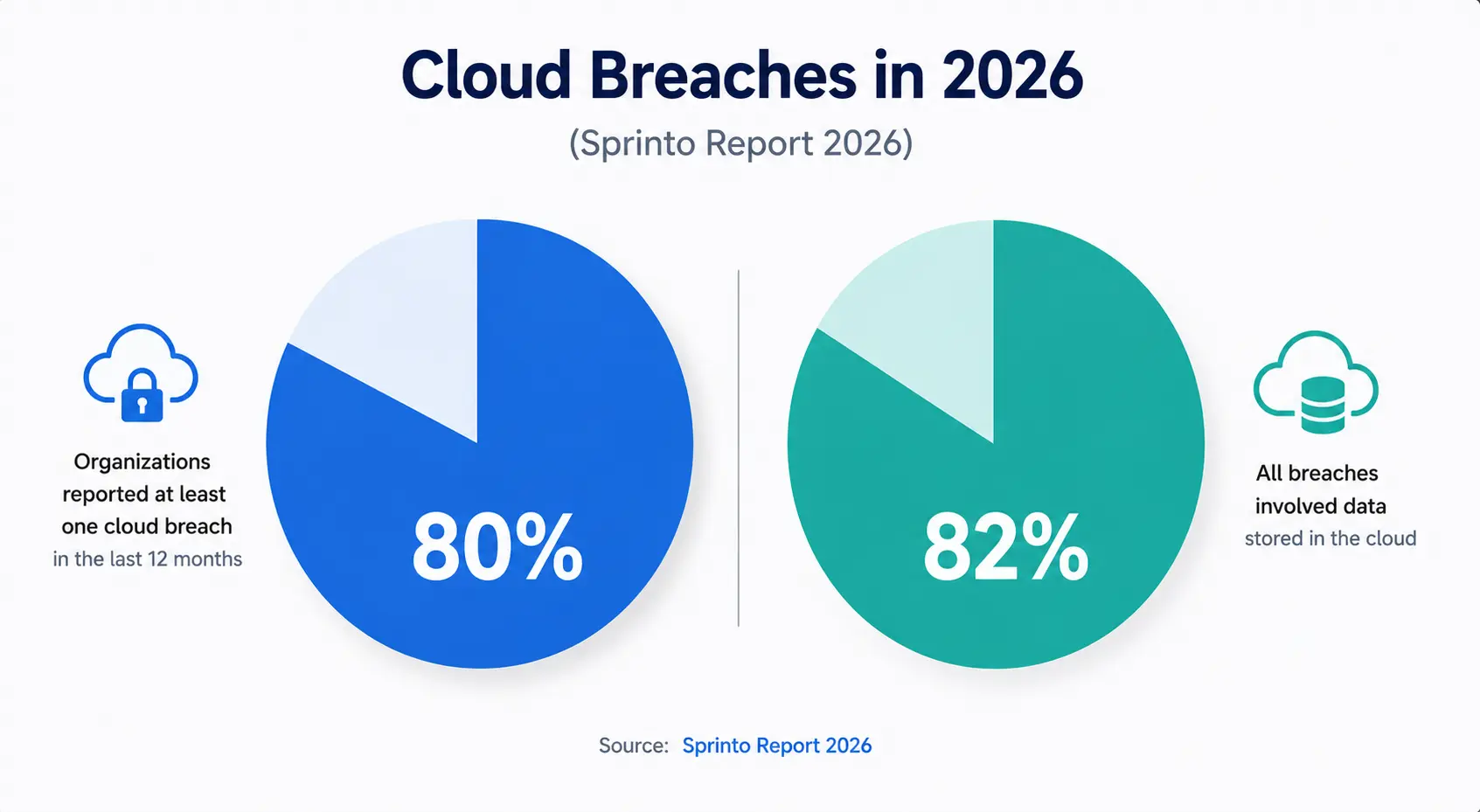
Here’s a number worth pausing on: according to Sprinto’s 2026 report, 80% of organizations reported at least one cloud breach in the last 12 months, and 82% of all breaches involved data stored in the cloud. That’s not a niche problem anymore—that’s the new normal.
Add to that the fact that 88% of organizations now operate in hybrid or multi-cloud environments, and the picture becomes clearer. Businesses aren’t just storing a few files online—they’re running payroll, customer databases, and product code across multiple platforms at once.
Every platform is a potential doorway, and every doorway needs to be locked properly. This is exactly why cloud security risks have become one of the most discussed — and most misunderstood — topics in business today. Understanding them isn’t just an IT department’s job anymore; it’s something founders, students, and everyday employees should grasp.
What Are Cloud Security Risks, Really?
In simple terms, these are the weaknesses or gaps in a cloud environment that attackers can exploit to steal data, disrupt services, or gain unauthorized access. They can come from technology (a misconfigured server), from people (an employee clicking a phishing link), or from process failures (skipping a routine check).
The tricky part is that they’re often invisible until something breaks. A storage bucket left open to the public doesn’t look dangerous — it just looks like a folder. An employee with more access than they need doesn’t look like a threat — they look like a trusted colleague.
That’s what makes cloud security risks so different from traditional office security, where a locked door is simply a locked door. In the cloud, the “doors” are digital, constantly changing, and easy to leave ajar without realizing it.
The Biggest Risks Businesses Face Today
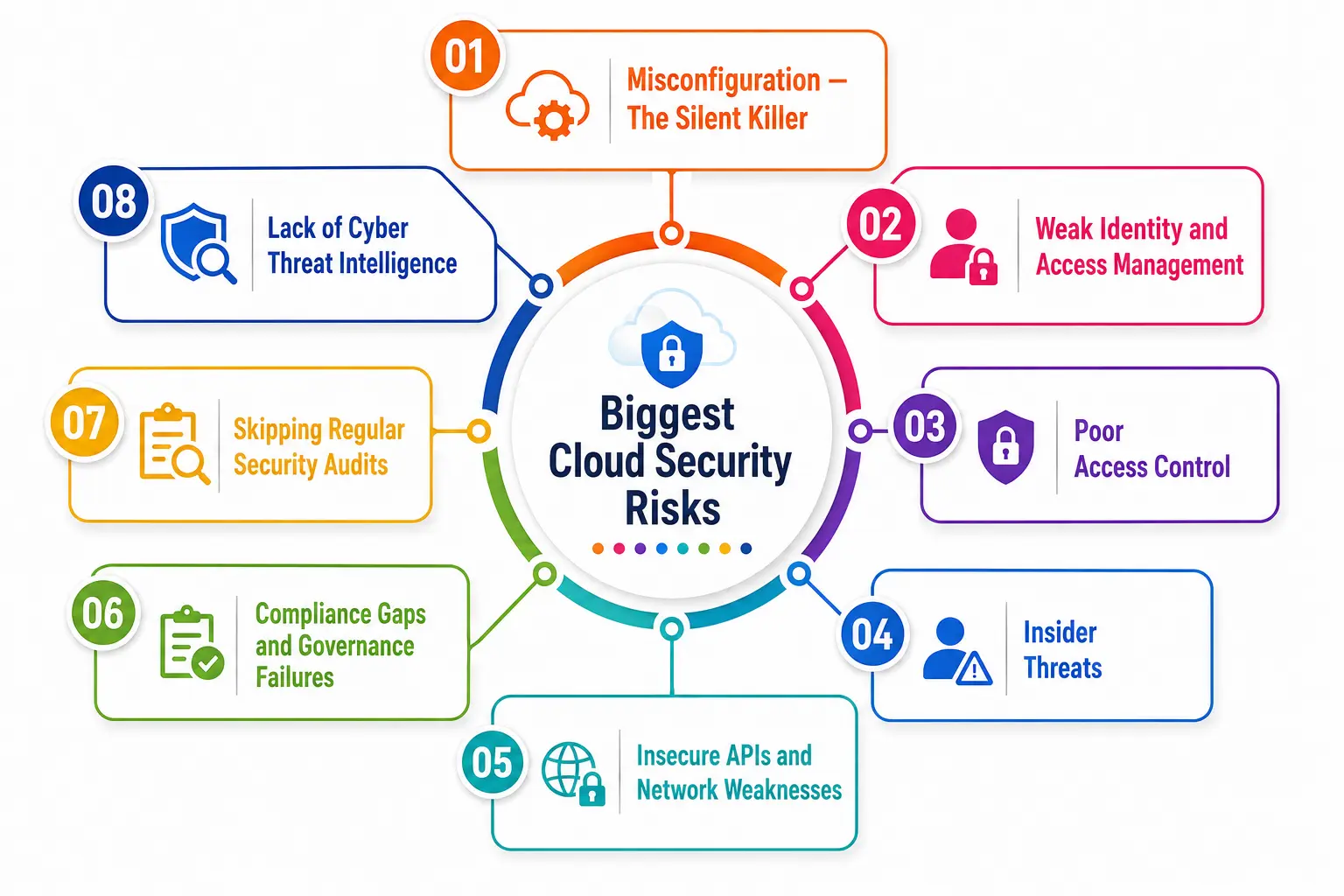
1. Misconfiguration — The Silent Killer
If there’s one villain in almost every conversation about cloud security risks, it’s misconfiguration. According to StationX’s 2026 report, misconfigured cloud services are cited as a major risk by 70% of organizations, and public cloud accounts average 43 misconfigurations each.
Misconfiguration happens when a cloud resource—a storage bucket, a database, or a server—is set up with weaker security settings than it should have. Sometimes a folder is accidentally made public, or a database is left without a password because someone was in a rush during setup.
These small oversights are common precisely because they’re so easy to make and easy to overlook.
2. Weak Identity and Access Management
Here’s a stat that surprised even me: 70% of organizations rate identity and access management as their top cloud risk, largely due to insecure identities and overprivileged accounts. This is one of the most frequently cited cloud security risks precisely because access controls are so easy to leave loose.
IAM is the system that decides who gets to see what in your cloud environment. Think of it like the guest list and key system at a large venue. If everyone gets a master key “just in case,” you’ve basically given up on security.
This weakness usually stems from convenience — it’s easier to grant broad access than to configure narrow, specific permissions. Good practice includes multi-factor authentication, regular access reviews, and removing access the moment someone changes roles or leaves the company.
3. Poor Access Control
Closely tied to the above is access control—the rules and mechanisms that determine who can enter a system or piece of data and what they’re allowed to do once inside. This weakness shows up in nearly every major breach report, and it’s one of the more preventable cloud security risks on this list.
A classic failure looks like this: a marketing intern is given admin-level access to the entire customer database “just to make onboarding easier.” Months later, that account is phished, and the attacker inherits the same broad reach the intern had.
The stronger approach follows the principle of least privilege—give people exactly what they need, nothing more. Simple in theory, but in fast-growing businesses it quietly falls apart unless someone actively maintains it.
4. Insider Threats
Not every danger comes from outside. Insider threats — malicious or simply careless — are a genuine and growing category of cloud security risks. According to Exabeam’s research, a striking 88% of security incidents are tied to human mistakes rather than software flaws, which shows how much this category contributes to the overall risk picture.
More often, it looks like someone sharing a file with the wrong person, reusing a weak password, or falling for a phishing email. Businesses that only guard against outsiders while ignoring this category are leaving the back door open while watching the front gate.
5. Insecure APIs and Network Weaknesses
Modern businesses run on APIs — the digital connectors that let apps and services talk to each other. Insecure APIs are increasingly flagged as a fast-growing concern, especially as companies adopt multi-cloud and AI-driven tools. This risk is escalating particularly in multi-cloud and GenAI deployments, where integrations often outpace proper security controls.
This is where network security comes in — the tools and practices (firewalls, encryption, segmentation, monitoring) that protect data as it moves between systems. Weak defenses here mean even safely stored data can be intercepted in transit. A strong setup acts like a series of checkpoints, letting legitimate traffic through while flagging anything suspicious.
6. Compliance Gaps and Governance Failures
A huge portion of cloud security risks aren’t purely technical—they’re organizational. Meeting compliance requirements (like GDPR, HIPAA, or industry-specific rules) isn’t just a legal checkbox; it forces businesses to actually think through how they handle data.
According to Neumetric’s guide to the NIST Cybersecurity Framework, its five core functions—Identify, Protect, Detect, Respond, and Recover—are specifically designed to help organizations manage compliance requirements while reducing risk. Skipping them usually means skipping the exact practices — encryption, access logging, retention limits — that would have prevented a breach in the first place.
This is where governance and compliance become inseparable from daily security work. It isn’t paperwork for its own sake; it’s about accountability—who approved this access and who reviewed this configuration. Without this discipline, businesses often don’t realize a problem exists until it’s too late.
Frameworks like ISO 27017, SOC 2, or NIST SP 800-53 give organizations a structured starting point that helps mitigate risk while building trust with customers across regulated regions.
7. Skipping Regular Security Audits
You can have the best policies in the world on paper, but if nobody checks whether they’re followed, they’re worthless. These are systematic reviews of a cloud environment — checking configurations, access logs, and permissions — to catch problems before attackers do.
Many businesses treat security audits as a once-a-year formality, leaving long windows where new vulnerabilities creep in unnoticed. Regular, ideally continuous, reviews help catch misconfigurations, unused accounts with lingering access, and infrastructure gaps before they turn into headlines. Skipping them is a bit like never getting a health checkup—everything feels fine, right up until it isn’t.
8. Lack of Cyber Threat Intelligence
Finally, there’s a risk that’s less about a specific flaw and more about awareness itself: missing cyber threat intelligence. This refers to the data and analysis that help organizations understand who might attack them, how, and why—before it happens.
Businesses without cyber threat intelligence are essentially playing defense blind. Attackers are increasingly using AI to exploit cloud vulnerabilities faster and map permission paths, which makes real-time cyber threat intelligence more valuable than ever for staying ahead rather than just reacting.
A Quick Reference Table
|
Risk Area |
What It Means | Common Cause |
Recommended Fix |
|
Misconfiguration |
Cloud resources set up with weak default settings | Rushed setup, lack of review |
Continuous configuration checks |
|
Identity and Access Management |
Poor control over who can access what | Overprivileged accounts, no MFA |
Enforce least privilege and multi-factor authentication |
|
Access Control |
Users have more permissions than needed | Convenience over security |
Role-based access, periodic reviews |
|
Insider Threats |
Harm caused by employees, intentional or accidental | Human error, lack of training |
Awareness training, monitoring |
|
Network Security Gaps |
Data exposed while moving between systems | Rapid integration without review |
Encryption, firewalls, API testing |
|
Compliance Requirements |
Legal or regulatory obligations unmet | Ignorance or resource limits |
Map controls to NIST or ISO |
|
Governance and Compliance |
No clear accountability structure | Fast growth without policy maturity |
Documented ownership of controls |
|
Security Audits |
Vulnerabilities go undetected for long periods | Treating audits as a formality | Continuous or quarterly reviews |
How Can Businesses Reduce These Risks?
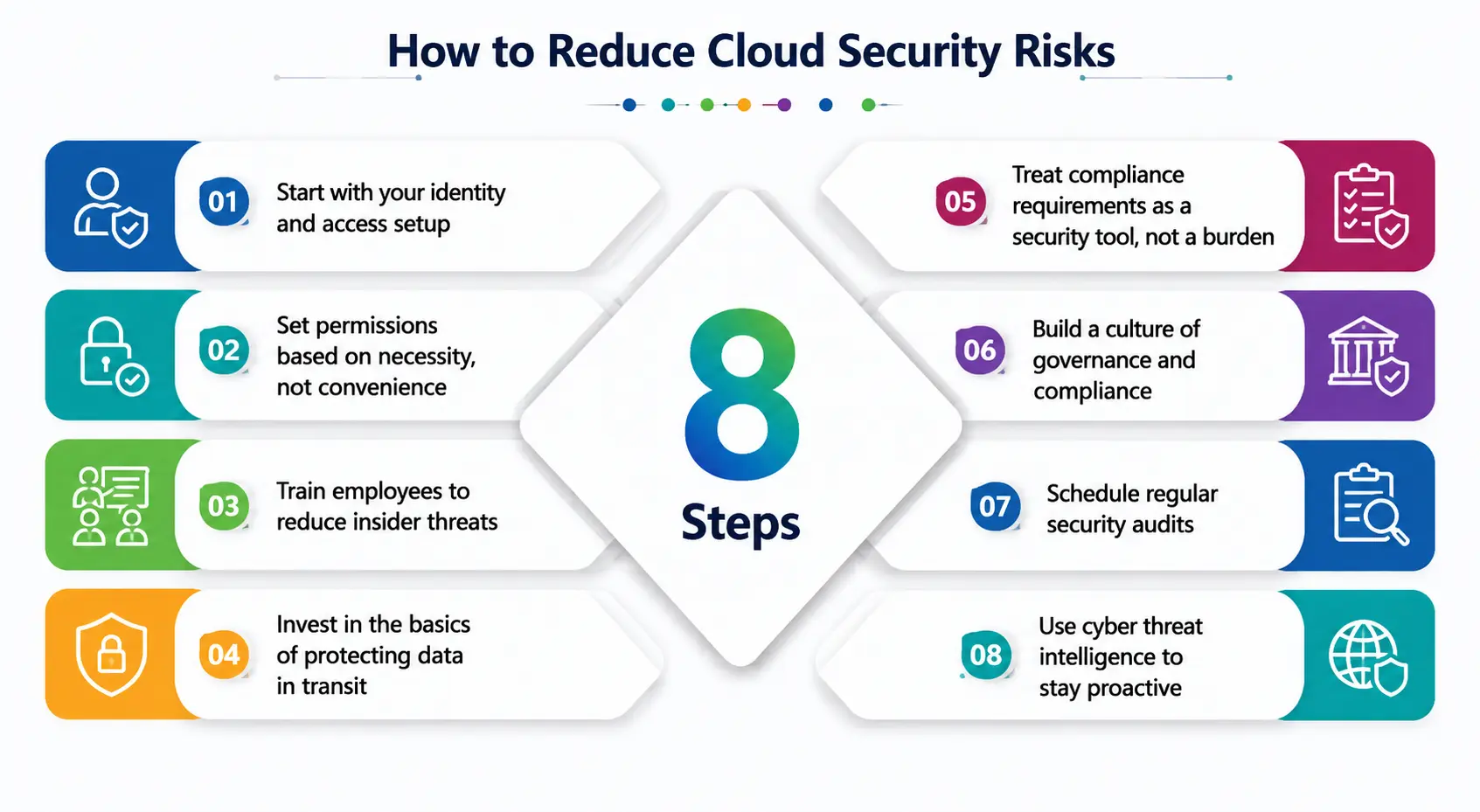
- Start with your identity and access setup. Since it’s consistently rated the top risk, tightening this first gives the biggest improvement for the effort.
- Set permissions based on necessity, not convenience. Review them quarterly, not once a year.
- Train employees to reduce insider threats. Short, regular sessions prevent more damage than expensive tools alone.
- Invest in the basics of protecting data in transit — encryption, firewalls, and API monitoring go a long way.
- Treat compliance requirements as a security tool, not a burden. Meeting them often means automatically closing major gaps.
- Build a culture of governance and compliance by assigning clear ownership for cloud decisions.
- Schedule regular security audits instead of waiting for a breach to check your own defenses.
- Use cyber threat intelligence to stay proactive, even through low-cost threat feeds for smaller teams.
None of this requires a massive budget. It requires consistency, which is usually the part businesses struggle with most.
A Personal Note
When I first started learning about this subject, it felt overwhelming — so many acronyms, so many frameworks, so many “you must do this or else” warnings. What actually helped wasn’t memorizing checklists; it was realizing that most of these problems are human problems wearing a technical costume.
A misconfigured server is really just someone forgetting to double-check their work. A weak spot in the system is often just someone who wasn’t trained properly or was having a bad day. Once I saw it that way, the whole subject felt a lot less intimidating and a lot more practical.
If you’re a student reading this, my honest advice is to not try to memorize every framework or statistic. That understanding will serve you far better in interviews and real jobs than any list of definitions ever could. Staying a little curious and a little healthily cautious goes a long way.