

Ask a career counselor which is the smarter bet, and most will dodge the question. That’s not helpful when you’re the one picking a certification track this semester. The honest answer is that an AWS Solutions Architect or Data Engineer career isn’t a competition with a single winner—it’s two different relationships with the same cloud platform, and the “best” one depends entirely on whether you’d rather design systems or build the pipelines that feed them data.
Students ask me this constantly, usually right after finishing an intro cloud course and realizing AWS alone offers a dozen plausible directions. This guide narrows it down to the one comparison that actually matters for most beginners: architecture-first thinking versus data-first thinking.
Both are strong, well-paid tracks in 2026. Neither is a fallback option for people who “couldn’t get” the other. Pick based on what kind of problem you enjoy solving, not on which title sounds more impressive at a family dinner.
Quick Comparison: AWS Solutions Architect vs Data Engineer
Before the deep dive, here’s a side-by-side snapshot of how the two roles actually differ where it counts.
|
Category |
AWS Solutions Architect | Data Engineer |
| Primary focus | Technical design of whole systems—compute, networking, security, cost |
Building and maintaining the pipelines that move and shape data |
|
Infrastructure design |
Owns the blueprint: account structure, service selection, fault tolerance |
Designs the infrastructure that data flows through, not the whole system |
|
Core deliverable |
Architecture diagrams, design documents, cost models |
Working data pipeline automation, clean datasets, reliable ETL jobs |
|
Signature AWS tool |
Well-architected framework, CloudFormation, multi-account design |
Amazon EMR, AWS Glue, Redshift, Kinesis |
|
Database work |
Chooses which database fits a workload (RDS vs DynamoDB vs Aurora) |
Builds and tunes the database architecture that powers analytics |
|
Typical background |
Systems engineering, consulting, pre-sales technical roles | Software engineering, analytics, backend development |
| Average US salary (2026) | ~$176,595/year |
~$134,798/year |
That table is a starting point. The real decision comes down to what you’d rather stare at all day—an architecture diagram or a pipeline dashboard full of failed jobs waiting to be fixed.
Reference Blog: How to prepare for the AWS Data Engineer Certification
What Each Role Actually Means?
Job titles vary wildly by company, which is exactly what makes the AWS Solutions Architect or Data Engineer career decision confusing for newcomers. A “data engineer” at a small startup might also be doing analytics and dashboarding because there’s no separate data science team yet.
A “solutions architect” at a large enterprise might spend half the week on stakeholder calls instead of drawing diagrams. Still, at most mid-size and large organizations, the split settles into a consistent pattern.
A solutions architect turns a business problem into a working system. The job leans heavily on technical design—evaluating what an application needs, what compliance rules apply, and what traffic it must handle, and then choosing AWS services that satisfy all of it.
The output is usually a diagram, a set of design documents, and a plan someone else builds. AWS’s own guidance for this certification track frames the role around designing cost-optimized, resilient architecture across the entire service catalog—which matches how the job runs in practice.
A data engineer builds the plumbing that makes data usable. They design schemas, write extraction and transformation logic, automate pipeline workflows so numbers move reliably from source systems into a warehouse, and keep an eye on data quality along the way.
Where an architect thinks in system diagrams, a data engineer thinks in schemas, jobs, and freshness guarantees. Both roles demand serious AWS fluency—the difference is what that fluency gets applied to.
Infrastructure Design and Technical Design: Who Owns What
Infrastructure design is where the AWS Solutions Architect or Data Engineer Career split becomes most visible. A solutions architect typically owns infrastructure design at the strategic level—deciding on a multi-account structure, picking regions, and figuring out how compute and storage services fit together for a given workload. That thinking happens before a single resource is provisioned, and it’s the core of the job’s architectural responsibility.
A data engineer’s relationship to infrastructure design is narrower but deeper in one specific lane: the systems that move and store data. They don’t usually decide the company’s entire cloud footprint, but they own the blueprint for every pipeline—how data lands, how often it refreshes, and what happens when a source system changes its schema without warning.
A solutions architect might decide that a workload needs a data lake; a data engineer decides exactly how that lake gets populated, partitioned, and kept clean. Good teams treat this as a handoff with constant back-and-forth, not a one-way instruction from architect to engineer.
Data Pipeline Automation: The Core of a Data Engineer’s Day
If there’s one phrase that defines the data engineer side of the AWS Solutions Architect or Data Engineer career fork, it’s data pipeline automation. A huge share of a data engineer’s week goes into building jobs that extract data from operational systems, transform it into a usable shape, and load it somewhere analysts and data scientists can query it—without a human needing to babysit the process.
Strong data pipeline automation means a broken upstream schema gets caught by a validation check instead of silently corrupting a dashboard three steps downstream. It means a nightly job that fails at 2 a.m. retries itself or pages someone before a report goes out wrong.
Building that reliability is unglamorous work compared to architecture diagrams, but it’s exactly the skill that separates a data engineer who’s trusted with production systems from one who still needs supervision. Tools like Apache Airflow, AWS Glue, and Step Functions are the usual backbone of that automated pipeline work in an AWS environment.
Amazon EMR and the Modern Data Stack
No serious conversation about the data engineer path skips Amazon EMR. It’s AWS’s managed big-data processing service, built to run open-source frameworks like Apache Spark, Hive, and Flink at scale without forcing an engineer to hand-manage clusters.
For anyone comparing the AWS Solutions Architect or Data Engineer career paths on hands-on technical depth, the service is a good litmus test: if the idea of tuning a Spark job across a petabyte-scale EMR cluster sounds interesting rather than terrifying, that’s a strong signal toward data engineering.
Amazon EMR shows up constantly in real pipelines—batch processing large historical datasets, running machine learning feature pipelines that feed into SageMaker, or powering near-real-time stream processing for fraud detection and clickstream analysis.
A solutions architect needs to know EMR exists and roughly when to recommend it over something like Redshift or Athena. A data engineer needs to actually configure, tune, and troubleshoot it, which is a meaningfully deeper level of hands-on ownership.
Database Architecture: A Shared Responsibility, Applied Differently
Database architecture sits at the intersection of both roles, which is part of why the AWS Solutions Architect or Data Engineer career comparison gets murky here. A solutions architect makes the high-level database call—should this workload run on DynamoDB for single-digit-millisecond lookups, Aurora for relational consistency, or Redshift for analytical queries at scale? That decision shapes everything downstream and usually gets made once, early in a project.
A data engineer lives inside that database architecture decision every day. Once the choice is made, they’re the one designing table schemas, indexing strategies, partitioning logic, and query performance tuning that keeps the system fast as data volume grows.
Weak schema-level design can quietly wreck a well-chosen database engine, which is why data engineers who understand both the “why” behind an architect’s decision and the “how” of implementing it tend to be the most valuable people on a data team.
Certifications and Career Path for 2026
Both paths often start from the same foundation: the AWS Certified Cloud Practitioner, followed by a role-specific associate certification. For the architecture track, that’s the AWS Certified Solutions Architect – Associate exam—130 minutes, 65 questions, focused on designing resilient, secure, cost-optimized systems.
For the data track, AWS now offers a purpose-built credential: the AWS Certified Data Engineer – Associate (exam code DEA-C01). It’s also 130 minutes and 65 questions, but it tests data modeling, pipeline orchestration, data lifecycle management, and data quality—a much closer match to real day-to-day data pipeline automation work than a general architecture exam.
AWS recommends it for candidates with two to three years of data engineering experience and one to two years of hands-on AWS work, which makes it a realistic second certification rather than a first one.
From there, future architects usually move toward the Professional-level Solutions Architect credential plus broader stakeholder-facing experience. Future data engineers often branch into specialty areas—analytics-focused certifications or deep specialization in tools like Amazon EMR, Spark, or streaming platforms like Kinesis. Neither ladder in the AWS Solutions Architect or Data Engineer career paths is faster; they simply reward different strengths.
Salary Comparison: What the 2026 Numbers Actually Show
Money shouldn’t be the only factor, but it’s a fair thing to check before committing years to a specialization. Per 2026 Glassdoor data (see the comparison table above), AWS Solutions Architects average around $176,595 a year in the United States, typically ranging from $145,000 to $217,000 depending on seniority and location. Data engineers, per the same source, average closer to $134,798 a year, with a typical range of $106,000 to $173,000.
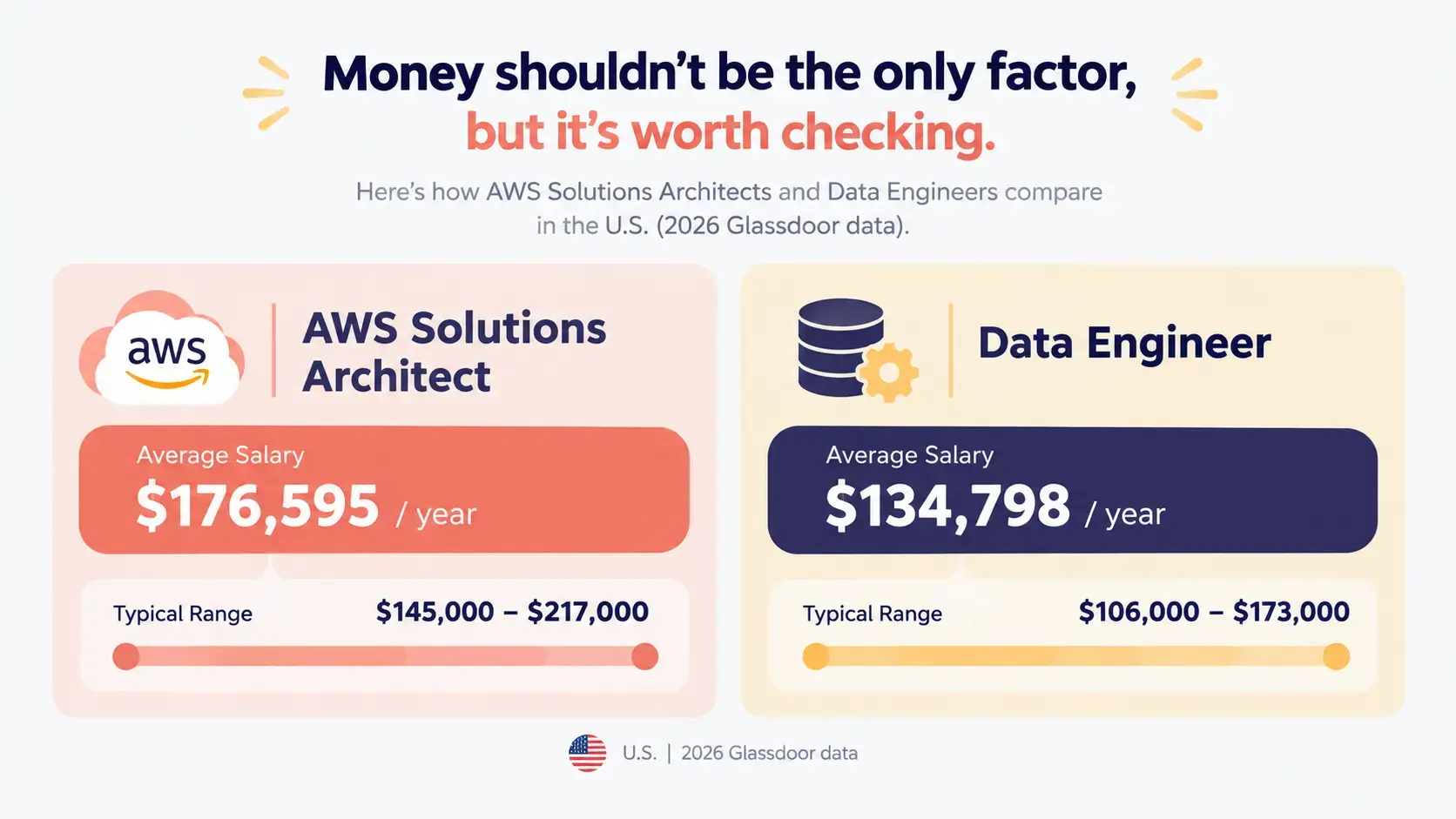
That gap tracks with how each career usually progresses — architect roles tend to require more years of broad experience before someone is trusted with end-to-end architecture decisions across an entire system, while data engineering rewards deep tool mastery earlier.
It’s also worth noting that the U.S. Bureau of Labor Statistics projects database architect roles — the closest official category to advanced data infrastructure work — to grow 9% between 2025 and 2035, notably faster than the 4% average across database-related occupations as a whole.
Which Path Should You Choose?
Strip away the certifications and the salary numbers, and the AWS Solutions Architect or Data Engineer Career decision comes down to a simpler question: do you want to decide how a whole system should be shaped, or do you want to be the person who makes data trustworthy and available at scale?
If you enjoy talking to non-technical stakeholders, thinking in trade-offs, and owning technical design decisions that affect an entire application, architecture is the natural fit. If you’d rather write a transformation job, watch a pipeline run clean overnight, and go deep on tools like EMR or Airflow, data engineering will feel far more satisfying.
Plenty of professionals do both across a career — some start as data engineers to build hands-on instincts around database design and pipelines, then move into architecture once the strategic side becomes more appealing than the technical one.
Others start in architecture and pull toward data engineering once they realize they miss being hands-on with actual systems. Neither move is unusual, and the overlap in AWS fundamentals makes switching lanes two or three years in far less risky than it sounds.
A Personal Note
I’ve watched enough students agonize over this exact choice to notice a pattern: the ones who end up genuinely happy didn’t pick based on which title sounded more senior. They picked based on what kind of Tuesday afternoon they wanted.
If you like the idea of a whiteboard covered in boxes and arrows, and explaining trade-offs to people who don’t speak AWS fluently, don’t talk yourself out of architecture just because data roles are trending.
And if the thought of debugging a stubborn pipeline job at 11 p.m., or squeezing better performance out of an EMR cluster, sounds oddly satisfying rather than exhausting, trust that instinct — it’s telling you something real about how you like to work.
Either way, build something small before you commit fully. A weekend spent designing one architecture diagram or writing one working pipeline will tell you more than this entire article can.