
Here’s a number that made me stop scrolling myself: Amazon Web Services still controls roughly a third of the entire global cloud infrastructure market in 2027, ahead of every other provider on the planet. If you’ve been putting off learning cloud skills or earning an AWS certification because the market “feels crowded,” that single fact should change your mind.
This guide breaks down the AWS Cloud Engineer Certification path in plain language—what AWS certifications you need, the exam cost, the AWS Cloud Engineer salary, and how to pick an AWS certification path that gets you hired instead of just adding another badge to your LinkedIn profile.
What Is the AWS Cloud Engineer Certification?
Let’s clear up a common mix-up first. AWS doesn’t sell one single exam with that exact name. Instead, the AWS Cloud Engineer Certification is really a cluster of credentials that, together, build the exact skill set employers mean when they post a “cloud engineer” job.
Most people start with AWS Certified Cloud Practitioner (CLF-C02), then move into AWS Certified Solutions Architect – Associate (SAA-C03) or the newer AWS Certified CloudOps Engineer – Associate (SOA-C03, formerly SysOps Administrator), depending on whether they lean toward design or operations. According to a detailed 2027 roadmap from StudyTech, the Cloud Practitioner exam even comes with a built-in discount voucher for your next attempt, which quietly shapes how most people plan their entire AWS certification path.
This matters because so many career-changers assume there’s a single shortcut exam. There isn’t. It’s a journey built one exam at a time, not a one-time purchase, and understanding that early saves you months of confused searching.
AWS Certification Salary 2027: Why Cloud Skills Pay More
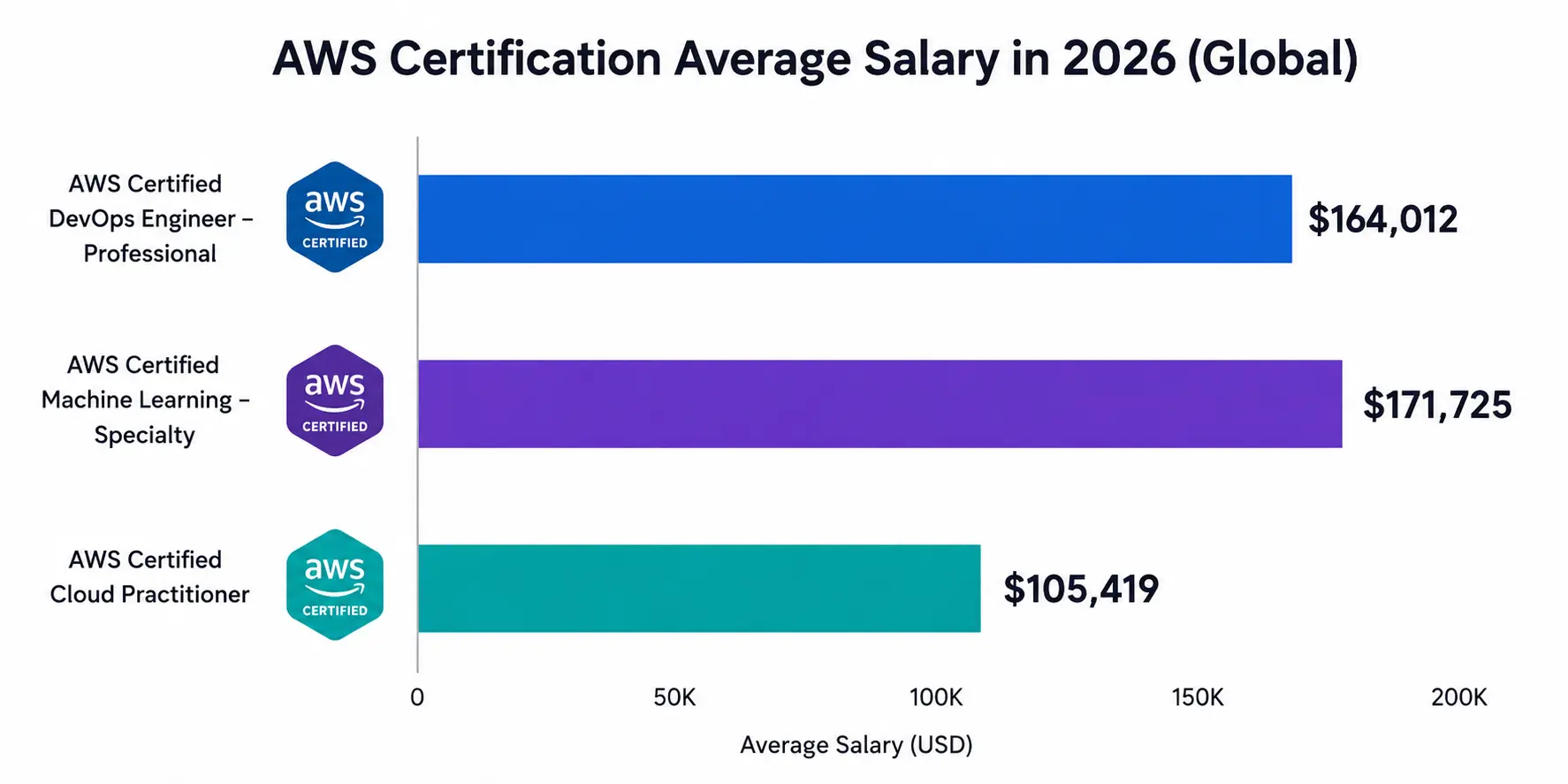
Every hiring manager I’ve spoken with this year says roughly the same thing: cloud skills are no longer a “nice to have” line on a resume; they’re the baseline. According to AWS Certified DevOps Engineer , the average AWS certification salary for AWS Certified DevOps Engineer – Professional holders is $164,012. Even the entry-level Cloud Practitioner credential averages a respectable $105,419 globally.
What’s driving this isn’t hype. Organizations are running production workloads on serverless architecture, leaning on Infrastructure as Code, and quietly discovering they don’t have enough certified people to manage it. That gap is exactly why an AWS cloud engineer with a recognized AWS certification can walk into salary negotiations with real leverage, not guesswork.
The spending numbers back this up. Gartner forecasts worldwide IT spending will reach $6.15 trillion in 2026, up 10.8% from the previous year, with data center and cloud infrastructure investment among the fastest-growing categories.
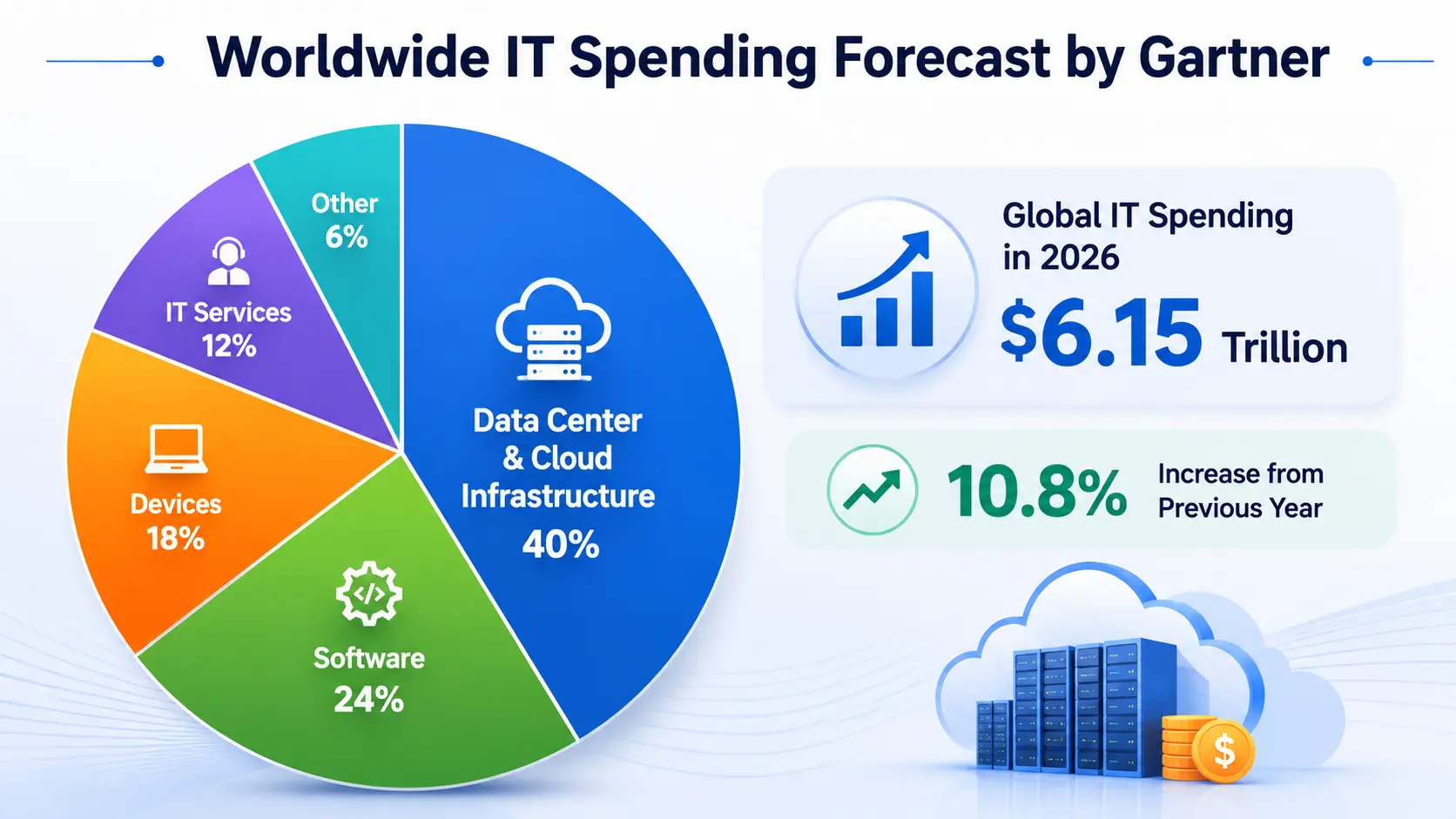
When budgets move that fast in one direction, hiring for cloud skills tends to follow close behind — which is exactly why so many mid-career professionals are treating cloud training as this year’s most practical investment, not a someday project.
AWS Certification Path 2027: Exam Cost, Salary & Best Fit by Role
Choosing the best AWS certification for your situation, whether you’re a beginner or switching careers depends on your starting point and your target role. Here’s a comparison built from 2027 exam data and salary reporting to help you map your own AWS certification path.
|
Certification |
Level | Exam Cost (USD) | Avg. Global Salary (2027) |
Best For |
|
AWS Certified Cloud Practitioner |
Foundational |
$100 |
$105,419 |
Total beginners, non-technical roles |
|
AWS Certified Solutions Architect – Associate |
Associate | $150 | $99,410–$125,000 |
Most popular first technical certification |
|
AWS Certified CloudOps Engineer – Associate |
Associate | $150 | $129,840 |
Operations-focused cloud engineer roles |
|
AWS Certified Developer – Associate |
Associate | $150 | $125,879 |
Developers building on AWS |
|
AWS Certified Solutions Architect – Professional |
Professional | $300 | $155,000–$221,069 |
Senior architecture and migration roles |
|
AWS Certified DevOps Engineer – Professional |
Professional | $300 | $164,012 |
Automation-heavy senior roles |
Numbers are drawn from different 2027 salary analyses, cross-checked with Network World’s reporting on IT certification pay. If you’re deciding between a broad foundation or a fast track into a specific role, this table is a reasonable starting map, not a rulebook—your existing experience should still guide the final call.
AWS Cloud Engineer Skills: What You Learn in AWS Cloud Training
A lot of people picture cloud training as memorizing service names. It isn’t. Good training, whether self-paced or instructor-led, is built around hands-on scenarios that mirror what a working cloud engineer does every week. Here’s what that actually looks like in practice:
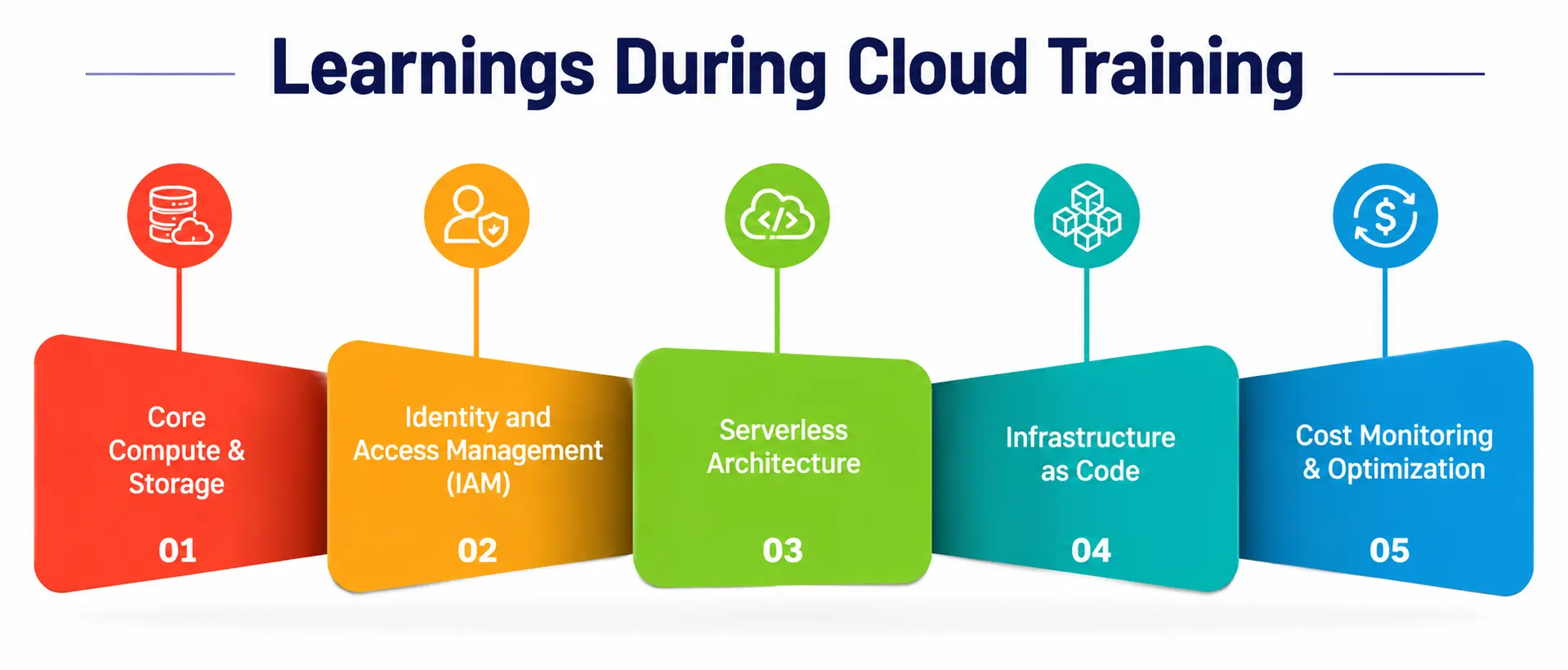
- Core compute and storage: Provisioning EC2 instances, configuring S3 buckets, and understanding when each service actually makes financial sense.
- Identity and Access Management (IAM): Setting permissions correctly the first time, because misconfigured IAM is still one of the most common causes of cloud security incidents.
- Serverless architecture: Building event-driven applications with AWS Lambda instead of defaulting to always-on servers.
- Infrastructure as Code: Using CloudFormation or Terraform so environments can be rebuilt in minutes, not days.
- AWS cost optimization: Using Cost Explorer and AWS Budgets to read a billing dashboard and knowing exactly which resource is quietly draining the budget.
This is also where a real AWS Cloud Engineer certification program earns its price tag. Reading documentation gets you halfway. Actually deploying, breaking, and fixing a small cloud environment is what makes the knowledge stick, and it’s the part most rushed prep courses skip entirely.
My AWS Certification Journey: Lessons From My First Practice Exams
I’ll be honest about my own experience, because I think it’s more useful than another generic checklist. When I first sat for a practice exam on my AWS certification path, I kept selecting the “technically correct” answer instead of the “most cost-effective” one—a habit that cost me close to fifteen questions before I even noticed the pattern.
It wasn’t a knowledge gap. It was a mindset gap. AWS exams, and honestly the job itself, reward the answer that balances performance, security, and cost—not just the answer that “works.” That single lesson changed how I studied and, later, how I mentored other people chasing the same AWS Cloud Engineer Certification.
If you’re new to this, expect a few humbling moments in your first practice tests. They’re not a sign you’re behind. They’re in the process of doing exactly what it’s supposed to do. Looking back, the biggest shift wasn’t technical at all. It was learning to treat cloud training as a series of small, honest failures instead of a race to a passing score.
I started keeping a simple log of every question I got wrong and why, and within a few weeks the pattern was obvious: I understood the services fine, but I didn’t yet think like someone responsible for a real production environment. That’s the gap good training is actually meant to close, and it’s the same gap I now watch other career-changers work through.
Best AWS Certification for Beginners and Career Changers
There’s no universal “correct” order, but a sensible default exists. If you’re brand new to IT, start with Cloud Practitioner, move into Solutions Architect – Associate, and decide from there whether operations, development, or architecture pulls you further on your AWS cloud engineer roadmap.
A detailed 2027 roadmap from ExamAssist confirms this exact sequence remains the most common entry route this year, alongside newer role-based options like AI Practitioner and Data Engineer—Associate for people leaning toward data and machine learning work.
If you already work as a cloud engineer in a related IT role—say, networking or general sysadmin work—you can often skip straight to an associate-level exam and treat the foundational cert as optional.
That’s really the mindset behind choosing the best AWS certification: pick the one that matches where you are now, and plan the next one before this one goes stale. It also helps to be honest about your timeline. Someone studying part-time around a full-time job will move through an AWS cloud engineer certification far slower than a full-time career changer, and that’s fine—cloud skills compound whether you build them in three months or nine.
What matters more than speed is consistency: a little structured cloud training every week beats a frantic study binge the weekend before your exam, almost every single time.
Final Thoughts: Is the AWS Cloud Engineer Certification Worth It?
If you take one thing from this guide, let it be this: the AWS Cloud Engineer Certification isn’t a magic ticket, but it is one of the clearest, most measurable ways to prove cloud skills to an employer who has never met you. Pick a realistic AWS certification path, commit to proper cloud training instead of cramming, and treat your first exam as the start of a career-long habit rather than a finish line.
For what it’s worth, this is also the exact gap Thinkcloudly was built to close. Alongside structured AWS certification training (including our [AWS Solutions Architect Associate SAA-C03 course] and [AWS Job Seeker’s Package]), the training includes hands-on labs, mentor support, and mock interviews designed to get you past the “technically correct but not practical” trap I fell into myself. If you’d rather not map out your entire cloud engineer journey alone, that guided structure is there when you’re ready for it.