

I used to think “governance, risk, and compliance” was just three separate departments that happened to share a meeting room. Then I watched a mid-sized fintech miss a single regulatory deadline—not because nobody knew the rule was changing, but because the team that tracked the rule and the team that owned the system it affected never talked to each other.
The fine was six figures. The post-mortem took longer than the fix. That gap between “we knew” and “we acted” is exactly what this discipline exists to close, and in 2026, with AI regulation, cross-border data rules, and enforcement actions multiplying faster than most compliance calendars can absorb, that gap is getting more expensive to leave open.
This piece is for students and early-career professionals who keep seeing this term on job postings and want to actually understand what it means before they walk into an interview and get asked to explain it. It’s just a straight explanation of what this discipline does, why it’s grown so fast, and how the pieces fit together.
What Is GRC Risk Management?
GRC risk management is the practice of aligning an organization’s governance structures, risk identification processes, and compliance obligations into one coordinated system instead of three disconnected ones.
Governance sets the rules of the game—who decides what, and who’s accountable when something goes wrong. Risk is the discipline of spotting what could go wrong before it does. Compliance is the proof that you’re actually following the rules regulators, customers, and auditors expect you to follow.
Treated separately, these three functions duplicate work, miss warning signs, and create the kind of silence that lets that fintech I mentioned walk straight into a fine. Treated as one integrated practice, it becomes a single source of truth: one risk register, one set of controls, one reporting line to the board.
That’s the entire pitch, and it’s why the OCEG—the research body that coined the “GRC” term back in 2002—still defines it as the capability to reliably achieve objectives, address uncertainty, and act with integrity, all at once rather than in sequence.
Why GRC Risk Management Matters More in 2026 Than It Did Five Years Ago?
The honest answer is that the volume and speed of regulatory change have outpaced the human capacity to track it manually. A handful of numbers make that concrete:
- The global governance, risk, and compliance software market is projected to grow from roughly $6.5 billion in 2025 to nearly $10.9 billion by 2031, a compound annual growth rate of about 9%. That’s not hype-cycle spending—it’s organizations admitting that spreadsheets stopped being enough.
- A CUBE survey of more than 2,000 senior compliance and risk officers across 1,300 financial institutions found that 82% now track between 26 and 100 regulatory alerts every month, and 39% are handling 51 to 100.
- The same research found that fully implementing a single regulatory change takes organizations more than a year on average, and 21% of respondents describe their own process as somewhat or highly ineffective.
- Gartner’s Q1 2026 survey of 337 senior risk and assurance executives found that information integrity risk—the danger of AI-enabled decisions built on flawed or manipulated data—is now the single top-ranked emerging risk, with AI and technology concerns accounting for three of the five highest-ranked risks overall, according to Gartner’s May 2026 press release.
Put those together and the picture is simple: more rules, changing faster, layered on top of AI systems nobody fully trusts yet. This work isn’t a compliance department’s internal process anymore—it’s become a board-level concern, which is exactly why 16% of firms in the CUBE survey said they now report potential regulatory change directly to their executive team or board, a figure the researchers flagged as unusually low given the stakes.
The Core Components of GRC Risk Management
Strip away the consulting-deck language, and this discipline is really built from five working parts. Here they are, in the order most programs build them:
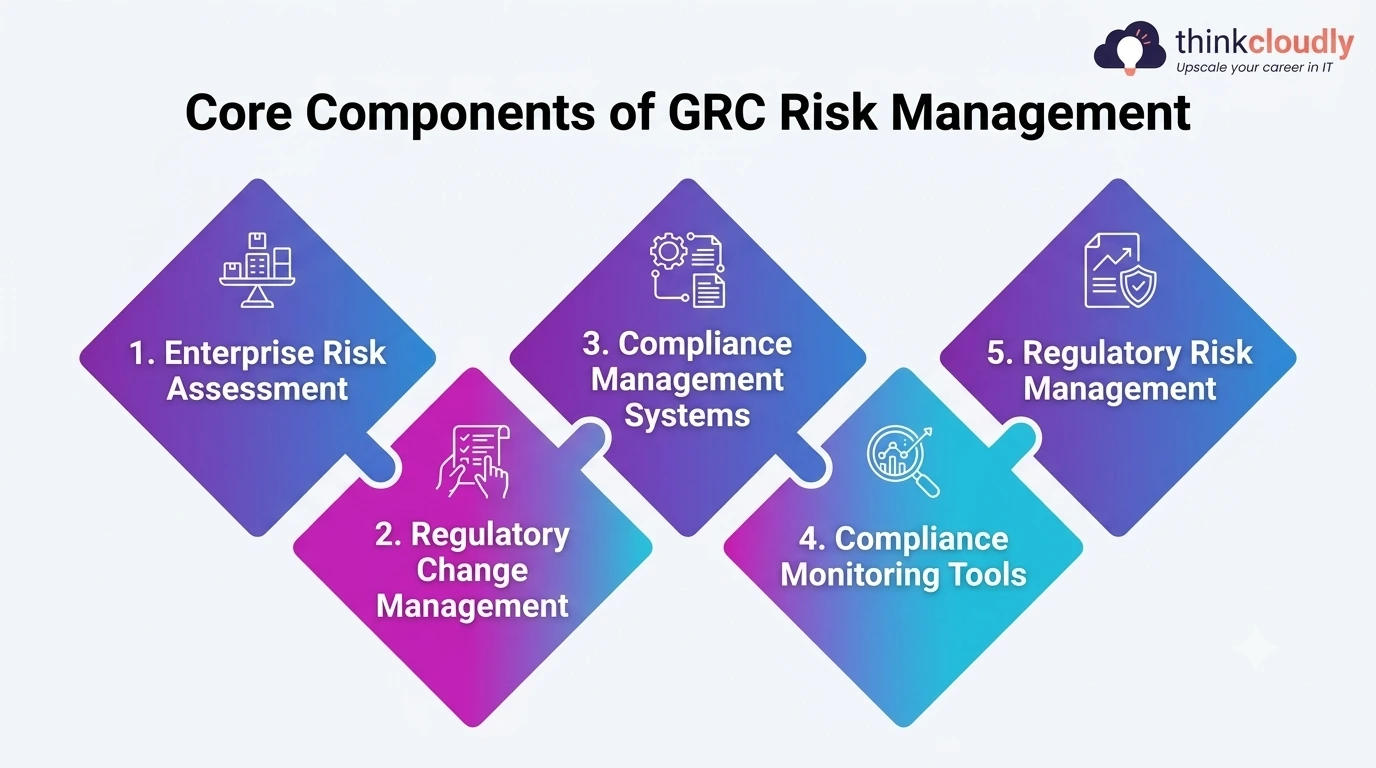
1. Enterprise Risk Assessment
The structured exercise of identifying, scoring, and ranking every material risk an organization faces, from cyber threats to third-party failures to regulatory exposure, so leadership knows where to spend limited attention first.
2. Regulatory Change Management
The ongoing process of monitoring new and amended rules across every jurisdiction an organization operates in, then translating each change into a concrete action: update a policy, retrain staff, or adjust a system.
3. Compliance Management Systems
The software and workflow backbone that stores policies, tracks attestations, logs training completion, and gives auditors a single place to verify that obligations are actually being met.
4. Compliance Monitoring Tools
The ongoing, often automated checks that confirm controls are working day to day, rather than waiting for an annual audit to find out something broke six months ago.
5. Regulatory Risk Management
The layer that sits on top of all of the above, deciding how much regulatory exposure the organization is willing to tolerate and making sure that tolerance lines up with what the business is actually doing.
None of these five pieces works well in isolation. A risk register that never feeds into the change-tracking process just produces a report nobody acts on. Monitoring checks that aren’t connected to the organization’s policy and attestation system generate alerts that go nowhere. The whole point of treating this as one coordinated practice, rather than five separate jobs, is making sure each piece feeds the next one.
A Quick Comparison: Where Each Discipline Fits
|
Discipline |
Core Question It Answers | Typical Output |
How Often It Runs |
|
Enterprise Risk Assessment |
What could go wrong, and how badly? | Ranked risk register |
Annually, with quarterly refreshes |
|
Regulatory Change Management |
What rules just changed, and what do we need to do about it? | Action log tied to a deadline |
Continuously |
|
Compliance Management Systems |
Can we prove we’re following the rules? | Policy repository, attestation records |
Always-on system of record |
|
Compliance Monitoring Tools |
Are our controls actually working right now? | Real-time alerts, exception reports |
Continuous or daily |
|
Regulatory Risk Management |
How much exposure are we willing to carry? | Risk appetite statement, board reporting |
Quarterly, reviewed by leadership |
This table is less about memorizing five names and more about understanding that GRC risk management is a pipeline. A gap anywhere in that pipeline—a stale risk register, a policy system nobody updates, automated checks that only run once a quarter—shows up eventually as a finding in an audit, or worse, a fine.
How Enterprise Risk Assessment Actually Works Inside a GRC Program?
An Enterprise Risk Assessment isn’t a one-time workshop where executives list their worries on sticky notes, even though that’s often how it starts. A serious version of it follows a repeatable method: identify risks across categories (strategic, operational, financial, regulatory, reputational), score each on likelihood and impact, and map ownership so every risk has a named person responsible for watching it.
The organizations getting the most value from this process are the ones that revisit it on a fixed schedule rather than only after something goes wrong, because a risk register that’s a year out of date is barely more useful than no risk register at all.
What makes this hard in 2026 specifically is the Gartner finding mentioned earlier—AI-related risks are now dominating the top of most risk registers, and most risk-scoring methodologies built five years ago simply weren’t designed to score “an AI model made a decision based on corrupted training data” alongside “a hurricane disrupts our main data center.” Programs are adapting, but the adaptation is uneven across industries.
Regulatory Change Management: Keeping Pace Without Burning Out the Team
This piece of the puzzle is, in practice, the part of the broader program that burns people out fastest, because it never stops. New guidance, amended statutes, and updated supervisory expectations arrive on a rolling basis, and someone has to read each one, decide if it applies, and route it to the right owner.
The CUBE research cited above found that 98% of surveyed institutions report at least some automation in this process already, yet 60% still expect the cost of running it to rise over the next twelve months—automation is helping, but it hasn’t solved the underlying volume problem.
The practical fix most mature programs land on is triage: not every regulatory update deserves the same depth of review. A minor clarification from a regulator gets logged and closed in a day. A structural change—a new AI disclosure requirement, for instance—gets escalated, assigned an owner, and tracked against a real deadline.
Regulatory change management done well looks boring from the outside, which is exactly the point; it’s the change-tracking processes that are chaotic and reactive that end up in the headlines.
Compliance Management Systems vs. Compliance Monitoring Tools: What’s the Actual Difference
Students mix these two up constantly, and the distinction matters. Compliance Management Systems are the system of record—they hold your policies, your training records, your attestations, and your audit trail. Think of this kind of platform as the filing cabinet that regulators and auditors actually trust, because everything in it is timestamped and traceable.
Compliance monitoring tools are different. Instead of storing proof that a policy exists, they check, continuously or on a schedule, whether the controls described in that policy are actually operating.
A Compliance Management Systems platform might confirm that an access-control policy was signed off last quarter; the monitoring layer is what catches the account that still has admin access three months after someone left the company.
Good GRC risk management programs run both side by side — the record-keeping layer and the real-time verification layer — because one without the other leaves a blind spot exactly where it matters most.
Building a Regulatory Risk Management Program: A Practical Sequence
If you’re trying to understand how a Regulatory Risk Management program actually gets built rather than just defined, here’s the sequence most organizations follow, roughly in order:
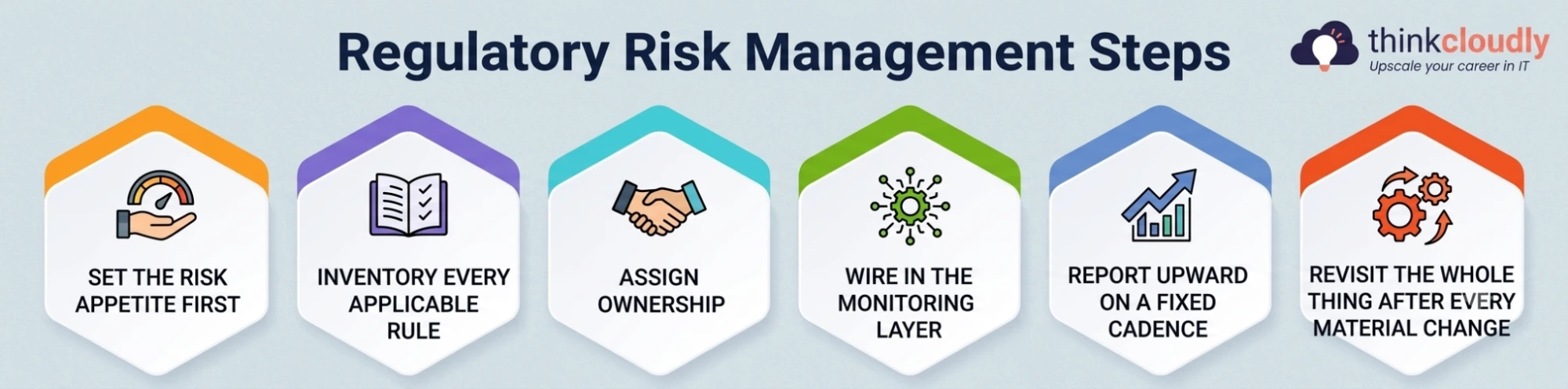
1. Set the risk appetite first
Before anything else, leadership decides how much regulatory exposure the organization is willing to tolerate in pursuit of its goals. Without this, every later decision is guesswork.
2. Inventory every applicable rule
Map out which regulations, in which jurisdictions, actually apply to the business — this becomes the backbone that the change-tracking process will monitor going forward.
3. Assign ownership
Every regulatory obligation needs a named owner, not a department. “Legal” isn’t an owner; a specific person accountable for that specific obligation is.
4. Wire in the monitoring layer
Connect automated monitoring checks to the controls that matter most, so breaches surface in days, not during the next annual audit.
5. Report upward on a fixed cadence
None of this works if the board or executive team never actually sees the findings — recall that only 16% of firms in the CUBE survey said they report potential regulatory change straight to the top, which is a gap worth closing early rather than discovering during an actual incident.
6. Revisit the whole thing after every material change
A new product line, a new market, or a new AI feature should trigger a fresh look at the Regulatory Risk Management program, not wait for the next scheduled review.
Common Mistakes Students and Early-Career Professionals Should Avoid
A few patterns show up again and again in how people misunderstand this field. They treat this discipline as paperwork rather than as a decision-making system, which leads them to build beautiful risk registers that nobody consults when an actual decision needs to be made.
They assume the policy platform alone is “doing compliance,” when the system is only as good as the monitoring checks and risk-scoring work feeding into it. And they underestimate how much of this job is translation — turning a dense regulatory update into three sentences an engineering team can actually act on is a skill in itself, and it’s rarely taught directly in a classroom.
The people who do well in this field early tend to be the ones who get comfortable reading primary regulatory text instead of relying on secondhand summaries, and who can explain, in plain language, why a specific control exists and what breaks if it’s removed.
A Personal Note
What surprised me most while researching this piece wasn’t the market-size numbers or the Gartner rankings — it was how often the actual failure point in GRC risk management has nothing to do with technology at all. It’s almost always a handoff problem: the risk team flagged something, the compliance team logged something, and nobody connected the two before the deadline passed.
Every tool and framework in this article exists to fix that one recurring human failure. If you’re early in this field and feeling overwhelmed by the acronyms, my honest advice is to stop trying to memorize frameworks first and start asking, in every system you look at, “who would actually see this alert, and would they know what to do with it?” That question will teach you more about this field than any certification syllabus will.