

A friend of mine spent four months applying to GRC Analyst Jobs with a resume that listed every security buzzword she could find and not one real example of work she’d actually done. Forty-plus applications, three callbacks, zero offers. Then she rebuilt her resume around a single mock risk assessment she’d built herself over a weekend, stopped applying to everything, and got two offers inside six weeks.
Nothing about the market changed in that window. What changed was that she finally understood what hiring managers screening candidates for this role are actually looking for, and it isn’t a longer list of acronyms.
This piece is for anyone staring at a stack of rejected applications and wondering what’s missing. It walks through why demand for this role is climbing, what the job actually involves day to day, the skills and credentials that get a resume past the first filter, and a practical sequence for breaking in—even if you’re starting with zero industry experience.
Why Are GRC Analyst Jobs Growing So Fast Right Now?
Governance, risk, and compliance hiring isn’t a passing trend. It’s a direct response to regulation outpacing the number of people qualified to manage it. A few numbers make the pressure concrete:
- The U.S. Bureau of Labor Statistics projects employment of compliance officers—the broader occupational family GRC Analyst Jobs sits inside—to keep growing through the next decade, faster than the average for all occupations, as regulatory obligations expand across finance, healthcare, and technology.
- Gartner’s Q1 2026 survey of senior risk and assurance executives found that information integrity risk—the danger of decisions built on flawed or AI-manipulated data—is now the single top-ranked emerging risk, with technology-related concerns filling three of the top five spots.
- ISC2’s most recent workforce research shows organizations worldwide are still reporting a meaningful shortage of skilled risk and compliance professionals, with budget holders naming governance and compliance skills among the hardest to fill, per the ISC2 Cybersecurity Workforce Study.
Put simply, organizations have more rules to track than people who can track them, and that gap is exactly what keeps opening new analyst seats every quarter. The role sits at the intersection of information security governance and day-to-day information security compliance work, which is precisely why it’s being created inside industries—healthcare, fintech, and SaaS—that didn’t need dedicated compliance headcount a decade ago.
Pay is tracking that demand upward, too. The research shows risk and compliance roles among the fastest-growing in base pay across the markets it tracks, with employers willing to move quickly on offers once they find a candidate who can actually demonstrate the skills a posting asks for. That willingness to move fast cuts both ways—it also means a candidate who can’t back up their resume in the first interview gets passed over just as quickly.
What a GRC Analyst Actually Does Day to Day
Job postings make the role sound abstract. In practice, a GRC analyst spends most of a given week on a narrower set of tasks than the title suggests. They maintain the risk register, which means tracking identified risks, their owners, and their current status.
They support audits by pulling evidence, mapping controls to frameworks like ISO 27001 or SOC 2, and chasing down the people who were supposed to complete a control but didn’t. They monitor policy attestations and training completion.
And increasingly, they work directly inside whatever risk management software the organization has standardized on—logging findings, updating dashboards, and making sure the system of record actually reflects reality instead of what it looked like three months ago.
This is also where the job overlaps with a traditional risk analyst role. The titles aren’t identical—a risk analyst tends to focus more narrowly on identifying and quantifying risk, while a GRC analyst folds that work into the broader governance and compliance picture—but in smaller organizations, one person often does both.
Understanding that overlap matters in interviews, because hiring managers will ask how comfortable you are moving between pure risk analysis and the governance and documentation side of the job.
7 Skills Employers Actually Screen For in GRC Analyst Jobs
Strip away the job-posting language and most employers are checking for the same seven things, in roughly this order of importance. Notice that only one of the seven is a formal GRC training credential—the other six are things you demonstrate through actual work, not through a certificate alone:
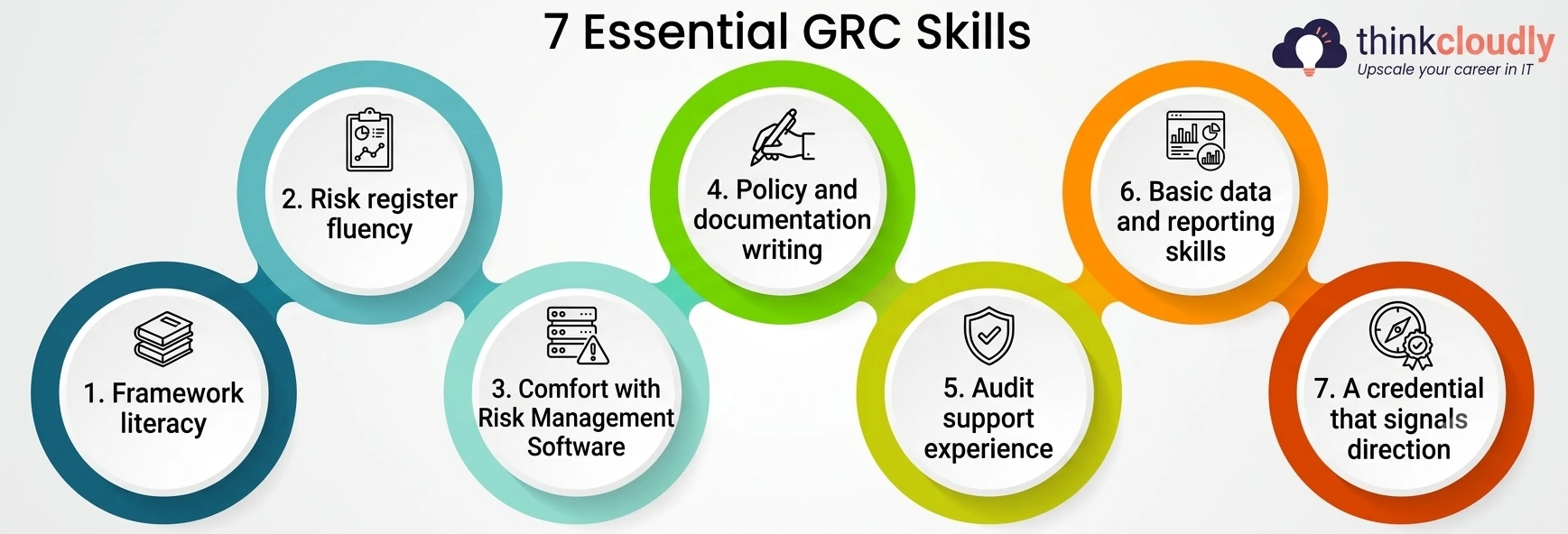
1. Framework literacy
You should be able to speak comfortably about at least one major framework—ISO 27001, NIST CSF, or SOC 2—and explain what a control actually verifies, not just recite its name.
2. Risk register fluency
Knowing how to score likelihood and impact, assign ownership, and keep a register current is a core, testable skill, and interviewers often ask candidates to walk through a sample.
3. Comfort with Risk Management Software
Hands-on familiarity with any GRC platform—even a free trial you explored yourself—signals you won’t need months of ramp-up time before contributing.
4. Policy and documentation writing
A huge share of this job is translating dense regulatory or technical language into something a non-specialist can follow and act on.
5. Audit support experience
Even informal exposure to how evidence gets collected and mapped during an audit cycle is a meaningful differentiator for entry-level candidates.
6. Basic data and reporting skills
Spreadsheet fluency and the ability to build a clear dashboard or summary report come up constantly, even in roles that sound purely qualitative.
7. A credential that signals direction
Completing recognized GRC training—something like ISC2 CGRC, CompTIA Security+, or an OCEG GRC Professional course—tells a hiring manager you’ve chosen a lane rather than applying broadly with no focus.
Candidates who can speak to all seven, even briefly, consistently outperform candidates with a longer list of unrelated certifications and no concrete examples to back them up.
Certifications and Tools Compared: What Actually Shows Up in Job Postings
|
Credential / Tool Category |
What It Signals to Employers | Approx. Entry Cost |
Best Fit For |
|
ISC2 CGRC |
Formal grounding in information security Governance and compliance documentation | ~$599 |
Entry to mid-level candidates with some security exposure |
|
CompTIA Security+ |
Baseline security literacy for candidates with no prior IT background | ~$400 |
Complete beginners pivoting into GRC |
|
OCEG GRC Professional (GRCP) |
Broad governance, risk, and ethics fluency across industries | Varies by provider |
Career-changers from legal, finance, or operations |
|
ISACA CRISC |
Deeper IT and enterprise risk management focus | 575–760 |
Candidates aiming at risk analyst or risk-lead roles |
|
Hands-on GRC Platform Trial |
Practical, demonstrable comfort with the tools used daily on the job | Often free |
Anyone building a portfolio before their first role |
This table isn’t a shopping list. One credential plus genuine hands-on time with risk management software will outperform three unrelated badges every time a resume actually gets read.
Building a Resume That Survives the First Filter
Most resumes rejected for GRC analyst jobs fail at the same two points before a human ever reads them closely.
- First, they list responsibilities instead of outcomes—”assisted with compliance tasks” tells a recruiter nothing, while “maintaining a risk register of 40+ items and closed audit findings within SLA” tells them exactly what you can do.
- Second, they bury the one or two signals that actually matter—a relevant credential, a built project, direct exposure to information security compliance work—under generic soft-skill language that every other applicant’s resume also contains.
A resume built around a single concrete artifact beats a resume built around a long list of adjectives almost every time. That artifact can be a mock risk assessment, a documented control framework you mapped yourself, or a short write-up of how you’d approach an audit for a hypothetical company.
Interviewers remember candidates who can walk through something they actually built far more than candidates who can only describe what a textbook says information security governance is supposed to look like.
A 6-Step Roadmap to Break Into GRC Analyst Jobs
For anyone starting from zero, here’s a sequence that consistently works better than applying broadly and hoping:
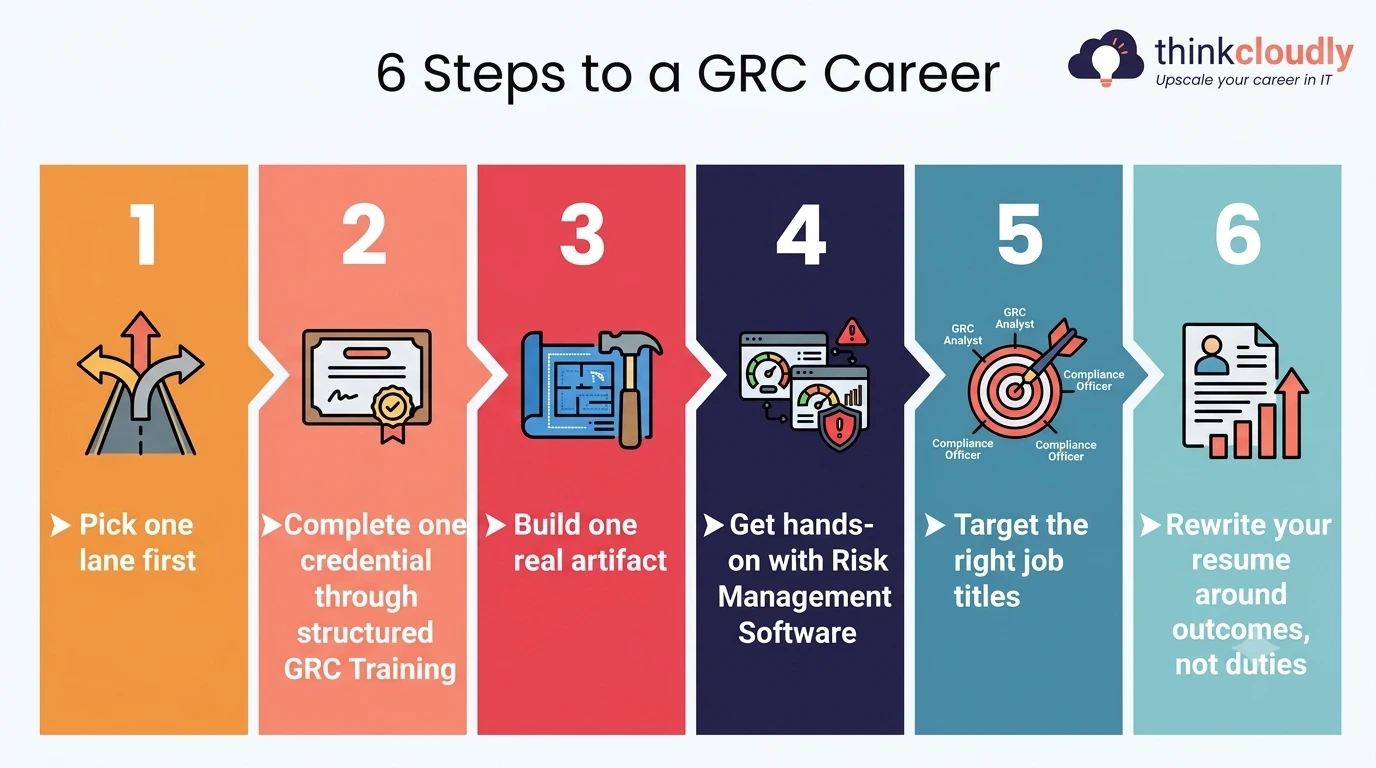
1. Pick one lane first.
Decide whether you’re aiming at technology and cyber risk, corporate compliance and ethics, or audit and assurance before choosing a certification or a course.
2. Complete one credential through structured GRC training.
A single, well-chosen course — not five scattered ones — gives you both the vocabulary and the proof-of-effort employers screen for.
3. Build one real artifact.
Document a mock risk register, map a control framework, or write a short Information Security Compliance policy for a fictional company and keep it ready to discuss.
4. Get hands-on with risk management software.
Most major GRC platforms offer free trials or demo sandboxes—spend a weekend inside one so you can speak specifically about navigating a real tool, not a theoretical one.
5. Target the right job titles.
“GRC Analyst,” “Compliance Analyst,” “IT Compliance Analyst,” and “Information Security Compliance Analyst” often describe overlapping work—widen your search accordingly rather than filtering on one exact title.
6. Rewrite your resume around outcomes, not duties.
Lead with the artifact you built, the credential you completed, and any measurable result, however small, before listing soft skills.
Candidates who follow this sequence in order—lane, training, artifact, tool exposure, targeted search, rewritten resume—consistently cut their time-to-offer compared with candidates who apply to GRC Analyst Jobs first and figure out their story afterward.
Where to Actually Find These Roles?
Beyond the obvious job boards, a few sources consistently surface these openings before they’re buried under hundreds of applicants. Company career pages for mid-sized fintech, healthcare, and SaaS companies often post these roles directly, ahead of the big aggregator sites.
Recruiting-focused research is also worth watching: LinkedIn’s annual look at fast-growing roles has repeatedly flagged compliance and risk-adjacent titles among the occupations adding headcount quickest, which lines up with what recruiters describe anecdotally about how hard these seats are to fill, as detailed in LinkedIn’s Jobs on the Rise research.
Professional associations — ISACA chapters, IAPP local groups, OCEG’s community — post roles that never make it to general job boards, and showing up to even a virtual chapter meeting puts you ahead of candidates relying purely on cold applications.
Common Mistakes That Quietly Sink Applications
A handful of patterns show up again and again in candidates who don’t get callbacks. Some skip structured GRC Training altogether and try to learn the vocabulary purely from job descriptions, which shows up fast in an interview the moment a follow-up question goes one layer deeper than the posting did.
They collect certifications without building anything tangible to show for them, so an interview question like “walk me through a risk you identified” has no concrete answer behind it. They apply to every listing regardless of fit, instead of tailoring even three sentences of their cover letter to the specific framework or industry the posting names.
They talk about Information Security Governance in abstract, textbook terms rather than describing how they’d actually apply it to a real control gap. And they treat the interview as a knowledge test rather than a conversation about judgment — hiring managers are far more interested in how you’d prioritize a messy risk register than in whether you can recite a framework from memory.
A Personal Note
The thing that struck me most while putting this guide together wasn’t the salary data or the certification comparisons — it was how consistently the candidates who actually got hired were the ones who stopped treating this search like a numbers game.
My friend who finally broke in after months of silence didn’t get there by submitting more applications; she got there by building one thing she could defend in detail and then being selective about where she sent it.
If you’re early in this search and it feels like GRC Analyst Jobs are a locked door, my honest advice is to put down the tenth tab of open job listings for a weekend and build the one artifact you keep meaning to get around to. It will do more for your callback rate than the next fifty applications combined.