

If you searched for how to prepare for the SC-500 certification and landed here, I have to stop you before you book a seat you can’t actually sit for. Microsoft retired the Azure Security Engineer Associate credential, and the AZ 500 certification exam, along with it, will be on August 31, 2026. You can no longer earn it, and anyone who already holds it can no longer renew it.
What replaced it is SC-500: Microsoft Certified Cloud and AI Security Engineer Associate, and if you’re reading this after October 2026, that’s the exam you actually need to prepare for.
This guide walks through why the switch happened, exactly what the new exam measures, how much of your old AZ 500 certification study time still counts, and a realistic plan for closing the gap—including the Microsoft Sentinel and AI-security material that didn’t exist on the old blueprint.
Why was the AZ-500 certification retired?
Microsoft doesn’t retire a popular, widely-held credential for no reason. The AZ 500 certification has been the standard proof-of-skill for Azure security engineers since 2020, and plenty of job postings still name it by exam code out of habit. But the role it was built to certify had quietly outgrown it.
Security engineering in 2026 isn’t just about locking down virtual networks and storage accounts anymore. Copilot rollouts, autonomous AI agents, and multicloud estates sitting half in Azure and half in AWS or Google Cloud have become normal parts of the job.
According to the certification’s own retirement notice on Microsoft Learn’s credentials page, the AZ 500 certification, its exam, and its renewal assessment all ended on the same date, with no bridge exam and no discount offered to existing holders moving to the replacement.
SC-500 certification entered beta in mid-May 2026 and reached general availability on July 21, 2026. It isn’t an upgrade of the old exam—it’s a separate, standalone Cloud and AI Security Engineer Associate credential that happens to inherit roughly three-quarters of its content from what used to be tested under the AZ-500 certification. The rest is new ground: AI agent identity, Copilot data-oversharing risk, and a noticeably heavier dose of Microsoft Sentinel.
What Does the SC-500 Exam Actually Measure?
The exam runs 120 minutes at a Pearson VUE testing center or as an online proctored session, and like most Microsoft role-based associate exams, you need a scaled score of 700 out of 1000 to pass.
If you’ve held any prior Azure Security Certification, the exam structure itself will feel familiar—four weighted domains, scenario-heavy questions, and a mix of multiple-choice, drag-and-drop, and case-study items. Here’s the skills breakdown as it stands on the current Microsoft. Learn outline:
|
Domain |
Weight |
What It Covers |
|
Manage identity, access, and governance. |
20–25% |
Microsoft Entra ID, Conditional Access, Privileged Identity Management, Entra Agent ID for AI agents, RBAC, and Azure Policy |
|
Secure storage, databases, and networking |
25–30% |
NSGs, Azure Firewall, Private Link, Key Vault, storage encryption, SQL auditing, and dynamic masking |
|
Secure compute (including AI workloads) |
20–25% |
VM and container hardening, JIT access, Copilot Studio and Foundry agent protection, AI Gateway guardrails in API Management |
|
Manage and monitor security posture. |
20–25% |
Microsoft Defender for Cloud, Secure Score, multicloud connectors for AWS and Google Cloud, Microsoft Sentinel analytics rules, and automation |
Notice that the largest single domain, storage, databases, and networking, is almost identical to what the SC-500 certification tested. That’s the part of your existing knowledge that carries straight over. The domain most people underestimate is compute, because it’s the one quietly carrying the new AI-agent content that didn’t exist on any previous Azure Security Certification.
A Step-by-Step SC-500 Study Plan
Treat this as the order to tackle things in, not a strict calendar—but if you want one, six to eight weeks at 8–10 hours a week is realistic for someone with prior Azure experience.
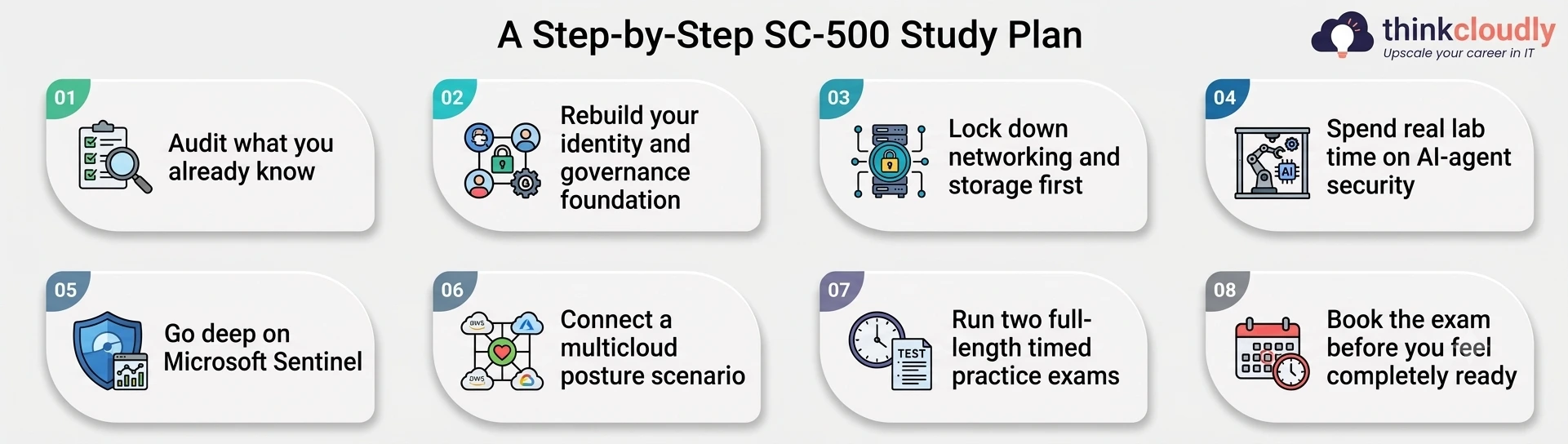
- Audit what you already know. If you studied for the AZ-500 certification before it retired, or you’ve worked hands-on in Azure security for a year or more, start by mapping your existing knowledge against the four SC-500 certification domains instead of relearning everything from zero.
- Rebuild your identity and governance foundation. Microsoft Entra ID, Conditional Access, and PIM haven’t changed much, but Entra Agent ID—identity for AI agents—is brand new and worth a dedicated study session on its own.
- Lock down networking and storage first. This is the biggest exam domain, and it’s also the most stable. NSGs, Azure Firewall, Private Link, and Key Vault configuration are safe places to bank early points.
- Spend real lab time on AI-agent security. Set up a free Microsoft 365 developer tenant and walk through Copilot Studio and Foundry agent protections yourself. Reading about blast-radius analysis in Defender XDR is not the same as watching it flag something.
- Go deep on Microsoft Sentinel. This exam leans on it more than the AZ 500 certification ever did. Build at least one analytics rule and one automation playbook from scratch rather than only reading about them.
- Connect a multicloud posture scenario. Defender for Cloud now manages posture across AWS and Google Cloud connections. You don’t need to learn those platforms’ native tools, but you do need to know how the connector and recommendations work from the Azure side.
- Run two full-length timed practice exams. Review every wrong answer the same day, and flag anything that touches a cloud risk assessment scenario, since those questions tend to combine two or three domains at once.
- Book the exam before you feel completely ready. A deadline forces focused review instead of open-ended procrastination.
The Azure Security Tools You Need to Know Cold
A chunk of SC-500 certification failures come down to candidates who understand the concepts but freeze when a scenario question names a specific tool and expects a specific action. Knowing the theory behind a service isn’t the same as knowing which Azure security tools to reach for under a specific set of constraints, so these are the ones worth hands-on time before exam day:
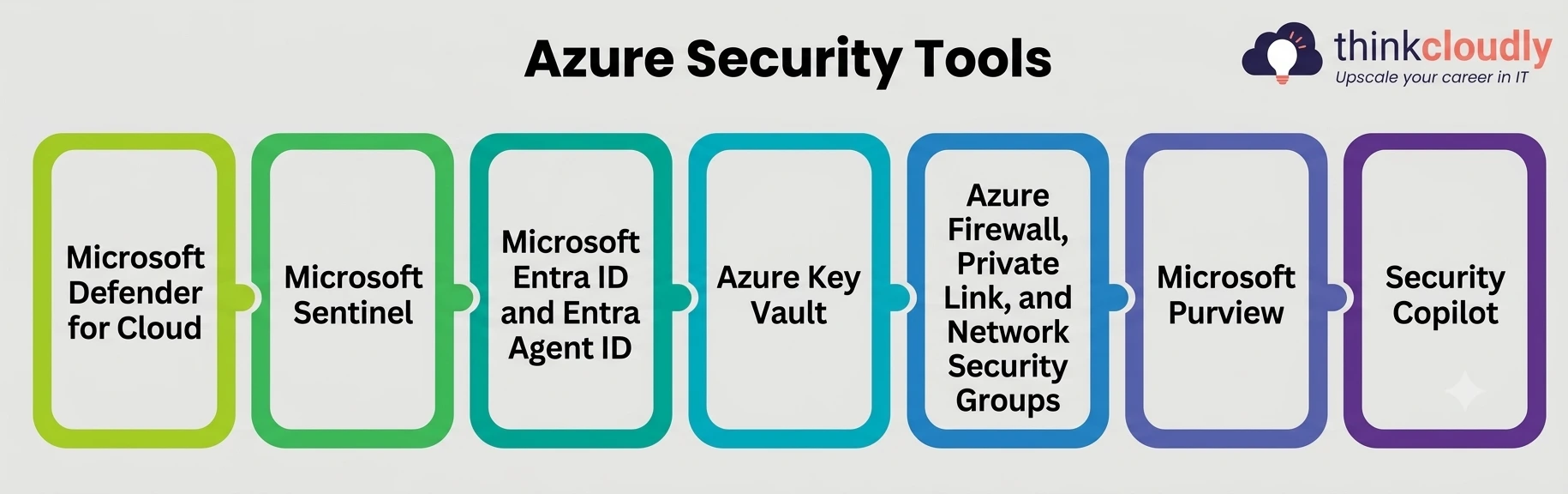
- Microsoft Defender for Cloud—for secure score tracking, regulatory compliance dashboards, and workload protection plans across hybrid and multicloud resources.
- Microsoft Sentinel—for analytics rules, data connectors, automation playbooks, and investigating incidents end to end, not just viewing a dashboard someone else built.
- Microsoft Entra ID and Entra Agent ID—for human identity governance and, now, identity for autonomous AI agents.
- Azure Key Vault—for secrets, certificates, and encryption key management, including bring-your-own-key scenarios.
- Azure Firewall, Private Link, and Network Security Groups—the core trio for any Cloud Security Configuration question involving traffic control.
- Microsoft Purview—for data classification and preventing oversharing before a Copilot rollout, a scenario the old AZ 500 certification never tested.
- Security Copilot—the first time a Microsoft certification has tested administration of an AI security assistant rather than just traditional tooling.
None of these Azure security tools are optional readings. The exam assumes you’ve clicked through each one, not just read a bullet list describing what it does.
Cloud Security Configuration Habits That Actually Carry Over From AZ-500
If there’s one encouraging fact in all of this, it’s that the fundamentals don’t reset. Cloud Security Configuration work—the habit of locking down a storage account, scoping a role assignment tightly, or writing a Conditional Access policy that doesn’t accidentally lock out your own admins—is identical whether the certification on the wall says AZ 500 certification or SC-500 certification.
Microsoft didn’t rebuild Azure’s security architecture; it rebuilt the exam to reflect that AI workloads now sit inside that same architecture and need the same discipline applied to them. That’s also why I’d push back on anyone telling you to start from zero. If you have real Azure Security Certification experience from the AZ-500 era, you’re not relearning a new platform.
You’re learning one new identity model (AI agents), one heavier-weighted tool (Microsoft Sentinel), and one new data-governance angle (Copilot oversharing prevention). Everything else is the same discipline applied to a slightly larger surface area.
Practicing a Cloud Risk Assessment the Way the Exam Expects
Scenario questions on SC-500 certification don’t ask you to define a term—they hand you a messy environment and ask what you’d fix first. That’s a Cloud Risk Assessment in miniature, and it’s worth practicing deliberately rather than hoping it clicks on exam day.
A reliable approach: read the scenario twice, identify which of the four domains it’s really testing (scenarios often disguise an identity problem as a networking one), check whether the fix needs to happen at the policy level or the resource level, and then pick the answer that solves the root cause rather than the symptom.
Microsoft’s scenario questions are notoriously good at offering a “technically works” answer next to the actually correct one, and a rushed Cloud Risk Assessment habit is exactly what picks the wrong one under time pressure.
Why Does This Transition Still Matters for Your Career?
It’s worth being direct about the career math here, because a lapsed exam code can quietly cost you interview callbacks. Job postings and vendor-compliance documents written before mid-2026 Still, reference the AZ 500 certification by name, and recruiters searching applicant tracking systems for that string won’t automatically catch a resume that lists SC-500 certification instead.
According to TrainingCamp’s breakdown of the transition, there’s no official equivalency mapping between the two credentials, so it’s on you to spell out the connection yourself—a line like “SC-500 certification, the Microsoft-certified successor to AZ-500” on a resume or LinkedIn profile does more work than either exam code alone.
The underlying skill set still commands a premium, regardless of which badge proves it. Employers running production Azure workloads need people who can hold an Azure Security Certification and actually apply it — scoping a Cloud Security Configuration correctly the first time, running a Cloud Risk Assessment before a new workload goes live, and knowing which Azure security tools catch a misconfiguration before it becomes an incident. None of that changed when the exam code did. What changed is the scope of the job, and SC-500 certification is simply catching the certification up to match it.
Exam Fees, Format, and Renewal
Microsoft prices role-based associate exams by country rather than publishing one global figure, but the U.S. price for this tier has held steady around $165 for the past few cycles — confirm the current number on the Cloud and AI Security Engineer Associate exam page before you register, since Microsoft does adjust pricing without much fanfare.
The certification stays valid for one year, after which a free, short online renewal assessment keeps it current without a full retake. One practical tip worth repeating from people who’ve already made the switch: register with a personal Microsoft account rather than a work one, so your exam history and badge don’t disappear the day you change employers.
If you want the official breakdown straight from the source rather than a summary, Microsoft’s Sentinel “what’s new” page is worth bookmarking too — SC-500’s Sentinel content tracks closely with whatever capabilities are currently GA, and that page updates faster than any exam guide can.
A Personal Note
I’ll admit I felt a little annoyed the first time I saw the az 500 certification retirement notice, mostly on behalf of everyone who’d spent six weeks of their evenings prepping for an exam code that quietly expired under them. But sitting with the SC-500 certification outline for a while changed my mind.
The old exam was already starting to feel like it was testing yesterday’s infrastructure while security teams argued about AI agents in production meetings. If you’re coming into this fresh, you’re not behind — you’re learning the version of Azure security that actually matches what’s running in most companies right now.
Don’t mourn the az 500 certification. Build the labs, break a few AI agent permissions on purpose in a sandbox, and let the SC-500 certification badge mean something more current than the one it replaced.