

Cloud breaches don’t wait for a convenient quarter, and neither do hiring managers. If you’ve been circling the idea of locking in an Azure security certification but keep putting it off, 2026 is a rough year to stay on the fence.
Microsoft’s security stack has grown wide enough that a single generalist badge no longer tells an employer much, and recruiters have gotten sharper about asking which exam code you actually hold.
This guide walks through the ten certifications worth your time right now, why each one matters, and how to sequence them so you’re not studying in circles. We’ll also look at a realistic Azure certification path for people starting from zero, plus the kind of Microsoft Azure security training that actually prepares you for the exam room instead of just the slide deck.
Why Does an Azure Security Certification Still Matters in 2026?
Cloud security hiring hasn’t slowed down, but it has gotten pickier. Companies running production workloads on Azure want people who can prove, not just claim, that they understand identity, data protection, and threat response inside Microsoft’s ecosystem.
Even hiring managers who can’t read an exam blueprint know that candidates with solid Azure security certification fundamentals ramp up faster on the job. Here’s the short version of why this still pays off:
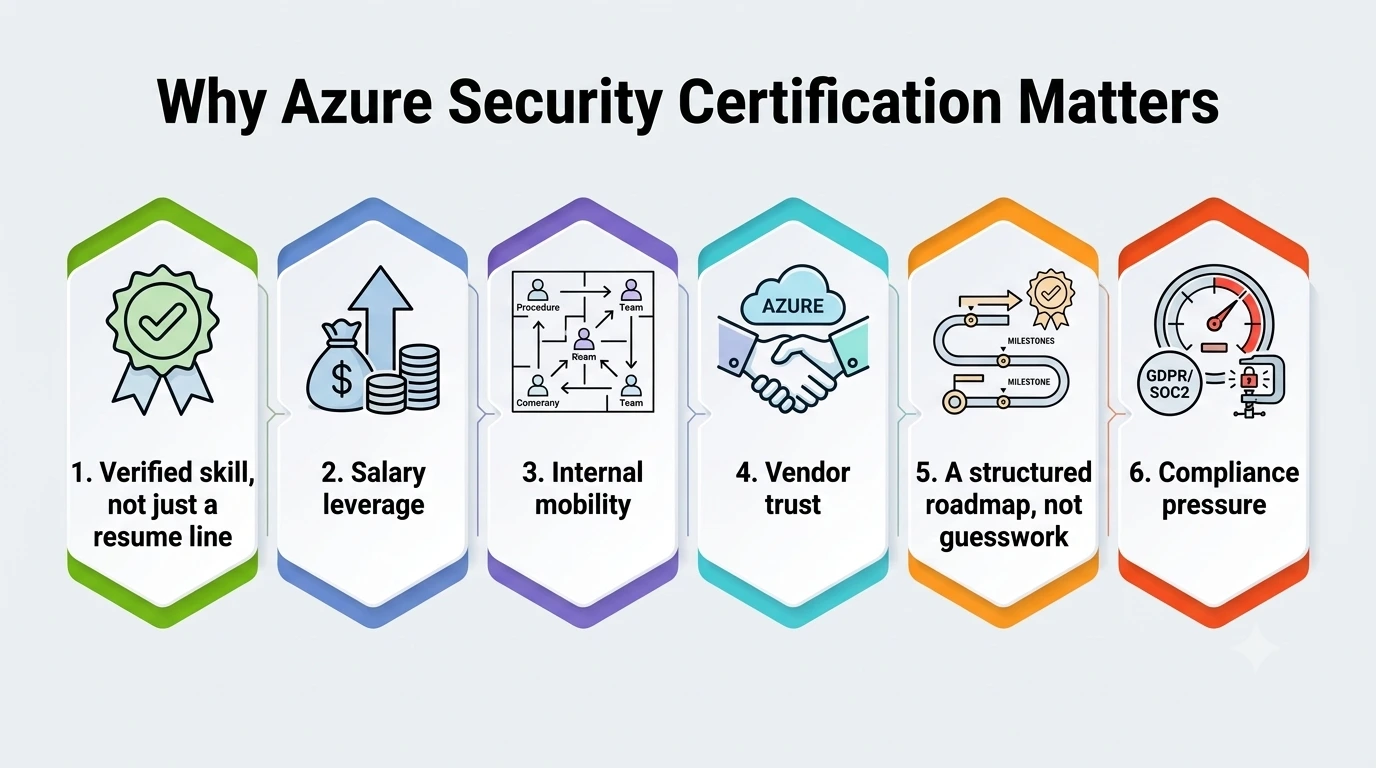
- Verified skill, not just a resume line. This kind of Microsoft-backed credential is one of the few things a hiring manager can trust without a three-hour technical interview.
- Salary leverage. Security-focused Azure roles consistently out-earn generalist cloud admin roles, and recent data shows that gap widening into 2026.
- Internal mobility. IT staff already working in Azure shops use these exams to move sideways into security teams without starting over.
- Vendor trust. Microsoft’s own badge system is recognized by enterprise procurement and government contracts in ways third-party bootcamp certificates aren’t.
- A structured roadmap, not guesswork. Instead of guessing what to learn next, the exam objectives hand you a syllabus for free.
- Compliance pressure. Regulated industries increasingly require certified staff on security-adjacent cloud projects, not just “experienced” ones.
None of that means a badge replaces hands-on skill. But it does mean this kind of credential is now one of the fastest, cheapest ways to get taken seriously in a crowded applicant pool.
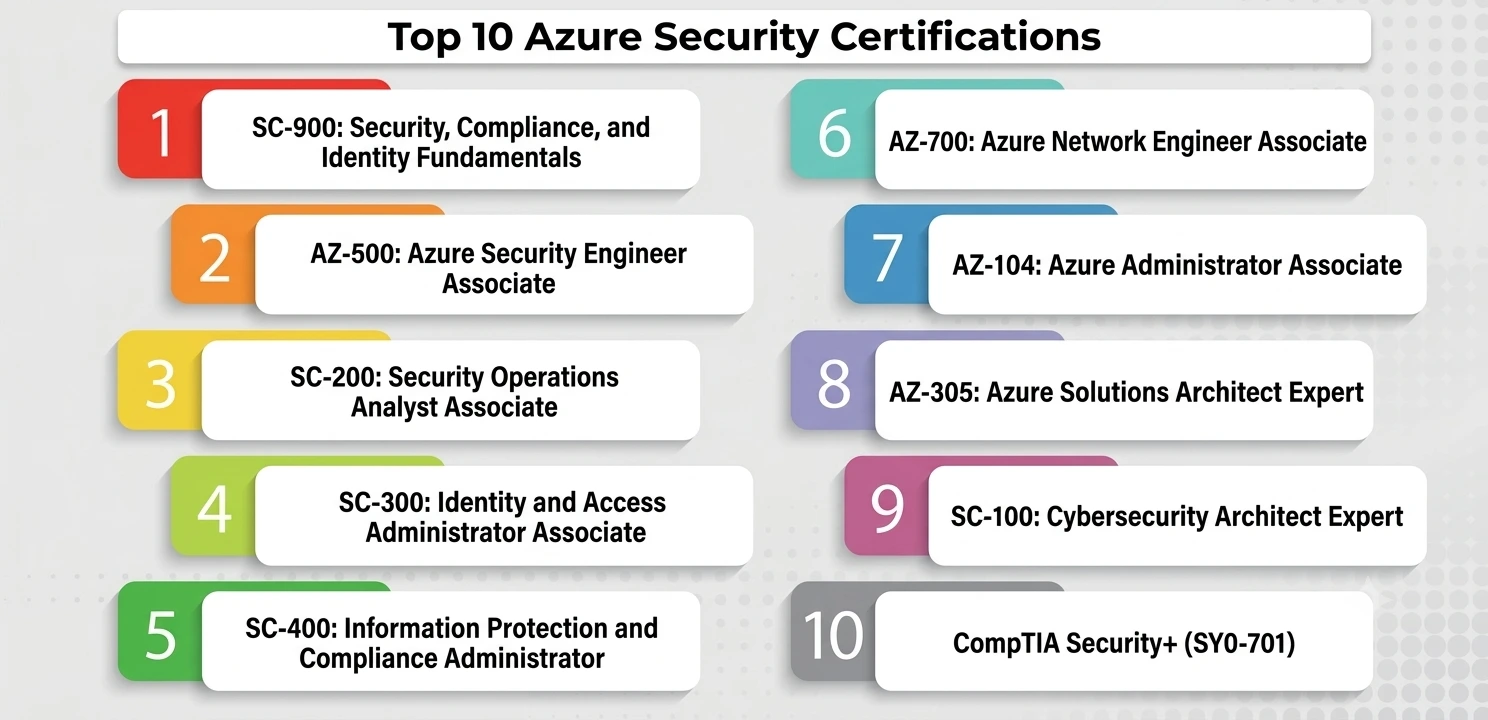
The Top 10 Azure Security Certifications
|
Certification |
Exam Code | Level |
Best For |
|
Security, Compliance, and Identity Fundamentals |
SC-900 | Fundamentals |
Beginners, non-technical roles |
|
Azure Security Engineer Associate |
AZ-500 | Associate |
Hands-on security engineers |
|
Security Operations Analyst Associate |
SC-200 | Associate |
SOC analysts, incident responders |
|
Identity and Access Administrator Associate |
SC-300 | Associate |
Identity and IAM specialists |
|
Information Protection and Compliance Administrator |
SC-400 | Associate |
Data governance and compliance teams |
|
Azure Network Engineer Associate |
AZ-700 | Associate |
Network security engineers |
|
Azure Administrator Associate |
AZ-104 | Associate |
Infrastructure admins moving into security |
|
Azure Solutions Architect Expert |
AZ-305 | Expert |
Architects designing secure environments |
|
Cybersecurity Architect Expert |
SC-100 | Expert |
Senior architects, strategy leads |
|
CompTIA Security+ |
SY0-701 | Foundational (vendor-neutral) |
Pairing with Azure-specific credentials |
Keep this table handy—it’s the fastest way to see where each credential sits on the ladder before you commit to an Azure security exam date. Notice how the first row is the only one built purely around Azure security certification fundamentals; everything below it assumes you already know the basics.
The Top 10 Azure Security Certifications
1. SC-900: Security, Compliance, and Identity Fundamentals
This is where most people should start their Azure certification path. SC-900 doesn’t require coding or deep Azure experience—it’s built around Azure security certification fundamentals like identity concepts, compliance basics, and how Microsoft’s security tools fit together. It’s also the cheapest and shortest of the group, which makes it a low-risk first attempt at an Azure security exam.
2. AZ-500: Azure Security Engineer Associate
AZ-500 is the one most employers actually ask for by name. It covers identity management, platform protection, data security, and security operations inside Azure, and it doubles as something close to an Azure threat protection certification because a large chunk of the exam deals with Microsoft Defender for Cloud and threat detection workflows. If you only have time for one credential this year, this is usually it.
3. SC-200: Security Operations Analyst Associate
Built for the people who live inside Microsoft Sentinel and Defender dashboards all day. SC-200 leans hard into detection, investigation, and response, making it the closest thing Microsoft offers to a dedicated Azure threat protection certification for SOC-focused staff. Anyone targeting a security operations center role should treat this as a priority, not an afterthought.
4. SC-300: Identity and Access Administrator Associate
Identity is the new perimeter, and SC-300 proves you can manage it—conditional access, identity governance, hybrid identity, and access reviews. Pair it with AZ-500 and you’ve covered most of what a mid-size company’s security team actually does day to day.
5. SC-400: Information Protection and Compliance Administrator
Less flashy than threat hunting, but critical in regulated industries. SC-400 focuses on data classification, labeling, loss prevention, and records management across Microsoft Purview. It’s a smart add-on for anyone whose employer deals with sensitive data under compliance rules.
6. AZ-700: Azure Network Engineer Associate
Network security doesn’t get enough credit, but firewalls, VPN gateways, and network segmentation are still where a lot of real-world breaches start. AZ-700 isn’t branded as a “security” exam, but a meaningful share of its content overlaps with securing traffic and access at the network layer.
7. AZ-104: Azure Administrator Associate
Not a security-specific exam, but it’s often the prerequisite experience behind one. AZ-104 covers the core administration skills—storage, virtual networks, and identity basics—that make the more specialized security exams easier to understand in context. Most structured Microsoft Azure security training programs assume this level of baseline knowledge already.
8. AZ-305: Azure Solutions Architect Expert
This is where security meets design. AZ-305 asks you to architect entire environments with governance, identity, and data protection baked in from the start, rather than bolted on afterward. It’s a natural next step once AZ-104 and AZ-500 are both done.
9. SC-100: Cybersecurity Architect Expert
The capstone. SC-100 assumes you already hold associate-level security knowledge and tests whether you can design a Zero Trust strategy across identity, operations, infrastructure, and data. It’s genuinely difficult, and it’s meant to be—this is the credential that signals “senior” on a resume.
10. CompTIA Security+ (SY0-701)
The one non-Microsoft entry on this list, and deliberately so. CompTIA Security+ is vendor-neutral, which makes it a useful companion credential if you ever move between cloud platforms. Many hiring managers still treat it as a baseline expectation alongside any Azure-specific badge.
Building a Realistic Azure Certification Path
Trying to sit every exam in one year is how people burn out and fail two of them. A more sustainable Azure certification path looks like this:
- Start with SC-900 to lock in Azure security certification fundamentals without the pressure of a technical exam.
- Move to AZ-104 if you don’t already have solid Azure administration experience.
- Sit AZ-500 next—this is the credential that actually gets noticed in job postings, and it doubles as the closest thing to an all-purpose Azure threat protection certification at the associate level.
- Branch into SC-200 or SC-300 depending on whether you’re drawn to threat-focused operations—SC-200 is arguably the other serious Azure threat protection certification on this list—or identity work.
- Finish with SC-100 or AZ-305 once you have real project experience to draw on, since both exams expect scenario-based judgment, not memorized definitions.
Whatever order you choose, give each Azure security exam at least four to six weeks of focused preparation. Microsoft’s own SC-900 exam page and AZ-500 exam page list the current skills-measured breakdown, and it’s worth re-checking them a week before your exam date since Microsoft updates objectives several times a year.
How Much Do These Exams Cost, and How Long Are They Valid?
Budget matters as much as study time, and it’s worth planning for both before you register for your next Azure security exam. Fundamentals-level exams like SC-900 typically run around $99 USD. Every associate- and expert-level option on this list—AZ-500, SC-200, SC-300, SC-400, AZ-700, AZ-104, AZ-305, and SC-100—sits closer to $165 USD through Pearson VUE, Microsoft’s official testing partner, whether you sit it online or at a test center. CompTIA Security+ costs more upfront, usually around $392 USD, but its three-year validity window is noticeably longer than Microsoft’s one-year cycle.
That one-year detail catches a lot of people off guard. Microsoft’s role-based certifications expire roughly twelve months after you pass, not because the badge disappears, but because the industry moves fast enough that Microsoft wants to confirm you’re still current.
The fix is painless: a free, ten- to twenty-minute online renewal assessment becomes available about six months before each anniversary, and passing it extends the credential for another year without a full retest. Skip it, and the certification quietly lapses.
Building renewal reminders into your calendar is just as important as passing the exam the first time, especially once you’re holding three or four badges from the same roadmap.
One more budgeting note: Microsoft occasionally offers discount vouchers tied to virtual training days, student programs, or partner events, so it’s worth checking the official exam page before paying full price. The savings won’t change your skills, but they make it easier to justify sitting the next exam sooner rather than stretching your plan across two extra years.
Choosing the Right Microsoft Azure Security Training
Not all prep material is equal, and a credential is only as good as the understanding behind it. Good Microsoft Azure security training usually combines three things: official Microsoft Learn modules for the free theory, a sandbox Azure subscription for hands-on labs, and timed practice exams to build exam-day pacing. Skipping the hands-on portion is the single most common reason candidates pass the exam but then struggle in their first real security incident at work.
If your employer doesn’t fund formal courses, Microsoft Learn’s free learning paths cover most of the SC and AZ exam objectives on their own — the gap is usually lab practice, not information.
Study groups help more than people expect, too. Working through practice questions alone makes it easy to memorize an answer without understanding why it’s correct, which falls apart the moment a scenario question rephrases the setup.
A small group — even two or three people prepping for the same exam — tends to catch those gaps faster than solo review ever does, simply because explaining a wrong answer out loud forces you to confront the part you skimmed past. If you can’t find a study group locally, Microsoft’s own community forums and several independent subreddits dedicated to specific exam codes are active enough to fill that role.
Final Thoughts
There’s no single “best” Azure security certification — there’s only the right one for where you are right now. Someone brand new to cloud security gets more from SC-900 than from jumping straight into SC-100’s architecture scenarios.
Someone already running a SOC gets far more immediate value from SC-200 than from a fundamentals badge they’ll outgrow in a month. Pick based on the job you want next, not the exam that sounds most impressive at a dinner party.
A Personal Note
I’ve watched a lot of people — myself included, years ago — treat certifications like a finish line instead of a checkpoint. The exam badge opens a door, but it’s the lab hours, the failed deployments, and the “why did that firewall rule break production” debugging sessions that actually make you good at this job. If you’re starting your Azure certification path this year, be patient with yourself.
Give each exam the hands-on hours it deserves before you book the test, and don’t let a tight timeline push you into memorizing dumps instead of understanding the material. The certification matters, but the judgment you build getting there is what actually keeps you employed.