

Every few months, someone in a cloud forum asks the same blunt question: is an AWS DevOps certification actually worth the $300 exam fee and the weeks of study, or is it just another line on a resume that nobody really checks?
Having watched this credential move through hype cycles, layoff waves, and now an AI-saturated job market, I think the honest answer is “mostly yes, but only if you’re clear on what it’s actually for.” This isn’t a credential that hands you a job. It’s a credential that gets you taken seriously once you’re already in the room.
This piece is for the person who has already got a foundational AWS credential, maybe Cloud Practitioner or Solutions Architect Associate, and is now staring at the AWS Certified DevOps Engineer – Professional exam, wondering if 2027 is the right year to chase it.
I’ll walk through what the exam covers, what it costs in time and money, what the 2026 job market actually pays people who hold it, and where I think it genuinely falls short. No recycled 2022 talking points—just what’s true for someone planning this move right now.
Before we get into specifics, it helps to separate two questions people tend to blur together: whether an AWS DevOps certification path makes sense for your career at all, and whether this exact exam is the right entry point onto that path.
If you’re searching for genuine AWS DevOps certification for beginners’ advice, the short version is that this guide isn’t it—this piece assumes you already have some AWS mileage, and I’ll say plainly, further down, where true beginners should start instead.
What the AWS DevOps Certification Actually Tests
The AWS Certified DevOps Engineer – Professional exam (exam code DOP-C02) isn’t an entry-level test, and AWS doesn’t pretend otherwise. According to AWS’s own certification page, the exam runs 180 minutes, includes 75 questions in multiple-choice and multiple-response format, and costs $300 USD before tax.
There’s no formal prerequisite you’re forced to hold, but AWS recommends roughly two years of hands-on experience provisioning, operating, and managing AWS environments, plus comfort with at least one programming or scripting language.
What actually gets tested is less about memorizing service names and more about judgment under pressure: how you’d design a CI/CD pipeline that survives a bad deployment, how you’d automate incident response instead of babysitting it manually, and how you’d enforce governance across dozens of accounts without slowing every team down to a crawl.
That’s the real substance behind any AWS DevOps certification worth earning—it’s testing whether you can run production systems that change constantly without breaking things that matter.
Why Employers Still Ask For It in 2026
Job postings haven’t stopped naming this credential, and there are specific, practical reasons why:
- It filters resumes fast. Recruiters screening hundreds of DevOps applicants use certifications as an early, blunt filter before a human ever reads your project history in detail.
- It proves you can operate at scale, not just script locally. Independent 2026 analysis of AWS certification value specifically credits this certification with showing you can “design and run complex CI/CD, automation, and reliability pipelines at scale,” not just script locally in a side project.
- It signals you’re current. The DOP-C02 version reflects AWS’s present-day services, not the practices from five years ago that some senior engineers are still running on legacy muscle memory.
- It shortens interview loops. Several engineers I’ve spoken with said interviewers skipped basic AWS trivia entirely once the certification was on the resume, spending the whole interview on real scenarios instead.
- It’s still rare enough to matter. Professional-level AWS certifications have a noticeably smaller holder pool than the associate-level exams, which keeps the credential from feeling diluted the way some entry-level badges now do.
None of this replaces real project experience. But in a market where AI tools have made it easier than ever to fake competence in an interview, a verified AWS DevOps certification is one of the few signals that’s actually hard to bluff your way past.
AWS DevOps Certification Course vs Self-Study: What Actually Works
Most people preparing for this exam choose between a structured AWS DevOps certification course and pure self-study using AWS’s free documentation and whitepapers. Both paths can get you to a pass, but they suit different situations.
A guided AWS DevOps certification course tends to work better if you’re coming from a non-operations background and need someone to sequence the material for you—these courses usually bundle practice exams, hands-on labs, and a community of other learners hitting the same confusing exam objectives you are.
Self-study, by contrast, rewards people who already have real AWS production experience and just need to fill specific gaps—maybe you’ve never touched AWS Config rules or Systems Manager Automation documents in anger, and you just need targeted practice there rather than a full course.
If you’re deciding between the two, be honest about how much hands-on AWS time you already have; an AWS DevOps certification course is money well spent for a beginner, but it can feel like a slow detour for someone who already runs production pipelines daily.
AWS DevOps Certification for Beginners: Where to Actually Start
A straight shot at the professional-level exam is a rough plan if you’re new to AWS. Anyone searching for AWS DevOps certification for beginners, advice should be heard clearly: this is not the first AWS credential to attempt.
AWS itself recommends building toward it through Cloud Practitioner, then an associate-level exam like Solutions Architect Associate or SysOps Administrator Associate, before circling back to the professional tier.
The reason isn’t bureaucracy—it’s that the DOP-C02 exam assumes fluency with services, networking, and IAM concepts that the foundational exams actually teach. Jumping straight to DevOps Professional without that base usually means relearning fundamentals mid-course anyway, which costs more time than just doing the associate exam first would have.
Good AWS DevOps certification for beginners guidance almost always starts the same way: get hands-on with a free-tier AWS account for several months before you ever open a practice exam.
What You’re Actually Signing Up For
Think of the table below as a compressed AWS DevOps certification syllabus overview you can scan in under a minute before committing to a full study plan.
|
Detail |
AWS Certified DevOps Engineer – Professional (DOP-C02) |
|
Exam format |
75 questions, multiple-choice and multiple-response |
|
Duration |
180 minutes |
|
Cost |
$300 USD (50% discount voucher if you hold an active AWS cert) |
|
Recommended experience |
~2 years managing AWS workloads, plus scripting/programming familiarity |
|
Formal prerequisites |
None, though an associate-level AWS cert first is strongly advised. |
|
Delivery |
Pearson VUE testing center or online proctoring |
|
Validity |
3 years before recertification is required |
|
Core domains |
CI/CD automation, configuration management, monitoring & logging, incident response, high availability, security & governance |
The AWS DevOps Certification Path: How Most People Actually Get There
Mapping an AWS DevOps certification path isn’t really about the exam day itself—it’s about sequencing your skills so each stage actually prepares you for the next one instead of leaving gaps you discover mid-exam. There isn’t one official route, but the pattern that shows up again and again among people who pass on their first attempt looks like this:
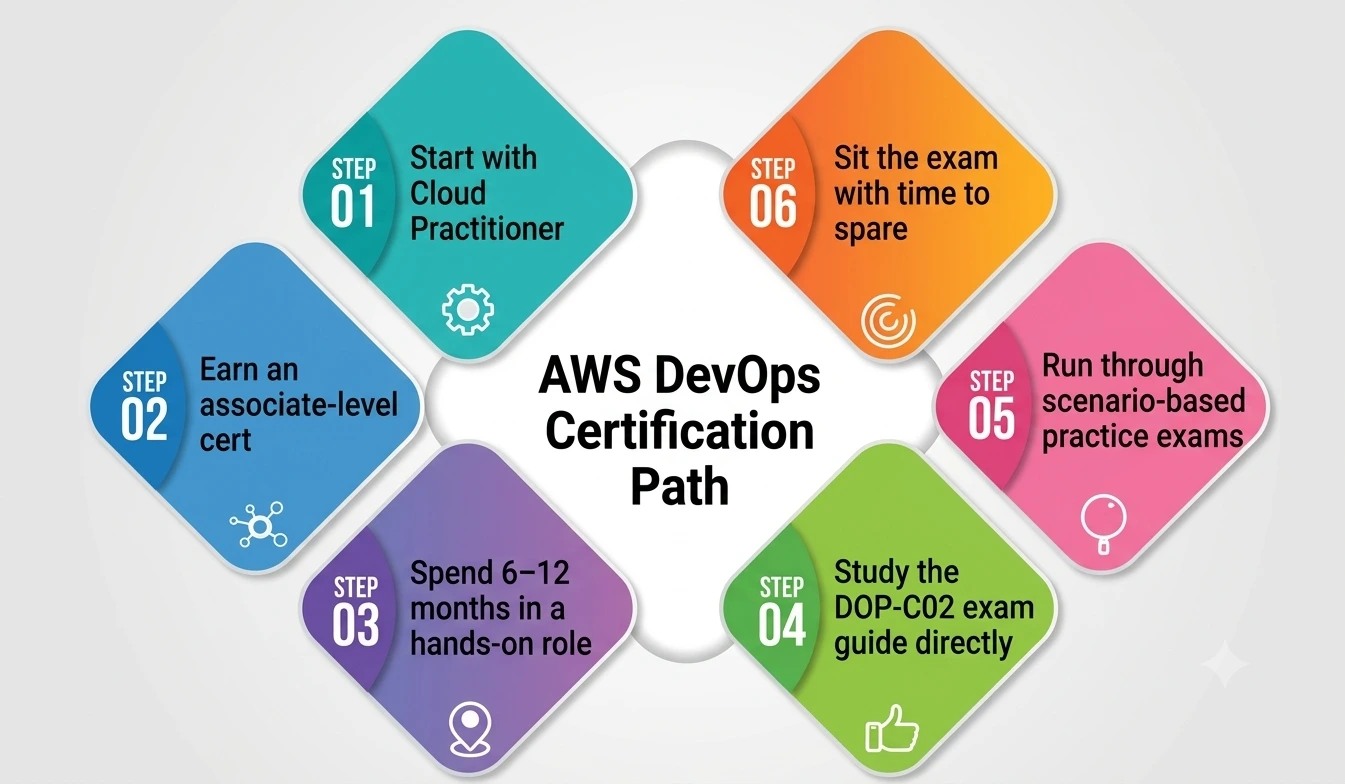
- Start with Cloud Practitioner to lock in AWS terminology and billing fundamentals without drowning in depth.
- Earn an associate-level cert—Solutions Architect Associate or SysOps Administrator Associate—to build real comfort with core services, networking, and IAM.
- Spend 6–12 months in a hands-on role touching CI/CD pipelines, infrastructure-as-code, and incident response, even informally on side projects if your job doesn’t offer it yet.
- Study the DOP-C02 exam guide directly, treating AWS’s official guide as the map rather than any third-party summary of it.
- Run through scenario-based practice exams, since this test rewards judgment over recall far more than the associate-level exams do.
- Sit the exam with time to spare, since 180 minutes for 75 scenario-heavy questions leaves less breathing room than it sounds like on paper.
Trying to shortcut this AWS DevOps certification path by skipping straight to professional-level practice tests rarely works—the gaps show up mid-exam, not mid-study.
AWS DevOps Certification Syllabus: What You’ll Actually Be Studying
The current AWS DevOps certification syllabus leans heavily on real operational judgment rather than trivia. Expect deep coverage of SDLC automation (CodePipeline, CodeBuild, CodeDeploy, and third-party CI/CD integration), configuration management and infrastructure-as-code using CloudFormation and tools like Terraform, monitoring and logging through CloudWatch and X-Ray, incident and event response automation, and policies and standards automation across multi-account environments using Organizations and Control Tower.
Security and governance also carry real weight in the current AWS DevOps certification syllabus—expect scenario questions about least-privilege IAM design, automated compliance checks, and secrets management rather than simple definitions.
If your study plan treats the syllabus as a checklist of service names to memorize instead of a set of operational problems to solve, you’ll likely find the real exam questions frustrating, since AWS writes most of them as “here’s a broken situation, what’s the best fix” rather than “what does this service do.”
Salary and ROI: Does It Actually Pay Off in 2026
This is where the “worth it” question gets concrete. According to recent 2026 market analysis, DevOps engineers holding this certification report a US median base salary around $135,000, with certified professionals earning roughly 18% more than uncertified peers in comparable roles.
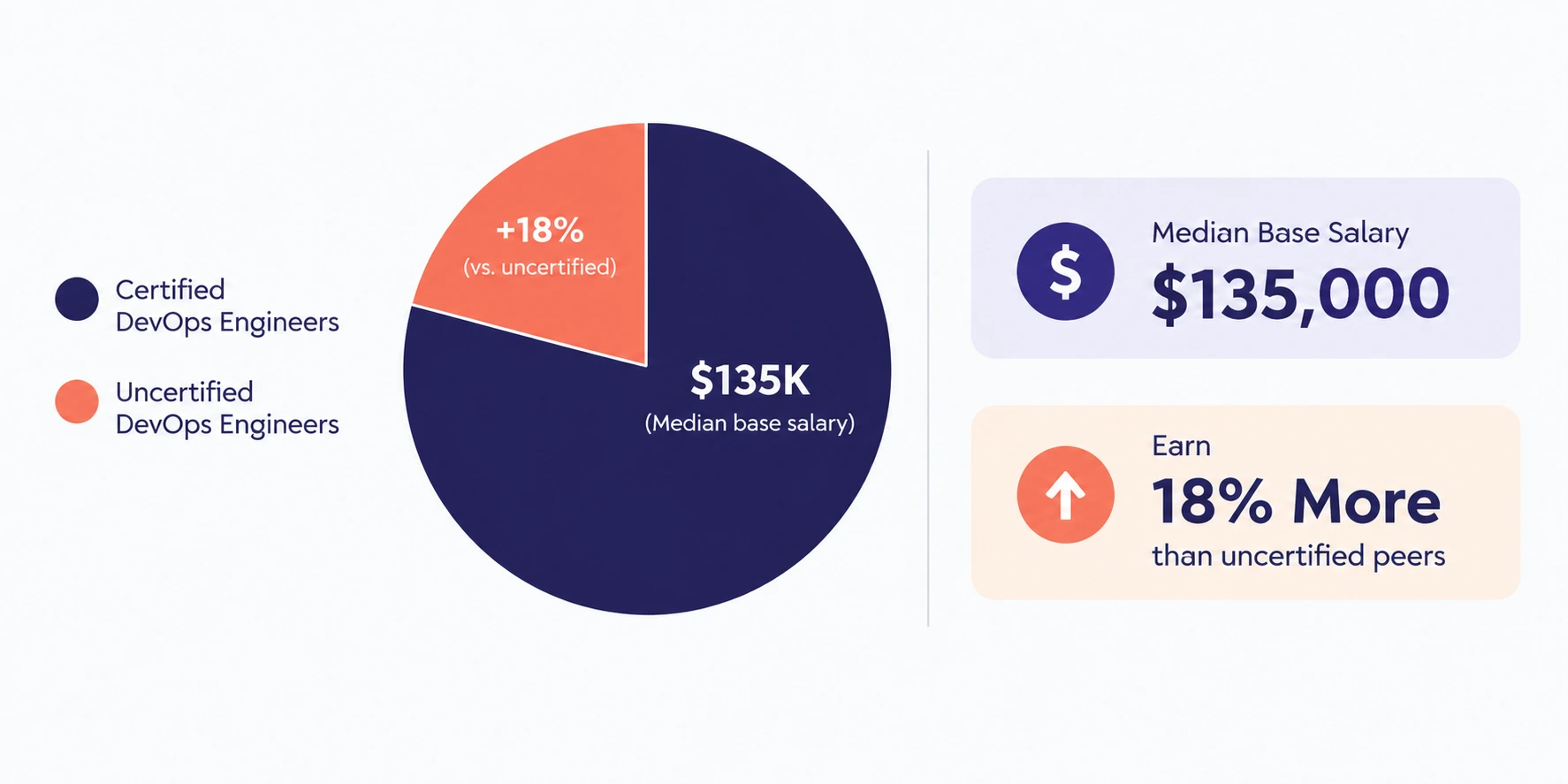
Senior-level holders with five-plus years of experience commonly land in the 145,000–180,000 base range, and engineers who bring the certification up directly during compensation conversations report meaningfully stronger initial offers.
That lines up with broader Glassdoor pay data for DevOps Engineers generally, which puts total US pay at a median of roughly $146,000 a year — certification isn’t the only variable in that number, but it’s clearly not pulling against it either.
That’s a meaningful financial case for pursuing AWS DevOps certification in 2026, though money is only part of what should drive the decision. That premium tracks with the broader labor picture.
The U.S. Bureau of Labor Statistics projects computer and information technology occupations overall will keep growing faster than the average for all occupations through the mid-2030s, with roughly 280,000 openings expected annually as companies keep shifting workloads to the cloud and automating what used to be manual operations work.
None of that growth is guaranteed to any individual, but it’s a tailwind, not a headwind, for anyone betting on this specific skill set right now.
Where the AWS DevOps Certification Falls Short
It would be dishonest to stop at the upside. None of these limits mean AWS DevOps certification is worthless — they just mean it’s one input among several, not a complete career plan on its own. This credential has real limits worth naming plainly:
- It tests judgment on paper, not under real production pressure, so it can’t replace the scar tissue of an actual 3 a.m. incident.
- It says nothing about your communication or collaboration skills, which matter enormously in a role that sits between engineering and operations teams.
- It ages. Services evolve fast enough that a three-year-old pass doesn’t guarantee current fluency, which is exactly why AWS forces recertification.
- It’s expensive to retake if you fail, and the pass rate on professional-level AWS exams is noticeably lower than associate-level exams.
- It won’t rescue a resume with no real cloud project experience behind it — even sources bullish on certifications admit a hiring manager will still want to see projects, repositories, or demos rather than the badge alone, since a recruiter’s filter and a hiring manager’s bar are two different things.
My Verdict for 2027
Yes, I think it’s worth it — for the right person, at the right stage. If you’ve already got a year or two of real AWS production experience, you’re aiming for senior DevOps, SRE, or platform engineering roles, and you want a credential that’s still hard to bluff your way through, this is one of the better $300 investments in cloud credentialing right now.
If you’re brand new to AWS with no production exposure yet, earn your fundamentals first; this exam will frustrate rather than teach you if you arrive without the base it assumes you already have.
Whichever AWS DevOps certification path you choose to follow, the sequencing matters more than the speed, and if the AWS DevOps certification syllabus feels overwhelming on first glance, that’s normal — almost nobody absorbs all six domains cleanly on the first pass through the exam guide.
A Personal Note
I’ve watched a lot of engineers chase this certification for the wrong reason — thinking the badge alone would fix a thin resume. It won’t, and I’d rather tell you that plainly than let you spend $300 to find out the hard way. What it will do is give you a sharper mental model of how production AWS environments are actually supposed to behave, and that model sticks with you long after the certificate expires.
If you’re already doing the work and just haven’t gotten around to proving it on paper, go get it. If you’re hoping the exam will teach you the job from scratch, spend those study hours building something real in a free-tier account first — the certification will come easier, and it’ll actually mean something when you hold it.