
Here’s a number that stopped me mid-scroll a few weeks back: there are currently over 500,000 unfilled cybersecurity jobs in the United States alone, and roughly 4.8 million globally, according to CyberSeek and ISC2’s most recent workforce data.
That gap is exactly why cyber certifications have quietly become one of the fastest, most reliable ways to jump into a six-figure career without spending four years in a classroom. I’ve spent the last couple of weeks going through 2026 salary reports, job postings, and certification pricing pages, and I want to walk you through what I found in plain English, not recruiter jargon.
This isn’t a list copied from someone else’s roundup. It’s a ranking built around one simple question: which cyber certifications actually pay off, and for whom?
Why Do Cyber Certifications Matter More in 2026 Than Ever Before?
Cyber threats aren’t slowing down, and neither is the hiring scramble to fight them. Ransomware groups, AI-assisted phishing kits, and supply-chain attacks have made it nearly impossible for companies to leave security roles unfilled, even during a year when tech hiring overall has cooled.
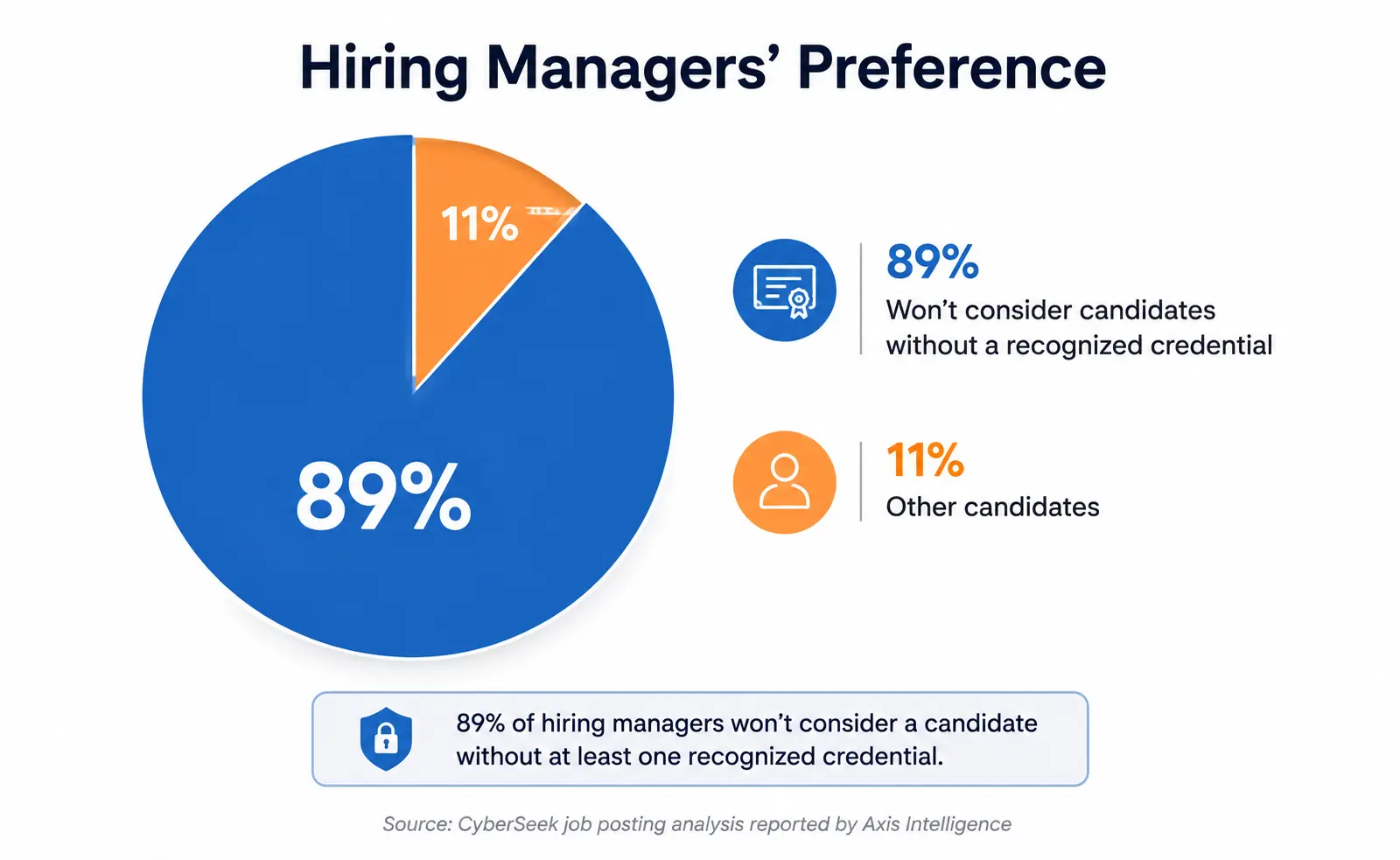
Because of that pressure, 89% of hiring managers now say they won’t even consider a candidate without at least one recognized credential, based on CyberSeek’s job posting analysis reported by Axis Intelligence. That single stat tells you almost everything: a resume without any cyber certifications on it barely makes it past the first filter anymore, no matter how talented the person actually is.
The other reason certifications matter so much right now is pay compression at the top. Employers are paying a real premium for people who can prove, on paper, that they understand governance, risk, and hands-on defense, not just theory.
The U.S. Bureau of Labor Statistics puts the median salary for information security analysts at roughly $124,910 a year, with the top 10 percent earning above $186,000, as summarized by StationX’s 2026 labor market analysis. Certifications are the fastest lever most people have to reach that upper range faster than years of tenure alone would get them there.
The Top Cyber Certifications, Ranked by Salary and Demand
Below is the ranking I put together after cross-referencing salary sources like Glassdoor, Payscale, and the BLS against job-posting frequency. I’ve grouped these by where they actually sit in a typical career path, since a $749 exam makes no sense for someone with zero experience.
|
Certification |
Typical US Salary Range | Best For |
Approx. Exam Cost |
| $150,000 – $185,000 | Senior security architects & managers |
$749 |
|
| $145,000 – $170,000 | Security leadership & governance roles |
$760 |
|
|
CCSP (ISC2) |
$140,000 – $170,000 | Cloud security specialists |
$599 |
|
CEH (EC-Council) |
$98,500 – $130,000 | Penetration testers & ethical hackers |
$950 – $1,199 |
| $85,000 – $115,000 | SOC analysts & active-defense roles |
$404 |
|
| $75,000 – $95,000 | Entry-level security foundation |
$404 |
|
|
ISC2 Certified in Cybersecurity (CC) |
$65,000 – $85,000 | First-ever security credential |
$199 |
A quick note on that table: these numbers reflect base salary in the US market and will shift depending on your city, your existing IT background, and whether you’re negotiating for a first role or a promotion. Someone holding both CISM and CISSP together tends to average north of $170,000, since that combination signals both hands-on technical depth and leadership readiness at once.
CISSP and CISM: The Top of the Cyber Certifications Ladder
CISSP consistently sits at or near the top of every cyber certification ranking I looked at, and for good reason. It covers eight broad domains, from security architecture to risk management, and it requires five years of verified experience before you can even sit the exam.
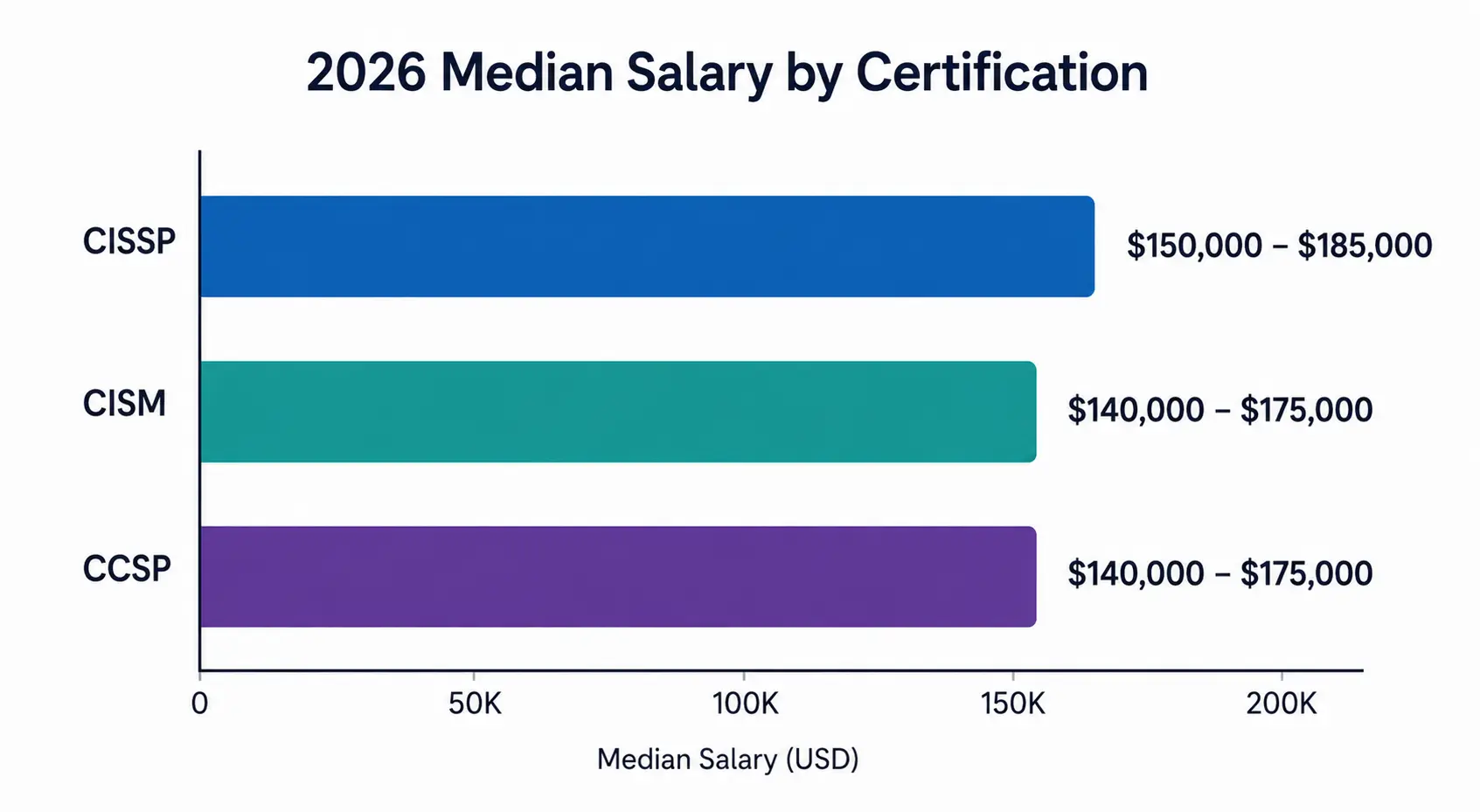
That barrier to entry is exactly what keeps the salary premium high. CertSelect’s 2026 salary breakdown puts CISSP holders at a median of $150,000 to $185,000, with CISM and CCSP trailing closely behind at similar experience levels.
CISM takes a slightly different angle. Instead of testing deep technical skill, it certifies whether someone can run a security program at the business level: policy, governance, incident response planning, and reporting up to a board.
Where Do Ethical Hacking and Threat Detection Fit In?
If leadership tracks aren’t the goal and hands-on offense is more your speed, an ethical hacking course leading to the CEH credential is usually the next stop. CEH validates the same tools and mindset that real attackers use, legally and in a controlled lab environment, and it remains one of the most requested credentials among penetration testing job listings.
Current CEH exam vouchers run $950 through EC-Council directly or up to $1,199 through a Pearson VUE test center, according to StationX’s certification cost breakdown, and certified holders report salaries between roughly $92,000 and $141,000 depending on experience and region.
For people who prefer defense over offense, CompTIA CySA+ has become the go-to credential for SOC analyst and threat detection work. It focuses squarely on identifying and responding to active intrusions rather than exploiting them, which makes it a natural next step after CompTIA Security+ for anyone building a defensive security career.
Demand for these roles has grown fast enough in the last two years that CySA+ now appears in a noticeably larger share of job postings than it did even eighteen months ago.
Networking Certifications and the Cybersecurity Certification Cost Question
One question I get constantly is whether to start with networking certifications before jumping into anything security-specific. My honest answer: yes, if you’re brand new. Understanding how traffic actually moves through a network, how firewalls and VLANs segment it, and how DNS and routing protocols behave under normal and abnormal conditions makes every later security concept click faster.
A foundational networking certification like CompTIA Network+ isn’t strictly a cyber certification, but it builds the mental model that network security concepts are layered on top of. That brings up the real elephant in the room: total cybersecurity certification cost. It’s easy to see a $404 exam fee and assume that’s the whole bill, but it rarely is.
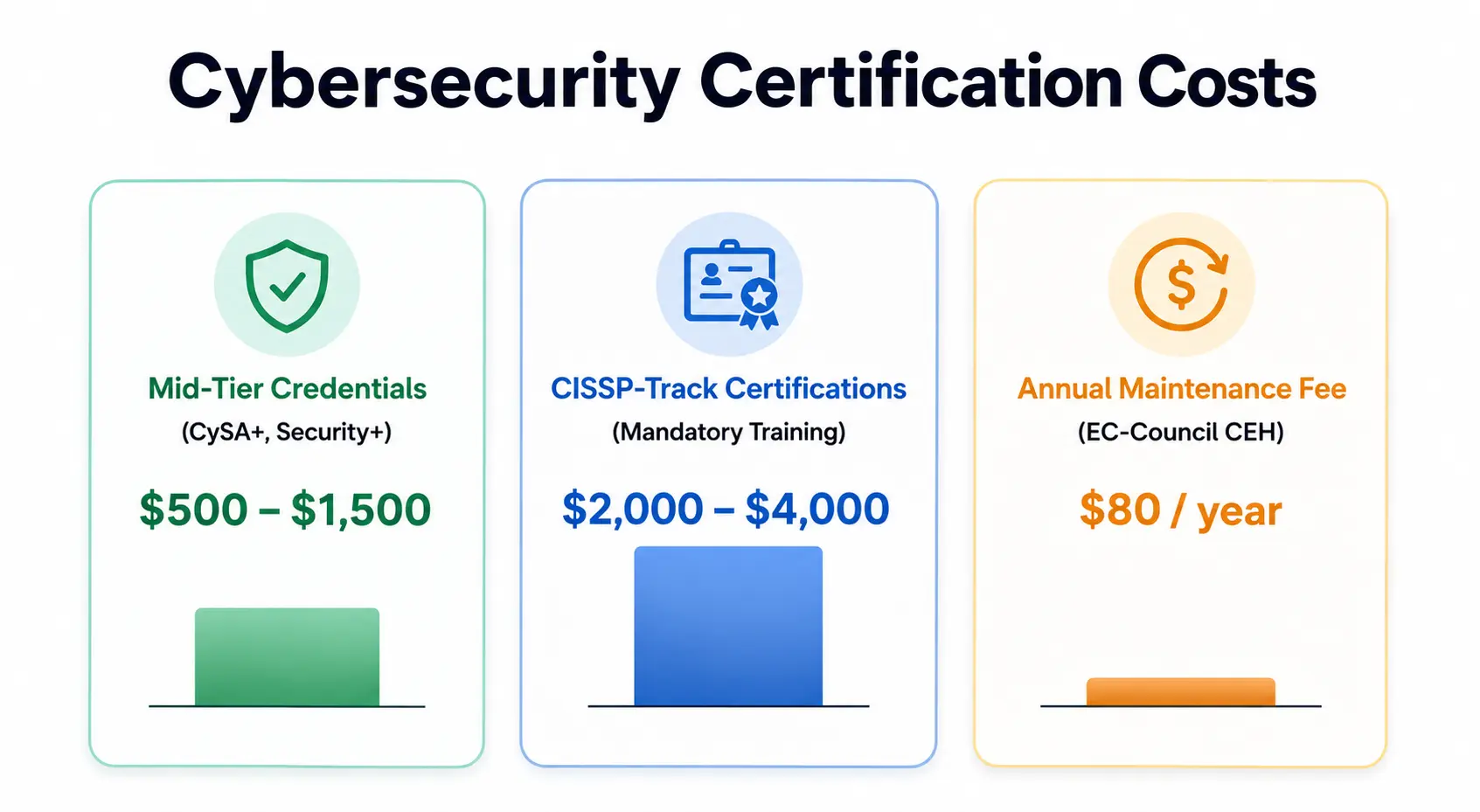
Training courses, practice exams, lab access, and annual maintenance fees all add up, and EC-Council alone charges an $80 yearly membership just to keep a CEH active. Realistic all-in pricing for a mid-tier credential like CySA+ or Security+ tends to land between $500 and $1,500 once you factor in a decent study course, while CISSP-track certifications with mandatory training can run $2,000 to $4,000 before you ever sit the exam.
Budgeting for that upfront, rather than getting surprised halfway through, is one of the most overlooked parts of certification planning.
How Fast-Moving Threats Are Reshaping the Rankings?
It’s worth pausing on why this ranking looks noticeably different than it did even two or three years ago. AI-assisted attacks have changed the shape of cyber threats faster than most certification bodies can update their exam content, which is part of why EC-Council folded AI-driven attack and defense material directly into the newest CEH curriculum rather than treating it as an optional add-on.
Cloud misconfiguration, identity-based attacks, and supply-chain compromises now account for a growing share of real breaches, which is exactly why CCSP and cloud-focused vendor certifications have climbed so quickly in both salary and job-posting frequency over the past two years.
This is also why hands-on, lab-heavy credentials are pulling ahead of purely multiple-choice exams in employer preference. A candidate who has completed a genuine ethical hacking course with real lab work behind it, rather than one who simply memorized flashcards, tends to interview noticeably better, because today’s cyber threats rarely follow a textbook pattern.
Hiring managers have picked up on this shift, and it’s showing up directly in which certifications get listed as “preferred” versus “required” in real job postings.
Does Location Change the Math?
Yes, significantly, and it’s worth planning around before you commit money to any single exam. A CISSP holder in San Francisco or the DC metro area can earn closer to $185,000, while the same credential in a smaller Midwest city might land closer to $130,000, largely because federal and defense-contractor demand concentrates so heavily around Washington, Virginia, and Maryland.
Remote-first security roles have narrowed that gap somewhat over the past couple of years, but they haven’t erased it, since many senior positions still carry location-based pay bands tied to cost of living.
If relocation isn’t on the table, it’s worth checking whether the certification you’re chasing actually opens remote-friendly roles in your target salary range, rather than assuming national averages apply evenly everywhere. Industry matters almost as much as geography.
Financial services, healthcare, and government contracting tend to pay above the national median for the same certification, largely because compliance requirements in those sectors make certified staff close to non-negotiable. A CySA+ holder working SOC shifts for a regional bank, for instance, often earns noticeably more than the same credential would command at a small retail company, purely because the regulatory stakes are higher.
A Realistic Roadmap Based on Experience Level
- Zero IT background: Start with a foundational networking certification, then move to CompTIA Security+ once basic network security concepts feel familiar rather than foreign.
- 1–3 years in IT or help desk: CompTIA Security+ first, followed by CySA+ if the interest leans toward defense and threat detection or an ethical hacking course leading to CEH if offense feels more exciting.
- 3–5 years in a security-adjacent role: CCSP if the environment is cloud-heavy, or CySA+ paired with real SOC experience to build toward a senior analyst title.
- 5+ years with governance or leadership ambitions: CISSP and eventually CISM once a management track becomes the clear direction, since together they open CISO-level conversations.
- Anyone unsure where to start: ISC2’s Certified in Cybersecurity (CC) is a low-cost, low-barrier entry point specifically designed for people with no existing credentials to point to yet.
A Personal Note
I’ll be honest about something most certification roundups skip over: I’ve watched people burn out chasing certifications back to back without ever pausing to apply what they learned on the job. A certification opens a door, but it doesn’t walk through it for you. If I were starting from scratch today, I’d pick one certification that matches where I actually am right now, not where I hope to be in three years, get genuinely good at the material through hands-on labs, and only then look at what comes next. The market rewards depth over a long list of acronyms, even when it doesn’t always feel that way from the outside.