


If you’ve been Googling “how much does a DevOps engineer actually make,” you’ve probably run into ten different numbers from ten different websites, and none of them seem to agree.
That’s not you doing something wrong — it’s just how the salary data world works. Every site pulls from a different pool of self-reported numbers, job postings, or employer submissions, so the devops engineer salary figure you see depends entirely on where you look.
This guide pulls together numbers from specialist recruiting firms, cross-checks them against each other, and lays out a realistic picture of DevOps engineer salary at every stage of a career—from your first job out of college to the senior, six-figure-plus roles that come after five or more years in the field.
Along the way, we’ll also talk about how this compares to related titles like SRE and which automation tools actually move the needle on your paycheck.
What Does a DevOps Engineer Actually Do?
Before we talk about money, it helps to understand what you’re being paid for. A DevOps engineer sits between software development and IT operations. The job is to make sure code moves from a developer’s laptop to a live, working product without things breaking along the way—and when they do break, to fix them fast.
Day to day, that usually means the following:
- Building and maintaining CI/CD pipelines (often using GitHub Actions or Jenkins)
- Managing servers and cloud resources through infrastructure management practices
- Writing automation scripts with tools like Ansible or Terraform
- Monitoring systems for downtime, performance issues, and security gaps
- Working closely with developers to make deployments smoother and safer
You’re the person who keeps the whole machine running, and companies pay a premium for that.
Entry-Level Pay: Where the DevOps Journey Starts
Let’s start where most students actually care the most—what happens right after you land your first job.
Numbers here vary more than at any other career stage because “entry-level” means different things at different companies. According to sources, entry-level DevOps engineers in the US typically fall in the range of roughly $92,000 to $153,000 annually, though their broader devops engineer dataset shows a wider entry-level band starting closer to $51,000 for smaller companies or non-tech industries.
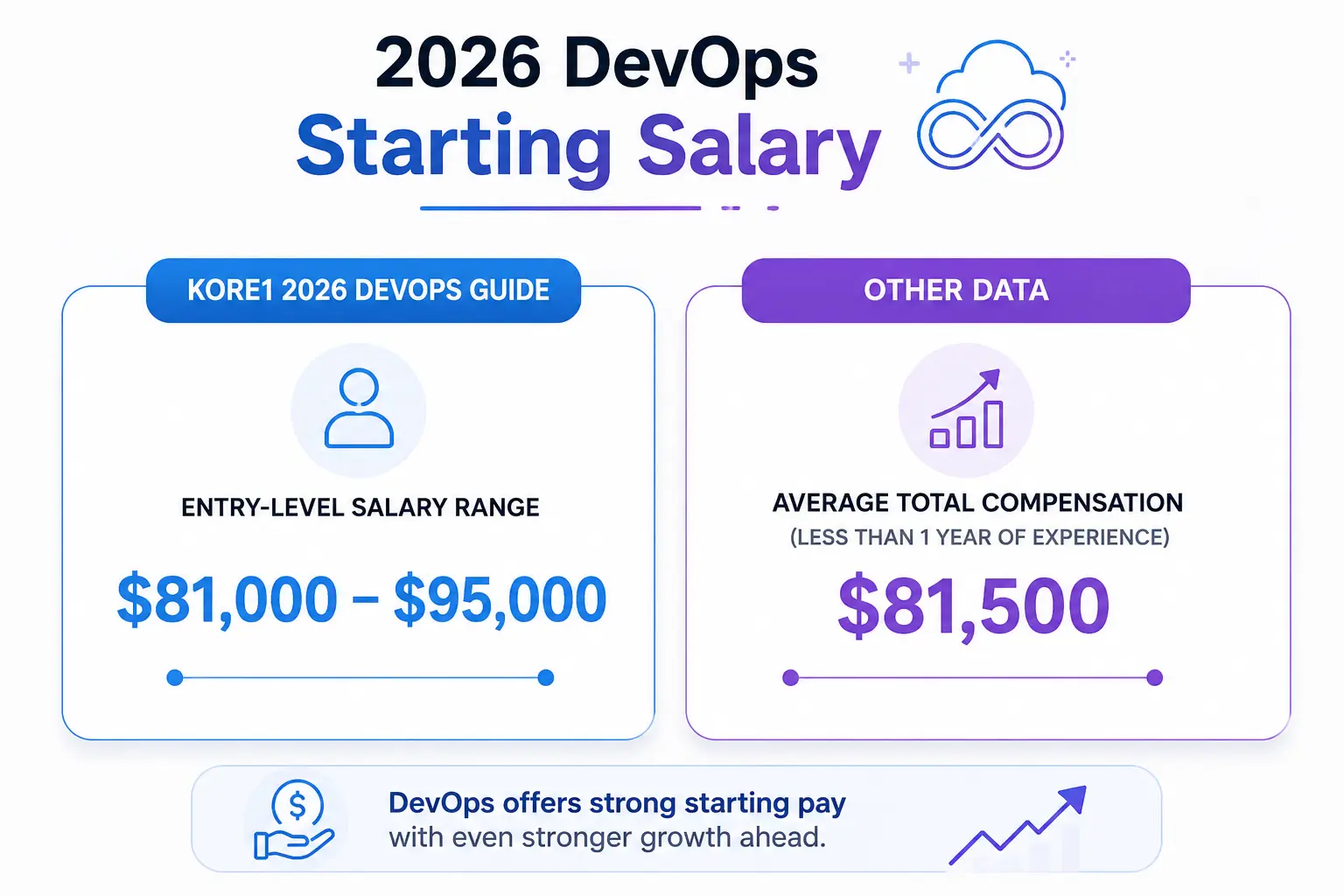
Other sources put the starting point lower. KORE1’s 2026 DevOps guide estimates entry-level roles landing between $81,000 and $95,000, while other data shows entry-level DevOps engineers with less than one year of experience earning an average total compensation around $81,500.
So what’s the honest takeaway?
If you’re a fresh graduate or bootcamp finisher landing your first devops engineer salary, expect somewhere in the $75,000–$95,000 range at most companies, with strong tech-hub roles or big-name employers pushing that closer to $100,000–$115,000. Cloud salary data tends to track closely with DevOps pay at this stage, since it’s a wide range driven by location, company size, and whether you walk in with cloud certifications.
Mid-Level Pay: The 3–6 Year Sweet Spot
This is where things start getting interesting, and honestly, where the job market gets the most competitive. Once you’ve got a few years of hands-on infrastructure management, container orchestration, and pipeline-building under your belt, your value jumps sharply.
KORE1 describes this bracket as “the war “zone”—engineers with three to six years of experience, solid Kubernetes and infrastructure-as-code skills, and comfort with at least one major cloud platform are fielding multiple offers within days, not weeks. Their guide places mid-level DevOps compensation between $110,000 and $135,000 in base pay.
Various references breakdown backs this up, noting that a mid-level DevOps engineer earns close to $90,858 on average, though that figure trends toward the lower end compared to tech-hub-heavy datasets.
Meanwhile, some job-posting-based data shows the overall average devops engineer salary across all experience levels sitting at $133,161, which gives you a sense of where mid-to-senior professionals are pulling the average up.
The pattern across all sources is consistent: once you cross into the mid-level bracket, a devops engineer salary of $110,000–$140,000 becomes very realistic, especially if your resume shows real GitOps and automation experience rather than just theoretical knowledge.
Senior-Level Pay: 7+ Years of Experience
At the senior level, the range widens dramatically because this is where company size, industry, and equity compensation really start to matter.
The data on experienced DevOps engineers shows a salary range of roughly $90,000 to $167,000 for those with five-plus years of experience, with top-paying industries like insurance, media, and financial services pushing median totals above $138,000.
Citing senior engineers with seven-plus years clearing $140,000 to $175,000+ regularly, with total compensation at large tech companies blowing past $200,000 once bonuses and equity are factored in.
Reponotes’ 2026 guide summarizes it well, stating that senior DevOps engineers can expect total compensation in the $150,000–$225,000+ range depending on location, cloud depth, and whether they carry reliability-adjacent responsibilities like incident response and production ownership.
If you’re aiming for the top of the ladder, a senior devops engineer salary of $150,000+ is the realistic target at established tech companies, and it’s not unusual to see that climb past $200,000 total compensation once equity and bonuses are added at bigger firms.
How Does DevOps Compare to SRE and Infrastructure Engineer Roles?
Students often ask whether they should aim for “DevOps engineer,” “site reliability engineer,” or “infrastructure engineer”—since job descriptions for all three overlap heavily. Here’s the honest comparison.
Site reliability engineering tends to pay slightly higher on average, largely because the role leans more toward software engineering and carries heavier on-call and incident-response responsibility. Built In reports the average SRE salary at $131,477, with engineers holding seven-plus years of experience averaging $162,756. The data on this role runs even higher, showing an average of $172,508 with senior reliability engineers averaging $185,489 and top earners clearing $285,000.
Infrastructure engineer roles, by contrast, tend to sit closer to traditional DevOps pay bands, since the focus is more on infrastructure management — provisioning servers, managing networks, and maintaining cloud environments — rather than the software-heavy reliability engineering that this comparison role involves.
If you’re weighing career paths, know that reliability engineering often pays a bit more but demands stronger coding chops and comfort with being paged at 2 a.m. DevOps sits in the middle ground, blending automation, deployment, and operations work without quite the same intensity of production ownership.
What Actually Moves Your Pay Up as a DevOps Engineer?
Not all DevOps roles are created equal, and the skills you bring in matter enormously. Based on the data we reviewed, a few things consistently correlate with higher pay:
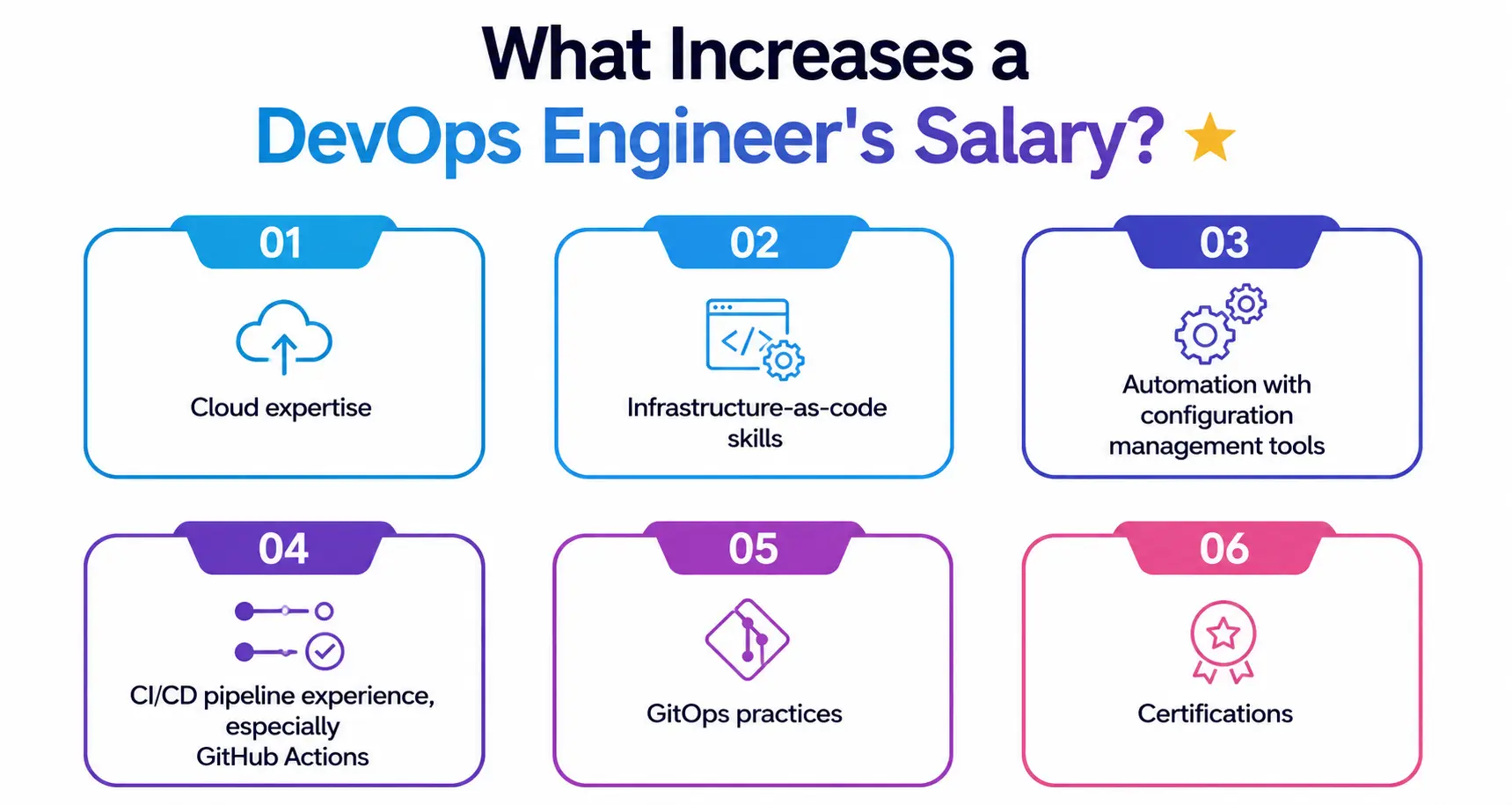
1. Cloud expertise
Whether it’s GCP, Azure, or AWS, cloud fluency is close to non-negotiable now, and it’s a major driver of cloud salary premiums across the industry. Engineers who can architect and cost-optimize cloud infrastructure — not just deploy to it — earn noticeably more.
2. Infrastructure-as-code skills
Terraform shows up repeatedly across salary guides as a baseline expectation for mid-to-senior roles. If you can write clean, reusable modules for provisioning cloud resources, you’re already ahead of a big chunk of the applicant pool.
3. Automation with configuration management tools
Platforms like Ansible remain heavily used for provisioning and patching servers at scale, and showing real project experience with them signals operational maturity to hiring managers.
4. CI/CD pipeline experience, especially GitHub Actions
Since it has become one of the most widely adopted CI/CD tools, hands-on experience building and maintaining pipelines is a strong resume booster.
5. GitOps practices
Managing infrastructure and deployments through Git as the single source of truth is increasingly expected at companies running Kubernetes at scale, and it shows up as a differentiator in multiple 2026 salary guides.
6. Certifications
HashiCorp Terraform Associate, AWS Certified DevOps Engineer, and Certified Kubernetes Administrator certifications are frequently mentioned as pay-boosting credentials, particularly for candidates trying to break into mid-level roles faster.
Salary Comparison Table
|
Career Stage |
Typical Base Salary Range |
Average / Midpoint |
|
Entry-Level DevOps Engineer |
$75,000 – $115,000 |
~$88,500 |
|
Mid-Level DevOps Engineer (3–6 yrs) |
$110,000 – $135,000 |
~$120,000 |
|
Senior DevOps Engineer (7+ yrs) |
$140,000 – $200,000+ |
~$160,000 |
|
Overall US Average (all levels) |
$114,000 – $134,000 |
~$125,000 |
|
Site Reliability Engineer |
$130,000 – $185,000 |
~$150,000 |
|
Senior Reliability Engineer |
$150,000 – $233,000+ | ~$185,000 |
Does Location Change Your DevOps Engineer Salary?
Yes, significantly. Geography remains one of the biggest levers on pay. KORE1’s research notes that a senior DevOps engineer at a company like AWS can hit $230,000–$330,000 all-in, a figure that a smaller company in a lower-cost city simply can’t match.
On the flip side, cities with lower costs of living and smaller tech scenes often post entry and mid-level salaries well below the national average. If you’re job hunting and remote work is on the table, it’s worth comparing offers not just on the raw number but on what that number actually buys you where you’ll be living.
Cloud salary benchmarks by city can help here—checking regional pay data before you negotiate is always worth the extra ten minutes.
A Personal Note
I’ll be honest with you — when I first started digging into DevOps as a career path, the salary numbers online felt more confusing than helpful. One site would say $70K, another would say $150K, and I had no idea which one to trust. What I eventually figured out is that the “right” number for you depends less on which website you read and more on what you actually build.
The engineers pulling the higher numbers in every single one of these salary guides are the ones who can point to real pipelines they’ve built, real infrastructure they’ve automated, and real problems they’ve solved under pressure.
If you’re a student reading this and trying to decide whether DevOps is worth the time investment, my honest advice is to stop comparing salary screenshots and start building something. Spin up a small project, wire up a CI/CD pipeline, write some infrastructure code, break it, and fix it. That’s what actually shows up in the paycheck later.