
If you’re studying IT, or you’ve just landed your first job as a sysadmin, cloud engineer, or SOC analyst, there’s one topic you cannot afford to skim past—cloud security. Almost every company today runs on AWS, Azure, or Google Cloud in some form, and that shift has quietly rewritten the rulebook for how we protect data.
The old approach of locking down a physical server room doesn’t work anymore when your “server room” is actually spread across five data centers you’ll never physically visit.
This guide walks through the cloud security best practices every IT professional—student or working engineer—genuinely needs to understand. No fluff, no jargon dumps. Just the practical stuff that actually keeps cloud environments safe.
Why Does Cloud Security Deserve Your Attention?
Here’s the uncomfortable truth: most cloud breaches aren’t caused by hackers cracking some brilliant encryption scheme. They happen because someone left a storage bucket open to the public, reused a weak password, or forgot to patch a known vulnerability.
According to Wiz’s cloud security guide, organizations that follow structured best practices significantly reduce their overall risk profile compared to those relying on ad-hoc fixes. The cloud runs on something called the shared responsibility model. Your cloud provider secures the underlying infrastructure—the physical servers, the data centers, and the networking hardware.
But you, the customer, are responsible for your data, your configurations, your user access, and your applications. Miss that distinction and you’ll assume you’re protected when you’re really not.
That’s exactly why learning cloud security best practices early in your career pays off. It’s not a checkbox exercise—it’s the difference between a company staying in business after an incident and one that ends up in the headlines for the wrong reasons.
1. Get Identity and Access Management Right
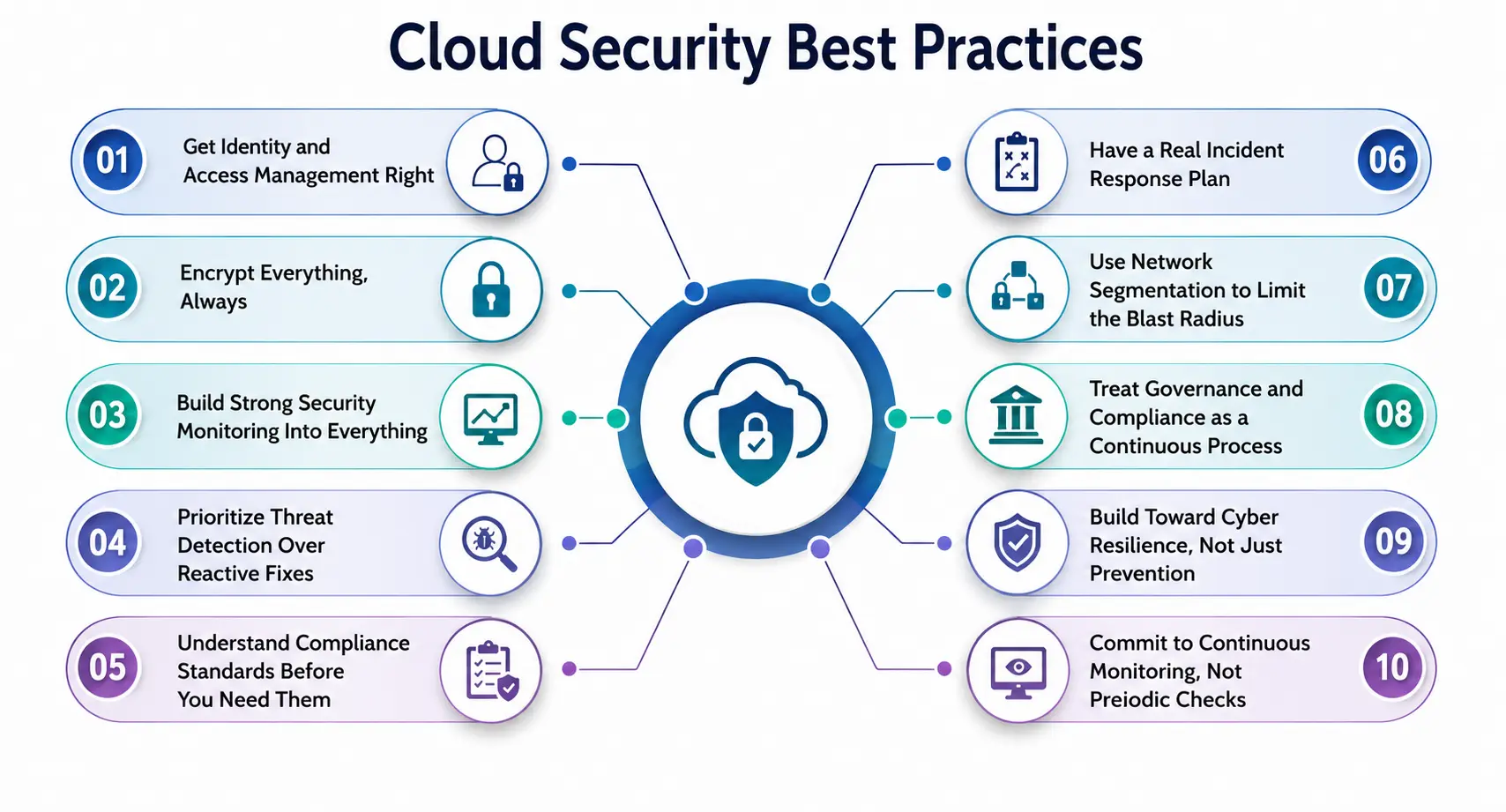
Nearly every major cloud incident traces back to identity in some way — stolen credentials, excessive permissions, or an old account nobody remembered to disable. This is why Identity and Access Management (IAM) sits at the top of almost every list of cloud security best practices.
Start with the principle of least privilege: give users and applications only the access they genuinely need, nothing more. Enforce multi-factor authentication everywhere, especially for admin accounts. Review permissions regularly instead of granting access once and forgetting about it—permission creep is real, and it’s one of the quiet ways attackers slip through.
2. Encrypt Everything, Always
Encryption is non-negotiable. Data should be encrypted both at rest (when it’s sitting in storage) and in transit (when it’s moving between systems). This is one of the fundamentals covered in Fidelis Security’s Report, which notes that encrypting everything stored in databases, buckets, and backups is one of the simplest yet most overlooked ways to reduce exposure.
Applying these cloud security best practices consistently, rather than only on “sensitive” systems, closes gaps attackers love to exploit.
3. Build Strong Security Monitoring Into Everything
You can’t defend against what you can’t see. Security monitoring means having constant visibility into what’s happening across your cloud environment—logins, configuration changes, data access, network traffic, and all of it.
Turn on audit logging for every service you use. Good security monitoring turns cloud security from guesswork into something measurable, and it’s foundational to nearly every other practice on this list.
4. Prioritize Threat Detection Over Reactive Fixes
Threat detection is about catching malicious activity while it’s happening, not discovering it three weeks later. Modern cloud environments generate signals—unusual login locations, abnormal API calls, and spikes in data transfer—that indicate something’s wrong.
Tools like Cloud-Native Application Protection Platforms (CNAPP) and Cloud Security Posture Management (CSPM) automate a lot of this work. In Sysdig practice guide, these platforms help teams monitor for misconfigurations and remediate them based on real risk context rather than reacting after the fact. Effective threat detection shortens the window attackers have to do damage — and that window is everything in security.
5. Understand Compliance Standards Before You Need Them
Compliance standards aren’t just a legal formality—they’re often a distilled version of decades of security lessons learned the hard way. Frameworks like ISO 27001, SOC 2, HIPAA, and PCI-DSS exist because industries figured out, sometimes painfully, what happens when certain controls are missing.
If you’re a student heading into IT, get familiar with at least one or two major compliance standards relevant to your target industry. Healthcare, finance, and government work all have their own regulatory expectations, and understanding them early makes you far more valuable on day one. Treating compliance standards as a learning resource rather than a bureaucratic hurdle is one of the most underrated cloud security best practices for anyone starting out.
6. Have a Real Incident Response Plan
No system is unbreakable. Eventually, something will go wrong—a phishing email gets clicked, a credential leaks, or a vendor gets compromised. What separates a minor hiccup from a full-blown crisis is incident response.
NIST’s Special Publication 800-61 Revision 3 is widely regarded as the gold standard here. It lays out a structured cycle covering preparation, detection, containment, eradication, and recovery, all tied into the broader NIST Cybersecurity Framework 2.0. Having a documented incident response plan — and actually practicing it — means your team reacts with a playbook instead of panic when something breaks.
7. Use Network Segmentation to Limit the Blast Radius
Imagine your cloud environment as a building. If every room connects directly to every other room, one break-in gives an attacker access to everything. Network segmentation is the equivalent of adding locked doors between sections, so a breach in one area doesn’t automatically compromise the rest.
In cloud terms, this means isolating workloads, using virtual private clouds (VPCs), setting up subnets, and applying strict firewall rules between segments. Good network segmentation dramatically reduces how far an attacker can move once they’re inside—a concept security professionals call limiting “lateral movement.”
8. Treat Governance and Compliance as a Continuous Process
Governance and compliance often get lumped together, and for good reason — governance is the internal policy and oversight structure that makes compliance actually achievable, rather than a once-a-year scramble before an audit.
This means assigning clear ownership for security decisions, documenting policies, and regularly reviewing whether your cloud setup still matches your stated rules. The effective security in modern cloud environments depends on continuous, risk-based governance rather than isolated tools or one-time checks.
Strong governance and compliance practices turn security from a reactive scramble into a predictable, manageable process. Without solid governance and compliance, even the best technical controls tend to drift out of alignment over time.
9. Build Toward Cyber Resilience, Not Just Prevention
Here’s a mindset shift worth internalizing early: perfect prevention is a myth. The goal isn’t to build a system that never gets breached — it’s to build one that keeps functioning, recovers quickly, and limits damage when something does go wrong. That’s cyber resilience.
The NIST CSF 2.0 framework reflects this thinking directly. By integrating threat intelligence, automating detection, and applying proactive controls, organizations can both prevent and rapidly respond to incidents, reducing their impact and accelerating recovery.
That’s cyber resilience in practice—regular backups, tested recovery plans, redundancy, and a culture that expects incidents rather than being shocked by them. Building genuine cyber resilience is less about buying more tools and more about designing systems that degrade gracefully instead of collapsing entirely.
10. Commit to Continuous Monitoring, Not Periodic Checks
This might be the single biggest shift in how cloud security is approached compared to traditional IT security. In the old world, a quarterly audit was often enough. In the cloud, environments change by the minute—new services spin up, permissions get modified, and code deploys automatically. A once-a-quarter check simply can’t keep up.
Continuous monitoring means security tools are always running in the background, flagging drift and risk in near real time rather than waiting for a scheduled review. This ties directly back into NIST CSF 2.0’s structure, where functions like Detect and Respond are meant to run constantly rather than as isolated events. Continuous monitoring is what makes every other practice on this list actually effective over time, instead of just effective on the day you set it up.
Quick Reference Table: Best Practices at a Glance
|
Practice |
What It Protects Against |
Core Action |
|
IAM & Least Privilege |
Credential theft, insider misuse |
MFA, regular access reviews |
|
Encryption |
Data interception |
Encrypt at rest and in transit |
|
Security Monitoring |
Blind spots in visibility |
Centralized audit logging |
|
Threat Detection |
Active attacks |
CNAPP/CSPM tools, real-time alerts |
|
Compliance Standards |
Regulatory penalties |
Align with ISO 27001, SOC 2, HIPAA |
|
Incident Response |
Prolonged breach damage |
Documented, tested response plan |
|
Network Segmentation |
Lateral attacker movement |
VPCs, subnets, firewall rules |
|
Governance & Compliance |
Policy drift |
Clear ownership, regular reviews |
|
Cyber Resilience |
Total operational failure |
Backups, redundancy, recovery testing |
|
Continuous Monitoring |
Slow detection of change | Always-on automated tooling |
Bringing It All Together
None of these cloud security best practices work well in isolation. Encryption without monitoring just hides problems longer. Incident response without network segmentation means a breach spreads before you can contain it.
The real strength comes from layering these practices together—identity controls, visibility, detection, response, and resilience all reinforcing one another. For students and early-career IT professionals, the good news is that you don’t need to master all of this overnight. Start with IAM and encryption, since they form the foundation.
Then build outward into monitoring, detection, and governance as you gain hands-on experience. Cloud platforms like AWS, Azure, and GCP all offer free-tier environments where you can practice these concepts safely—use them!
A Personal Note
I’ve spent enough time around cloud environments to notice a pattern: the engineers who genuinely understand security aren’t necessarily the ones who memorized every acronym. If you’re a student reading this, my honest advice is to stop treating security as a separate subject you’ll “get to later.”
Build the habit now of questioning defaults, reading documentation instead of skimming it, and actually breaking things in a sandbox environment so you understand how they fail. That curiosity will serve you far longer than any certification will.