
If you’re a student trying to make sense of governance, risk, and compliance for the first time, here’s the honest starting point: most organizations don’t fail at GRC because they lack rules.
They fail because governance, risk, and compliance sit in three different silos, run by three different teams, using three different spreadsheets, none of which talk to each other. A real GRC strategy is what stitches those pieces into one working system instead of three departments quietly duplicating each other’s paperwork.
This guide walks through what a GRC strategy actually is, why it matters, and how to build one—in plain language, with a practical structure you can apply to a classroom case study or a real internship project.
What Is a GRC Strategy?
GRC stands for Governance, Risk, and Compliance. Put simply:
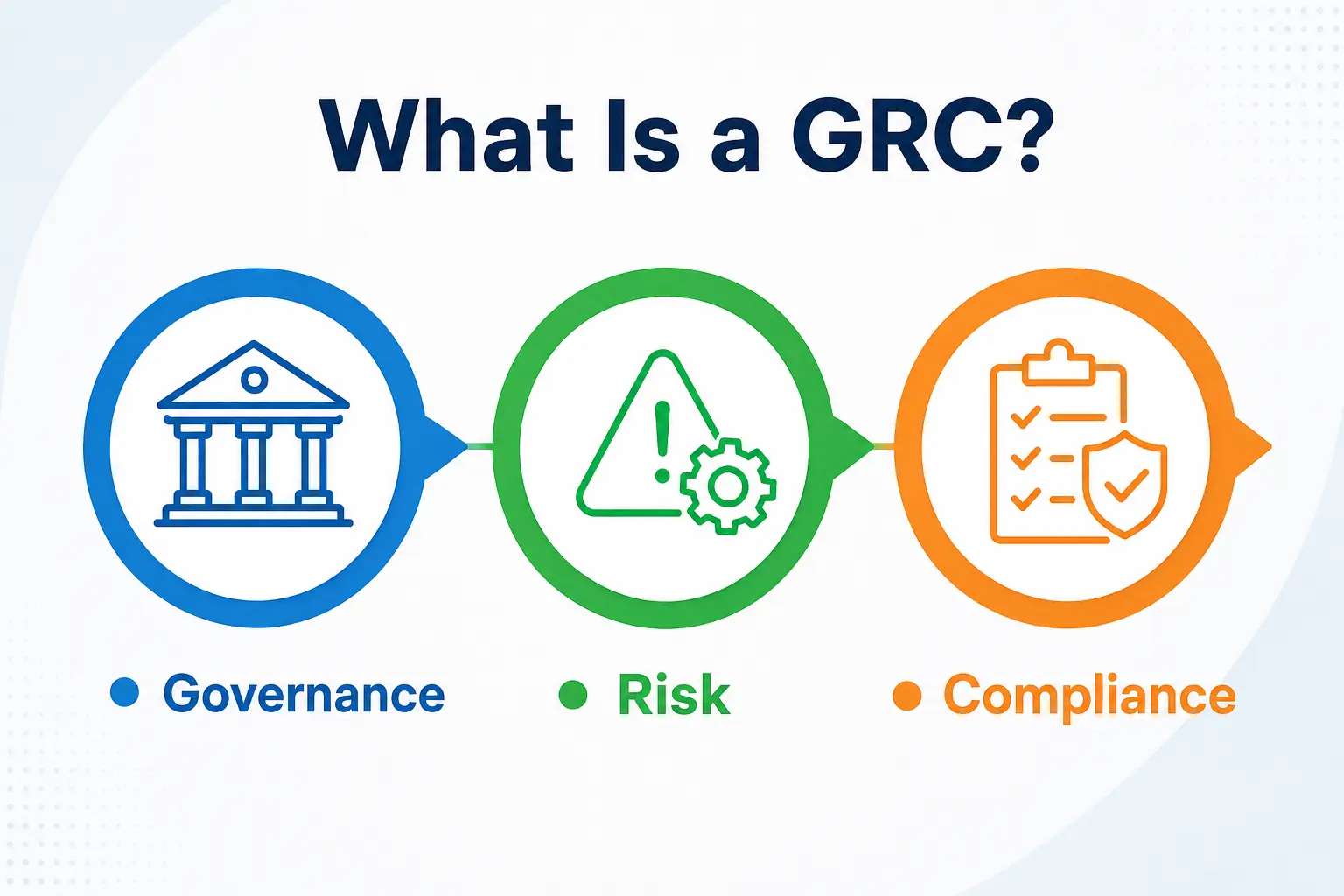
- Governance is how an organization sets direction — who makes decisions, who is accountable, and how those decisions get enforced.
- Risk covers the process of finding, measuring, and reducing the things that could derail the organization.
- Compliance means staying inside the boundaries set by laws, regulators, and internal policy.
A GRC strategy is the plan that ties these three functions together so they reinforce each other instead of operating in isolation. As one recent industry breakdown puts it, GRC is best understood as an integrated approach that aligns strategy, manages uncertainty, and meets regulatory obligations by combining governance, risk management, and compliance. That word “integrated” is doing a lot of work — it’s the difference between GRC as a checklist and GRC as a strategy.
The U.S. Centers for Medicare & Medicaid Services frames it similarly in its own program: governance sets the tone for decision-making and accountability, while risk management involves identifying, assessing, and prioritizing potential risks and then taking action to mitigate or manage them. That shift — from reactive compliance to proactive risk management — is exactly what separates a mature GRC strategy from a paperwork exercise.
Why Does a GRC Strategy Matter?
Every organization, from a five-person startup to a multinational bank, deals with three constant pressures: rules imposed from outside (regulators, laws, and industry standards); threats from inside and outside (cyberattacks, fraud, and operational failure); and the need to make consistent decisions at scale. A GRC strategy exists to manage all three at once.
Without one, organizations tend to drift into two bad patterns. The first is duplication — the security team runs its own risk assessment, the legal team runs its own compliance review, and nobody compares notes. The second is blind spots—risks slip through precisely because no one owns the space between departments.
A well-known 2026 industry analysis noted that organizations still running governance, risk, and compliance as disconnected departments — where risk teams don’t see compliance gaps and compliance teams don’t understand threat context — are the ones getting blindsided by audit findings and security breaches.
There’s also a financial argument. Regulatory fines have gotten sharper and faster. In the EU, NIS2 penalties are now active with fines that can reach into the millions, and data protection failures elsewhere carry similarly steep costs. A GRC strategy isn’t a nice-to-have anymore — it’s risk-adjusted insurance for the entire business.
Core Components of an Effective GRC Program
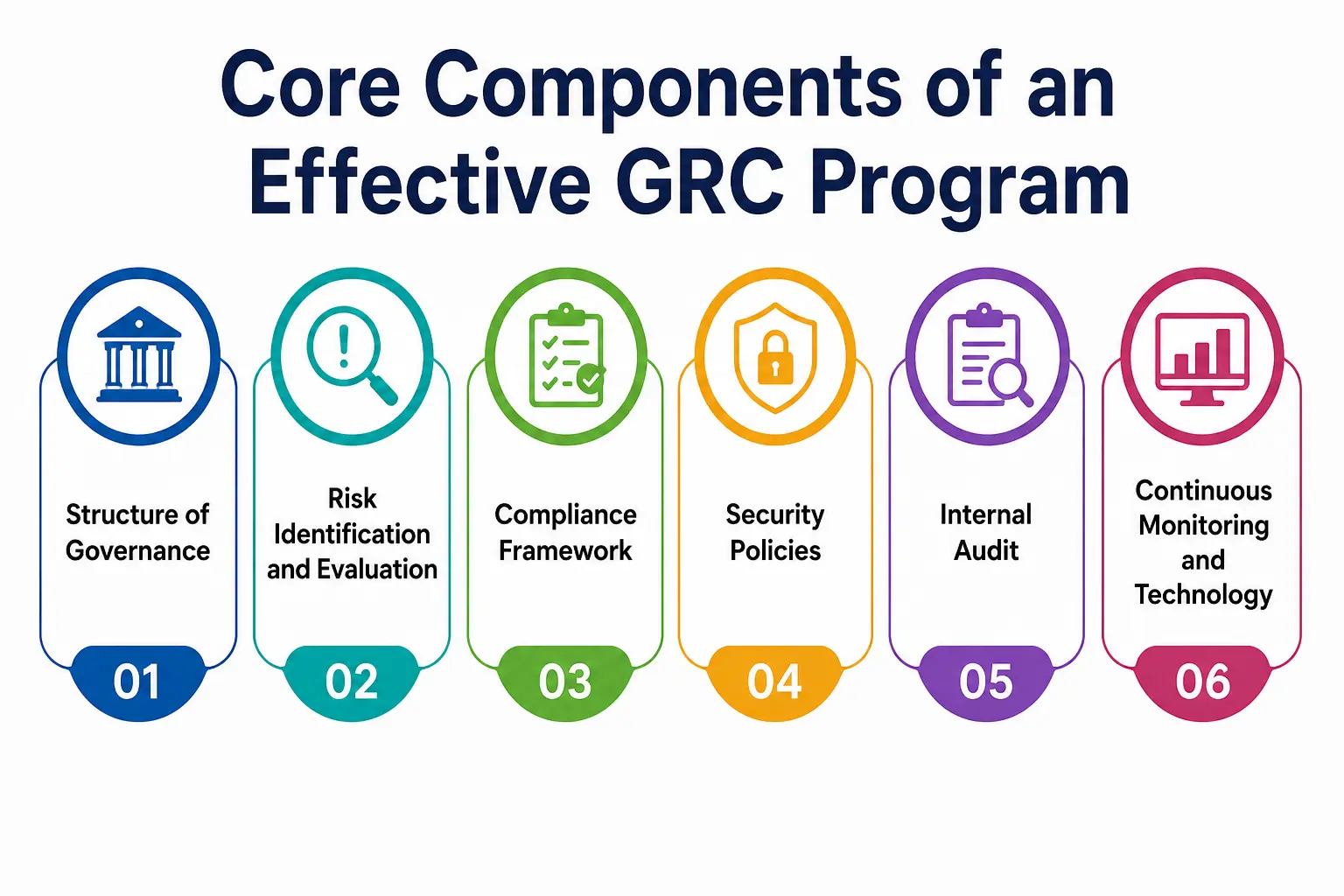
A GRC strategy isn’t one document — it’s a set of interlocking practices. Here’s what a functioning program typically includes.
1. Structure of Governance
First of all, an organization must be clear as to who decides what. This means defining roles (a risk owner, a compliance officer, and an audit committee), a reporting line to the board, and documented decision rights. Without this layer, risk management and compliance work occurs in a vacuum with no one accountable for acting on the findings.
2. Risk Identification and Evaluation
Risk identification is the process of systematically surfacing potential failures. These failures can be financial exposure, cybersecurity threats, third-party vendor risk, regulatory changes, or operational failure. This is not a one-off exercise. Organizations most at risk of being surprised are those that consider risk identification an annual activity rather than an ongoing activity.
Once risks are identified, they need to be scored — likelihood versus impact — so leadership can prioritize what actually deserves attention and budget. Diligent’s guide on this makes the point directly: risk assessments identify potential issues throughout business operations, and doing this well is what allows a GRC strategy to focus resources where they matter most instead of spreading effort evenly across low- and high-priority risks.
3. Compliance Framework
A compliance framework is the structured set of rules, controls, and processes an organization follows to meet legal and regulatory obligations. This could mean data privacy laws, industry-specific regulations, or internal codes of conduct. The framework needs to be living—updated as laws change—not filed away and forgotten.
Well-known reference frameworks that many organizations map their compliance framework against include the OCEG GRC Capability Model, COSO Enterprise Risk Management, ISO 31000, and the NIST Cybersecurity Framework, which the Federal Trade Commission describes as a voluntary tool that helps businesses of all sizes better understand, manage, and reduce their cybersecurity risk.
Choosing which frameworks to align with is itself a strategic decision—pick ones that match your industry and regulatory exposure rather than adopting every framework available.
4. Security Policies
Security policies are the specific, written rules that govern how people and systems behave—password requirements, data handling procedures, incident response steps, and access controls.
These policies are where a GRC strategy becomes concrete. A governance structure can exist entirely on paper, but security policies are what employees actually interact with day to day. If your security policies don’t match your stated risk priorities, the strategy has a credibility gap.
5. Internal Audit
Internal audit is the independent check on whether governance, risk management, and compliance are actually working as designed — not just whether they exist on paper. A good internal audit function tests controls, flags gaps, and reports directly to the board or audit committee, independent of the teams being audited. This independence matters: internal audit is the feedback loop that tells you if your GRC strategy is real or theoretical.
6. Continuous Monitoring and Technology
Continuous control monitoring, automated evidence collection, and dashboards that provide leadership with real-time visibility, not just quarterly snapshots—automation is becoming an increasingly common aspect of a modern GRC strategy.
A 2026 McKinsey benchmarking survey snapshot of the industry finds that 42% of organizations say their IT and GRC systems “need improvement,” and 15% describe them as missing or lagging altogether—a reminder that most programs still have real room to mature.
How to Build a GRC Strategy: Step-by-Step
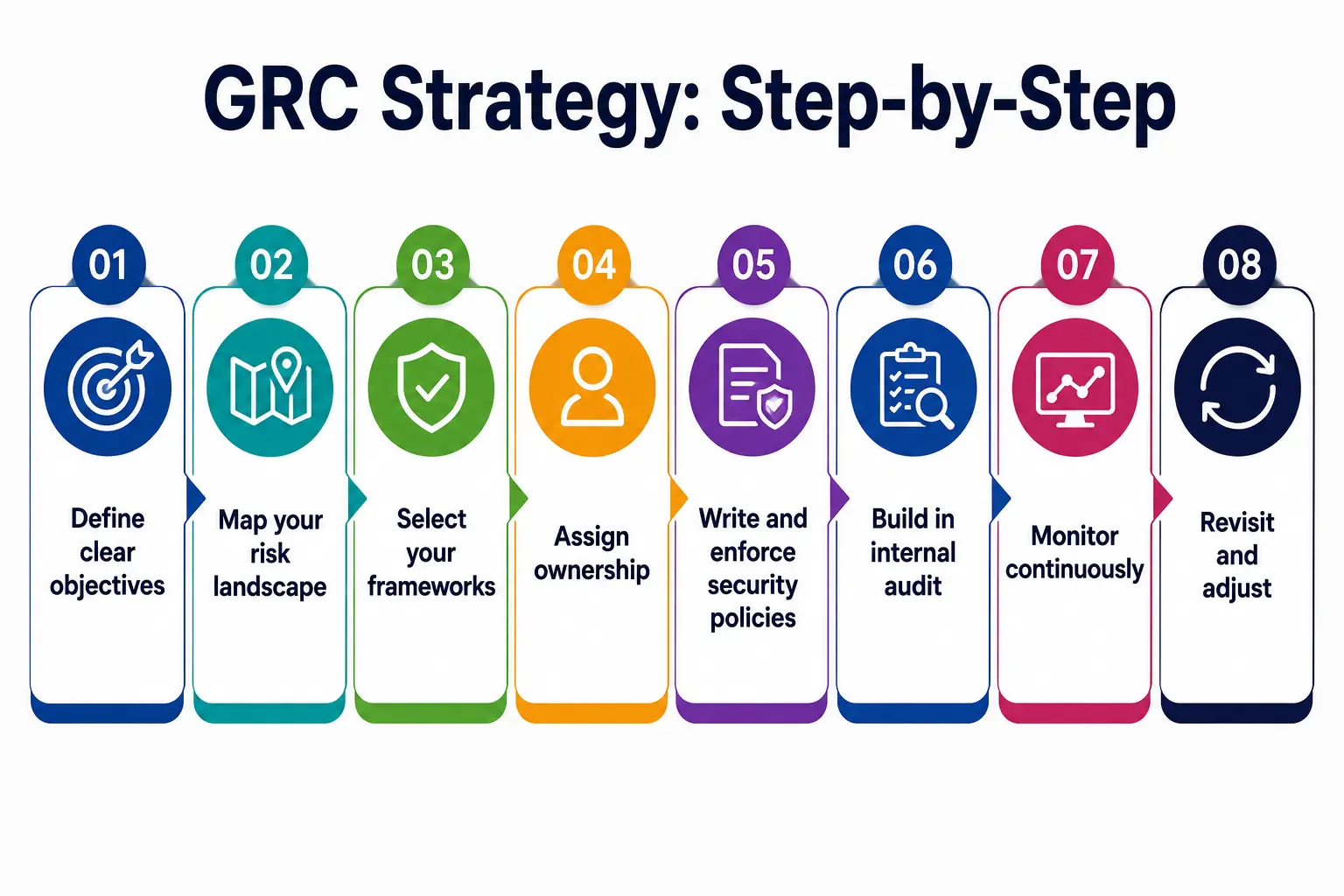
- Define clear objectives. Know what you’re protecting and why—regulatory obligations, reputation, financial stability, or all three.
- Map your risk landscape. Run structured risk identification across departments, not just IT or finance.
- Select your frameworks. Choose a compliance framework and governance model that fits your industry and regulatory footprint.
- Assign ownership. Every risk and every control needs a named owner—not a department, but a person.
- Write and enforce security policies. Translate governance decisions into rules employees can actually follow.
- Build an internal audit. Schedule regular, independent reviews of whether controls are working.
- Monitor continuously. Use tools and dashboards so risk visibility doesn’t wait for the next scheduled review.
- Revisit and adjust. Regulations change, threats evolve, and your GRC strategy has to move with them.
GRC Strategy Components at a Glance
|
Component |
What It Does |
Key Question It Answers |
|
Governance |
Sets direction, accountability, and decision rights |
Who is responsible for what? |
|
Risk Management |
Identifies and prioritizes threats to the organization |
What could go wrong, and how badly? |
|
Compliance Framework |
Aligns operations with laws and regulations |
Are we meeting our legal obligations? |
|
Security Policies |
Translates rules into day-to-day practice |
What should employees actually do? |
|
Internal Audit |
Independently verifies controls are working |
Is the strategy real or just documented? |
Common Mistakes Students and Early-Career Professionals Should Know
A lot of GRC coursework focuses on definitions and frameworks, but the practical failure points are usually simpler than that. Organizations treat risk identification as a once-a-year checkbox instead of an ongoing habit. They write security policies that don’t match how people actually work, so employees quietly route around them.
They let an internal audit report go to the same people it’s supposed to be checking, which undermines its independence. And they adopt a compliance framework because a competitor uses it, not because it fits their actual risk profile. Understanding these failure patterns is often more useful than memorizing framework names.
A Personal Note
I’ve noticed that GRC gets taught as if it’s mostly about memorizing frameworks—COSO here, ISO there, NIST somewhere else. In practice, the frameworks matter far less than the discipline of actually connecting governance, risk, and compliance instead of letting them run as three separate conversations.
If you’re a student heading into this field, spend less time memorizing acronyms and more time understanding why organizations keep failing at the handoffs between departments. That’s where the real work — and the real value you can bring — actually lives.