

Every IT classroom, every LinkedIn comment section, and every hiring manager’s interview sheet eventually lands on the same question: AWS vs Azure, and which one should you actually bet your career or your workload on? It’s not a trivial debate.
These two platforms together run a huge share of the world’s digital infrastructure, and the choice between them shapes everything from your monthly cloud bill to the certification you’ll spend the next three months studying for.
This comparison is written for students and early-career professionals trying to make sense of the noise. We’ll go through AWS vs Azure differences in architecture and philosophy, compare AWS vs Azure features side by side, break down AWS vs Azure services across compute, storage, and security, look closely at AWS vs Azure machine learning tooling, and finish with an honest take on AWS vs Azure certification paths and what they’re actually worth in 2026.
Where AWS and Azure Stand in 2026—The Numbers That Matter?
Before picking a side in the AWS vs Azure conversation, it helps to know the scale each platform is operating at. Here’s a quick, infographic-friendly snapshot of where things stood heading into late 2026:
- AWS holds roughly 30–31% of global cloud infrastructure market share, making it the largest single provider by a clear margin
- Azure sits around 24–25% but is growing faster year-over-year, largely on the back of enterprise AI adoption
- The global cloud computing market crossed roughly $943 billion in 2025 and is on pace to cross $1 trillion in early 2026, according to Holori’s cloud market share report
- Azure now operates in more than 60 geographic regions worldwide, while AWS runs in 34 regions—a real advantage for Azure in data-residency-sensitive industries
- AWS leans on custom silicon (Trainium and Inferentia chips) for AI workloads, while Azure holds exclusive enterprise access to OpenAI’s models through Azure OpenAI Service
- Managed Kubernetes is priced very differently: Azure’s AKS control plane is free, while AWS’s EKS charges roughly $0.10 an hour per cluster
None of these numbers settle the AWS vs. Azure debate on their own, but they frame it honestly—this isn’t a story of one platform “winning” and the other falling behind. It’s two different approaches scaling at two different speeds.
AWS vs. Azure: Side-by-Side Comparison Table
|
Category |
AWS |
Azure |
|
Global market share (2026) |
~30–31% |
~24–25% |
|
Regions worldwide |
34 regions |
60+ regions |
|
Compute pricing (entry-level) |
~$30/month for 2 vCPU |
~$30/month, slightly higher baseline memory |
|
Object storage pricing |
S3: ~$0.023/GB |
Blob Storage: ~$0.018/GB (about 22% cheaper) |
|
Managed Kubernetes |
EKS: ~$0.10/hour per cluster |
AKS: control plane free |
|
AI/ML flagship tools |
SageMaker, Bedrock, Trainium/Inferentia chips |
Azure AI Foundry, Azure OpenAI Service |
|
Hybrid cloud tooling |
AWS Outposts |
Azure Arc, Azure Stack HCI (generally considered stronger) |
|
Identity & security |
Fine-grained IAM policies |
Microsoft Entra ID, tight Microsoft 365 integration |
|
Entry certification |
AWS Certified Cloud Practitioner |
Microsoft Azure Fundamentals (AZ-900) |
|
Best suited for |
Startups, cloud-native products, teams wanting maximum flexibility |
Microsoft-centric enterprises, regulated industries, hybrid environments |
A table like this is useful for a quick scan, but it can’t capture nuance—so let’s unpack each row in plain language.
Understanding the Core AWS vs. Azure Differences
The most important of all the AWS vs. Azure differences isn’t a feature or a price tag—it’s philosophy. AWS was built cloud-native from day one, with a sprawling, à la carte catalog of services that assumes you’ll pick and assemble exactly what you need.
That flexibility is powerful, but it comes with a steeper learning curve for newcomers who aren’t sure which of AWS’s 200-plus services actually apply to their problem. Azure training, by contrast, grew out of Microsoft’s existing enterprise relationships.
One of the clearest AWS vs Azure differences shows up here: Azure is designed to plug directly into tools organizations already use—Active Directory, Microsoft 365, Windows Server—so migrating an existing Microsoft-heavy enterprise onto Azure tends to feel more like an extension of familiar tooling than a fresh start.
Pricing philosophy is another of the meaningful AWS vs. Azure differences worth knowing before you commit to either ecosystem. AWS storage and compute, according to the data, typically cost a bit more at list price—S3 standard storage runs around $0.023 per GB versus Azure Blob Storage’s $0.018 per GB—but AWS offsets this with Graviton ARM-based instances that deliver 20–40% better price-performance for compute-heavy workloads.
Azure, meanwhile, wins decisively on archival storage pricing and on Kubernetes, where AKS’s free control plane beats AWS EKS’s hourly charge outright.
Comparing AWS vs. Azure Features Across the Stack
When people ask about AWS vs Azure features, they usually mean the practical building blocks: compute, storage, networking, and security. On compute, both platforms offer comparable entry-level virtual machine pricing, hovering around $30 a month for a basic 2 vCPU instance, though Azure tends to include slightly more baseline memory at that tier.
Storage is where the AWS vs Azure features comparison gets genuinely interesting. Azure’s hot-tier object storage is meaningfully cheaper than AWS S3, and the gap widens even further in cold storage—Azure Blob Archive is reported to run about 75% less than AWS S3 Glacier Deep Archive for long-term, rarely-accessed data. If your workload involves massive archival datasets, that single AWS vs. Azure features difference alone could swing a procurement decision.
Security is a tie in capability but a difference in approach. AWS’s IAM system is famously granular—almost to a fault, since misconfigured policies are a leading cause of cloud security incidents industry-wide.
Azure folds identity into Microsoft Entra ID, which feels more guided for teams already standardized on Microsoft’s ecosystem but offers slightly less low-level control than AWS IAM for teams that want to fine-tune every permission boundary themselves.
Breaking Down AWS Vs Azure Services: Breadth, Depth, and Everyday Use
Catalog size is often the first thing people cite in an AWS vs. Azure services discussion, and AWS does technically offer more individual services. But raw count is a misleading metric—what actually matters is whether the services you need exist, integrate well, and don’t require three different consoles to configure.
Both platforms cover the essentials: compute (EC2 vs Azure Virtual Machines), serverless (Lambda vs Azure Functions), managed containers (EKS vs AKS), and relational databases (RDS vs Azure SQL Database) in roughly comparable depth.
Where the AWS vs. Azure services comparison really splits is hybrid cloud. Azure Arc and Azure Stack HCI let organizations manage on-premises servers and cloud resources through one consistent control plane—a capability AWS Outposts doesn’t match with the same maturity.
For any organization that isn’t fully cloud-native and still runs on-premises data centers, this single category of AWS vs. Azure services can outweigh almost every other comparison point on this page.
DevOps tooling is another area worth a close look when weighing this out. AWS leans on CodePipeline, CodeBuild, and a broad third-party ecosystem built around Terraform and Jenkins. Azure DevOps and GitHub Actions (also a Microsoft product since the GitHub acquisition) give Azure a tighter, more opinionated pipeline experience that many enterprise teams find faster to stand up from zero.
AWS vs. Azure Machine Learning: Where the Real Competition Is Happening
If there’s one place the AWS vs Azure rivalry has gotten genuinely intense in 2026, it’s artificial intelligence. AWS vs Azure machine learning comparisons used to be a fairly quiet corner of the broader cloud debate; now it’s arguably the main event, since enterprise AI spending is driving a large share of both companies’ growth.
On the AWS side of the AWS vs. Azure machine learning story, Amazon SageMaker handles the full ML lifecycle—data labeling, training, tuning, and deployment—while Amazon Bedrock gives teams access to multiple foundation models (Anthropic’s Claude, Meta’s Llama, Amazon’s own Nova models, and others) through a single API.
According to Glorium Tech’s comparison of Azure AI and AWS AI, AWS also leans heavily on custom silicon—its Trainium and Inferentia chips—to give technically mature teams more control and better economics at scale.
Azure’s answer in the AWS vs Azure machine learning conversation centers on Azure AI Foundry and its exclusive enterprise access to OpenAI’s model family. For teams that want guided workflows, consistent interfaces, and a faster path from zero to a working AI feature, Azure AI tends to have a shorter learning curve.
AWS vs. Azure Certification: Which Path Is Worth Your Time?
For students, this is often the most practical part of the whole AWS vs Azure debate. The AWS vs Azure certification decision shapes months of study time, so it deserves more thought than “pick whichever logo looks better on LinkedIn.”
AWS’s certification ladder starts with AWS Certified Cloud Practitioner and typically moves into AWS Certified Solutions Architect – Associate, a widely respected credential that AWS describes as validating skills in designing cost-optimized, resilient systems. AWS exam questions tend to be scenario-heavy multiple-choice and multiple-response formats—predictable in structure but demanding in depth.
Azure’s AWS vs Azure certification counterpart starts with Azure Fundamentals (AZ-900), detailed on Microsoft Learn’s official certification hub, and typically progresses to Azure Administrator Associate (AZ-104). Azure exams mix in case studies, drag-and-drop sequencing, and process-reordering questions, which rewards a slightly different kind of exam preparation than AWS’s more uniform, scenario-based question style.
On pure market demand, AWS certifications currently have a slight edge simply because of AWS’s larger market share, especially among startups and product-led tech companies. But Azure certification demand is rising quickly inside large enterprises that already run on Microsoft infrastructure — and salary data for equivalent roles (architect, administrator, developer) comes out close enough between the two that the honest answer to “which AWS vs Azure certification pays more” is: it depends far more on your target industry than on the badge itself.
Two Quick Decision Points for Picking Between Them
If you’re still undecided about AWS vs Azure after all that, here’s the shortest honest version, broken into the two questions that actually predict the right choice:
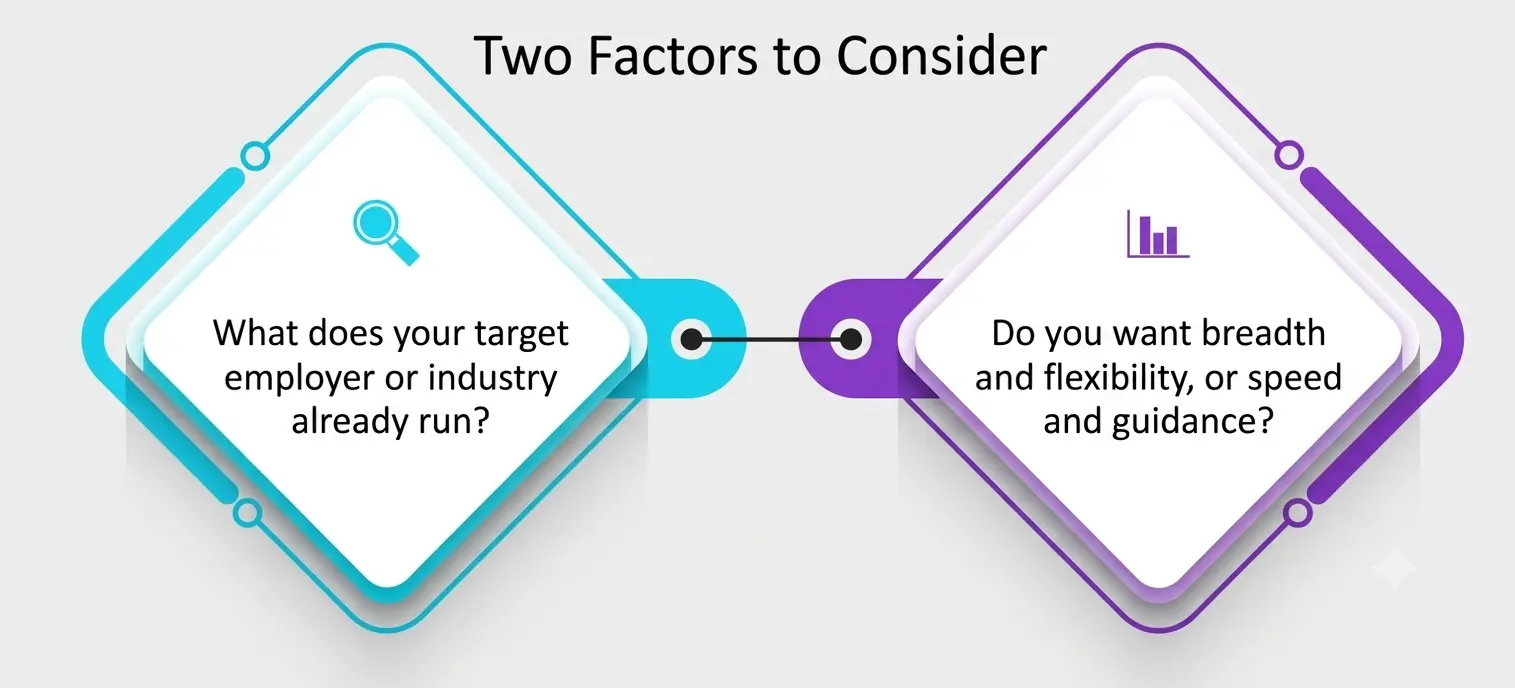
- What does your target employer or industry already run? If you’re aiming at startups, product companies, or cloud-native tech roles, AWS’s larger footprint and job market give you more options. If you’re targeting large enterprises, government contractors, banks, or any Microsoft-heavy organization, Azure skills will open more doors specific to that environment.
- Do you want breadth and flexibility, or speed and guidance? AWS rewards people who enjoy assembling solutions from a large toolbox and don’t mind a steeper initial climb. Azure rewards people who want guided workflows, faster onboarding, and tighter integration with tools they may already know from Microsoft 365 or Windows environments.
There’s no wrong answer here, and this isn’t really a once-and-done decision — plenty of cloud professionals end up fluent in both platforms within a few years, because employers increasingly want people who aren’t married to a single vendor.
A Personal Note
I’ve watched enough students agonize over AWS vs Azure to know the anxiety is usually bigger than the stakes. I picked a side early in my own learning simply because a mentor happened to use it, not because of some grand strategic analysis — and it worked out fine, because the underlying cloud concepts transfer almost completely once you actually understand them.
If you’re stuck choosing between AWS and Azure right now, my honest advice is to stop treating it like a permanent marriage. Pick the one with better free-tier access to your first course or the one your target company already uses, get genuinely hands-on with labs instead of just watching videos, and let your second certification be the informed choice — because by then, you’ll actually know what you’re choosing between.