

Cloud budgets are still climbing, hiring managers are still short-staffed, and the gap between “I know the theory” and “I can run this in production” is still where most IT careers stall. If you have been circling the decision to enroll in AWS, Azure & DevOps courses for a few months now, 2027 is the year that indecision starts costing you more than the course fee would.
I have watched this pattern repeat for years: a system administrator or a computer science graduate delays training because the syllabus feels overwhelming, then watches a less experienced colleague get promoted simply because that colleague had a certification and a portfolio project to point to.
This blog breaks down, in plain language, why AWS Azure & DevOps courses are worth the time in 2027, what you actually learn, how AWS and Azure paths differ from DevOps training, and how to pick a program that will not waste your evenings. Along the way we will lean on fresh 2026 industry data rather than guesswork, because this decision deserves more than a sales pitch.
Across job boards in the US, UK, and Canada, postings increasingly name AWS Azure certification courses as a preferred qualification rather than a nice-to-have, and that shift is only getting sharper heading into 2027.
Why 2027 Is the Tipping Point for Cloud and DevOps Skills?
Cloud spending did not slow down in 2026—it accelerated. Gartner’s May 2026 forecast shows organizations increasing public cloud budgets at a double-digit pace not just in one region. At the same time, Synergy Research Group reported that the global cloud infrastructure market passed $143 billion in a single quarter of 2026, its highest growth rate in eight years, driven largely by AI workloads that still need to be provisioned, secured, and automated by human engineers.
What does that mean for someone deciding between a weekend tutorial and a structured program? It means employers are no longer hiring for “cloud familiarity.” They are hiring for people who can design a VPC, write a CI/CD pipeline, and explain why a deployment failed at 2 a.m.
That is precisely the skill set built by well-designed AWS, Azure & DevOps courses, and it is why enrollment in structured cloud computing courses has kept rising even as the broader tech hiring market has cooled in other areas. This is exactly the backdrop that turns AWS, Azure & DevOps courses from an optional upskilling exercise into a baseline expectation for anyone planning to stay in IT past the next hiring cycle.
A second shift matters too: cloud platforms stopped behaving like separate silos. Most mid-size and enterprise companies now run workloads across more than one provider, which is exactly why AWS and Azure courses taken together, rather than one platform studied in isolation, have become the more employable combination.
Top Benefits of AWS, Azure & DevOps Courses in 2027
Here are the benefits that show up most consistently once learners finish a structured path—written as a quick-reference list you can scan or turn into a visual:
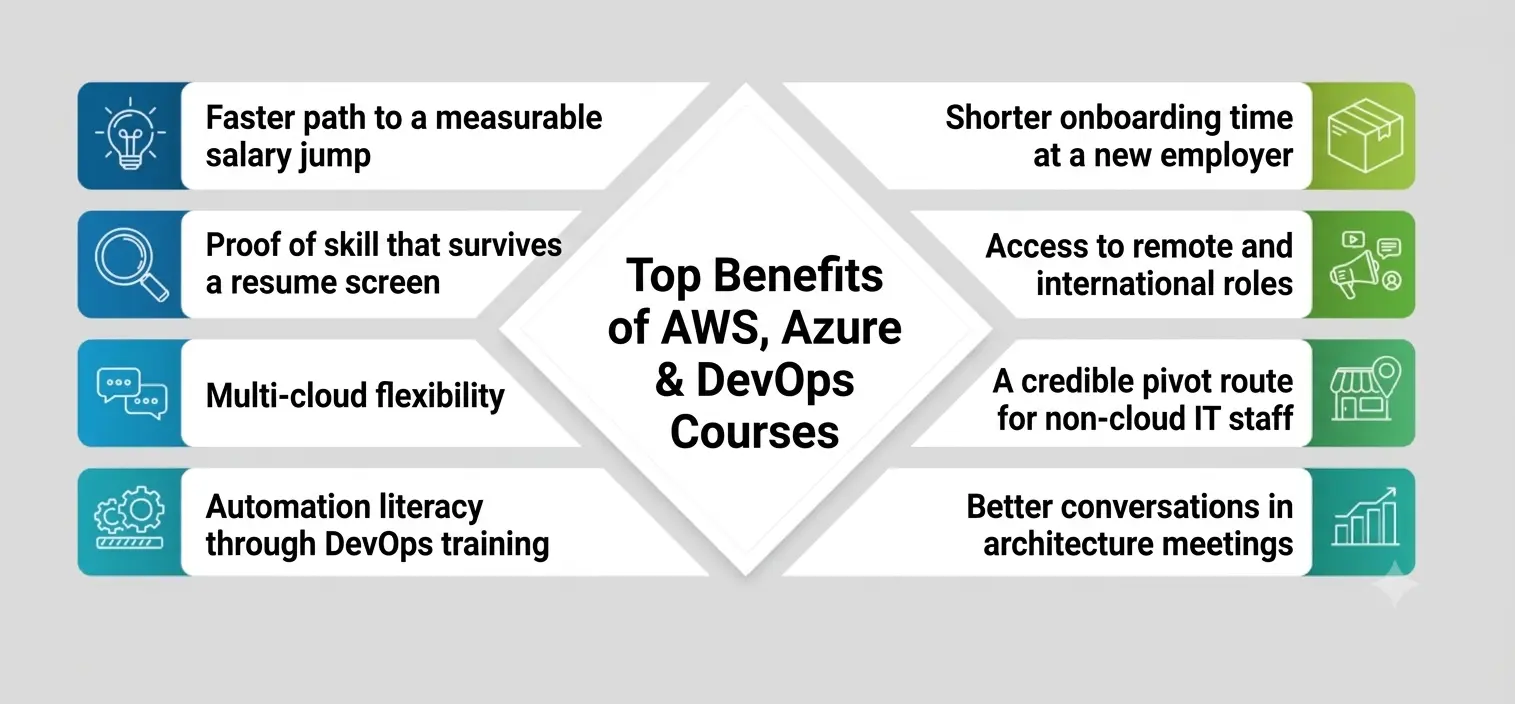
- Faster path to a measurable salary jump. Recruiters and hiring platforms have repeatedly found that certified cloud professionals out-earn uncertified peers in the same role, which is the single biggest reason people commit to AWS certification training in the first place.
- Proof of skill that survives a resume screen. An ATS or a recruiter scanning hundreds of applications will shortlist a certification before a vague “familiar with cloud” bullet point.
- Multi-cloud flexibility. Learning AWS and Azure together means you are not locked out of a job posting just because a company standardized on the “other” provider.
- Automation literacy through DevOps training. You stop being the person who waits for a ticket to be closed and become the person who writes the script that closes it.
- Shorter onboarding time at a new employer. Someone who already understands IAM roles, networking basics, and pipeline design needs weeks, not months, to become productive.
- Access to remote and international roles. Cloud and DevOps skills are among the most portable in tech, because the tooling is identical whether the company is in Austin, London, or Toronto.
- A credible pivot route for non-cloud IT staff. Network admins, helpdesk engineers, and QA testers routinely use cloud computing courses as the bridge into a cloud engineering title.
- Better conversations in architecture meetings. Even if your job title does not say “architect,” understanding the AWS and Azure courses curriculum means you can push back intelligently when a design choice looks expensive or fragile.
Taken together, these are the reasons AWS, Azure & DevOps courses keep showing up as a recommended first move for anyone serious about a long IT career rather than a short-term job.
AWS vs Azure vs DevOps: What Each Course Path Covers
Before enrolling, it helps to see the three paths side by side, since most learners eventually combine two of them rather than mastering all three from day one.
|
Course Path |
Core Focus | Typical Entry Certification |
Best Fit For |
|
AWS |
Compute, storage, networking, IAM on Amazon’s cloud | AWS Certified Cloud Practitioner / Solutions Architect – Associate |
Beginners and engineers targeting AWS-heavy employers |
|
Azure |
Identity, hybrid cloud, enterprise integration on Microsoft’s stack | Microsoft Certified: Azure Fundamentals (AZ-900) |
IT staff already working with Windows Server, Active Directory, or Microsoft 365 |
|
DevOps |
CI/CD pipelines, containers, infrastructure as code, monitoring | Certified Kubernetes Administrator, AWS/Azure DevOps Engineer tracks |
Developers and sysadmins who want to own deployment, not just infrastructure |
This is also why most serious AWS Azure certification courses bundle at least two of these tracks: a Solutions Architect credential paired with a DevOps Engineer credential signals that you can both design the environment and ship software into it reliably.
Skills You’ll Gain From AWS, Azure & DevOps Courses in 2027
Rather than listing abstract topics, here is what a learner can actually do by the end of a well-structured program—again laid out as a scannable list:
- Provision and secure cloud infrastructure using IAM, security groups, VPCs, and resource policies on both AWS and Azure.
- Automate deployments with CI/CD pipelines using tools like Jenkins, GitHub Actions, or Azure DevOps Pipelines.
- Docker and Kubernetes are the backbone of almost every modern DevOps curriculum. Containerize and orchestrate applications with them.
- Write infrastructure as code with Terraform or CloudFormation so environments are repeatable and version controlled, not hand-built.
- Monitor and troubleshoot production systems with CloudWatch, Azure Monitor, and open-source observability stacks.
- Manage cost and scaling decisions, a skill that matters more in 2027 than ever given how quickly AI-related workloads can inflate a cloud bill.
- Communicate trade-offs to non-technical stakeholders, because the engineers who get promoted are usually the ones who can explain why a decision was made, not just execute it.
These are the exact competencies hiring managers screen for, and they are the reason graduates of solid cloud certification programs tend to move roles faster than self-taught peers with the same years of experience.
Several AWS Azure certification courses now fold these exact competencies into one cohesive syllabus instead of three disconnected modules, which shortens the overall study timeline considerably.
Who Should Choose AWS and Azure Courses vs. DevOps Training?
Not everyone needs the same starting point, and this is where a lot of learners waste months on the wrong sequence.
If you are early in your IT career or coming from a non-technical background, starting with AWS and Azure courses at the fundamentals level makes sense—you need the vocabulary and the platform mental model before automation will click.
If you are already a developer or a Linux/Windows administrator, you probably already have that vocabulary, so jumping straight to DevOps training and layering AWS or Azure specifics on top can be faster.
Another popular hybrid route that has gained ground through 2026 is taking cloud computing courses that explicitly combine one cloud platform with a DevOps module rather than treating them as two separate purchases. This avoids the common trap of becoming “certified but “unemployable”—holding a credential with no deployment experience to back it up.
How to Choose the Right AWS Certification Training Program?
Not all programs are built the same, and the difference shows up the moment you start job hunting. A few things worth checking before you pay for any AWS certification training:
- Does it include hands-on labs, not just slide decks? Employers care about what you can build, not what you can recite.
- Is the curriculum updated for 2026-2027 exam versions? AWS and Azure both revise their certification blueprints regularly, and outdated material wastes study time.
- Does it map to a real-world project, such as deploying a multi-tier application or building a CI/CD pipeline from scratch?
- Is there instructor access or a community so you are not stuck googling an error at midnight with no way to ask a human?
- Does the provider talk about career outcomes honestly, rather than promising a six-figure job the moment you pass one exam?
A program that checks these boxes will usually cost more upfront than a $15 video bundle, but it is also far more likely to translate into an interview callback.
Industry Demand and Salary Trends in 2026 and Beyond
The demand signal is not subtle. UK data continues to show Azure certification requirements embedded in a steady share of permanent IT job postings, and Microsoft’s own enterprise adoption numbers back that up—Azure-skilled professionals remain in demand wherever a company already runs on Windows Server or Microsoft 365.
Meanwhile, the growth in AI infrastructure spending documented by Flexera’s 2026 State of the Cloud Report shows that FinOps and cost-governance skills — taught in most intermediate and advanced DevOps training programs — are becoming as valuable as raw infrastructure skills.
Put plainly: employers are not just paying for someone who can click through a console. They are paying for someone who finished rigorous AWS Azure certification courses, understands cost implications, and can be trusted to deploy changes without breaking production on a Friday afternoon.
That combination, more than any single badge on a LinkedIn profile, is what moves a salary number. That return on investment is precisely why spending on AWS certification training keeps rising even in years when overall tech hiring budgets tighten, and why finance teams are increasingly comfortable approving it as a line item rather than treating it as optional perk spending.
Common Mistakes to Avoid When Picking Cloud Computing Courses
A few patterns show up again and again among learners who regret their first choice of program:
- Choosing a course based only on price, then discovering there are no labs or practice exams included.
- Studying AWS and Azure in total isolation from each other, then struggling in interviews that ask about multi-cloud trade-offs.
- Skipping DevOps fundamentals entirely and assuming infrastructure knowledge alone is enough for a modern cloud role.
- Treating the certification exam as the finish line instead of the starting point for a portfolio project.
- Ignoring instructor-led or mentor-supported cloud certification programs in favor of fully self-paced content with no accountability.
Avoiding these mistakes is often a bigger factor in career outcomes than which specific certification badge ends up on your profile.
A Personal Note
I have sat on both sides of this decision — as a learner overwhelmed by acronyms, and later as someone mentoring others through the same confusion. The thing I wish someone had told me earlier is that the certification itself is not the goal; it is the receipt for the work you actually did.
The learners I have seen succeed fastest were not the ones who picked the “best” course on a forum thread — they were the ones who picked a reasonably good program and then actually built something with it: a small pipeline, a sample app, a broken deployment they fixed at 1 a.m. If you take one thing from this article, let it be that: enroll in something structured, but treat the labs as the real curriculum and the exam as a bonus.
The Bottom Line for 2027
None of this requires a dramatic career leap overnight. It requires picking one reasonably good program, showing up consistently for a few months, and treating the labs as seriously as the exam.
The data from Gartner, Synergy Research, and Flexera all point the same way: cloud and automation spending is not slowing down, and the engineers who benefit most are the ones who invested in AWS, Azure & DevOps Courses before the job posting that required it ever got published. Start now, and 2027 becomes the year your resume catches up to where the market already is.