

Most people preparing for the AZ 305 certification spend weeks memorizing service names and almost no time rehearsing how Microsoft actually phrases its scenario questions. That gap is why so many experienced engineers walk out of the testing center surprised. This exam isn’t a trivia test about Azure features—it’s a test of judgment, and judgment only improves with practice under realistic conditions.
This guide walks through what the exam covers in 2026, why practice questions matter more than another round of video lectures, and how to build a study plan around the skills Microsoft is actually measuring right now.
Along the way, we’ll look at the role of Azure Cost Optimization, Azure migration, data migration, technical architecture, enterprise application modernization, and cloud governance framework design in the exam, since these are the themes that show up again and again in scenario-based questions. We’ll also walk through what exam day itself actually looks like, since logistics trip up more candidates than people expect.
What the AZ 305 Certification Actually Tests?
The AZ 305 certification exam—officially titled “Designing Microsoft Azure Infrastructure Solutions”—leads to the Azure Solutions Architect Expert credential, which most people just call the Azure Solutions Architect certification.
Microsoft’s study guide describes the ideal candidate as someone with advanced knowledge across networking, identity, security, business continuity, data platforms, and governance, who also has hands-on experience with Azure administration and development. There’s no formal prerequisite exam you must pass first, but Microsoft is explicit that this one isn’t aimed at beginners.
That audience description matters. The AZ 305 certification assumes you already know how to click through the Azure portal. What it actually measures is whether you can translate a business requirement—”we need to cut spending by 20% without breaking the “app”—into a coherent architecture. That’s a different skill than configuring a virtual network, and it’s precisely where candidates who only skim documentation get stuck.
Unlike entry-level Azure exams, the Azure Solutions Architect certification path doesn’t reward memorized syntax. A question might describe a retail company running a legacy order-processing system, hint at compliance requirements, and ask you to pick the design that balances resilience, cost, and governance all at once.
There’s rarely one “correct” service—there’s a best-fit answer given the constraints in the scenario, which is exactly why timed practice questions matter so much more here than in associate-level certifications.
Skills Measured: The Official 2026 Breakdown
As of the update that took effect in April 2026, Microsoft reorganized the AZ 305 certification skills outline into four weighted domains. This revision applies to the Azure Solutions Architect certification path as a whole, so candidates who studied an older outline should re-check it before scheduling. Here’s how the current version breaks down:
|
Domain |
Weighting |
What It Actually Covers |
|
Design identity, governance, and monitoring solutions |
25–30% |
Identity architecture, a cloud governance framework for policy and compliance, logging, and monitoring design |
|
Design data storage solutions |
20–25% |
Relational and non-relational storage, data migration planning, and data integration patterns |
|
Design business continuity solutions. |
15–20% |
Backup strategy, disaster recovery, and high-availability architecture |
|
Design infrastructure solutions |
30–35% |
Compute, architecture decisions, application design, network layout, and Azure migration scenarios |
Two things stand out when you look at this table closely.
- First, infrastructure design now carries the single largest weighting of any domain, which means practice questions about compute choices and migration patterns deserve more of your study time than most prep courses allocate.
- Second, governance isn’t a side topic anymore—a governance framework for policy, cost control, and access management sits inside the highest-weighted identity domain, not bolted on as an afterthought. That placement alone tells you how Microsoft weighs the exam: governance is treated as foundational, not optional.
7 Core Topics the AZ 305 Certification Exam Covers
Rather than studying Azure service-by-service, it helps to organize your prep around the themes the exam actually rewards. These seven recur constantly across practice questions:
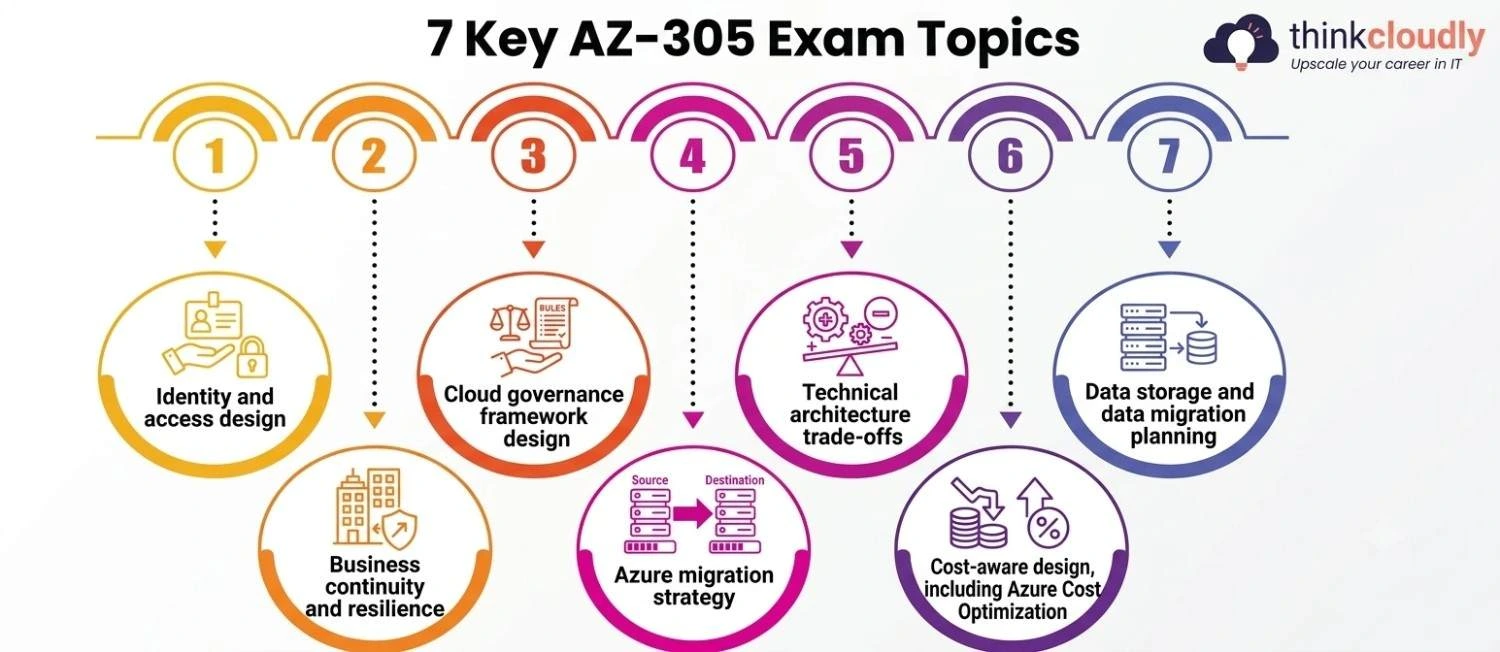
- Identity and access design—choosing between Microsoft Entra ID configurations, conditional access, and hybrid identity models for different business requirements.
- Cloud governance framework design—structuring management groups, policies, and blueprints so an organization’s Azure footprint stays compliant as it scales.
- Technical architecture trade-offs—picking compute (VMs, containers, serverless) based on workload patterns rather than habit.
- Data storage and data migration planning—matching relational, NoSQL, and analytics workloads to the right storage tier and mapping out how existing data gets there.
- Business continuity and resilience—designing backup, failover, and recovery strategies that meet a stated recovery time objective.
- Azure migration strategy—sequencing a lift-and-shift, replatform, or full enterprise application modernization effort based on technical debt and business urgency.
- Cost-aware design, including Azure Cost Optimization—selecting pricing tiers, reserved capacity, and architecture patterns that keep spending predictable.
Notice that these topics overlap on purpose. A single exam scenario might touch identity, Azure cost optimization, and technical architecture in the same question—which is exactly how Microsoft tests whether you can juggle competing priorities, not just recall facts in isolation.
Why Practice Questions Beat Passive Review?
Reading documentation teaches you what a service does. Practice questions teach you how to decide between two services that both technically “work.” That second skill is what this exam is built to measure, and it’s the one most self-study plans neglect.
There’s a practical reason for this, too. Microsoft’s scenario questions are long—often a paragraph of business context before the actual question appears. Candidates who haven’t rehearsed this format under time pressure routinely misread a constraint buried in sentence three and pick an answer that would have been correct for a slightly different scenario. Repeated practice questions train you to extract the two or three constraints that actually matter (a budget cap, a compliance requirement, an RTO) and ignore the narrative padding around them.
Practice also exposes blind spots that reading never will. You might feel confident about Azure migration until a timed question forces you to choose between Azure Migrate, Azure Database Migration Service, and a manual export-and-import approach for a specific SQL Server scenario—and realize you never actually compared those options side by side.
This is also where a lot of candidates discover they’ve been studying services in isolation rather than as a system. A compute decision is rarely just a compute decision in these scenarios—it’s a technical architecture call that drags along a networking implication, a cost implication, and usually a monitoring implication too.
Practice questions are the only format that forces you to hold three or four of those threads at once, the same way you’d have to on the actual exam. Flashcards and video lectures can teach you what each thread looks like individually, but they can’t simulate the feeling of juggling all of them under a two-minute clock, which is exactly what trips up otherwise well-prepared candidates.
8 Practice Question Strategies That Actually Move Your Score
Grinding through hundreds of random questions isn’t the same as improving. These strategies make practice sessions count:
- Time yourself from day one. The real exam gives you roughly two minutes per question on average once you account for case studies—train at that pace, not slower.
- Read the last sentence first. It usually contains the actual question; everything above it is scenario context you’ll reread with purpose.
- Eliminate answers that violate a stated constraint, even if they’re technically valid Azure solutions. A technically correct answer that ignores the compliance requirement in the scenario is still wrong.
- Keep a mistake log, not a score log. Write down why you picked the wrong answer—guessed, misread the scenario, or didn’t know the service—because each cause needs a different fix.
- Group questions by domain after your first full practice run so you can see whether your weak spot is governance, storage planning, or architecture decisions specifically.
- Revisit flagged questions after 48 hours, not immediately. Spaced review surfaces whether you actually learned the concept or just memorized the answer.
- Explain your reasoning out loud for every question, right or wrong. If you can’t articulate why a distractor is wrong, you got the right answer for the wrong reason.
- Simulate the full case-study format at least twice before exam day, since those sections combine identity, Azure cost optimization, and enterprise application modernization decisions into one long scenario that rewards stamina as much as knowledge.
Building a Realistic Study Plan
Most candidates who pass the AZ 305 certification on their first attempt spend six to eight weeks preparing, assuming they already have production Azure experience. A reasonable structure looks like this:
- Weeks 1–2: Build or refresh hands-on familiarity with identity, networking, and governance—ideally in a free-tier Azure subscription, not just slides.
- Weeks 3–4: Work through data storage, data migration, and business continuity scenarios, pairing each topic with 20–30 practice questions.
- Weeks 5–6: Focus on infrastructure design, architecture trade-offs, and migration case studies, including early enterprise application modernization patterns, since this domain carries the heaviest weighting.
- Weeks 7–8: Run full-length timed practice exams, maintain the mistake log, and revisit only the domains where you’re scoring below 70%.
Microsoft’s guidance is worth reading in weeks 1 and 5 respectively — not to memorize, but because exam scenarios borrow their language almost directly. A question that asks you to “align usage to billing increments” or “build a dedicated governance team” is lifting vocabulary straight from these frameworks.
Common Mistakes Candidates Make
A few patterns show up repeatedly among people who don’t pass on the first attempt:
- Treating migration as one topic. Azure migration actually spans discovery, assessment, the business case, and execution — Microsoft’s own Azure Migrate overview treats these as distinct phases, and exam questions test each one separately.
- Underestimating governance questions. Since identity and governance together make up the largest domain, skipping a cloud governance framework review to focus on “more interesting” compute topics is a common and costly miscalculation.
- Ignoring cost as a design constraint. Azure Cost Optimization isn’t a separate section — it’s woven into infrastructure and data questions, and candidates who treat cost as an afterthought lose points on otherwise well-reasoned answers.
- Skipping Enterprise application modernization scenarios. These questions, about re-platforming legacy apps onto App Service or containers, are easy to under-practice because they feel less “infrastructure-y” than networking or compute questions.
- Not simulating fatigue. The exam runs long, and candidates who only practice in 20-minute bursts are often undone by domain four, not domain one.
Exam Logistics: What to Actually Expect on the Day
Knowing the content is only half the battle — plenty of well-prepared candidates lose points to format surprises instead of knowledge gaps. A few logistics worth planning around:
- Length and format: Expect a mix of single-answer, multiple-answer, drag-and-drop, and at least one longer case study that bundles several questions around one scenario. Budget your time knowing the case study will eat more minutes than an average question.
- Passing score: You need 700 or higher on a scaled 1,000-point system. There’s no public breakdown of how many raw questions that equals, so treat domain-level practice accuracy, not a raw question count, as your real signal.
- Retake policy: A failed attempt comes with a mandatory waiting period before you can retake, and the wait grows longer after repeated attempts, so it pays to be honest with yourself about readiness rather than treating the first sitting as a “free” diagnostic run.
- Renewal: The credential isn’t permanent. It expires annually and renews through a free assessment on Microsoft Learn, so the practice habit you build now is worth keeping, not just cramming for once.
- Accommodations and language: Extended time and other accommodations are available on request, and non-English versions roll out roughly eight weeks after the English release, so plan your exam date accordingly if you’re testing in a localized language.
A Personal Note
I’ve watched enough candidates prepare for this exam to notice the same pattern every time: the people who pass aren’t necessarily the ones with the most Azure experience — they’re the ones who treat practice questions as a diagnostic tool instead of a confidence exercise.
Grinding through hundreds of easy questions feels productive, but it mostly just confirms what you already know. The AZ 305 certification rewards candidates who get comfortable being wrong in practice, often, so they stop being wrong in the exam room.
The Azure Solutions Architect certification title looks good on a resume, but what actually transfers to the job afterward is the decision-making habit you build while grinding through those practice questions, not the badge itself.
If there’s one thing worth taking from this guide, it’s that: track your mistakes honestly, revisit them without judgment, and treat every wrong answer as information rather than a setback.