

A college senior I mentored last year spent three months applying to generic “IT support” postings with a resume that named no specific platform. Zero callbacks. Then she spent six weekends learning one tool inside and out, added a single certification badge to her profile, and had two interview requests within days.
The tool was ServiceNow. Nothing else about her resume changed. That’s the leverage one well-chosen platform skill can hand you in a market otherwise brutal for newcomers, and it’s why so many freshers and mid-career switchers are quietly building a career in ServiceNow instead of chasing broader, more crowded titles.
This guide isn’t a sales pitch for one piece of software. It’s a practical look at why demand for this skill set keeps climbing, what the work actually involves, which certifications and skills employers screen for, and a step-by-step path for getting your first offer—whether you’re a fresher with zero experience or a working professional looking to pivot. Read it end to end if you’re serious about starting a career in ServiceNow this year, because the pieces build on each other.
Why a Career in ServiceNow Is Worth Betting On Right Now?
ServiceNow isn’t a niche tool anymore. It’s the backbone that large enterprises run their internal IT, HR, and customer service operations on, and the numbers behind that backbone keep getting bigger. A few data points make the case better than any opinion could:
- ServiceNow’s own Q2 2026 results show subscription revenue of $3.877 billion, up 24.5% year over year, with 123 deals worth more than $1 million in new annual contract value closed in that single quarter alone—a figure that rose nearly 40% from the year before. That kind of enterprise spending doesn’t happen without a matching need for people who can configure, implement, and run the platform.
- The IT service management software category that ServiceNow training leads is itself expanding fast, with the market projected to climb from roughly $10.96 billion in 2026 toward $22.91 billion by 2031, a compound annual growth rate near 15.9%, largely driven by automation and AI adoption inside enterprise service desks.
- The U.S. Bureau of Labor Statistics projects that computer and information technology occupations broadly will grow faster than the average for all U.S. occupations through 2035, with a median annual wage of $109,470 in May 2025—more than double the $50,980 median across all occupations.
None of this means the platform sells itself to hiring managers without effort on your part. What it means is that the hiring pipeline isn’t shrinking—it’s widening, and it’s widening specifically around people who understand ServiceNow Workflow Automation, IT Operations Management, and the kind of hands-on configuration work that keeps a company’s internal systems running without constant firefighting.
Enterprises aren’t buying this software to let it sit idle; they’re buying it because they need fewer manual processes and more automated ones, and someone has to build and maintain that automation layer every single day.
What a ServiceNow Professional Actually Does Day to Day?
Job titles in this space can sound intimidatingly broad—Administrator, Developer, Business Analyst, Architect—but the daily work is more concrete than the titles suggest. A ServiceNow administrator configures forms, workflows, and user access; keeps the instance patched and healthy; and handles the tickets and change requests that come from every department using the platform.
A developer builds custom applications on top of the platform—scripting business rules, designing UI pages, and extending out-of-the-box modules to fit a specific company’s processes. This hands-on building work is where a growing share of IT Operations Management budgets are now being directed, since custom automation inside the platform tends to pay for itself within a year or two.
A business analyst sits between IT and the rest of the organization, translating a vague request like “we need better visibility into incidents” into an actual ITSM implementation project with defined scope and milestones.
This is also where the platform overlaps heavily with traditional IT operations management. Incident management, problem management, change management, and the configuration management database (CMDB) are all core ITSM disciplines that existed before ServiceNow, but the platform is now how most large organizations actually execute them.
Understanding that overlap matters in interviews—hiring managers want to know you grasp the underlying IT service management concepts, not just which button to click inside the tool.
7 Skills You Need to Build a Career in ServiceNow
Strip away the job-posting jargon, and most employers hiring for this field are checking for a consistent set of abilities, in roughly this order of importance:
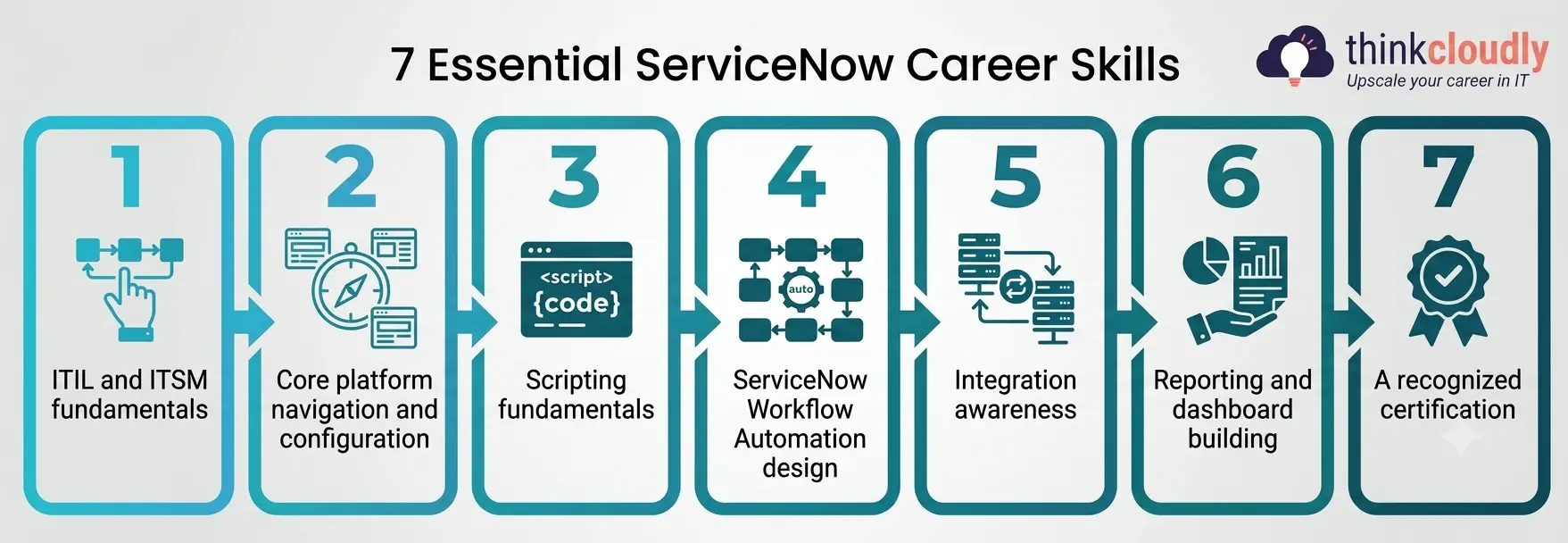
- ITIL and ITSM fundamentals. You should be able to explain incidents, problems, and change management in plain language before you ever touch the software itself. The platform is just the delivery mechanism for ITSM implementation; the discipline underneath it is what actually gets tested in interviews.
- Core platform navigation and configuration. Knowing how to build forms, lists, business rules, and basic workflows is the bread-and-butter skill every entry-level role expects on day one.
- Scripting fundamentals. A working knowledge of JavaScript—specifically how it’s used inside the platform’s server-side and client-side scripting—separates administrators from candidates who can only click through menus.
- ServiceNow Workflow Automation design. Understanding how to map a messy, manual business process into an automated flow is one of the highest-value, most interview-tested skills in this field, and it’s the skill most directly tied to the ROI companies expect from their investment.
- Integration awareness. Most real deployments connect to other enterprise systems through REST or SOAP APIs, so even a basic understanding of how integrations work gives you an edge over candidates who’ve only worked inside a sandboxed training instance.
- Reporting and dashboard building. Stakeholders constantly ask for visibility into ticket volume, SLA compliance, and backlog trends, and being able to build a clear report or dashboard is a skill that comes up in nearly every role.
- A recognized certification. Completing the Certified System Administrator (CSA) credential, and later a Certified Implementation Specialist (CIS) or Certified Application Developer (CAD) badge, tells a hiring manager you’ve invested real, structured effort rather than just browsing documentation.
Candidates who can speak credibly to all seven — even briefly, even as a fresher with no paid experience — consistently beat out candidates with a longer list of unrelated tech buzzwords and nothing concrete to back them up.
Certification Paths Compared: Which One to Start With
|
Certification |
What It Proves | Best Fit For |
Typical Next Step |
|
Certified System Administrator (CSA) |
Core platform configuration, navigation, and basic scripting | Freshers and anyone starting a career in ServiceNow with zero prior exposure |
CAD or a CIS specialization |
|
Certified Application Developer (CAD) |
Building custom applications: UI design, business logic, scripting | Candidates aiming at enterprise application development roles |
A product-specific CIS badge |
|
Certified Implementation Specialist (CIS) |
Deep expertise in one module, such as ITSM or customer service management | Professionals pursuing ITSM implementation or consulting-track roles |
Architect-level roles or a second CIS specialization |
|
Micro-certifications |
Narrow, fast-to-complete proof of a specific skill (e.g., a scripting topic) | Working professionals adding targeted proof without a full exam cycle |
Supplementing a CSA or CAD |
One practitioner who documented their own certification journey described the CSA exam as the easiest entry point “provided you have your fundamentals clear,” and recommended building at least one custom application before attempting CAD, according to their account on the official ServiceNow community. That sequencing—fundamentals first, hands-on building second, specialization third—holds up as sound advice for almost anyone starting from zero.
6-Step Roadmap to Start a Career in ServiceNow
Here’s a practical, in-order sequence that works whether you’re a fresher straight out of a degree program or a professional pivoting from a different IT role:
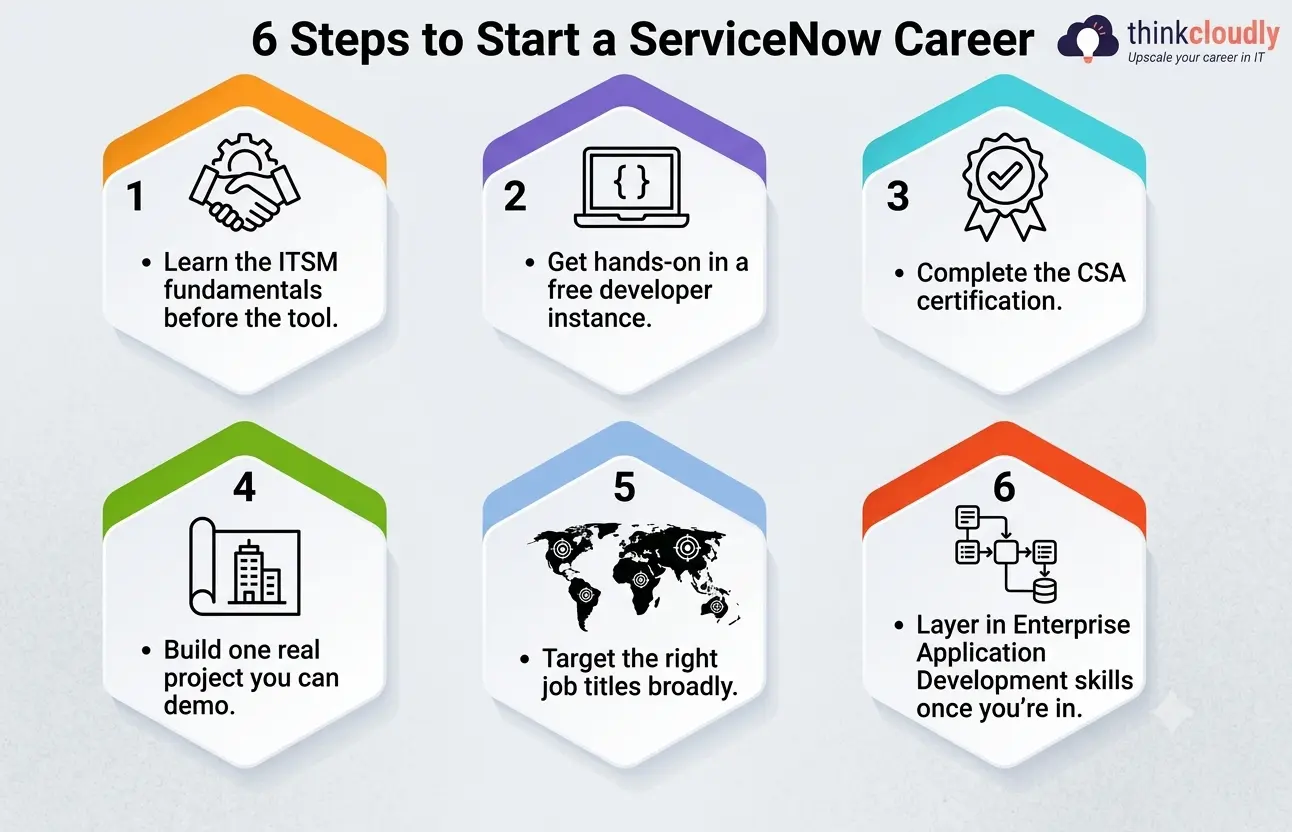
- Learn the ITSM fundamentals before the tool. Spend a week or two understanding incidents, problems, and change management conceptually. This foundation makes every later step easier and is exactly what separates strong candidates in entry-level software jobs from weak ones.
- Get hands-on in a free developer instance. ServiceNow offers free personal developer instances specifically so newcomers can practice configuration, scripting, and workflow building without needing a paid enterprise account.
- Complete the CSA certification. This single credential is the most widely recognized signal for entry-level software jobs in this space and is usually the first filter recruiters apply when screening resumes.
- Build one real project you can demo. Document a custom workflow, a small application, or an automated approval process you built yourself in your developer instance. Interviewers remember a candidate who can walk through something they actually built far more than one who only describes textbook theory.
- Target the right job titles broadly. “ServiceNow Administrator,” “ServiceNow Developer,” “ITSM Analyst,” and “Platform Business Analyst” often describe overlapping responsibilities—widen your search instead of filtering on one exact title, especially when hunting for entry-level software jobs where titles vary wildly between companies.
- Layer in Enterprise Application Development skills once you’re in. Once you’ve landed your first role, start learning how to build and extend custom applications on the platform. This is the skill that tends to move people from administrator-level pay into developer- and architect-level pay over the following two to three years.
Following this sequence in order — fundamentals, hands-on practice, certification, a built project, a broad job search, then advanced skill-building — consistently shortens the time it takes to land a first offer compared with applying blindly and hoping a recruiter notices a bare resume.
Where These Roles Actually Live, and What They Pay?
Beyond general job boards, a few places consistently surface these openings early. Mid-sized and large enterprises across finance, healthcare, telecom, and government maintain in-house IT Operations Management teams that are almost always hiring platform administrators, since the tool touches nearly every internal process once it’s adopted.
ServiceNow was named a Leader in the 2026 Gartner Magic Quadrant for ITSM platforms and ranked first in three separate use-case categories in the companion Critical Capabilities report, according to ServiceNow’s own account of the recognition — a signal that enterprise adoption, and the hiring that follows it, isn’t slowing down anytime soon.
Pay varies widely by region and experience, but entry-level roles typically sit in a lower band than mid-career administrator or developer roles, which climb meaningfully once a candidate has one or two years of hands-on configuration and scripting experience behind them.
Professionals who add custom-development skills — building rather than just maintaining — tend to see the fastest pay growth of anyone in this ecosystem, since companies consistently struggle to find enough developers who can extend the platform rather than just administer it.
Common Mistakes That Quietly Sink Applications
A handful of patterns show up again and again in candidates who don’t get callbacks. Some skip the ITSM fundamentals and try to learn the platform purely by clicking around a trial instance, which falls apart the moment an interviewer asks a conceptual question about change management or the CMDB.
Others collect a certification badge but never build anything tangible, so “walk me through something you configured” has no real answer behind it. Many apply to every listing without tailoring even a sentence to the specific module or industry named, signaling a lack of genuine interest in ServiceNow Workflow Automation versus just wanting any job. And some treat the field as pure configuration work, missing that ITSM Implementation increasingly requires understanding how AI-driven automation is reshaping the role.
A Personal Note
What strikes me most, having watched a fair number of people break into this field over the past couple of years, is how often the ones who succeed are the least flashy on paper. They don’t have computer science degrees. They don’t have five unrelated certifications. What they have is one credential, one project they built themselves, and the ability to talk through it in detail without flipping open notes.
If you’re early in building a career in ServiceNow and it feels like the platform is too big to ever feel confident in, my honest advice is the same thing I tell everyone I mentor: stop reading about it for a weekend and go build something small inside a free developer instance instead. You’ll learn more from one broken workflow you had to debug yourself than from another ten articles about why this field is growing.