

Most people treat a security course like a certificate they need, not a skill they’ll actually use under pressure. That’s the wrong way to think about information security training. The real test isn’t whether you can define a buffer overflow on a multiple-choice exam—it’s whether you can recognize a live intrusion at 2 a.m., document what happened, and close the gap before it happens again. Practical ability, not paper credentials, is what separates someone who survives a real incident from someone who freezes.
This piece walks through what actually belongs in a hands-on information security training program in 2026, why the usual classroom-only approach keeps falling short, and how five specific disciplines — security audit procedures, phishing attack prevention, information assurance, network traffic analysis, and digital asset protection — fit together into one coherent skillset instead of five disconnected modules nobody retains past the final quiz.
Why Does the Skills Gap Make Information Security Training Non-Negotiable?
The numbers behind this aren’t abstract anymore. ISC2’s most recent workforce research found that 95% of security professionals report at least one skill gap on their team, a figure that climbed five points from the prior year, and 59% describe that gap as critical or significant—up fifteen points year over year. Nearly nine in ten respondents said a skills shortage had already caused a measurable security consequence inside their organization, and most had been hit more than once.
That’s the environment any serious information security training plan has to answer to. Budgets are tight, nearly a third of teams say they can’t staff adequately, and the roles that used to be filled by generalists now need people who can read a packet capture, trace a phishing email back to its sender infrastructure, and explain a finding to an auditor in the same afternoon. A course that only covers theory doesn’t close that gap. A course built around the actual daily tasks of a security analyst does.
Core Components of Practical Information Security Training
A program built for practical skill, rather than exam recall, generally needs to cover the following ground:
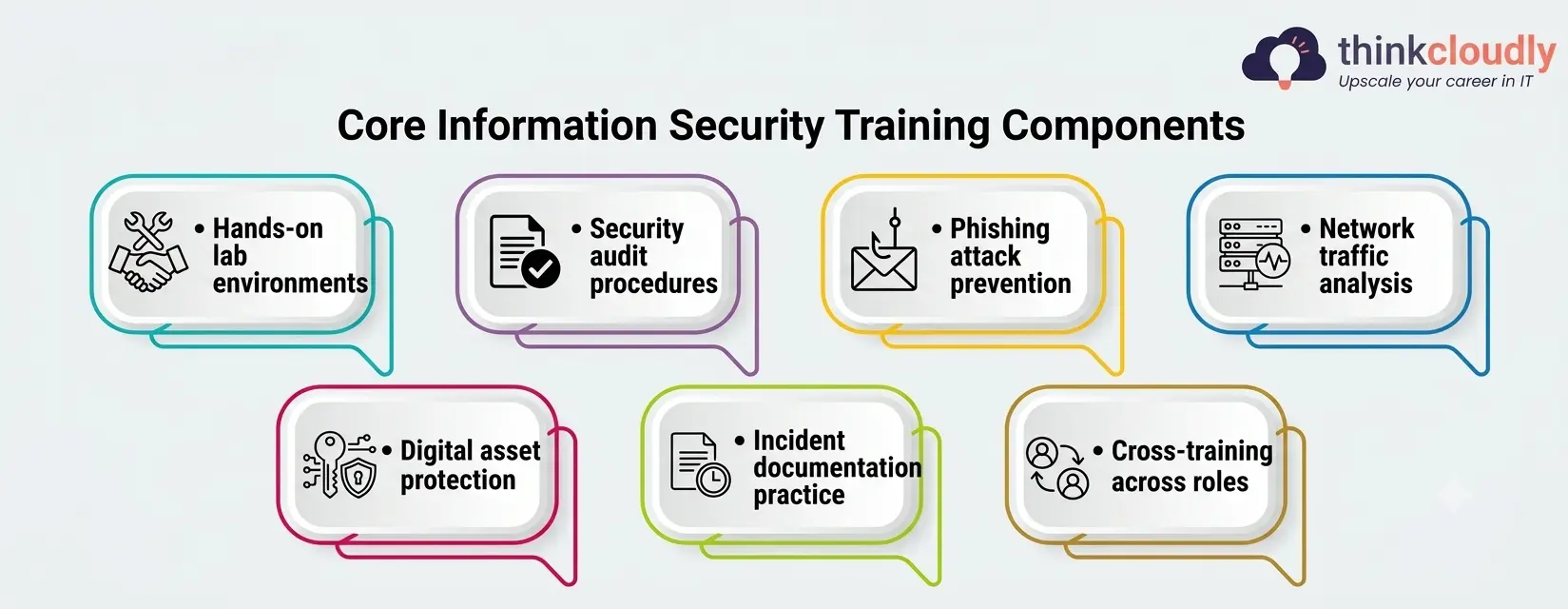
- Hands-on lab environments—simulated networks where learners break things, fix them, and see the consequences, rather than reading about intrusion patterns in a slide deck.
- Security audit procedures as a repeatable workflow, not a one-time lecture, so learners can walk through evidence gathering, control testing, and findings documentation the way a real auditor would.
- Phishing attack prevention exercises using live-style simulated emails, so learners build pattern recognition instead of memorizing a definition of “social engineering.”
- Network traffic analysis drills using real packet capture tools, so a learner can tell the difference between normal background noise and an actual exfiltration attempt.
- Digital asset protection scenarios covering encryption, access control, and data classification, applied to realistic business data rather than toy examples.
- Incident documentation practice, because an analyst who can stop an attack but can’t write it up clearly leaves the organization exposed to the same gap next time.
- Cross-training across roles, so a learner understands how a finding from one discipline—say, packet-level detection work—feeds into another, like a formal audit report.
Programs that skip the lab work and rely purely on lecture slides tend to produce people who can pass a quiz but hesitate the first time a real alert fires. The skill only becomes real once it’s been practiced under conditions that feel at least a little uncomfortable.
Security Audit Procedures as a Discipline, Not a Checklist
Security audit procedures get treated, far too often, as a once-a-year scramble before a compliance deadline. That’s backwards. Properly taught, this kind of review becomes a continuous habit: reviewing access logs on a schedule, checking configuration drift against a known baseline, and verifying that controls documented on paper actually match what’s running in production.
A trainee who only sees the process explained in the abstract, with no hands-on walkthrough of an actual control test, usually struggles the first time they’re handed a real audit checklist and asked to produce evidence rather than just read about it.
Good training treats auditing as muscle memory. Learners should practice pulling logs, matching them against a stated control objective, and writing up a finding the way a real assessor would—short, factual, and tied to evidence rather than opinion. That rhythm, repeated across a handful of simulated audits, builds the kind of procedural confidence that no slide deck alone can teach.
Phishing Attack Prevention: Where Training Usually Falls Short
Phishing hasn’t slowed down—it’s gotten more convincing. A large share of phishing emails flagged in recent industry research were AI-generated, and the median time it takes someone to click a malicious link sits at roughly 21 seconds, far faster than most people can pause and think, according to StationX’s 2026 phishing statistics roundup.
The same research notes that comprehensive security awareness training can cut click-through rates from an industry baseline near 33% down to under 5%—an improvement that simply doesn’t happen from a once-a-year slideshow.
That’s the gap most phishing attack prevention modules fail to close. A single annual presentation about “spotting suspicious emails” barely moves the needle, because recognizing a phishing attempt is a reflex, not a fact you memorize.
Effective training uses repeated, realistic simulations instead—sent at unpredictable intervals, scored individually, and followed by immediate, specific feedback rather than a generic reminder email.
Done that way, the habit stops being a once-a-year compliance exercise and starts functioning as an actual reflex, which is the only thing that holds up against a message crafted convincingly enough to fool a distracted employee on a Monday morning.
Comparing Training Formats: What Actually Builds Retained Skill
Not every training format produces the same result, and picking the wrong one wastes a budget that could have gone toward something that sticks.
|
Training Format |
Typical Duration | Skill Retention |
Best Suited For |
|
Annual slide-deck compliance module |
30–60 minutes, once a year | Low—often forgotten within weeks |
Meeting a bare regulatory minimum |
|
Instructor-led classroom course |
1–5 days | Moderate—good for concepts, weak on muscle memory |
Introducing new frameworks or tools |
|
Hands-on lab/cyber range simulation |
Ongoing, modular sessions | High—mistakes happen in a safe environment and get corrected immediately. |
Technical roles: analysts, auditors, incident responders |
|
Recurring phishing simulation program |
Monthly or quarterly, ongoing | High for the specific behavior being trained |
Building reflexive, phishing-resistant habits org-wide |
|
Mentorship / shadowing a senior analyst |
Weeks to months | High, but slow to scale |
Developing judgment that’s hard to teach from a script |
The pattern across every strong program is the same: repetition beats a one-time event, and realistic practice beats abstract explanation. A single format rarely covers everything, which is why the strongest training plans blend at least two or three of these rather than leaning on one alone.
Information Assurance: The Broader Mindset Behind the Technical Skills
Information assurance is easy to confuse with pure technical defense, but it’s a wider discipline—it covers the confidentiality, integrity, availability, and authenticity of information across its entire lifecycle, not just whether a firewall rule is configured correctly. A program that teaches it alongside hands-on technical drills gives learners a framework for deciding why a control matters, not just how to configure it.
This matters because tools and attack techniques change constantly, but the underlying goals of information assurance don’t. A learner who understands the principle—protecting data integrity, say—can apply that reasoning to a brand-new tool they’ve never seen before.
A learner who was only taught to click through a specific vendor’s interface is stuck the moment that interface changes. A strong program builds the principle first, then layers the current tools on top of it, so the skill survives the next product refresh instead of expiring with it.
Building a Network Traffic Analysis Skillset, Step by Step
Network traffic analysis is one of the hardest skills to fake, because it requires genuine pattern recognition built through repetition rather than memorized terminology. SentinelOne’s breakdown of core SOC analyst skills emphasizes exactly this: analysts need fluency in packet-level inspection and the judgment to separate routine background traffic from an active compromise, a distinction documented in SentinelOne’s guide to SOC analyst fundamentals. A realistic path toward that fluency generally looks like this:
- Start with a clean baseline. Spend time capturing and reviewing ordinary traffic on a lab network before trying to spot anomalies—you can’t recognize unusual activity if you’ve never studied what normal looks like.
- Learn the tools hands-on. Open-source packet analyzers and flow-monitoring platforms should be used on live captures, not just described in a slide.
- Practice on injected scenarios. Instructors (or self-guided lab platforms) should inject realistic attack traffic into otherwise normal captures so learners practice finding the signal inside the noise.
- Pair findings with documentation. Every anomaly a learner identifies during these drills should be written up the way it would be for a real incident report, closing the loop between detection and communication.
- Escalate complexity gradually. Move from obvious, loud attacks to subtler ones—slow data exfiltration, low-and-slow scanning—once the basics are second nature.
Treat this kind of packet-level drilling the way a musician treats scales: boring in isolation, but the thing that makes everything else possible once a real situation demands fast, confident judgment.
Digital Asset Protection: Turning Training Into a Daily Habit
Digital asset protection ties the other disciplines together, because none of them matter if the organization doesn’t know what it’s actually protecting. Classifying data, controlling who can access it, and encrypting it appropriately in transit and at rest are the daily, unglamorous habits that make every other control more effective.
IBM’s most recent breach-cost research found that more than half of breached organizations had sensitive data sitting unencrypted at rest or in transit, and that human error contributed to nearly a quarter of all breaches.
That statistic is really a training problem in disguise. Digital asset protection fails less often because of a missing tool and more often because someone didn’t apply the tool consistently — a database left unencrypted during a migration, an access permission that was never revoked after a role change.
A program that treats this as a living checklist, reviewed on a recurring schedule rather than configured once and forgotten, closes exactly that kind of gap. Build it into onboarding, into quarterly refreshers, and into the muscle memory of every system owner, not just the security team.
Common Mistakes Organizations Make With Information Security Training
A few patterns show up again and again in programs that don’t produce lasting skill. Training gets treated as a once-a-year, check-the-box event instead of an ongoing habit, so whatever was learned fades within weeks. Programs lean entirely on lecture and slides, skipping the hands-on practice that actually builds muscle memory for tasks like audit evidence-gathering or packet-level inspection.
Phishing training gets reduced to a single generic email reminder instead of realistic, varied simulation. And the governance side gets taught in isolation from the technical skills it’s supposed to inform, leaving learners who can recite a definition but can’t apply it under pressure.
The fix is consistent across all of it: information security training works when it’s frequent, realistic, and tied to the actual tasks people will face, not when it’s treated as a formality to get through before the real job starts.
A Personal Note
I’ve sat through more compliance-driven security training than I can count, and the ones that actually changed how I worked were never the slickest-looking ones. They were the sessions where an instructor handed me a broken lab environment and said, essentially, “go figure out what happened.”
That discomfort — not knowing immediately, having to dig through logs and traffic captures and second-guess my first theory — is what made the lesson stick long after the slide decks from other courses had faded from memory.
If you’re building or choosing a training program for yourself or your team, weigh it toward that kind of discomfort. The polished presentations are forgettable. The messy labs are not.