

I get asked this question almost every week by someone standing at the edge of their first cloud certification: is the AZ-104 exam actually hard, or is that just internet noise from people who didn’t prepare properly? The honest answer sits in between.
This certification isn’t a trivia test you can cram for a weekend, but it also isn’t the unbeatable monster some forum threads make it out to be. It’s a working exam, built for people who’ve actually touched the Azure portal, and it punishes guessing far more than it rewards memorization.
This guide isn’t a repeat of the standard week-by-week study calendar you’ve probably already seen. Instead, it’s a straight answer to “how hard is this, really,” broken down by the parts candidates consistently underestimate, followed by the preparation habits that separate a first-attempt pass from a frustrating retake.
How Hard Is the AZ-104 Exam?
Compared to the entry-level Azure Fundamentals exam, this one is a clear step up in difficulty. Fundamentals ask you to recognize terms. This one asks you to make a decision, usually under a time limit of roughly a minute and a half per question, with a scenario that includes two or three answers that look technically correct and only one that actually satisfies every constraint in the prompt.
Microsoft doesn’t publish an official pass rate, so most of what circulates online is anecdotal rather than verified. What’s consistent across candidate reports, though, is that this one sits noticeably above AZ-900 in difficulty but below the associate-level security exam, AZ-500, and the expert-level architecture exam, AZ-305, in terms of raw depth. It’s an operations exam, not a design exam—you’re judged on whether you can run an environment competently, not whether you can architect one from scratch.
What makes the AZ-104 training exam genuinely difficult isn’t obscure trivia—it’s breadth. You’re expected to be competent across identity management, storage, compute, networking, and monitoring at the same time, and the exam mixes these domains inside single case studies rather than testing them in isolated chunks.
The current version (effective as of 2026) still weights identity and governance alongside compute as the two heaviest domains, each sitting at 20–25% of the total score. That’s a lot of ground to cover well, not just know about.
It’s also worth knowing the retake rules going in, since they shape how you should pace your own preparation. A first attempt that doesn’t clear the bar comes with a mandatory 24-hour cooling-off period before you’re allowed to try again, and that wait stretches longer on a second or third retake.
According to Microsoft’s exam policies page, a retake costs the same as the original sitting, so a rushed, underprepared attempt is an expensive way to find out which domain needed more work. Plan for one solid attempt rather than treating the first sitting as a free diagnostic run.
Why Candidates Find the AZ-104 Exam Challenging?
Rather than bury the reasons in paragraphs, here’s the list in a format you could drop straight into a slide or an infographic—it also tracks closely with what a recent 2026 industry outlook on exam trends flags as the biggest friction points for candidates right now:
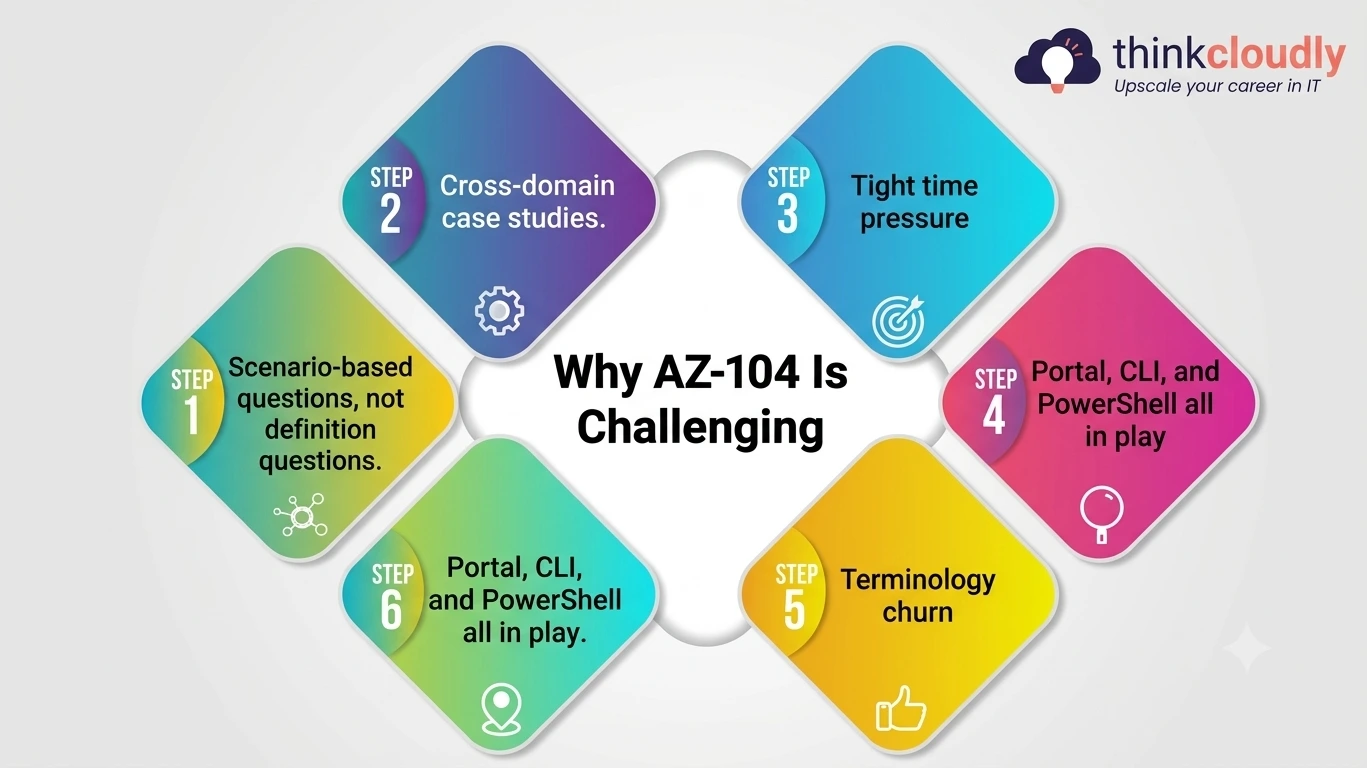
- Scenario-based questions, not definition questions. Most items describe a business situation first and ask you to pick the response that fits every stated constraint, not just a technically valid one.
- Cross-domain case studies. A single case study can test identity, networking, and compute together, so a gap in any one area shows up in multiple questions.
- Tight time pressure. With roughly 100 minutes for a mix of around 40–60 items depending on the exam form, there’s little room to second-guess every answer.
- Portal, CLI, and PowerShell all in play. Questions can reference command-line syntax as easily as portal navigation, so candidates who only practiced clicking through menus get caught out.
- Terminology churn. Microsoft Entra ID replaced the Azure AD name across the platform, and candidates studying from older material sometimes stumble on wording they don’t recognize.
- Underestimating the smaller domains. Monitoring sits at only 10–15% of the score, but it’s exactly the section candidates skip while cramming the bigger topics, and those are easy points left on the table.
None of this means the certification is unfair. It means it’s testing judgment under realistic conditions, which is a harder thing to fake than recall.
AZ-104 Exam Format and Domain Weighting at a Glance
Before you can prepare better, you need the actual shape of the exam in front of you. Here’s the current breakdown:
|
Domain |
Weighting |
What It Mostly Covers |
|
Manage Azure identities and governance. |
20–25% |
Microsoft Entra users/groups, role-based access, Azure Policy, cost management |
|
Deploy and manage Azure compute resources. |
20–25% |
ARM templates, Bicep, virtual machines, scale sets, containers, App Service |
|
Implement and manage storage |
15–20% |
Storage accounts, redundancy, SAS tokens, and Blob lifecycle management |
|
Implement and manage virtual networking. |
15–20% |
VNets, peering, network security groups, DNS, load balancers |
|
Monitor and maintain Azure resources |
10–15% |
Azure Monitor, log queries, alert rules, backup, and site recovery |
A passing score on the AZ-104 exam is set at 700 out of a possible 1000, scaled rather than a simple percentage, which means not every question carries identical weight. Treat that scaled score as a reason to be consistently solid across every domain rather than excellent in two and weak in three.
Directory Services and Governance: The Quiet Difficulty Spike
If there’s one area that surprises candidates coming from a different cloud background, it’s identity. The exam leans heavily on Microsoft Entra ID, the rebranded successor to Azure Active Directory, and treats directory services knowledge as foundational rather than optional.
You’re expected to know how to manage users and groups, configure self-service password reset, assign roles at different scopes, and interpret how access actually resolves when policies and role assignments overlap.
Candidates who treat this as “just user management” tend to lose points on the scope and inheritance questions specifically—the ones where a role assigned at the subscription level behaves differently than one assigned at a resource group.
Spend real lab time here. Build a few test groups, assign conflicting roles on purpose, and watch how Azure resolves them. That exercise alone clears up more directory services confusion than another hour of reading ever will.
Licensing and external-user scenarios add another layer worth rehearsing. A question might describe a guest user invited from a partner organization and ask how their access differs from an internal employee’s or how a removed license affects a user’s existing role assignments. These aren’t exotic edge cases—they reflect how real organizations actually manage directory services day to day, which is exactly why Microsoft keeps testing them.
Azure Networking: The Domain That Trips Up Most First-Time Candidates
If identity is the quiet difficulty spike, Azure Networking is the loud one. This is consistently the domain candidates report struggling with most, and it’s not hard to see why—networking concepts don’t fully click until you’ve actually broken a connection and had to troubleshoot why.
Expect questions on virtual network peering, network security group rule evaluation, Azure Bastion, DNS resolution, and load balancer configuration, often combined into a single “a user can’t reach this resource; diagnose why” scenario.
Azure Networking also tends to carry subtle wording—a question might ask what happens with a specific combination of NSG rules at the subnet and NIC level, and the right answer depends on understanding rule precedence, not just naming the service.
The fix here is almost entirely hands-on. Build two VNets, peer them, deliberately misconfigure an NSG rule, and use Network Watcher to trace the failure. Doing this once, deliberately, teaches more about Azure Networking than passively reading five articles about it.
Tips to Prepare Better for the AZ-104 Exam
Here’s the second list, written so it can stand alone as a quick-reference card or infographic panel:
- Lab every topic you read about the same day you read it, even for ten minutes.
- Mix your study tools. Use the Azure portal, Azure CLI, and PowerShell for the same task so no single interface becomes a crutch.
- Time yourself on practice questions from week one, not just the final week, so timing pressure stops being a surprise on exam day.
- Don’t skip the small domains. Monitoring and storage feel less exciting than compute, but they’re reliable, easy points if you give them real attention.
- Review wrong answers the same day, while you still remember why you picked them.
- Rehearse the exam check-in process at least once before the real attempt, especially for an online proctored sitting.
- Study directory services and Azure Networking with equal seriousness, since they’re the two areas most candidates underestimate going in.
- Book the exam date early. A fixed deadline consistently produces more focused preparation than open-ended “whenever I feel ready” studying.
Should You Use AZ-104 Dumps or a Proper AZ-104 Practice Test?
This question comes up constantly, so it deserves a direct answer: avoid AZ-104 dumps. Leaked or recycled question banks violate Microsoft’s certification agreement; they get pulled and invalidated without warning, and—more practically—they teach you to recognize specific wording instead of understanding the underlying concept. Someone who passes on memorized AZ-104 dumps usually finds that out the hard way on their first real support ticket.
A proper AZ-104 practice test is a completely different tool. It’s built to mirror the current skills outline, it explains why an answer is correct rather than just flagging it, and it’s meant to reveal weak domains so you can go lab them, not to be memorized verbatim.
Microsoft itself offers a free Practice Assessment that uses real exam-style items, and it’s worth running before you pay for any third-party AZ-104 practice test. Use a practice test diagnostically — review every wrong answer, trace it back to the skill, and go build it in a lab — rather than treating a high score on a single practice run as proof you’re ready.
If you ever see a site openly advertising “real exam questions” or guaranteed passes through AZ-104 dumps, treat that as a warning sign, not a shortcut. The people who struggle most after certification are often the ones who passed using leaked question banks instead of a genuine AZ-104 practice test built on current objectives.
Is the Azure Administrator Certification Worth the Difficulty?
Given everything above, it’s fair to ask whether the Azure Administrator Certification is worth the grind. For most IT professionals working toward or already inside a cloud role, yes. Recent US salary data compiled by Payscale shows systems administrators with Azure skills earning a base salary that climbs noticeably once a recognized certification and a couple of years of hands-on experience are added to the picture.
The Azure Administrator Certification also acts as a prerequisite mindset for several higher-level paths — security, DevOps, and solutions architecture all assume this operational foundation is already solid.
One more detail worth planning around: this credential expires annually and renews through a free, open-book online assessment on Microsoft Learn rather than a repeat of the full proctored exam.
Skip that renewal window and the badge quietly lapses, which recruiters and hiring managers do notice before an interview rather than after one. Treating the Azure Administrator Certification as a one-time event instead of an annually maintained credential is a small but avoidable mistake.
The difficulty is, in a strange way, part of the value. A credential that any reasonably attentive person could pass on their first try without labs wouldn’t carry much weight with hiring managers.
The AZ-104 exam’s reputation for being a genuine test of hands-on skill is exactly why the Azure Administrator Certification still opens doors in 2026, even as the broader credential market gets more crowded every year.
A Personal Note
I’ll say the thing most certification guides dance around: difficulty is relative to how you prepare, not to the exam itself. I’ve watched people with two years of hands-on Azure experience struggle because they walked in cold on exam strategy, and I’ve watched relative newcomers pass comfortably because they treated every study session like a lab, not a reading assignment.
If you’re nervous about this certification right now, that’s a reasonable reaction to a real exam — just don’t let the nerves turn into either overconfidence or procrastination. Build the labs, break something on purpose, fix it yourself, and the exam stops being a mystery.