

I get asked a version of the same question almost every week by people stuck in IT support roles: is it actually worth putting six weeks of evenings into a single exam? After watching dozens of students move from help-desk tickets to platform ownership on the back of one credential, I can answer that honestly—a ServiceNow Administrator Certification is one of the few IT credentials in 2026 that still pays for itself within a single job change.
This guide walks through what the exam covers, the skills it actually builds, how it connects to real IT service delivery work, and a realistic path to earning it without burning out. I’m not going to pad this with vague encouragement.
I’ll tell you exactly where the exam gets hard, what the domain weights really mean for your study time, and why this particular ServiceNow Administrator Certification has quietly become one of the most requested lines on enterprise IT résumés.
Why Does the ServiceNow Administrator Certification Still Matters?
ServiceNow stopped being a niche ticketing tool years ago. It now sits underneath IT Service Delivery, HR case management, security operations, and increasingly, AI agent orchestration for large enterprises across North America, Europe, and Australia.
That expansion is exactly why the ServiceNow Administrator Certification, officially called the Certified System Administrator (CSA) credential, has grown from a “nice to have” into a baseline requirement on job postings for platform administrator, ServiceNow support analyst, and junior implementation roles.
The certification proves something specific: that you can configure, secure, and maintain a live ServiceNow instance without breaking production. That’s a different skill from simply knowing how tickets move through a workflow.
Hiring managers who’ve been burned by someone who “sort of knows ServiceNow” now specifically filter for the CSA badge before they’ll even schedule a first interview where administrators compare notes on how recruiters screen for the credential.
That demand isn’t anecdotal. Workforce analytics firm Revelio Labs tracked monthly job postings for ServiceNow-related roles, climbing from roughly 1,463 in 2023 to just under 2,000 in 2026—a double-digit jump even after two separate rounds of broader tech-sector layoffs.
Most of that hiring activity sits in the United States and the United Kingdom, with Japan now listed as the fastest-growing region for new ServiceNow headcount. Very few of those job postings ask for a vague familiarity with “ticketing systems.” They ask, by name, for a ServiceNow Administrator Certification, because it’s the fastest signal a hiring manager has that a candidate won’t need months of supervised ramp-up before touching a production instance.
Core System Administration Skills the Certification Builds
A lot of candidates assume this exam tests memorization of menu locations. It doesn’t. What it actually validates is a working set of system administration skills you’ll use on day one of a real job. Here’s what that looks like in practice, broken into the areas the exam weighs most heavily:
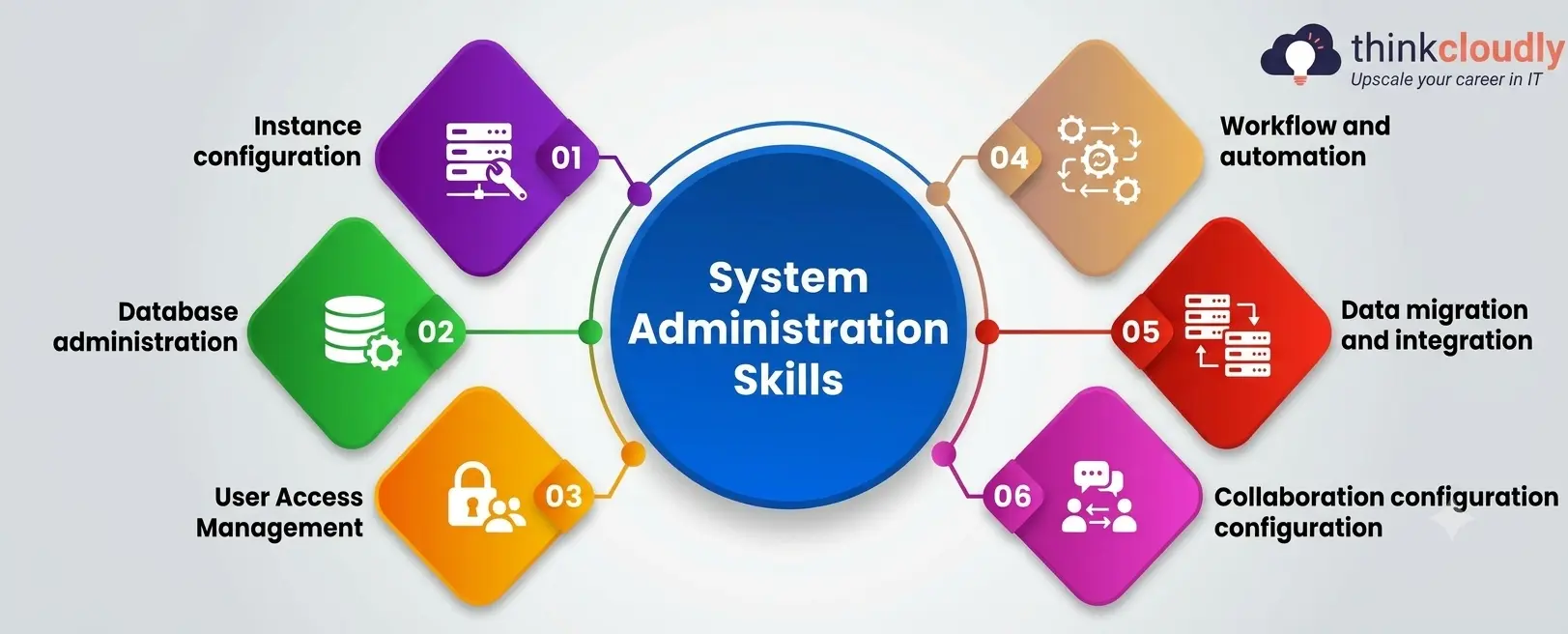
- Instance configuration—setting up business rules, UI policies, and client scripts without introducing performance problems, which is the most common system administration skills gap among self-taught candidates.
- Database administration—understanding tables, relationships, and the Configuration Management Database structure that every other ServiceNow module quietly depends on.
- User Access Management—building roles, groups, and ACLs so the right people see the right records, and nobody sees what they shouldn’t.
- Workflow and automation—building flows that actually hold up under real ticket volume instead of falling apart the first week after go-live.
- Data migration and integration—moving data between instances and external systems without corrupting the CMDB or breaking downstream reporting.
- Collaboration configuration—setting up notifications, service catalogs, and knowledge bases that reduce the support team’s ticket load rather than adding to it.
Notice how many of these items circle back to the same two things: User Access Management and the Configuration Management Database. That’s not a coincidence. Nearly every ServiceNow module—incident, problem, change, asset—reads from or writes to the CMDB, and nearly every security question on the exam is really an access control question wearing a different costume.
Exam Format and Domain Breakdown
The exam itself runs 90 minutes, delivered as a proctored online test through a ServiceNow-approved testing partner, with 60 questions split between single-answer multiple choice and multiple-select formats.
Most current study guides, including the detailed breakdown on CertLand’s 2026 study guide, put the passing threshold at 70%, meaning you need roughly 42 correct answers out of 60 to pass. You can sit the exam from home or an office, which removes the old excuse of “there’s no test center near me,” but it also means you’re responsible for a quiet room, a working webcam, and a government-issued ID on hand before the proctor will let you start the clock.
Domain weights shift slightly with every release—the exam content is refreshed to match whatever version of the platform is currently live, which in late 2026 means Zurich-era functionality layered on top of the Yokohama-era fundamentals most study material was originally written around. Here’s the domain split most current prep resources agree on:
|
Exam Domain |
Approximate Weight |
What It Tests |
|
Database Administration & Platform Security |
28–30% |
Tables, relationships, the CMDB, ACLs, and access controls |
|
Self-Service, Automation & Collaboration |
18–20% |
Service catalogs, flows, notifications, knowledge management |
|
Instance Configuration & Navigation |
15–20% |
UI policies, business rules, client scripts, platform navigation |
|
Data Migration & Integration |
13–15% |
Import sets, transform maps, web services, update sets |
|
Platform Overview |
7–10% |
Core architecture, application scoping, baseline terminology |
That first row is worth staring at. Database administration and platform security carry nearly a third of the exam weight, which means the Configuration Management Database and User Access Management aren’t side topics—they’re the backbone of the entire test. If you only have time to deep-study two areas before exam day, make it those two.
It also explains why so many candidates who feel confident after a quick video course still underperform on exam day: watching someone else click through a configuration screen builds recognition, not the deeper understanding the scenario questions actually demand.
A Step-by-Step Path to Earning the Certification
Here’s the order I’d actually walk through this in, not a vague “study hard” suggestion:
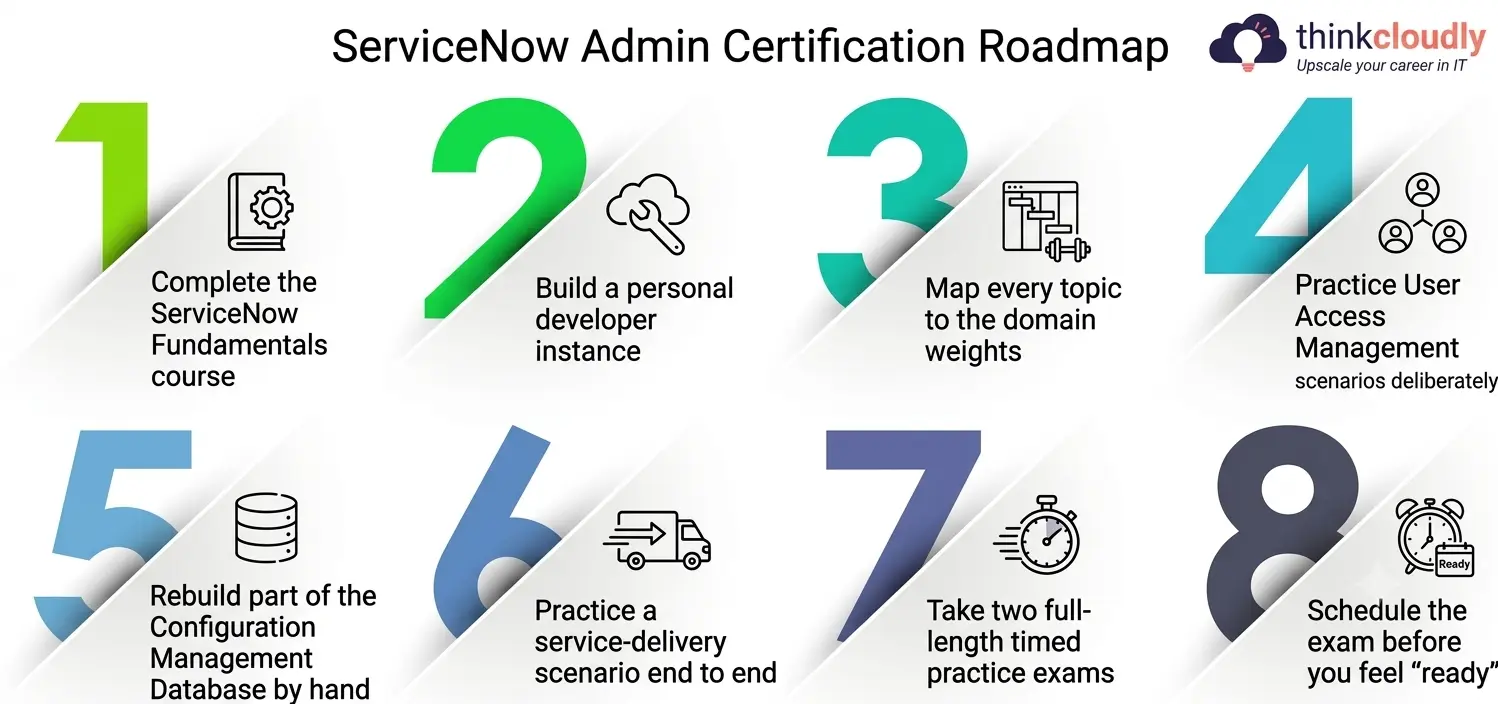
- Complete the ServiceNow Fundamentals course. This free, self-paced course is the official on-ramp and the source material the exam is drawn from—skipping it to jump straight into third-party dumps is the single most common reason candidates fail on the first attempt.
- Build a personal developer instance. ServiceNow gives free developer instances for exactly this reason. Reading about a business rule and writing one yourself are not the same exercise.
- Map every topic to the domain weights. Spend your study hours proportionally—if database administration and security are nearly 30% of the exam, they should be close to 30% of your study time, not an afterthought.
- Practice User Access Management scenarios deliberately. Build three different ACL configurations from scratch and break them on purpose, so you understand why a misconfigured role can silently expose records.
- Rebuild part of the Configuration Management Database by hand. Create a few CI classes, relate them, and watch how a service map actually traces dependencies. This single exercise clears up more exam confusion than any amount of reading.
- Practice a service-delivery scenario end to end. Walk an incident from creation through resolution, including the SLA clock, so Service Level Management concepts feel familiar rather than theoretical when the exam phrases them as a scenario.
- Take two full-length timed practice exams. Review every wrong answer the same day, and flag anything touching data migration, since that domain surprises more candidates than any other.
- Schedule the exam before you feel “ready.” A booked date forces focused review instead of open-ended, low-intensity studying that drags on for months.
Service Level Management and IT Service Delivery: The Part Most Self-Taught Candidates Skip
Here’s a pattern I’ve seen repeatedly: candidates who’ve spent real time clicking around a ServiceNow instance still stumble on Service Level Management questions, because SLAs feel abstract until you’ve actually watched one breach.
On the exam and on the job, it isn’t a settings screen—it’s the mechanism that turns a vague promise (“we’ll respond quickly”) into an auditable, enforceable commitment with a timer attached.
Every scenario question that mentions a missed deadline, an escalation, or a breached response time is really testing whether you understand how service level management workflows tie back to the broader delivery model as a whole.
A ServiceNow administrator who understands this connection can configure SLA definitions, schedules, and workflows that actually reflect business commitments, rather than copying a default template and hoping it fits.
That distinction—between configuring a feature and understanding the business process behind it—is exactly what separates administrators who get promoted from administrators who get stuck maintaining the same instance for years.
IT Service Delivery, more broadly, is the frame the entire exam sits inside. Incident management, problem management, change management, and request fulfillment are all just different lenses on the same underlying goal: keeping that service delivery predictable for the people depending on it. Candidates who memorize module names without connecting them to that bigger picture tend to pass the exam narrowly and then struggle in their first real administrator role.
Why Do Employers Keep Asking For This Specific Credential?
Recommended experience for the exam is three to six months of hands-on instance administration, according to several current training providers including Global Knowledge’s certification overview, and that’s a realistic bar — not an arbitrary gatekeeping number. It roughly matches how long it takes someone to go from “I can open a ticket” to “I can safely configure this instance without supervision.”
Salary data varies by region and employer size, but platform administrator roles tied to this certification commonly land in the $85,000 to $120,000 range in the United States, with senior platform roles and implementation specialist positions pushing higher once a CSA holder adds a Certified Application Developer (CAD) or Certified Implementation Specialist (CIS) credential on top. The CSA isn’t the ceiling — it’s the floor that everything else gets built on, which is a large part of why recruiters treat it as a non-negotiable line item rather than a bonus.
There’s no mandatory annual recertification fee attached to the base CSA credential, but ServiceNow does run release-aligned “delta” exams so your knowledge stays current as the platform evolves, a point confirmed in several administrator discussions on the ServiceNow sysadmin community.
Skipping those delta updates doesn’t revoke your original certification, but it does mean your practical knowledge can quietly drift out of step with whatever release your employer is actually running.
None of this is about collecting badges for their own sake. A ServiceNow Administrator Certification earns its place on a resume because it compresses months of trial-and-error into a verified baseline, and because the platform itself keeps expanding into new departments — HR, legal, security operations — that all need administrators who’ve already cleared this bar.
Employers in competitive markets like the United States, the United Kingdom, and Australia increasingly treat it the way they’d treat a driver’s license: not proof of mastery, just proof you won’t crash the car on your first day.
A Personal Note
I used to think certifications were mostly about the piece of paper — something to list on a résumé and forget about. The CSA changed my mind on that, mostly because of how often the exam content mapped directly onto problems I later hit on the job. The first time I had to untangle a messy CMDB that someone had populated by hand for years, I was grateful I’d actually built CI relationships myself during study instead of just reading about them.
If you’re on the fence about whether this certification is worth the evenings it costs you, I’d say this: don’t study it to pass a test. Study it the way you’d actually use it, and the exam takes care of itself. The ServiceNow Administrator Certification will still be sitting there waiting; the real question is whether you want to be the person configuring the instance, or the person still waiting for someone else to fix it.