

I’ve sat across the table from enough hiring managers to know what makes them skeptical: a resume that says “familiar with Agile” with nothing to back it up. That phrase means almost nothing anymore. What moves a candidate from the “maybe” pile to the “schedule the call” pile in 2026 is a recognized Agile Scrum Certification next to their name, paired with evidence they actually know what to do with a stuck sprint or a disengaged stakeholder.
This guide walks through why that credential still carries weight this year, which certifying body actually fits your career stage, what real preparation covers once you’re past the marketing copy, and how the skills map onto actual job postings rather than exam blueprints alone.
I’m not going to pretend every option is equally good, or that a badge by itself changes your trajectory—it doesn’t. But paired with the right groundwork, an Agile Scrum Certification remains one of the fastest, cheapest ways to get taken seriously in a hiring market where plenty of applicants claim Agile fluency and very few can prove it under interview pressure.
Why Does an Agile Scrum Certification Still Matters?
Agile adoption hasn’t slowed, but it has fragmented. The research found that while roughly seven in ten software teams report using Agile practices, satisfaction with how well it’s actually working has dropped sharply—and only about a quarter of respondents said their Agile culture genuinely enables value rather than existing on paper as a label.
That gap between teams that say they’re Agile and teams that actually run it well is exactly where a certified practitioner earns their keep. Here’s the short version of why the credential still pays off:
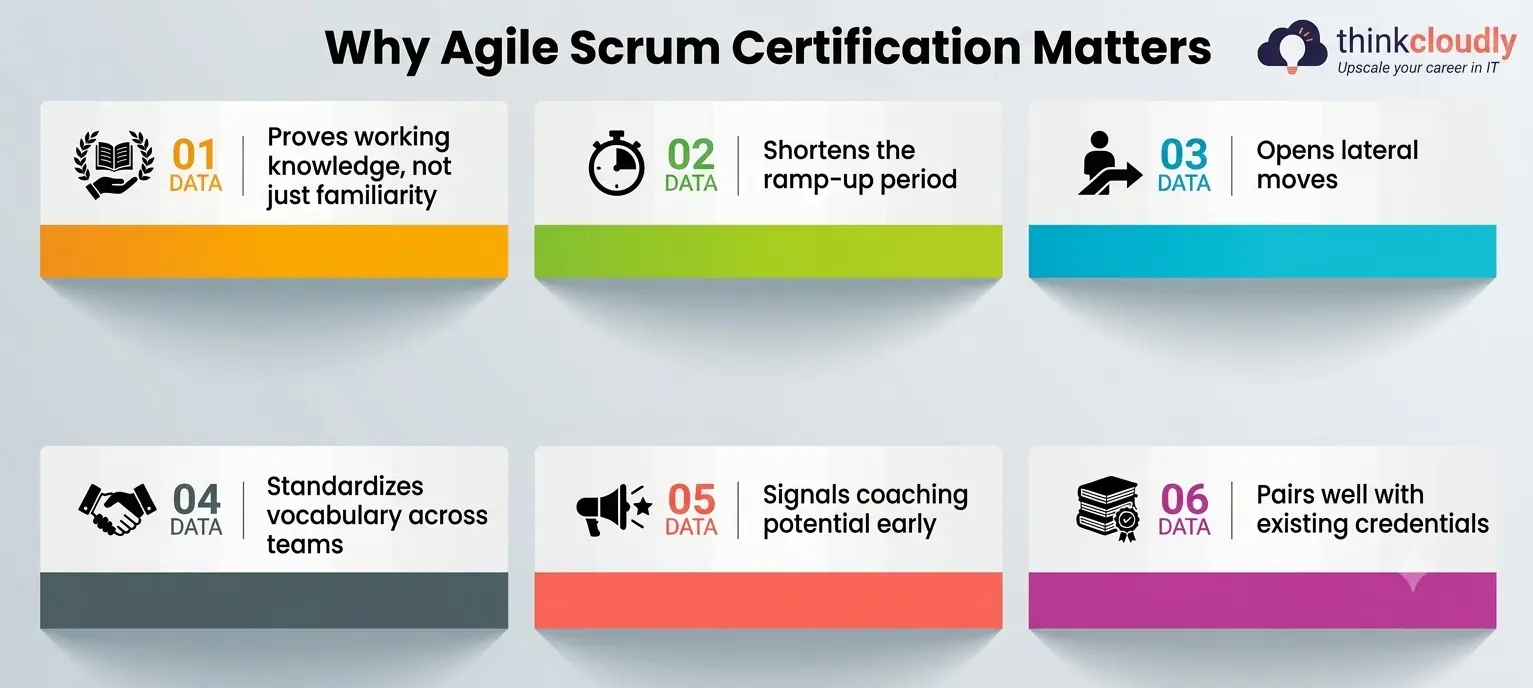
- It proves working knowledge, not just familiarity. A hiring manager can’t verify “I understand Scrum” in conversation, but they can verify a certification number against the issuing body’s registry.
- It shortens the ramp-up period. Teams waste real weeks re-explaining ceremonies and roles to someone who has never studied them formally.
- It opens lateral moves. Developers, business analysts, and professionals coming from a project management background use it to pivot into facilitation-heavy roles without starting from zero.
- It standardizes vocabulary across teams. When everyone trained the same way, planning sessions run noticeably faster.
- It signals coaching potential early. Certified practitioners are usually the first people tapped when a company starts building out an internal agile coaching function across departments.
- It pairs well with existing credentials. Professionals already holding a PMP or similar badge often add a Scrum credential specifically to cover gaps that classical project frameworks don’t address.
None of that means the badge replaces judgment built on the job. But it does mean a verified Agile Scrum Certification is still one of the fastest signals of competence a resume can carry this year.
Quick Comparison: The Main Scrum and Agile Certifications
Picking a path first saves you from studying for the wrong exam. Here’s how the major options stack up against each other right now.
|
Certification |
Issuing Body | Level | Typical Cost (USD) |
Best For |
| Scrum.org | Fundamental | ~$200 |
Self-starters comfortable with independent study |
|
|
Professional Scrum Master II/III |
Scrum.org | Advanced/Distinguished | 250–500 |
Practicing as a Scrum Master moving toward coaching work |
|
Certified ScrumMaster (CSM) |
Scrum Alliance | Fundamental | 500–1,400 |
People who want structured, instructor-led preparation |
|
Professional Scrum Product Owner (PSPO I) |
Scrum.org | Fundamental | ~$200 |
Business analysts and product-minded staff |
|
Certified Scrum Product Owner (CSPO) |
Scrum Alliance | Fundamental | 500–1,400 |
Product-focused professionals wanting a facilitated course |
|
SAFe Scrum Master (SSM) |
Scaled Agile | Fundamental | 500–1,000 |
Large enterprises running Scaled Agile Framework programs |
Scrum.org’s own certification overview breaks the PSM track into three tiers—fundamental, advanced, and distinguished—which gives you a built-in roadmap instead of a one-and-done exam. That structure is worth noting before you commit, since it means your first Agile Scrum Certification doesn’t have to be your last one.
What Real Scrum Master Preparation Actually Covers?
A lot of candidates assume the coursework behind this credential is mostly vocabulary memorization—sprints, backlogs, and retrospectives. It’s a reasonable guess, and it’s wrong. Solid Scrum Master Training spends most of its time on facilitation under pressure: how to run a planning session when the team disagrees on scope, how to protect a sprint from mid-cycle scope creep, and how to translate Scrum Master Responsibilities into daily behavior instead of textbook definitions.
The better-run courses also spend real time on conflict resolution and stakeholder communication, because that’s where most new Scrum Masters actually struggle once they’re on the job. Reading the Scrum Guide alone gets you through the exam.
It doesn’t prepare you for a product owner who wants to change priorities halfway through a sprint or a sprint review where the demo breaks in front of leadership. Good instincts—asking questions instead of handing out answers—get built during training, long before anyone starts doing formal Agile Coaching work.
Core Scrum Master Responsibilities You’ll Be Tested On
Exam blueprints differ slightly between certifying bodies, but the core duties of every credible program test are consistent. Here’s what to expect walking in:
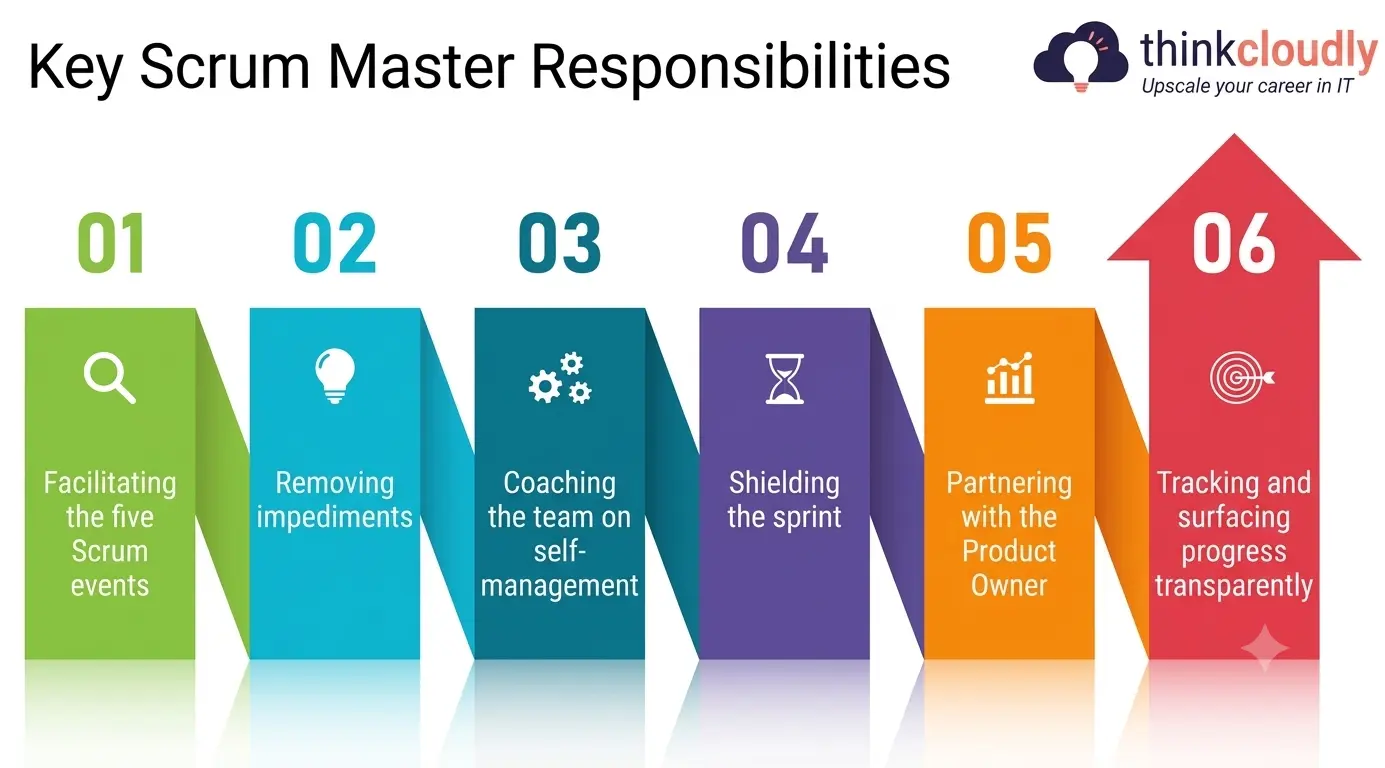
- Facilitating the five Scrum events—sprint planning, the daily Scrum, the Sprint Review, the sprint retrospective, and backlog refinement—without turning any of them into status-update theater.
- Removing impediments the team can’t clear on their own, whether that’s a blocked dependency or a leadership decision stuck in approval.
- Coaching the team on self-management, which is a very different skill than managing the team directly.
- Shielding the sprint from mid-cycle scope changes that would derail the current commitment.
- Partnering with the Product Owner on backlog health, so the team never walks into planning with poorly defined work.
- Tracking and surfacing progress transparently—burned-down charts, velocity trends—without turning metrics into a weapon against the team.
Notice how little of that list resembles traditional project management in the Gantt chart or resource allocation sense. It’s almost entirely about facilitation and protecting the team’s ability to focus, which is exactly why candidates arriving from a classical command-and-control planning background sometimes struggle to unlearn old habits during their first few months as a Scrum Master.
Formal Scrum Master Training spends real class time on exactly that unlearning process, because it’s the single biggest predictor of whether a newly certified practitioner succeeds in their first facilitation role or quietly reverts to directing the team like a traditional supervisor.
Where Agile Coaching Fits Into Your Career Path?
Most Scrum Masters don’t stay Scrum Masters forever. Within two or three years, a meaningful share moved into dedicated Agile Coaching roles, where the job shifts from running one team’s ceremonies to improving how multiple teams collaborate across an entire department.
The data from a 2026 market breakdown puts compensation for this coaching track well above standard Scrum Master pay in the US market, often by $30,000 to $50,000 a year, which explains why so many practitioners treat their first Agile Scrum Certification as a stepping stone rather than an end point.
This coaching track also overlaps more than people expect with organizational change work. Coaches spend real time with department leaders translating Agile principles into language that fits a company’s existing culture, rather than imposing a textbook framework wholesale.
That’s a harder skill to certify than ceremony facilitation, which is why the advanced-level exams—PSM II, PSM III—weigh coaching scenarios so heavily compared to their fundamental-level counterparts.
Sprint Review and the Ceremonies Every Certification Must Cover
If there’s one ceremony candidates consistently underestimate—on exams and in real jobs—it’s the Sprint Review. It’s easy to assume this is just a demo, but a well-run review is actually a working session between the team and stakeholders to inspect the increment and adapt the product backlog based on what’s been learned.
Treating it as a one-way presentation is the single most common mistake new Scrum Masters make, and it’s a mistake most certification prep explicitly calls out because it shows up so often in real teams.
The other ceremonies matter too—sprint planning sets the commitment, the daily Scrum keeps the team synchronized, and the retrospective is where the team actually improves its own process over time.
But this particular ceremony is where coaching instincts get tested earliest, because it’s the one most exposed to outside stakeholders who weren’t in the room for the rest of the sprint.
Salary and Job Market Data for 2026
Numbers help more than vague reassurance, so here’s what the current market actually shows. US Scrum Master base pay sits in a roughly $100,000 to $130,000 range for mid-career practitioners, climbing past $165,000 at the senior level, according to aggregated 2026 compensation data.
Cloudwards’ certification comparison found that certified professionals average noticeably more than uncertified peers holding the same title—a gap commonly cited at 20% to 24%, though that figure reflects experience as well as the credential itself, so treat it as directional rather than guaranteed.
Regionally, the same data shows UK Scrum Masters earning roughly £50,000 to £80,000, Canadian practitioners in the C95,000toC125,000 band, and Australian roles sitting between A120,000 and A155,000—all currencies reflecting local market conditions rather than one global figure.
What stays consistent across every region is that an Agile Scrum Certification remains the credential employers filter for first, well ahead of generic experience alone, when screening resumes for facilitation-heavy roles.
Cost is worth weighing honestly before you commit to one. A self-study PSM I exam runs about $200 with no mandatory course, while a fully instructor-led CSM track can run past $1,000 once materials and a live instructor are factored in.
Neither path guarantees a raise by itself — the credential tends to pay off fastest for people who pair it with actually running ceremonies for a real team within the following few months, rather than letting the badge sit unused on a resume for a year while nothing changes day to day.
How to Choose the Right Certification for Your Career Stage?
There’s no universal “best” option here, only the right fit for where you currently sit:
- New to Agile entirely? Start with PSM I or CSM. Both validate foundational Scrum Master Responsibilities without assuming prior facilitation experience.
- Coming from a classical project-delivery background? A fundamental-level certification plus deliberate practice unlearning command-and-control habits will matter more than the letters after your name, especially if your prior work leaned heavily on Project Management tools like Gantt charts and fixed-scope planning.
- Already working as a Scrum Master? PSM II or an advanced CSP track pushes you toward dedicated coaching work and the compensation that comes with it.
- Working in a large enterprise running scaled frameworks? SAFe’s Scrum Master credential matters more locally than Scrum.org or Scrum Alliance badges, since it’s built specifically around that framework.
Whatever you choose, give yourself real preparation time instead of cramming. Scrum Master Training that skips hands-on scenario practice in favor of flashcard memorization produces people who pass the exam and then struggle the first time a real sprint review goes sideways in front of stakeholders. The exam tests recall. The job tests judgment, and only one of those two things gets built by repeating practice questions until they stick.
A personal note
I’ve watched plenty of capable people treat their Agile Scrum Certification like a finish line instead of a starting point. The exam proves you know the framework. It doesn’t prove you can hold a room steady when a sprint falls apart two days before the deadline, or tell a well-meaning Product Owner that their mid-sprint request has to wait.
Give yourself permission to feel clumsy in your first few ceremonies after certifying — that discomfort is just the gap between knowing the material and having lived it, and it closes faster than you’d expect if you stay curious instead of defensive about what goes wrong along the way.