

If you’re hunting for your first tech job in the UK right now, you’ve probably typed “DevOps Engineer salary” into a search bar more than once, hoping for a straight answer instead of five contradictory numbers.
You’re not imagining the confusion—a fresher’s DevOps Engineer salary gets quoted anywhere between £26,000 and £75,000 depending on which site you land on, and most of that gap comes down to people mixing graduate pay with five-years-experience pay.
This guide pulls apart the real, current UK numbers for 2026, compares them against a typical software engineer starting salary, and tells you honestly where a fresher should expect to land in year one—city by city, skill by skill, and certification by certification—with nothing rounded up to make the headline look better.
Why DevOps Is Still One of the Smartest First Jobs in the UK?
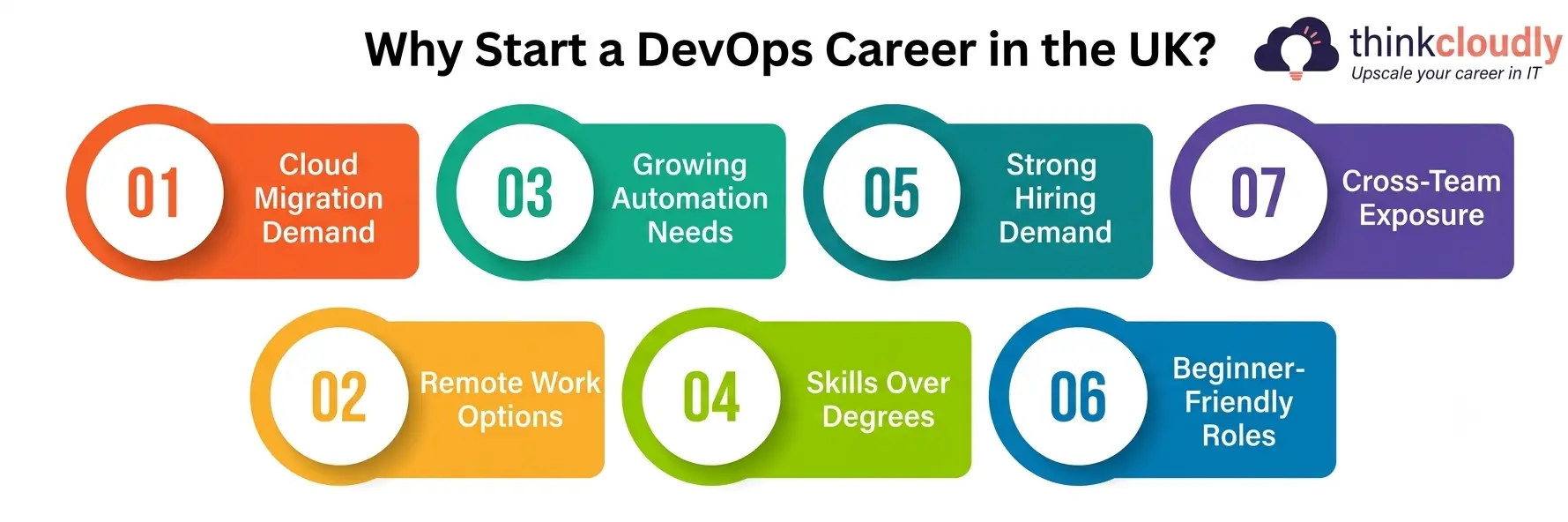
- UK companies are still migrating legacy infrastructure to the cloud at a pace, and every migration project needs people who can automate the process rather than click through consoles by hand.
- Internal platform teams are shrinking in headcount but growing in scope, so one fresher who understands automation can replace several people doing manual server builds the old way.
- The hiring gap is real: UK job boards consistently show more open requisitions for DevOps online training and cloud roles than there are qualified juniors to fill them.
- Unlike a narrow coding role, DevOps work touches nearly every department—product, security, finance, support—so your path to a raise doesn’t depend on a single team’s budget.
- Remote and hybrid DevOps roles are more common in the UK than in most other engineering disciplines, which widens the pool of companies you can apply to from day one.
- Entry-level hiring has shifted toward practical skill over pedigree, so a strong personal project can outweigh a weaker degree on paper.
- Companies that have already invested in infrastructure automation are hiring juniors specifically to maintain and extend it, which is a far gentler first-year entry point than being asked to build an entire pipeline from zero.
That demand is exactly why this role’s starting pay conversation matters so much right now—employers are competing for a limited supply of juniors who already understand automation, even at the entry level.
DevOps Engineer Salary in the UK for Freshers: The Real Numbers
Let’s get to the number you actually came here for. According to itjobswatch’s UK data for Junior DevOps Engineer roles, covering live permanent vacancies through October 2026, the median sits at roughly £35,981 a year for a junior role.
That’s a meaningfully different figure from the blended median of around £70,000 reported across itjobswatch’s full DevOps Engineer listings—a number that mixes in five-, ten-, and fifteen-year veterans, so it isn’t a fair comparison point for a true beginner.
For a first-year fresher with no prior IT job—just a degree, a bootcamp, or a handful of personal projects—realistic UK offers in 2026 tend to fall between £26,000 and £38,000, with London and the South East sitting toward the top of that band and the Midlands, the North of England, and Scotland sitting slightly lower.
A candidate who already holds a cloud certification, or who can show working automation scripts on GitHub, regularly pushes past the £38,000 mark even in their very first role.
Here’s a table format breakdown so you can see how this compares against nearby roles at the same experience level:
|
Role (0–2 years, UK) |
Typical Starting Salary (2026) | Typical Salary After 3–5 Years |
|
DevOps Engineer (fresher) |
£28,000 – £38,000 |
£55,000 – £70,000 |
|
Software Engineer (graduate) |
£28,000 – £38,000 |
£50,000 – £65,000 |
|
Site Reliability Engineer (junior) |
£32,000 – £42,000 |
£65,000 – £80,000 |
|
Linux Administrator (junior) |
£26,000 – £34,000 |
£45,000 – £65,000 |
|
Cloud/Platform Engineer (junior) |
£30,000 – £40,000 |
£55,000 – £72,000 |
Notice how close a fresher’s starting point sits to a typical software engineer starting salary—the two paths genuinely begin on similar footing in the UK. The real separation shows up later, once a DevOps specialist who leans into automation starts outpacing a generalist developer’s pay.
Does Location Change a Fresher’s Pay in the UK?
Location shifts the number more than most beginners expect. London and the wider South East still carry the biggest premium in the UK, often adding £4,000–£7,000 on top of the national starting range simply because the cost of living and the concentration of fintech, SaaS, and consultancy employers push offers upward.
Manchester, Leeds, Bristol, and Edinburgh form a strong second tier, with fresher offers usually £2,000–£4,000 below London for near-identical roles. Remote-first companies have flattened some of this gap, since a handful of UK employers now advertise one national band regardless of where a junior sits, which is worth checking before you assume a provincial offer is automatically weaker.
Interestingly, the regional gap between a fresher’s pay and a typical Site Reliability Engineer salary narrows outside London, because SRE hiring outside the capital is thinner and companies there pay closer to parity to attract anyone qualified at all.
How a Fresher’s Pay Grows Over Time?
Nobody stays a fresher forever, and the growth curve here is one of the steeper ones in UK tech. Year one is about learning the pipeline tools and surviving your first production incident without panicking. By year two or three, if you’ve taken ownership of real infrastructure automation projects and picked up a cloud certification, a jump to £45,000–£55,000 is common.
By year five, engineers who’ve specialized—particularly those who move toward configuration management jobs involving tools like Ansible, Puppet, or Chef at scale—are regularly clearing £65,000 to £75,000 outside London and more inside it.
The jump isn’t automatic, though. It’s tied directly to whether you can point to specific automation you built, not just tools you’ve “used.” Hiring managers reading a CV for a mid-level pay bump want to see you reduced deployment time, cut manual steps, or prevented an outage—not just that you attended a Kubernetes workshop once.
DevOps Engineer Salary vs Related Roles: SRE, Linux Admin, and Software Engineering
Freshers often ask whether they should target a straight DevOps title or a related role instead. Here’s an honest comparison.
A site reliability engineer salary in the UK tends to run slightly ahead of comparable DevOps pay at every experience level, because SRE roles are concentrated at larger, higher-traffic companies that pay a premium for reliability expertise.
The median sits around £80,000 across all experience levels—but very few of those roles are open to true freshers, since SRE work usually expects some production experience first.
A Linux Administrator Salary, by contrast, often starts a touch lower, reflecting that pure sysadmin work is seen as slightly less specialized than automation-focused DevOps work. The data puts the UK median at roughly £65,000 across all experience bands, with juniors typically starting in the high £20,000s to low £30,000s.
It’s still a solid entry point, and plenty of engineers use a Linux administrator salary as their stepping stone into a bigger DevOps paycheck two or three years later. Many sysadmin postings now expect at least basic configuration management job exposure as standard, which blurs the old line between pure Linux administration and DevOps work a little more every year.
Compared with a typical software engineer starting salary—which UK graduate salary data from Payscale puts at an average of around £30,700 in early career—a fresher DevOps Engineer salary starts in roughly the same bracket but tends to grow faster once automation skills kick in, simply because fewer people can do that work well.
Skills That Actually Move the Needle on Pay
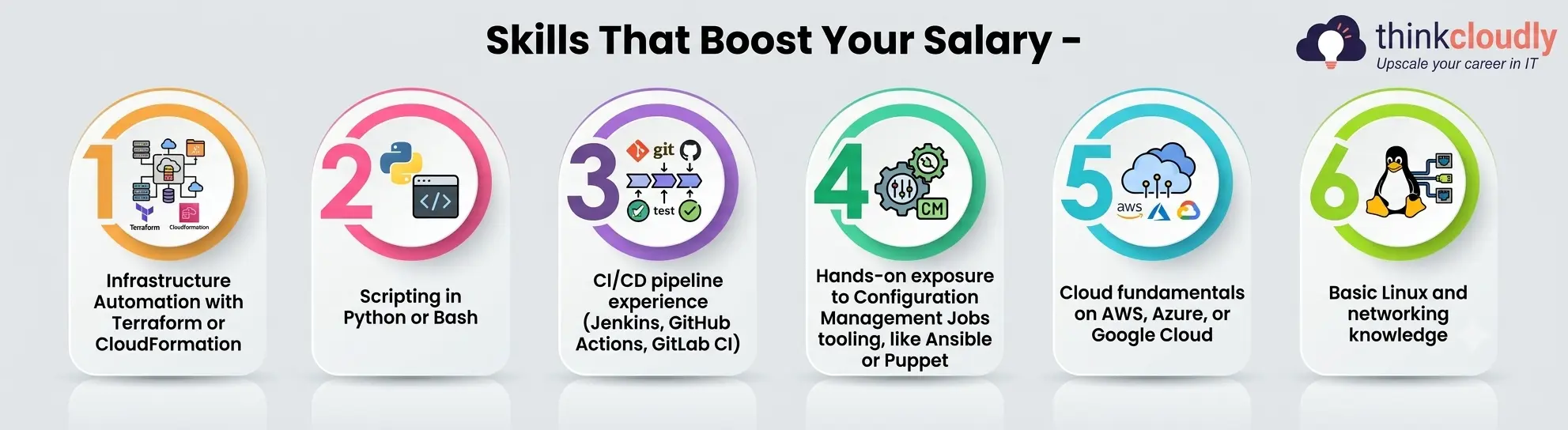
- Infrastructure Automation with Terraform or CloudFormation—provisioning a full environment from code, not a console click, is the single biggest lever for a fresher’s offer.
- Scripting in Python or Bash—automation is only as good as the scripts behind it, and recruiters test for this in almost every first-round interview.
- CI/CD pipeline experience (Jenkins, GitHub Actions, GitLab CI)—understanding how code actually ships, not just how it’s written, separates a DevOps fresher from a generalist.
- Hands-on exposure to configuration management Job tooling, like Ansible or Puppet—even basic familiarity signals you understand repeatable, auditable infrastructure changes.
- Cloud fundamentals on AWS, Azure, or Google Cloud—a single associate-level certification is often worth an extra £3,000–£5,000 on a starting offer.
- Basic Linux and networking knowledge—the same foundation that underpins Linux Administrator salary ranges also underpins a junior DevOps role, so don’t skip it.
Employers in 2026 are less interested in how many tools you’ve touched and more interested in whether you can explain why a deployment pipeline is built the way it is. That depth is what tips a borderline offer toward the higher end of the pay band.
Certifications Worth Pursuing as a Fresher
Not every certification moves the needle equally, so it helps to know which ones hiring managers actually recognize before you spend money on an exam voucher. The AWS Certified Cloud Practitioner or Microsoft’s Azure Fundamentals (AZ-900) are the cheapest, fastest entry points and are widely accepted as proof you understand how cloud billing, identity, and basic services fit together—useful even if the job description never names a specific tool.
Beyond that, an associate-level certification such as AWS Certified SysOps Administrator or Terraform Associate carries more weight because it tests hands-on configuration rather than multiple-choice theory, and recruiters notice the difference.
Where a typical software engineer starting salary assumes you already know a programming language well, DevOps hiring in the UK cares more about tooling breadth, which is exactly what these certifications are designed to prove.
Several of them also double as a stepping stone into Configuration Management Jobs at larger enterprises, where tools like Ansible and Puppet run across hundreds of servers rather than a handful, and that enterprise exposure tends to pay noticeably more once you’re past the fresher stage.
How to Land Your First DevOps Role in the UK
Getting the interview is often harder than passing it, especially with no prior job title to point to. A few things genuinely move the needle: build two or three small, documented automation projects — a provisioned AWS environment, a CI/CD pipeline for a toy app, a monitoring dashboard — and put them on GitHub with a clear README; get one cloud certification before you apply rather than after; and target companies that explicitly list infrastructure or configuration-management tooling in their listing, since that signals they’re hiring for the skill rather than the title.
Smaller companies and scale-ups are usually more willing to take a chance on a fresher than large enterprises, who often want a year or two of experience even for “junior” postings. It also helps to apply slightly below your confidence level for your first role — a fresher who takes a £30,000 offer with real automation exposure and a supportive senior engineer usually outpaces, within two years, a peer who held out for £35,000 at a company with no mentorship structure at all.
A Personal Note
I started out exactly where you probably are now — staring at wildly different salary numbers online and not knowing which one to trust. My first offer undercut the number I’d convinced myself I deserved, and I nearly turned it down over it.
I’d also briefly chased the idea of skipping straight to a Site Reliability Engineer Salary band, before a few rejection emails made it clear most SRE teams wanted production incidents under my belt that I simply didn’t have yet.
What actually moved my pay by year two wasn’t a certificate I’d collected; it was the small automation project I kept polishing on weekends, the one I almost didn’t mention in my second interview because it felt too simple to matter.
It became the thing every interviewer wanted to talk about. If you’re a fresher reading these numbers and feeling behind, don’t be. Build the small thing, document it properly, and let the pay catch up to the work — because in this field, it genuinely does.