

A friend of mine spent three years staring at SIEM dashboards at 2 a.m. as a security analyst, then watched a former teammate — someone with half her technical depth — move into a governance-focused seat and land a bigger offer within a year.
She assumed the title change was a demotion in disguise. It wasn’t. It was a different pay curve entirely, and nobody had explained to either of them that these two titles aren’t competing for the same budget line, let alone the same ceiling.
That confusion is everywhere right now, because both roles get lumped into the same vague “cybersecurity jobs” bucket on job boards, and most comparison pieces answer the pay question with a single flattened number that hides more than it reveals.
This guide pulls the real 2027 compensation data for both paths, walks through why a GRC analyst and a security analyst can be paid wildly differently depending on which version of each title you’re looking at, and lays out what actually decides the winner for a given person’s situation. The honest answer is more interesting than “X pays more,” and it’s below.
What a GRC Analyst Actually Does Day to Day?
Before comparing paychecks, it helps to be clear about what each job involves, since the titles get used loosely across postings. This analyst spends most of a working week on governance documentation, risk registers, and audit support rather than hands-on technical defense.
That means mapping controls to frameworks like ISO 27001 or SOC 2, chasing policy attestations across departments, tracking identified risks through to resolution, and preparing evidence packages for internal or external auditors. It’s a role built around translation — turning dense regulatory language into something a business team can act on — more than it’s built around stopping an active attacker.
A security analyst, by contrast, sits closer to the technical front line. This role monitors alerts, investigates suspicious activity, triages potential compromises, and works inside detection platforms rather than policy documents.
The two jobs occasionally overlap — a technical analyst might feed findings into a risk register, and the governance side might need to understand what a specific control actually does — but the daily rhythm of each is genuinely different, which is exactly why they land on different pay curves.
GRC Analyst Salary vs Security Analyst Salary: The Real 2027 Numbers
Here’s where the comparison gets more complicated than most articles admit. Depending on which data source and which exact job title you check, either role can appear to “win,” because the two biggest salary trackers define these titles very differently.
The average pay for this governance role in the US sits at $97,659 a year, with the middle half of reported pay falling between roughly $55,000 and $111,000, and top earners climbing past $197,000 in regulated industries.
Entry-level figures typically start closer to 70,000–85,000, mid-career professionals land near $100,000, and senior-level pay in finance, healthcare, or federally regulated sectors regularly tops $140,000 once bonuses are folded in.
Security analyst pay tells a split story depending on which version of the title you’re pricing. A generic “Security Analyst” listing — the kind Payscale and ZipRecruiter track most often — averages $75,884 and $73,654 respectively, with typical ranges sitting between roughly $56,000 and $107,000. Those figures land genuinely lower than GRC analyst salary at the same career stage, which surprises a lot of people walking into this comparison for the first time by opting for GRC Training.
But the picture flips once you move to the US government’s own occupational category. According to the Bureau of Labor Statistics, Information Security Analysts earned a median annual wage of $129,180 in May 2025, with employment projected to grow 21% between 2025 and 2035 — far faster than the average occupation — and roughly 14,100 openings expected per year over the decade.
That median sits well above typical governance pay, because the BLS category folds in senior technical roles, breach responders, and security engineers that generic job-board listings mostly leave out.
|
Role |
Typical 2027 Average |
Typical Range |
|
Governance Analyst (GRC) |
$97,659 |
55,000–111,000 |
|
Security Analyst (generic listing) |
73,654–75,884 |
56,000–107,000 |
|
Information Security Analyst (BLS category) |
$129,180 (median) |
— |
|
Risk Analyst |
$76,869 |
55,000–108,000 |
|
IT Auditor |
$85,992 |
65,000–128,000 |
|
Breach Response Analyst |
$68,400 |
42,000–97,000 |
Read that table as directional rather than exact — every figure moves with city, industry, and whether an employer is federally regulated. The pattern underneath it still holds: GRC analyst salary outpaces a bare “Security Analyst” title on a job board, while the broader, technically deeper “Information Security Analyst” occupational family — senior SOC roles, engineers, and handlers included — out-earns both.
Why Is the Pay Gap Between These Two Titles So Confusing?
The gap isn’t a data error. It reflects two genuinely different hiring markets stacked under similar-sounding job titles. Entry-level security analyst roles are often the first rung into cybersecurity, filled by career-changers and recent graduates doing alert triage, which keeps the average for that specific title lower than people expect.
GRC analyst salary, on the other hand, skews higher at entry because the role usually requires some fluency in business process and regulatory language before a company will hire for it at all — fewer candidates can walk in day one and competently run an audit-support workflow than can learn to watch a dashboard.
Risk Analyst Salary data tells a similar story to generic security-analyst pay at the lower end: Payscale’s 2027 figures put the average Risk Analyst Salary at $76,869, with a range of $55,000 to $108,000 — a near-identical band to the generic listings, because both roles are often filled by candidates with comparable years of experience and comparable scope of authority.
The real separation shows up further up the ladder, where governance and technical security tracks both start pulling ahead of narrower analyst titles, just via different routes — governance through regulatory scope and audit ownership, technical security through specialization in breach handling, cloud security, or threat hunting.
IT Audit work sits in an interesting middle position in this comparison. Payscale’s 2027 data shows IT Audit professionals averaging $85,992, with a spread from $65,000 to $128,000 for the most senior, specialized practitioners — higher than a generic security analyst listing, but still below where a seasoned professional in this seat typically lands once they own cross-functional audit readiness rather than just supporting it.
Cyber Risk work follows a comparable pattern: titles that blend technical fluency with governance responsibility — the kind of role this career track often grows into — tend to out-earn both a pure IT Audit function and a generic security analyst role at matching seniority, because employers pay a premium for someone fluent in both languages at once.
Where Incident Response Fits Into the Comparison?
Incident Response is the category that complicates any simple verdict here the most. Payscale’s 2027 data puts dedicated breach-response pay at an average of $68,400, with a range of $42,000 to $97,000 — lower than you’d expect given how high-pressure the work sounds, largely because many organizations still bundle that work into a broader security analyst role rather than paying for it as a standalone specialty.
That’s starting to shift. The study found that 95% of security teams report at least one meaningful skills gap, with 59% calling it critical or significant — up sharply from 44% the year before — and governance, risk, and compliance named specifically as one of the hardest skill areas to fill.
Meanwhile, ISACA’s 2027 State of Cybersecurity survey, covered by SecurityWorldMarket, found that 64% of organizations have run no AI-specific response exercises at all, and 48% either don’t have AI playbooks or don’t know if they exist.
That’s a governance gap as much as a technical one — someone still has to write the Incident Response plan, decide who gets notified, and prove to a regulator afterward that the process was followed, and increasingly that’s falling to whoever owns governance inside the security function rather than the person running point on containment.
The practical upshot: a technical analyst who adds deep breach-handling skill tends to climb the technical ladder, while someone on the governance side who absorbs response-plan ownership — playbooks, post-breach reporting, regulatory notification timelines — tends to become the person both the security team and the compliance team can’t function without. Both routes raise pay. Neither is automatically faster than the other.
6 Factors That Push Governance Pay Higher or Lower
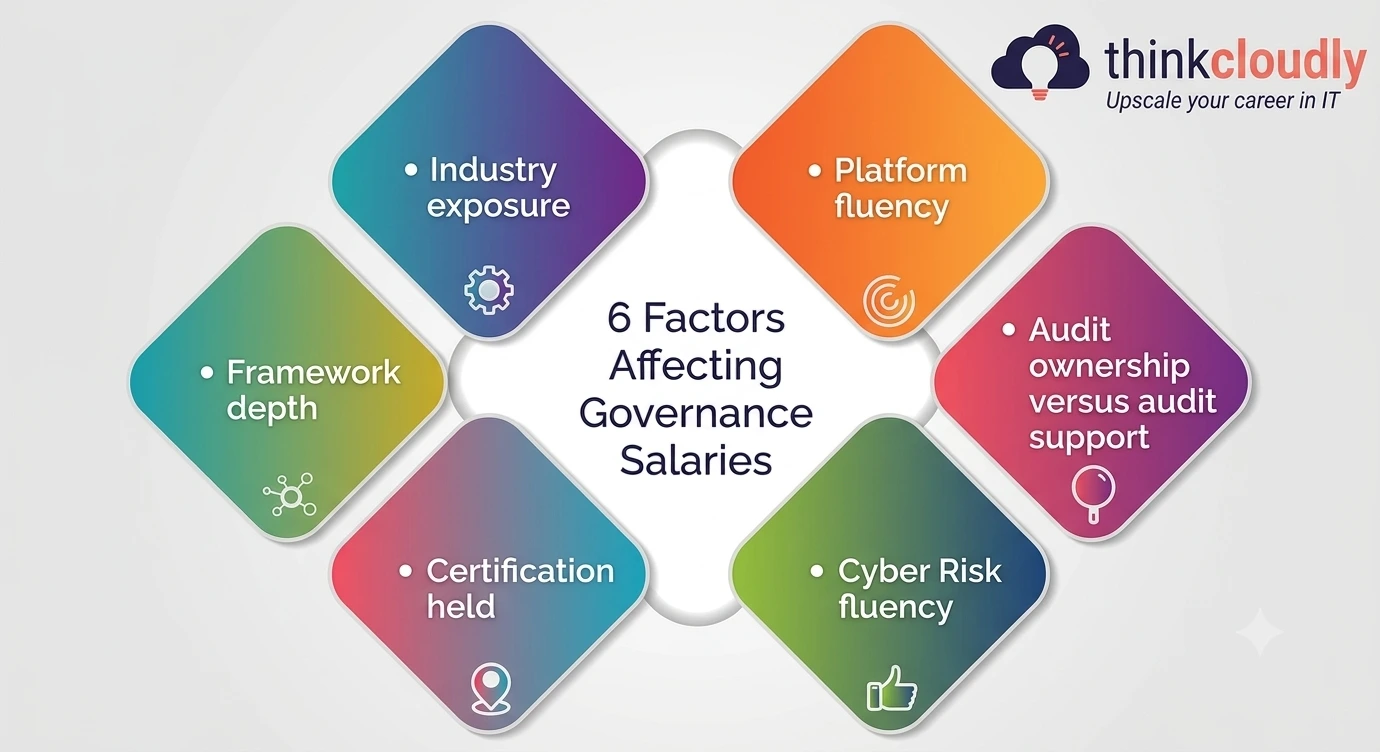
- Industry exposure. Financial services, healthcare, and defense-adjacent employers consistently pay above the averages quoted above, because the cost of a compliance failure in those industries is simply larger.
- Framework depth. Genuine, demonstrable fluency in one framework — SOC 2, ISO 27001, NIST CSF, or PCI-DSS — moves an offer toward the top of the range far more reliably than shallow familiarity with five.
- Certification held. A recognized credential like CRISC, CGRC, or CISA doesn’t guarantee a raise by itself, but it consistently appears in postings offering the upper end of any quoted range.
- Platform fluency. Hands-on comfort with a governance platform — Archer, ServiceNow GRC, or Vanta — is increasingly treated as a baseline expectation, and lacking it can cap an offer at the lower end.
- Audit ownership versus audit support. Someone who owns audit readiness for a business unit is paid meaningfully more than someone who only gathers evidence for someone else’s audit.
- Cyber Risk fluency. Candidates who can translate a technical Cyber Risk finding into language a board will act on routinely out-earn peers who can only describe the finding itself.
GRC Analyst vs Security Analyst: Which Path Fits You
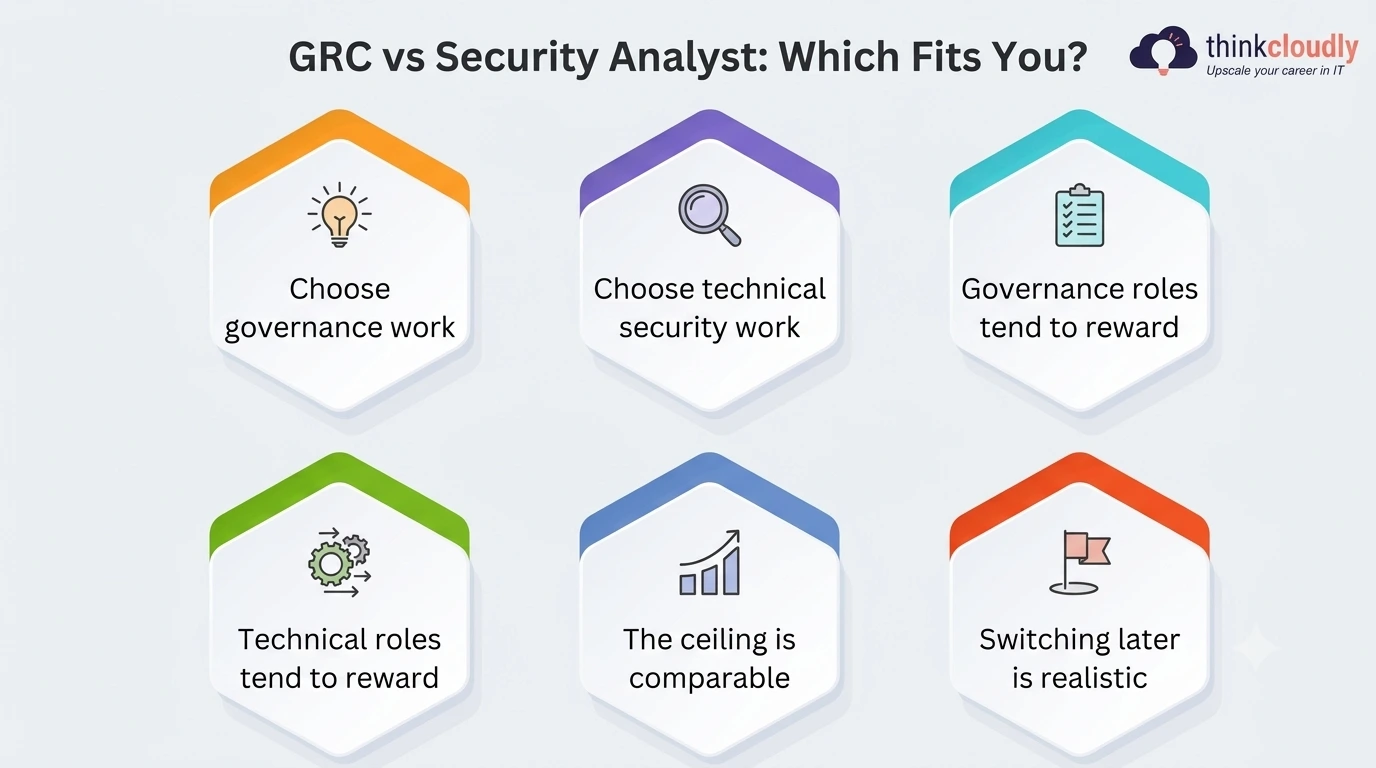
- Choose governance work if you’d rather own the “why” behind a control than the “how” of defending it, and you’re comfortable spending most of a week in documentation, policy language, and stakeholder follow-up.
- Choose technical security work if you want to stay hands-on with detection tools, logs, and live investigations, and a quiet week without an active alert sounds boring rather than relaxing.
- Governance roles tend to reward regulatory fluency, audit ownership, and the ability to turn technical risk into business language a board will actually act on.
- Technical roles tend to reward specialization — threat hunting, cloud security, or breach-response depth — over broad generalist knowledge.
- The ceiling is comparable at senior levels in both tracks, but the path to get there looks different: one side climbs through scope and regulatory ownership, the other through specialization and hands-on mastery of a narrower skill.
- Switching later is realistic. Plenty of professionals move from technical work into a governance-focused seat once they’ve seen enough incidents to understand why that side of the job exists, and the reverse move happens too, just less often.
A Personal Note
What struck me most while pulling this data together wasn’t the dollar figures — it was how often the “which pays more” question turns out to be the wrong question entirely. My friend from the opening of this piece didn’t get a smaller offer because governance work is undervalued; she got a bigger one because she’d quietly built exactly the kind of audit-ownership experience that pushes pay toward the top of its range, while her former teammate was still priced as a generic security analyst doing alert triage.
If you’re weighing these two paths, don’t ask which title pays more on average. Ask which version of either job — the deep technical specialist or the regulatory owner — you’re actually willing to become, because that’s the decision the pay data is quietly measuring the whole time.