

I’ve sat across the table from candidates who studied for four straight months, memorized every process group chart they could find, and still walked out of the test center rattled. The problem was never their effort. It was that they were preparing for an exam that no longer exists in the form they studied it.
PMI overhauled the PMP exam in July 2026, and anyone building a plan for 2027 without accounting for that change is studying the wrong map. The right PMP exam prep training now means preparing for a different exam than the one your colleague passed two years ago, and this guide is the walkthrough I wish someone had handed me before my own first attempt.
Whether you’re a project coordinator eyeing your first promotion or a seasoned program lead finally making the certification official, the same ground rules apply: know exactly what changed, build a realistic plan around it, and practice the way the exam actually asks you to think rather than the way an old syllabus taught you to think.
Why Does PMP Exam Prep Training Look Different After the July 2026 Update?
PMI didn’t tweak a few questions this year — it rebuilt the weighting of the entire exam. According to PMI’s own announcement of the updated exam, the Business Environment domain jumped from 8% of the test to 26%, while Process dropped from 50% to 41% and People moved from 42% to 33%.
That’s not a cosmetic adjustment. It means a huge chunk of the exam now rewards candidates who understand organizational strategy, compliance, benefits realization, and external market forces — material that older study guides barely touched.
PMI also folded in two topics that weren’t formally tested before: artificial intelligence’s role in project delivery, and sustainability considerations in project decisions. Neither topic needs you to code anything, but you do need to recognize how an AI-assisted scheduling tool or a sustainability constraint changes a project manager’s decisions in a scenario question.
That’s exactly why PMP exam prep training built around the old 2021 blueprint will waste your hours in 2027 and 2027 — the scenarios have shifted even where the underlying project management logic hasn’t.
The mechanics changed too. The exam stayed at 180 questions, but total time increased from 230 to 240 minutes, and candidates now get two 10-minute breaks instead of one. Small detail, but worth planning your pacing around if you’re used to the older format from a friend’s notes or an outdated question bank.
This isn’t PMI’s first major overhaul, either. The exam content outline gets revisited every few years to track how project work is actually practiced in the field, and the 2027 version is simply the latest checkpoint.
The lesson for anyone studying right now is the same lesson every prior cohort learned the hard way: whatever guide, app, or question bank you’re using needs a visible publication or “last updated” date, and if it doesn’t have one, treat that as a warning sign rather than an oversight.
What Smart PMP Exam Prep Training Actually Covers?
Good exam prep starts with knowing exactly what PMI tests, not guessing from memory. Here’s the structure worth building your study map around, broken into the pieces that map cleanly onto an infographic or study poster:
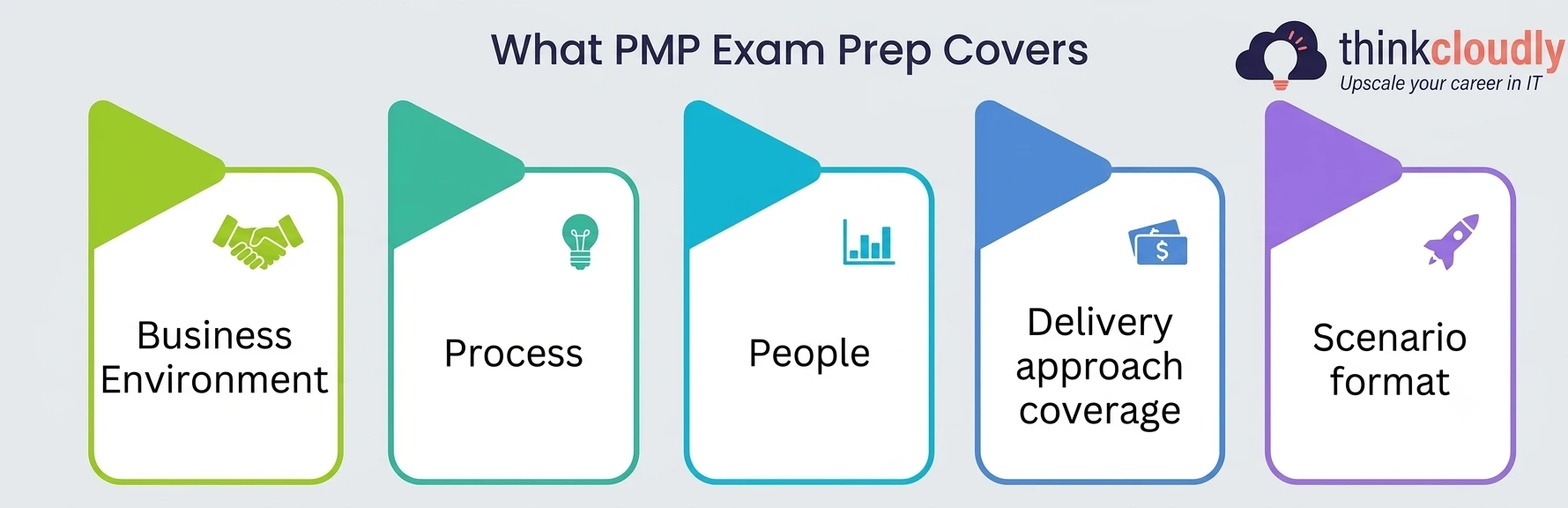
- Business Environment (26%): Organizational strategy alignment, compliance and regulatory awareness, benefits management, external and internal business factors, and now AI and sustainability considerations in decision-making
- Process (41%): Scope, schedule, cost, quality, risk, procurement, and stakeholder processes across predictive, agile, and hybrid delivery approaches
- People (33%): Team leadership, conflict resolution, stakeholder engagement, servant leadership, and emotional intelligence applied to real project scenarios
- Delivery approach coverage: Predictive, agile, and hybrid methods are tested throughout, not siloed into a separate section
- Scenario format: Expect situational, multi-step questions rather than straight definition recall — PMI is testing judgment, not vocabulary
Treat this list as your syllabus, not a reference you skim once, and cross-check it against whatever learning resources you’re already using before you commit another week to them. Every domain weight tells you exactly how many study hours to assign it.
The PMP Exam at a Glance: 2026–2027 Facts Candidates Need
Before you build a schedule around your PMP exam training, look at the numbers that actually define the test rather than a recycled figure from an old forum post.
|
Detail |
Current Figure |
|
Total questions |
180 (175 scored, 5 pretest) |
|
Exam duration |
240 minutes, with two 10-minute breaks |
|
Exam fee (PMI member) |
$425 |
|
Exam fee (non-member) |
$675 |
|
Retake fee (member) |
$275 |
|
Eligibility (bachelor’s degree) |
36 months leading projects + 35 hours of project management education |
|
Eligibility (high school diploma) |
60 months leading projects + 35 hours of project management education |
|
New exam effective date |
July 9, 2026 globally |
These figures come from Training Camp’s 2026 PMP cost and eligibility guide, and PMI itself confirms the eligibility paths require you to have led or directed projects, not simply served on a team. Don’t assume your experience counts without checking which bucket applies to your education background.
Building a Study Schedule That Survives a Real Job
Every candidate asks the same question first: how long should my study schedule actually run? Most working professionals need eight to twelve weeks of structured prep at six to eight hours a week, depending on how much hands-on project leadership experience they already carry into the exam.
A plan that ignores your actual calendar — work deadlines, travel, family obligations — gets abandoned by week three, so build in deliberate flex days rather than pretending every week will go according to plan.
A study schedule that works tends to follow this rhythm:
- Weeks 1–3: Read the full Exam Content Outline once, then rebuild your understanding domain by domain, starting with Business Environment since it now carries the most weight
- Weeks 4–7: Work through process groups and knowledge areas with scenario-based practice after each topic, not weeks later
- Weeks 8–10: Shift almost entirely to full-length PMP mock test runs under timed conditions
- Final 1–2 weeks: Review only your weak areas, retake short practice sets daily, and rest the final two days before the exam
Spreading your study schedule unevenly — cramming theory into the first half and leaving zero room for timed practice — is the single most common reason a well-prepared candidate still runs out of time on test day. Pair that schedule with study techniques that actually stick, which matters more than the number of hours logged on a calendar.
Study Techniques and Learning Resources That Actually Move the Needle
The study techniques inside solid PMP exam prep training aren’t exotic — they’re just applied consistently instead of occasionally. Active recall, spaced repetition, and scenario rehearsal outperform passive re-reading every single time, and the research behind that isn’t PMP-specific; it’s how adult learners retain applied judgment skills generally.
Learning resources worth prioritizing over a stack of random PDFs:
- PMI’s own Study Hall subscription and updated Exam Content Outline, which track the July 2026 changes directly rather than a third party’s interpretation of them
- A current, timed PMP mock test bank rebuilt for the new domain weights, not a 2021-era question set repackaged with a new cover
- A study group or forum where you explain concepts out loud — teaching a stakeholder-engagement scenario to someone else exposes gaps that silent reading never will
- Short daily review blocks rather than single marathon weekend sessions, since spaced repetition beats cramming for long-term recall
If your current learning resources haven’t been updated since before July 2026, assume they’re testing the wrong exam. That’s not a small gap — it’s the difference between studying Business Environment at 8% weight and studying it at 26%.
Why PMP Practice Questions Deserve Daily Time, Not Just Weekend Time?
No exam prep plan is complete without weekly timed PMP practice questions, and “weekly” undersells it — daily short sets build pattern recognition faster than occasional long sessions.
They aren’t there to test memorization; they’re there to train you on PMI’s specific style of situational, multi-answer-looking questions where two choices feel almost right and only one fits the exact constraint buried in the scenario. This is one of the simplest study techniques available, and it’s also the most frequently skipped once candidates feel like they already “know” a topic.
Run a full PMP mock test under real time pressure at least three times before your actual exam date, and treat every wrong answer the same day you get it — not a week later when the context has faded.
A PMP mock test also recalibrates your pacing: at roughly 80 seconds per question across 240 minutes, candidates who’ve never rehearsed that rhythm often run short on the final 20–30 questions, rushing exactly the scenarios that need the most careful reading.
Mistakes That Sink First-Time Candidates
Most PMP exam prep training mistakes come from skipping the Business Environment domain because it feels “soft” compared to scheduling math or earned value formulas. That instinct is backwards now — it’s over a quarter of the exam.
A second common mistake is studying from a bank of PMP practice questions that predates the July 2026 update, which quietly trains you on the wrong proportions of content.
A third is treating the PMP mock test as a one-time dress rehearsal instead of a recurring diagnostic tool you return to every week during the back half of your prep. Pair that audit with a hard look at your other learning resources, too — a syllabus, video course, or book written before July 2026 will under-serve you no matter how well-reviewed it once was, simply because it’s teaching proportions that no longer exist on the real exam.
A fourth mistake, easy to miss, is assuming one study technique fits every domain. Business Environment questions reward reading PMI’s actual guidance on organizational strategy and compliance, while Process questions reward repeated scenario drills. Treating both the same way wastes hours you don’t have to spare.
A quieter mistake is underestimating exam-day logistics if you’re testing from home: webcam checks, ID verification, and workspace scans eat into your focus if you’ve never rehearsed the check-in process. Run through it the evening before, not the morning of your exam.
Clear your desk down to the required ID and permitted materials, close every extra application, and confirm your internet connection well ahead of your scheduled start time — a failed system check with ten minutes to go is a stress nobody needs on top of a 240-minute exam.
What the PMP Credential Is Actually Worth in 2026 and 2027?
Credentials cost money and time, so it’s fair to ask whether PMP exam prep training pays off. PMI’s Earning Power salary survey, covering over 14,600 project professionals across 21 countries, found PMP holders earn a median salary 17% higher than non-certified peers globally.
In the United States specifically, certified professionals reported a median salary of $135,000 against $109,157 for those without the credential — a gap of nearly 24%. Professionals certified for more than a decade reported a median of $173,000, which suggests the advantage compounds rather than fades.
Beyond salary, PMI’s own talent-gap research projects a need for up to 30 million additional project professionals worldwide by 2035, which is a long runway for anyone finishing their exam preparation this year or next.
The credential doesn’t guarantee a number on an offer letter, but it consistently clears the automated resume filters that screen for named certifications before a human recruiter ever opens the file. Full eligibility requirements and the application steps are documented on PMI’s own PMP certification page, which is worth bookmarking before you pay a single exam fee.
A Personal Note
If I could change one thing about how people approach PMP exam prep training, it would be this: start earlier than you think you need to, and stop treating the exam content outline like optional reading. I’ve watched candidates who were genuinely excellent project managers fail their first attempt not because they lacked the skill, but because they studied the 2021 version of a test that no longer exists in that form.
Read the actual outline PMI publishes, weight your hours the way the exam weights its domains, and don’t let a stack of outdated PMP practice questions convince you that you’re ready when you’re really just familiar with the wrong material. The certificate matters less than the judgment it’s supposed to prove you have — study for the judgment, and the certificate takes care of itself.