

Everyone wants into security right now, and almost everyone starts the same way: they open a search bar, type “how to get into cybersecurity,” and land on a wall of acronyms and conflicting advice.
If you’ve been stuck in that loop, here’s the short version — a Google Cyber Security path is one of the few starting points that actually matches what entry-level hiring managers look for in 2027, because it was built around real analyst tasks instead of academic theory.
This guide walks through that Cybersecurity Roadmap from first principles: what the certificate covers, which hands-on skills you need to practice rather than just read about, and which beginner-friendly roles are realistic to target once you’re done.
Why 2027 Is the Right Time to Start a Google Cyber Security Plan?
The timing argument isn’t based on vibes. The U.S. Bureau of Labor Statistics projects information security analyst employment to grow 21% between 2025 and 2035, with a median wage of $129,180 a year as of May 2025 and roughly 14,100 openings projected annually over the decade. That’s “much faster than average” growth, and it isn’t slowing down.
At the same time, ISC2’s 2025 Cybersecurity Workforce Study — based on more than 16,000 practitioners surveyed in mid-2025 — found that 59% of organizations now report critical or significant skills shortages, up sharply from 44% the year before.
Junior staff make up only about 5% of the respondents in that study, which tells you something important: the shortage isn’t at the senior level, it’s at the bottom of the ladder, exactly where a beginner is trying to climb on.
A well-built Google Cyber Security roadmap exists precisely to close that gap, because it’s designed to get a newcomer from zero to “demonstrably useful” without years of prior IT experience standing in the way.
There’s a newer wrinkle worth noting too. The same ISC2 research found that 73% of practitioners expect artificial intelligence to create more specialized skill needs rather than erase entry-level work outright, and 63% of active AI-tool users already report a real productivity boost from it.
That’s good news for anyone starting now: the work is shifting toward people who can direct and verify AI-assisted analysis, not disappearing because a chatbot can write a script.
What Does the Google Cybersecurity Certificate Actually Teach You?
A lot of people assume this is a generic “intro to security” course. It isn’t. The current Google Cybersecurity Certificate runs across eight to nine courses and roughly 130-plus hours of instruction, and the course list reads like a job description rather than a textbook: foundations of cybersecurity, managing security risks, networks and network security, Linux Security and SQL, assets and vulnerabilities, detection and response, Python automation, and job-search preparation.
According to data 75% of U.S. graduates report a positive career outcome — a new job, a promotion, or a raise — within six months, and graduates can apply directly to a network of more than 150 U.S. employers, including names like American Express, Deloitte, and Walmart.
This program also preps you for the CompTIA Security+ exam as a dual credential, stacking two recognizable qualifications into one study effort instead of two separate ones — and it’s exactly why this certificate anchors the wider Cybersecurity Roadmap the rest of this guide follows.
Step-by-Step Google Cyber Security Roadmap for 2027
Here’s the actual sequence, broken into stages you can follow in order rather than jumping around:
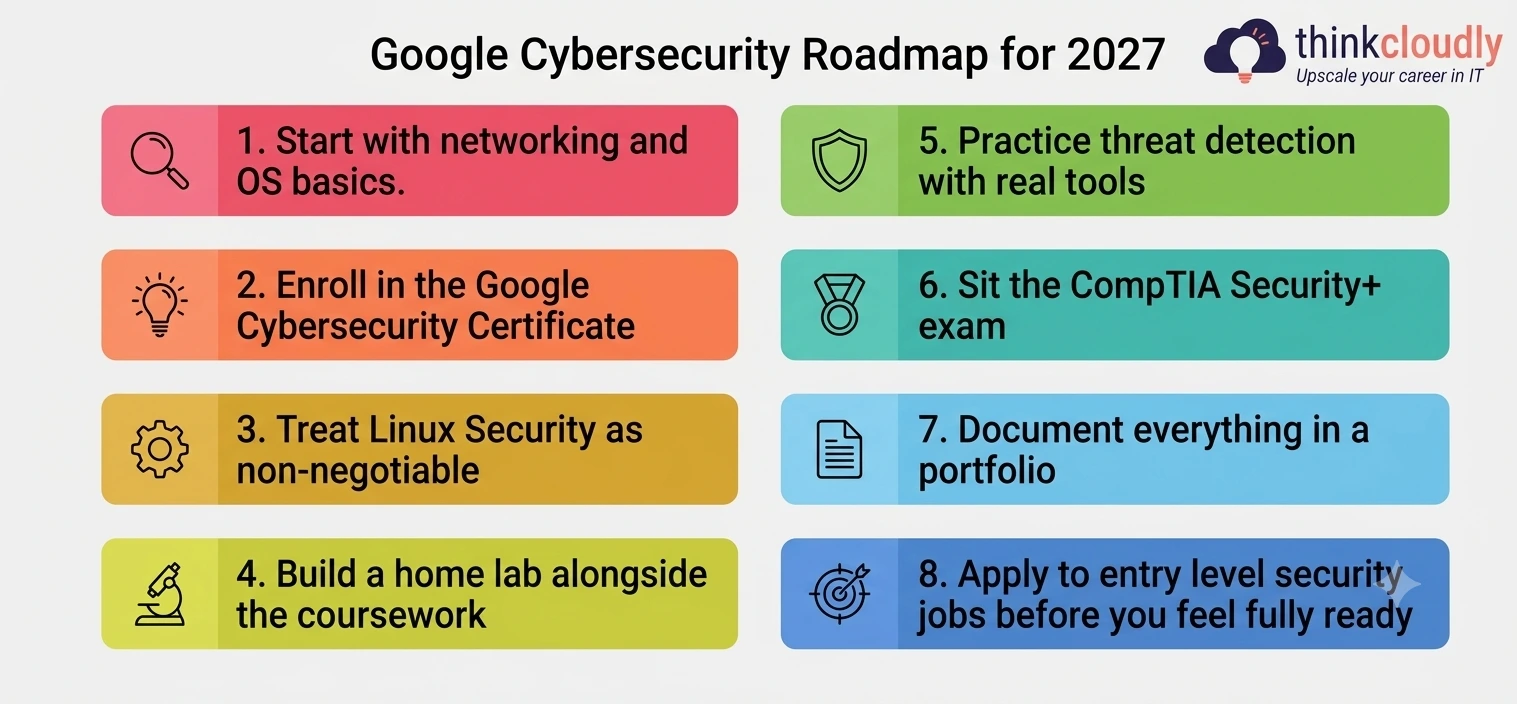
- Start with networking and OS basics. Before touching a single security tool, understand how TCP/IP, DNS, and basic routing work. Everything later depends on this foundation.
- Enroll in the Google Cybersecurity Certificate. Work through the eight-to-nine course track at a steady pace — most learners finish in three to six months doing roughly 5–7 hours a week.
- Treat Linux Security as non-negotiable. Don’t skim the OS and SQL module to get to the “exciting” parts. Command-line comfort is what separates candidates who can follow a real incident playbook from those who can only describe one.
- Build a home lab alongside the coursework. Spin up a free virtual machine, practice basic hardening, and break something on purpose so you learn how to fix it.
- Practice threat detection with real tools. Use the SIEM exposure from the certificate (Chronicle, Splunk) and pair it with free practice environments to build pattern-recognition instincts, not memorized answers.
- Sit the CompTIA Security+ exam while the material is fresh, since the certificate track is built to prepare you for it directly.
- Document everything in a portfolio. A short write-up of your lab work and one detection scenario you walked through carries more weight in an interview than a resume full of unexplained badges.
- Apply to entry level security jobs before you feel fully ready. Nobody feels ready. Apply once you can talk through your lab work and your coursework clearly and specifically.
This Google Cyber Security roadmap works because every step produces something you can point to in an interview — not just a certificate name, but an actual answer to “walk me through a time you investigated something.”
Linux Security Fundamentals Every Beginner Must Master
It’s tempting to rush past the command line on the way to flashier topics like threat hunting or penetration testing, but that’s backwards. The overwhelming majority of servers, cloud infrastructure, and security tooling run on Linux, which means weak operating-system instincts quietly sabotage everything built on top of them.
At minimum, get comfortable with file permissions and ownership (chmod, chown), process monitoring, log navigation (especially under /var/log), basic firewall rules, and user account management.
The certificate introduces these through Bash scripting exercises, but genuine command-line competence only comes from repetition outside the course — reinstalling a distro a few times, breaking a permission structure, and fixing it without a tutorial open in another tab.
Hiring managers notice the difference between someone who memorized a command and someone who understands why it works, and that difference almost always traces back to practice logged outside of class hours, well before any application ever gets submitted. This operating-system layer is what the rest of the Cybersecurity Roadmap quietly depends on.
Building Real Detection Skills Before You Apply
Threat detection is the skill most beginners claim and fewest can actually demonstrate. It’s easy to say “I understand SIEM tools” in a cover letter; it’s a different thing to sit in front of Splunk or Chronicle and explain why a specific alert is a false positive versus a real indicator of compromise. Build this skill in layers.
- First, understand the detection lifecycle — collection, correlation, triage, escalation — conceptually.
- Second, get hands-on with the SIEM exposure inside the detection module, where you’ll work with Suricata-generated alerts and basic log correlation.
- Third, supplement with free-tier practice labs that simulate live alerts, since repetition under slightly different scenarios is what turns threat detection from a definition you memorized into a reflex you can describe fluently in an interview.
Candidates who can walk through one real (even simulated) detection story, start to finish, consistently outperform candidates with more badges but no story to tell — a point that matters more on a resume than any single line item.
Entry Level Security Jobs You Can Target After This Roadmap
Once the certificate, the lab work, and Security+ are behind you, here’s where this Cybersecurity Roadmap actually leads. These are the roles worth prioritizing over titles you’re not yet qualified for:
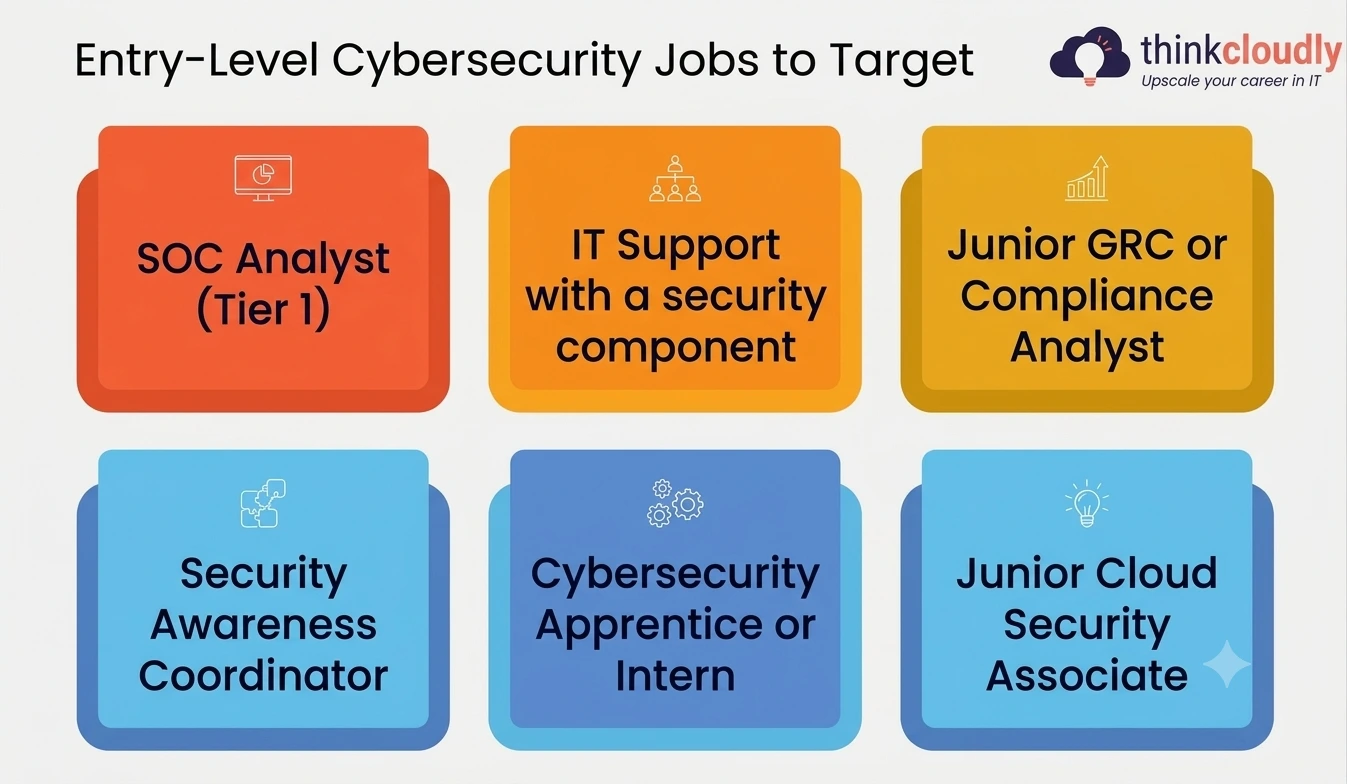
- SOC Analyst (Tier 1): The most common true entry point, built almost entirely on the alert-triage skills the certificate teaches directly.
- IT Support with a security component: Less glamorous, but it builds troubleshooting instincts that transfer directly into later security work.
- Junior GRC or Compliance Analyst: A strong fit for detail-oriented beginners who are stronger on documentation and frameworks than pure technical depth.
- Security Awareness Coordinator: Smaller organizations often need someone to run phishing simulations and training programs — a legitimate, underrated way in.
- Cybersecurity Apprentice or Intern: Many mid-size firms and managed security providers now run structured apprenticeship tracks specifically because junior seats keep going unfilled.
- Junior Cloud Security Associate: As workloads keep shifting to the cloud, even basic cloud literacy on top of the certificate opens doors faster than a plain IT background alone.
Among all the entry level security jobs listed above, the SOC Analyst seat remains the one most directly built from certificate coursework — which is exactly why it’s worth targeting first, even if it isn’t the most exciting title on the list.
Google Cyber Security Roadmap at a Glance
|
Stage |
Timeframe | What You’re Doing |
Core Skill Built |
|
Foundations |
Weeks 1–4 | Networking and OS basics |
TCP/IP, DNS fundamentals |
|
Certificate coursework |
Months 1–4 | Certificate modules, course by course |
Command-line skills, SQL, risk frameworks |
|
Hands-on practice |
Months 2–5 (overlapping) | Home lab, free CTF-style platforms |
Detection skills, log analysis |
|
Credential |
Month 4–5 | CompTIA Security+ exam |
Validated baseline knowledge |
|
Portfolio |
Month 5 | Write-up of lab work and detection scenarios |
Interview-ready evidence |
|
Application |
Month 5–8 | Apply to junior security roles |
Interview and negotiation skills |
Notice that nothing in this table demands years of prior experience. It demands consistency across roughly five to eight months, which is a realistic, honest estimate rather than an inflated “get hired in 30 days” promise.
Print it, pin it above your desk, or drop it into a spreadsheet you check weekly — whatever keeps the next concrete action visible on the days when motivation alone isn’t enough.
Common Mistakes That Derail a Google Cyber Security Plan
The most common failure isn’t lack of intelligence — it’s sequencing.
- People rush past the command line straight to “exciting” topics like malware analysis, then wonder why interviews go flat when asked basic Linux questions. Others collect three or four certificates before applying anywhere, mistaking volume for readiness, when a single finished credential paired with real lab evidence beats a stack of half-explained badges every time.
- A second mistake is treating detection work as something you read about rather than practice. You cannot talk convincingly about triaging an alert if you’ve never actually looked at one.
- A third mistake is applying only to dream titles — penetration tester, red teamer — while ignoring the junior roles that are genuinely hiring right now, like Tier 1 SOC seats and GRC analyst roles. The CyberSeek career pathway tool, built on U.S. labor data, is one of the few free resources that shows exactly which roles are actually hiring by region, rather than which ones merely sound impressive. Check it before you specialize, not after.
- A fourth, quieter mistake is skipping communication practice entirely. Most rejections at this stage don’t come from a missing technical answer — they happen when a candidate can’t walk an interviewer through their own lab notes clearly, under a little bit of pressure. Record yourself explaining one project out loud before the first real interview; it exposes gaps a silent study session never will.
Final Thoughts
There’s no version of a Cybersecurity Roadmap that skips the unglamorous parts and still works. The sequence that actually gets people hired is boring on paper: finish one certificate instead of starting three different courses, put in real hours on the command line instead of skimming it, practice threat detection until you can describe a scenario out loud without notes, and apply to entry level security jobs before you feel completely ready.
Pair that with the CompTIA Security+ exam as your credential, and you have a plan that mirrors how hiring managers actually evaluate junior candidates, not how marketing pages describe the process.
A Personal Note
I’ve walked a few friends and former coworkers through this exact path, and the pattern repeats every time — the ones who get hired aren’t the ones who finish the certificate fastest.
They’re the ones who keep a messy lab notebook, who can explain one detection scenario in detail without rehearsing it, and who apply to the unglamorous Tier 1 role instead of waiting for the “cool” one to open up. If you’re a few weeks into this and feeling behind, you’re probably not. You’re just at the part of the process that doesn’t make it onto anyone’s highlight reel.