

I keep running into the same message in my inbox this fall: “I was two weeks into studying for the old AWS machine learning exam and now everyone’s saying it’s gone.” That panic is understandable, but it’s also based on half the story. AWS didn’t cancel the Machine Learning Engineer Associate credential—it rebuilt it.
The new version, MLA-C02, went into beta testing at the end of September 2027, and if you’re starting from zero right now, you’re actually in a better position than someone who memorized the old content domains six months ago.
This AWS MLA-C02 study guide exists because most of what’s floating around online right now is either outdated MLA-C01 material or vague marketing copy that never tells you what to actually study first.
I’m writing this as someone who has watched three certification cycles come and go, and the pattern is always the same: beginners either overstudy the wrong domain or underestimate how much hands-on SageMaker AI time the exam actually expects.
This AWS MLA-C02 study guide is built to fix both problems. We’ll walk through what changed, how the exam is structured, what to study first, and which beginner mistakes cost people their first attempt.
What Is the AWS MLA-C02 Exam?
MLA-C02 is the updated version of the AWS Certified Machine Learning Engineer – Associate exam. According to AWS’s official exam guide, beta registration opened on September 1, 2027, and beta testing began on September 28–29, 2027, right after the English-language version of the older MLA-C01 exam retired. If you already hold MLA-C01, that certification stays valid through its original expiration date—nothing is being revoked.
The core difference is scope, not structure. AWS kept the same four content domains from the previous version but rewrote the task statements inside each one to reflect how machine learning engineering actually looks in 2027: generative AI integration through Amazon Bedrock, retrieval-augmented generation, agentic workflows, and responsible AI practices sitting right alongside the traditional model-building skills the older exam tested.
Independent exam-prep trackers like Tutorials Dojo have been following the beta rollout closely, and their running notes are worth a skim if you want a second source confirming what actually changed. Anyone treating this as “the same exam with a new name” is going to be caught off guard by at least a third of the questions.
The target candidate, per AWS’s own description, has roughly a year of hands-on experience with Amazon SageMaker AI and Amazon Bedrock, plus a background in a related role—data engineer, backend developer, MLOps engineer, or data scientist. It’s explicitly not an architecture exam.
AWS lists “designing full end-to-end ML solutions” and “setting ML strategy” as out of scope, which tells you the exam wants people who can build and operate pipelines, not necessarily design them from a blank whiteboard.
The Four Domains at the Center of This AWS MLA-C02 Study Guide
Any serious AWS MLA-C02 study guide has to start with domain weighting, because that’s what tells you where your limited study hours should actually go. Here’s the breakdown, pulled directly from the official exam guide:
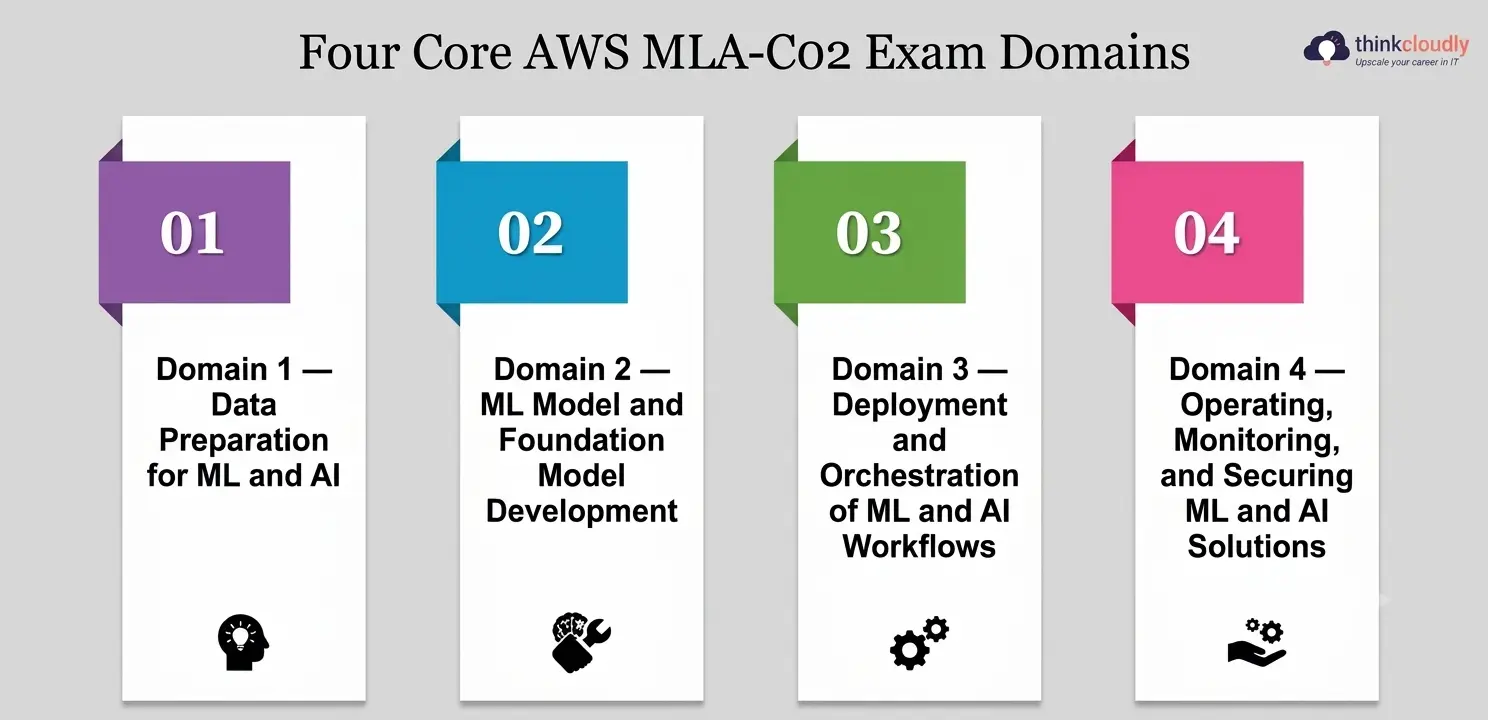
- Domain 1 — Data Preparation for ML and AI (28%): ingesting, transforming, validating, and preparing data for modeling. This is the single heaviest domain, and it covers everything from AWS Glue transformations to feature engineering decisions—including SageMaker Feature Store usage—that feed both traditional models and foundation models.
- Domain 2—ML Model and Foundation Model Development (24%): selecting algorithms, training traditional models, selecting and adapting foundation models through Bedrock, fine-tuning, and evaluating model performance before anything touches production.
- Domain 3 — Deployment and Orchestration of ML and AI Workflows (24%): building CI/CD pipelines for ML, choosing deployment patterns, and orchestrating multi-step workflows using services like Step Functions and Amazon Managed Workflows for Apache Airflow.
- Domain 4 — Operating, Monitoring, and Securing ML and AI Solutions (24%): logging, monitoring drift and performance, applying IAM and encryption correctly, and keeping compliance and audit trails intact as models move through their lifecycle.
Notice that three of the four domains are weighted almost identically at 24%, with Data Preparation pulling ahead at 28%. That near-even split is actually useful information: you can’t afford to skip any single domain and hope the others carry you, since no domain-level score exists separately—it’s all compensatory, meaning your overall scaled score is what matters.
Exam Format, Cost, and Logistics
Beta pricing and format differ from what general availability will eventually look like, so it’s worth locking in the current numbers before you schedule anything.
|
Detail |
MLA-C02 (Beta, Current) |
|
Exam code |
MLA-C02 |
|
Duration |
170 minutes |
|
Total questions |
85 (scored and unscored combined, not individually identified) |
|
Question types |
Multiple choice and multiple response |
|
Passing score |
720 out of a scaled 100–1,000 |
|
Cost |
75 USD (beta pricing) |
|
Language during beta |
English only |
|
Certification validity |
3 years |
Unanswered questions count against you the same as wrong answers, so there’s genuinely no reason to leave anything blank, even as a guess. Once the exam exits beta and moves to general availability, expect pricing to shift closer to the standard Associate-level rate shown on AWS’s certification page, and additional languages—Japanese, Korean, and Simplified Chinese—to come back online, matching how the previous version was offered.
Who This AWS MLA-C02 Study Guide Is Actually For?
This isn’t a credential for people who have never touched AWS. If you’re brand new to cloud computing generally, the AWS Certified AI Practitioner is the better starting point—it’s foundational, concept-based, and doesn’t assume hands-on build experience.
This AWS MLA-C02 study guide is written for people who already have roughly a year of practical exposure to SageMaker AI or Bedrock, even if that exposure came from personal projects rather than a job title that says “ML engineer.”
A useful gut check: if you’ve trained a model in SageMaker, deployed something behind an endpoint, or built even a basic retrieval pipeline using Bedrock Knowledge Bases, you’re closer to ready than the word “beginner” might suggest.
If none of that sounds familiar yet, spend two or three weeks building a free-tier SageMaker project and getting comfortable with the core machine learning tools covered above before you open a single practice question—the exam’s scenario-based questions assume you’ve actually done this work, not just read about it.
A Step-by-Step Study Plan
Here’s how I’d break down preparation time for someone with a day job, aiming for roughly eight weeks of part-time study.
- Week 1–2: Focus entirely on Domain 1. Work hands-on with AWS Glue, Glue DataBrew, and Amazon Athena for data transformation. Spend real time inside Amazon SageMaker AI’s feature engineering tools, including the SageMaker Feature Store, since storing and reusing engineered features correctly is a recurring theme across scenario questions, not a one-off topic.
- Week 3–4: Move into Domain 2. Train a traditional model end to end, then separately work through foundation model selection and fine-tuning inside Amazon Bedrock. Practice model validation deliberately here—compare evaluation metrics across a traditional model and a foundation model so the differences actually stick.
- Week 5: Build a small CI/CD pipeline for a model using CodePipeline or Step Functions. This domain rewards people who’ve actually automated a deployment, not people who can describe one.
- Week 6: Spend the week on monitoring and security. Set up CloudWatch dashboards, configure IAM roles with least-privilege access, and read through how model governance and audit logging actually get implemented in a real account rather than in theory.
- Week 7: Take a full-length practice exam under timed conditions, then go back through every missed question and trace it to a specific domain gap. AWS’s own free Skill Builder labs are a reasonable, low-cost way to log extra hands-on hours before this week if you’re still shaky on any domain.
- Week 8: Close remaining gaps and do a final pass through the official exam guide’s task statements, checking each one off as something you’ve genuinely practiced.
The Machine Learning Tools You Actually Need to Know
A lot of beginner confusion comes from treating “AWS machine learning” as one giant undifferentiated service. It isn’t. The exam draws a fairly clean line between data-layer machine learning tools and model-layer ones, and knowing which bucket a tool belongs to saves real time on scenario questions.
On the data side, AWS Glue, Glue DataBrew, and Glue Data Quality handle ingestion, transformation, and validation—this is where most of Domain 1’s data preparation questions live. On the model side, Amazon SageMaker AI is the center of gravity for traditional ML, while Amazon Bedrock and Bedrock AgentCore cover foundation models, retrieval-augmented generation, and agentic workflows.
The SageMaker Feature Store sits in an interesting middle position: it’s technically a data-layer tool, since it stores and serves engineered features, but it directly feeds model-layer work, which is exactly why exam scenarios like to test it at the boundary between Domain 1 and Domain 2.
Orchestration tools—Step Functions, Amazon Managed Workflows for Apache Airflow, and EventBridge—stitch these machine learning tools together into actual pipelines, which is the entire premise of Domain 3.
Treating each tool as an isolated flashcard, rather than understanding how data readiness feeds model development, which feeds deployment, is the single biggest conceptual gap I see in people who fail this exam on their first attempt.
Model Validation and Model Governance: The Parts Beginners Skip
If there’s one pairing of topics this AWS MLA-C02 study guide wants you to take seriously, it’s model validation and model governance, because both get tested indirectly through scenarios rather than through direct definition questions.
Model validation on this exam isn’t just “check the accuracy score.” You’re expected to know which evaluation metric fits which problem — precision and recall trade-offs for imbalanced classification, BLEU or ROUGE-style scoring for generative text output, and how to interpret SageMaker Clarify’s bias and explainability reports before a model ever reaches production. A model that performs well on paper but fails those checks for bias or drift is exactly the kind of scenario this exam likes to set up.
Model governance, meanwhile, shows up throughout Domain 4 as compliance features, model versioning, and audit trail requirements rather than as a single named topic. In practice, that means understanding how to track which model version is deployed where, how to log who approved a model for production, and how encryption and IAM policies protect both training data and model artifacts.
Teams that treat this as paperwork tend to underperform on these questions, because the exam frames it as an operational requirement with real technical implementation, not a compliance checkbox.
Common Mistakes First-Time Candidates Make
- Studying only generative AI content because it’s newer and more interesting, while skipping traditional ML fundamentals and the core machine learning tools that still carry real weight across Domains 1 and 2.
- Skipping hands-on SageMaker Feature Store practice because it feels like a minor feature, when it actually bridges two domains and shows up more than beginners expect.
- Treating model validation as a one-line accuracy check instead of learning which metric fits which problem type.
- Ignoring model governance until the week before the exam, even though audit logging and compliance questions are woven through Domain 4 rather than isolated to one section.
- Assuming beta exam content won’t matter later. Beta results and feedback directly shape the general availability version, so skipping beta-era materials because “it’s not final yet” leaves real gaps.
A Personal Note
I’ll be honest about something most AWS MLA-C02 study guide write-ups won’t say out loud: I think beta exams are underrated. Nobody has a perfect answer key yet, scoring takes longer to come back, and the material feels less polished than a mature exam guide. But that’s also exactly why this is a good moment to go deep rather than wide.
You’re not competing against years of recycled exam-dump questions floating around forums, because those don’t exist yet for MLA-C02. What actually works is the same thing that’s always worked: build something real in SageMaker, break it, fix it, and then go find the gap between what you built and what the official guide says you should know. That gap is where the real studying happens, and no amount of flashcard memorization replaces it.