

Every hiring manager I’ve spoken with this year says the same thing: they don’t need another “prompt engineer.” They need someone who can wire a language model into a system that actually does things — books the meeting, pulls the data, fixes the ticket, and knows when to stop and ask a human.
That’s the job now called agentic AI engineering: building LLM Applications that act on a goal instead of just answering a question, and it’s quietly become one of the fastest-growing technical careers heading into 2027.
If you’re asking how to become an agentic AI engineer without years of machine-learning research behind you, the honest answer is: you don’t need a PhD, you need systems-engineering instincts and a handful of specific, learnable skills.
This guide walks through exactly what those are, in the order you should learn them, using what’s actually working in production right now — not a theoretical syllabus.
What Does an Agentic AI Engineer Actually Do?
An agentic AI engineer takes a pre-trained large language model and turns it into something that can reason through a goal, call tools, check its own work, and act with minimal supervision.
That’s different from traditional AI engineering, which is mostly about training or fine-tuning models. Here, the model is a given — your job is the scaffolding around it: the control flow, the memory, the retries, the guardrails.
Practically, a working week might include wiring an LLM to a billing API, debugging why an agent looped on the same tool call six times, or writing an evaluation set so a regression doesn’t ship silently. It’s closer to backend systems engineering with an unpredictable component bolted in the middle than it is to classic data science.
That reframing is the first real step in learning how to become an Agentic AI engineer — most beginners spend too long on model theory and not enough on the engineering discipline that keeps an agent reliable in production.
Why Does This Career Bet Make Sense Right Now?
The numbers back up what recruiters are saying anecdotally. Agentic-AI job postings grew by roughly 280% year over year, pushing open listings into the tens of thousands, and forward-deployed engineering roles — people who sit with a client and ship agents into their actual workflows — rose by more than 800% in the same window.
Compensation has moved with demand: entry-level roles in the US are landing around 120K–160K base, mid-level engineers sit between $160K and $220K with total comp climbing higher at venture-backed startups, and senior engineers at frontier labs are reportedly clearing 400K–500K including equity.
That growth is a real signal, but it also means the field is noisy — plenty of short courses are selling a certificate instead of a skill. The companies hiring (banks, insurers, SaaS firms, consulting shops) are testing for whether you can design, measure, and ship an agent, not whether you can describe one.
If you’re serious about how to become an agentic AI engineer rather than just sound like one in an interview, that distinction is exactly where your practice time should go.
The Core Skill Stack: What You Actually Need to Learn
This is the part most guides on how to become an agentic AI engineer skip past. Here’s the stack, broken down so you can turn it into a checklist or a visual roadmap:
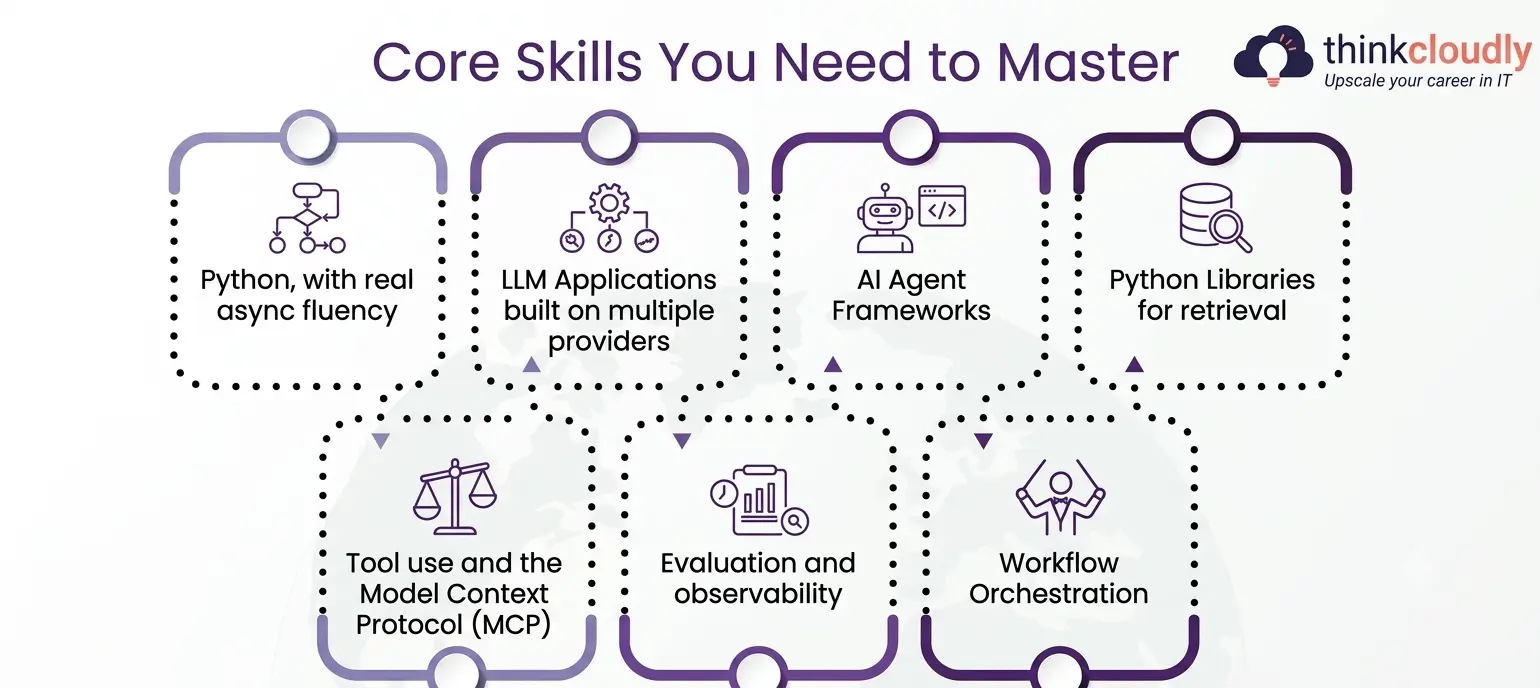
- Python, with real async fluency — concurrency, timeouts, and retry logic aren’t optional once an agent is calling three APIs in parallel and one of them hangs.
- LLM Applications built on multiple providers — Anthropic, OpenAI, and Bedrock all have different quirks around structured outputs, tool calling, and streaming; building real LLM Applications means knowing all three, not just one.
- AI Agent Frameworks — LangGraph, CrewAI, the Claude Agent SDK, or Microsoft’s Agent Framework. You don’t need all of them, but you need to be fluent in picking the right agent framework for the job rather than defaulting to whichever one you learned first.
- Python Libraries for retrieval — vector stores like Pinecone, pgvector, and Weaviate, plus the libraries that chunk, embed, and rerank documents for retrieval-augmented generation. Pydantic and httpx round out the stack you’ll touch in almost every project, agent framework or not.
- Tool use and the Model Context Protocol (MCP) — a now-standard way of exposing external tools to an agent with a clean schema, which the Model Context Protocol documentation explains in more technical depth than most tutorials bother to.
- Evaluation and observability — versioned eval sets, LLM-as-judge scoring, and human review, because “it looked right in the demo” is not a quality bar.
- Workflow Orchestration — once you have more than one agent or one multi-step pipeline, you need Workflow Orchestration logic to sequence, retry, and checkpoint steps instead of hand-rolling control flow that breaks the moment a step fails.
Notice that only two of those seven items are about the model itself. The rest is exactly why people searching for how to become an agentic AI engineer are often surprised by how much of the job is plain software engineering.
A Learning Roadmap by Phase
|
Phase |
Focus | Core Tools |
What You Should Be Able to Do |
|
Foundation (Weeks 1–4) |
Python async, one LLM API end to end | Anthropic or OpenAI SDK, FastAPI, and core async Python Libraries like httpx |
Build a single agent using two or three real tools and log its failures |
|
Framework Fluency (Weeks 5–8) |
Rebuilding with explicit state | LangGraph or Claude Agent SDK, a vector store |
Rebuild the same agent with checkpoints, memory, and a retrieval pipeline |
|
Production Readiness (Weeks 9–12) |
Evaluation, orchestration, deployment | LangSmith or similar tracing, Docker, a task queue |
Ship a versioned eval set, trace a live run, and deploy a small public demo |
|
Specialization (Month 4+) |
Pick a lane: multi-agent systems, RAG, or enterprise integration | Role-specific frameworks and client APIs |
Reframe past experience (APIs as tools, data work as retrieval) into a portfolio piece |
Which AI Agent Frameworks Should You Actually Learn?
You don’t need to master every framework on the market, but you do need working knowledge of the major families of AI Agent Frameworks, because interviewers will ask you to justify a choice, not just name one.
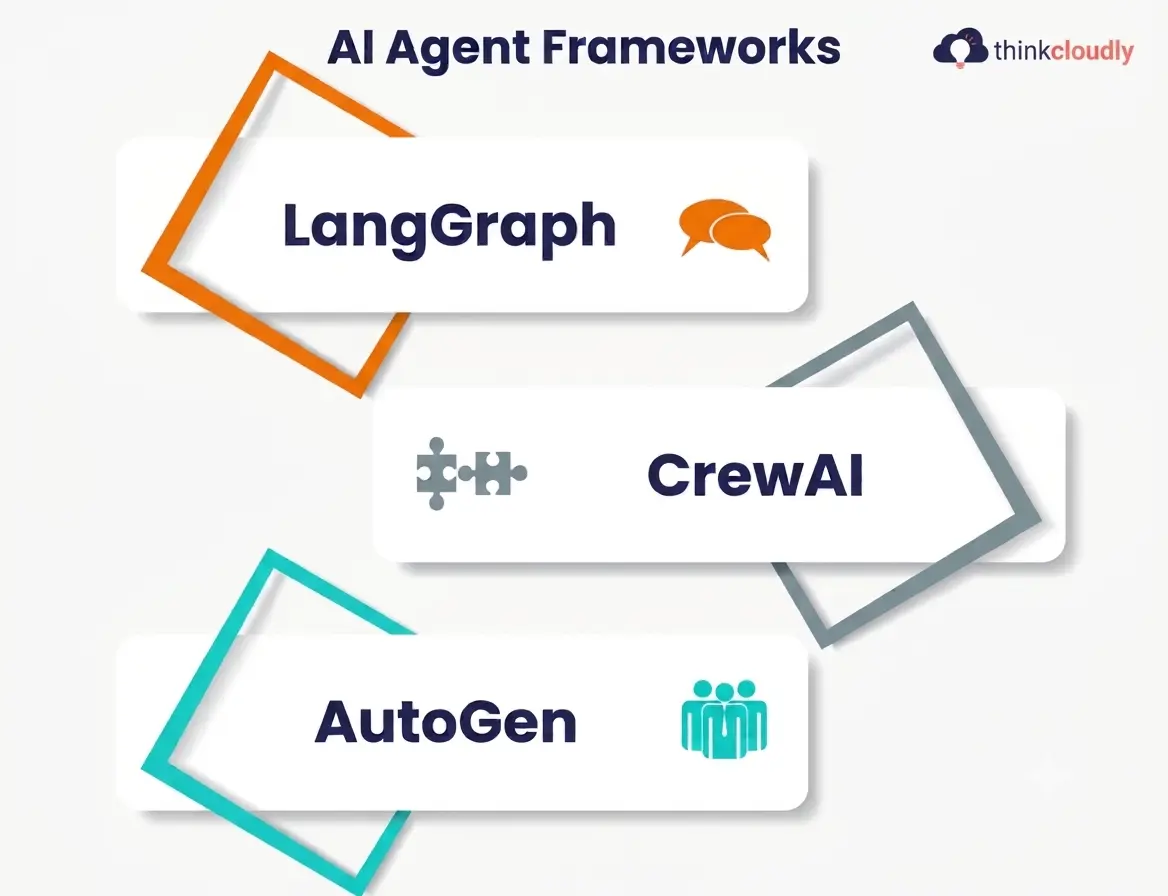
- LangGraph is the low-level option — a typed, versioned state machine built for regulated or long-running workflows where you need deterministic execution and an audit trail. It’s reportedly running in production at companies including Uber, LinkedIn, and Klarna, and its newer “Deep Agents” abstraction is credited with cutting input-token usage by roughly 65% on default agent turns. The tradeoff is a steeper learning curve and more boilerplate for a first prototype.
- CrewAI takes the opposite bet: role, goal, and backstory are the whole mental model, which makes it the fastest route to a working multi-agent demo. It now reportedly processes somewhere around 450 million agentic workflows a month across its user base, and its enterprise tier has added compliance features like FedRAMP High and SSO. The cost is less fine-grained control over branching logic, so it’s a better fit for prototyping than for anything that needs airtight determinism.
- AutoGen popularized the multi-agent “group chat” pattern, but Microsoft moved the original project into maintenance mode and now points new users toward Microsoft Agent Framework 1.0, which merged AutoGen with Semantic Kernel. A community fork called AG2 keeps the original style alive for teams that don’t want to migrate yet. If you’re learning today, it’s worth knowing the pattern AutoGen popularized, but plan your production work around its successor.
The practical takeaway: pick LangGraph when you need control and an audit trail, CrewAI when speed to prototype matters more, and treat AutoGen as a pattern to understand rather than a framework to bet a new project on.
Underneath all three, you’re still leaning on the same core Python Libraries — async HTTP clients, Pydantic for structured outputs, and a vector-store SDK — which is exactly why building multi-step LLM Applications by hand once, before picking a framework, makes every later choice easier to justify.
From Prototype to Production: AI Application Deployment Basics
Plenty of people can get an agent working in a notebook. Fewer can carry it through AI Application Deployment without it falling over the first time real traffic hits it, and this is usually the stage where self-taught learners stall — shipping real LLM Applications is a different skill than prototyping them, and it’s often left out of guides on how to become an agentic AI engineer because it’s less exciting to write about than frameworks. The basics that separate a demo from a shippable system:
- Containerize early. Docker isn’t optional once more than one person needs to run your agent reliably, and it makes every later deployment step more predictable.
- Treat orchestration and deployment as two different jobs. Workflow Orchestration decides the order and recovery logic of your steps; AI Application Deployment decides where that logic actually runs — a serverless function, a container cluster, or a managed agent-hosting service.
- Budget for latency and cost, not just correctness. Track p99 latency and token spend the same way you’d track error rate; a technically correct agent that takes 40 seconds and burns a dollar per call will get killed in review.
- Add tracing before you need it. Step-level tracing tools make debugging a bad run possible instead of a guessing game, and most agent frameworks now ship with some native support for it — Microsoft’s own Agent Framework 1.0 release notes are a good example of how seriously vendors are treating this as of 2026.
- Checkpoint before anything irreversible. A refund, a sent email, or a database write should pass through a point where a human can intervene, especially early on.
Getting comfortable with AI Application Deployment is usually the last gate between “I built an agent” and “I’m employable as one of the people who ships them.”
A Practical 90-Day Path to Get There
If you want a concrete answer to how to become an agentic AI engineer rather than an abstract one, here’s the version that fits in three months of consistent, part-time work:
- Days 1–30: Learn Python’s async patterns properly, pick one LLM provider, and build a single agent calling two or three real tools. Spend real time reading its failure logs — that’s where the actual learning happens, not in the happy path.
- Days 31–60: Rebuild the same agent using LangGraph or the Claude Agent SDK with explicit state and checkpoints. Add a retrieval pipeline over documents you actually care about, not a toy dataset.
- Days 61–90: Build a small, versioned evaluation set with scoring and a few rounds of human review. Add tracing, wire up basic Workflow Orchestration so a failed step retries sanely, and deploy a small public demo so you have something to point to.
- Ongoing: Write up one failure your evals caught and what you changed. That single artifact, paired with even a small working AI Application Deployment, tells an interviewer more about how you think than a polished README ever will.
Common Mistakes Beginners Make
Most people trying to work out how to become an agentic AI engineer fail for the same reason: not a lack of talent, but bad sequencing. People read about AI Agent Frameworks before they’re comfortable with plain async Python and the Python Libraries underneath it, so every bug looks like a framework problem when it’s actually a concurrency problem.
Others skip evaluation entirely because it’s less fun than building, then can’t answer the most basic interview question: “how do you know your agent works?” And a surprising number of learners never deploy anything — they stay in notebooks, where Workflow Orchestration and real latency constraints simply don’t exist yet. None of this is a talent gap. It’s a sequencing gap, and it’s the easiest one to fix once you see it.
A Personal Note
I’ve watched a lot of people try to break into this field by memorizing framework syntax first and systems thinking second, and it almost never works out well — they can build a demo but can’t explain why it sometimes fails.
The engineers who actually get hired and stay hired are the ones who get comfortable being uncomfortable with unpredictability: an agent that works 95% of the time and a plan for the other 5%. If you’re serious about this path, build fewer things and break them more thoroughly. That’s the real shortcut.